
It is July 1st of your M4 year. Your Step 1 is Pass, your Step 2 CK is lower than you wanted, and VSLO just confirmed your away sub-I at a solid academic program you would actually rank high.
You are staring at the email thinking one thing:
“If this rotation does not go well, I am done for this specialty.”
Good. That level of urgency is exactly right. Because for applicants with low scores, sub-internships are not “nice to have.” They are your primary repair tool.
Let me lay out a concrete blueprint: how to use sub-internships strategically and tactically to compensate for weak board scores and still be taken seriously by programs.
1. What Sub-Internships Can (and Cannot) Fix
First, clarity. Sub-Is are powerful, but they are not magic.
What a strong sub-I can do
A high-quality sub-I, especially an away at a program where you want to match, can:
- Override first impressions from your score report by:
- Putting your work ethic, clinical judgment, and team fit directly in front of decision-makers.
- Creating strong, specific letters of recommendation from people the PD actually knows.
- Get you labeled as:
- “We should interview this student even though their scores are low.”
- “They crushed their month here.”
- Give you:
- Concrete bullets for your ERAS application and personal statement.
- Residents and fellows who will quietly advocate for you in ranking meetings.
Programs talk like this:
“Their Step 2 is a little rough, but Dr. X said they were basically functioning at intern level and did great with sick patients.”
That sentence saves applications. I have heard versions of it in ranking meetings.
What a sub-I cannot fix
You cannot expect an away rotation to fix:
- Multiple red flags (failed Step attempts + major professionalism issues + failed clerkships).
- Catastrophic knowledge gaps you never address.
- Lack of basic reliability (late, disorganized, no follow-through).
A sub-I is an amplifier. If you come in prepared and deliberate, it amplifies your strengths. If you come in scattered, it amplifies your weaknesses.
So your job is to show up already tuned.
2. Strategy: Choosing and Sequencing Sub-Internships
If you have low scores, you do not have unlimited margin for error. Rotation selection is strategy, not vibes.
Step 1: Decide your primary objective
Pick ONE primary goal per sub-I:
- Get a letter from a name the PD will respect.
- Prove you belong at that specific program (audition rotation).
- Show you can handle high-acuity, high-volume service in your specialty.
- Demonstrate a clear upward trajectory after low scores.
You can hit more than one of these, but if you try to treat every month as “I must impress everyone everywhere,” you burn out and dilute your efforts.
Step 2: Where to rotate (especially with low scores)
Here is how I would prioritize with low Step scores:
Home program sub-I in your specialty
- Non-negotiable if you have that specialty at your school.
- Goal: nail your letter from a home faculty member who will advocate for you.
- You want your home PD saying: “I would take them here” when programs call.
One or two well-chosen away sub-Is
- Avoid 4–5 aways. You are not a robot. Performance drops after 2–3 heavy months.
- Target programs where:
- Your school has matched there in the last few years.
- Your Step 2 is at least near their typical lower bound.
- There is a reputation for actually interviewing their rotators.
Safety and fit
- You do not need to chase the absolute top-tier names if your scores are low.
- You want programs that:
- Take a decent share of “non-home” rotators.
- Actually value clinical performance over raw numbers.
| Priority | Rotation Type | Purpose |
|---|---|---|
| 1 | Home Sub-I | Anchor letter, advocacy |
| 2 | Away #1 (realistic) | Audition where you could match |
| 3 | Away #2 (stretch or fit) | Expand options / regional tie |
| 4 | Electives (non Sub-I) | Breadth, backup specialty |
Step 3: Sequencing your months
If possible:
- Do a home sub-I first:
- Lower pressure than an away.
- You learn what “intern-level” actually looks like.
- You make your novice mistakes in front of people who already know you.
- Then schedule aways:
- After you have at least one strong letter.
- Once you have refined your workflow and presentations.
If you are stuck with an away as your first sub-I, you just need more prep up front. Which we will get into next.
3. Pre-Rotation: Building a Score-Offset Plan
You want day 1 to feel like week 3 to everyone else. That is how you erase a low score from their mind.
A. Triage your weaknesses from prior evaluations
Pull your MS3 evals and shelf feedback. Look for comments like:
- “Needs more organized presentations.”
- “Could improve prioritization of tasks.”
- “Knowledge base appropriate but sometimes hesitant with plans.”
Translate each into a concrete skill to fix:
- Disorganized ⇒ practice a strict template for H&Ps and progress notes.
- Hesitant plans ⇒ rehearse “assessment and plan” out loud daily.
- Slow follow-through ⇒ build a task-tracking system (paper list or app).
You are not guessing. You are directly patching the holes people already noticed.
B. Learn the specialty’s “day 1 expectations”
For your chosen field (IM, surgery, OB, EM, etc.), list what an excellent sub-I should handle:
- Types of patients you must manage comfortably.
- Common orders you should know.
- Standard presentations (pneumonia, CHF, post-op fever, DKA, etc. in IM; appendicitis, SBO, pancreatitis in surgery; etc.).
Then hit a focused reading plan:
- 30–45 minutes per day, 4–6 weeks before rotation:
- EM: Rosh, EMRA basics, Tintinalli snippets.
- IM: Step-Up to Medicine, UW questions on common inpatient issues.
- Surgery: Surgical Recall, SCORE topics, common post-op complications.
- OB/GYN: Case Files, Blueprints, ACOG practice bulletins on basics.
You do not need to become a fellow. You need to know 80% of the common stuff cold.
C. Script your “low score” narrative now
Some attending or resident will see your score if they are writing your letter or later in interviews. You want a clean, rehearsed explanation:
Briefly state the fact:
“My Step 1/2 score was lower than I would have liked.”Provide a specific, credible reason (no melodrama, no excuses):
“I under-estimated how much time I needed for content review and over-relied on question banks early.”Immediately pivot to what you changed and evidence of improvement:
“Since then I created a more structured approach to clinical studying, which helped me honor X/Y rotations and perform well on my sub-I here.”
Practice this until it is boring. You do not volunteer this on day 1; you use it when (if) it comes up.
4. On-Rotation Blueprint: How to Perform Like an Intern
This is where you actually offset your score. Not with charm. With function.
A. Day 1–3: Fast integration protocol
Your goal in the first 72 hours:
- Learn the workflow.
- Show you are reliable.
- Avoid trying to “impress” with knowledge on day 1.
Actions:
Meet the senior and intern and ask explicitly:
- “What are your expectations for a strong sub-I?”
- “How do you like notes structured?”
- “How do you want me to pre-round and present?” Write the answers down. Follow them.
Adopt a tangible tracking system
- Pocket list or small notebook. One line per patient:
- Name
- Problems
- Tasks with checkboxes
- Check off tasks in real time: consults placed, labs followed up, pages returned.
- This is how you avoid the classic “forgot to follow up X” mistake.
- Pocket list or small notebook. One line per patient:
Become predictable
- Always on time or early.
- Present in the same structured way.
- Write your notes in a consistent format.
People trust what they can predict.
B. Core behaviors that make you stand out (even with low scores)
Here is what actually gets said on evaluation forms and in letters.
- Ownership of patients
You want seniors saying: “They really owned their patients.”
That looks like:
- You know:
- Vitals, new labs, imaging results, overnight events.
- The plan for each active problem.
- You anticipate:
- What needs to happen next (PT/OT evals, discharge planning, follow-up appointments).
- You communicate:
- You update the team before they have to ask.
- You tell the nurse: “If X happens, please page me.”
- Clear, concise presentations
Especially critical if you had mediocre scores—they are already wondering about your processing speed and knowledge.
Fix this by using a tight template:
- One-liner: “Mr. X is a 65-year-old with CHF and CKD admitted with shortness of breath, hospital day 2.”
- Overnight events (bullet style).
- Focused physical exam.
- Assessment and plan:
- Problem-based.
- Start with the active issues.
- For each: 1–3 key data points, then your recommended plan.
If you are not sure of the plan:
- State what you DO know and propose something:
- “For his pneumonia, I think we should continue ceftriaxone and azithromycin, reassess oxygen needs, and repeat a chest X-ray only if he worsens.”
- Then add: “I am not certain whether we should broaden coverage yet. I was thinking through his risk factors for resistant organisms.”
That sounds like a thinking physician, not a memorizer. Attending physicians like that.
- Relentless follow-through
This matters more than 10 obscure factoids.
You:
- Write down every task you are assigned.
- Repeat tasks back to the senior if it is a complex list.
- Close the loop: “GI was consulted; they will scope tomorrow morning. I added the prep orders.”
If you tack that behavior onto solid knowledge, your low Step score starts to look like an outlier instead of a pattern.
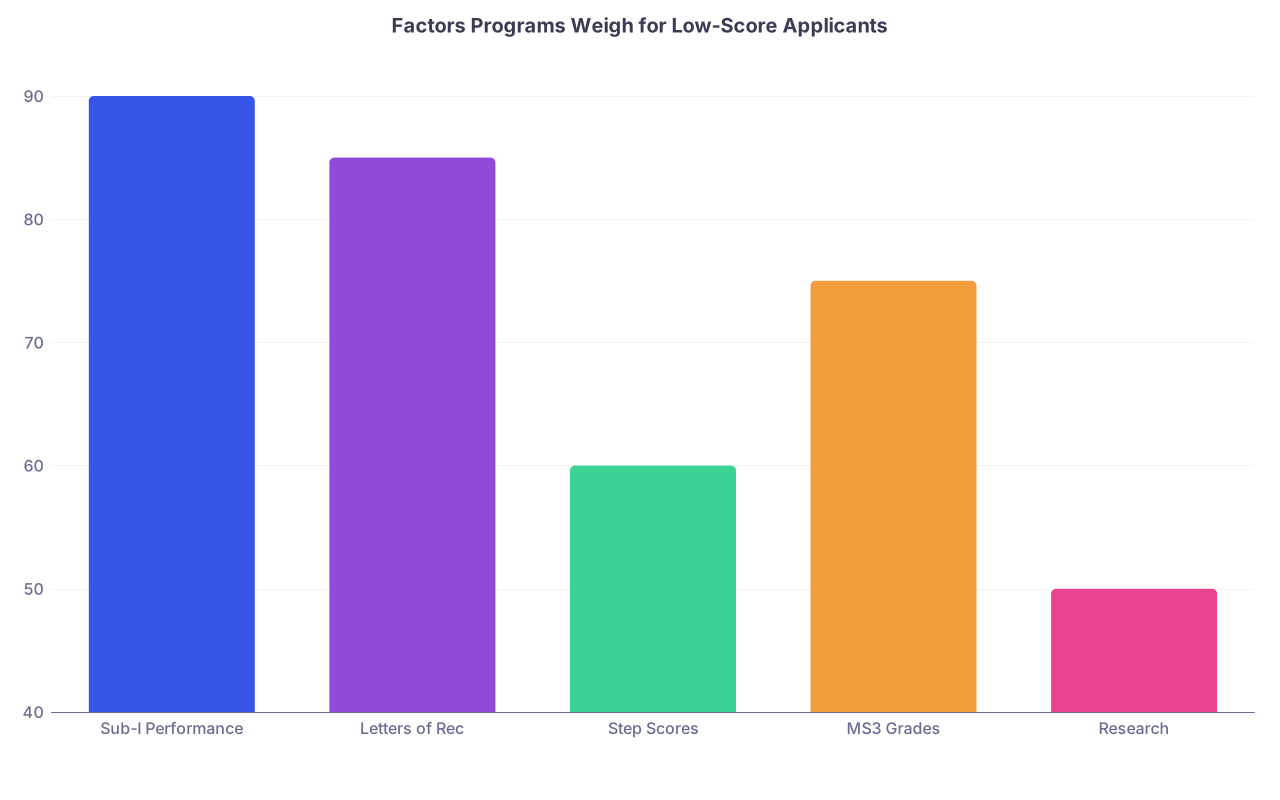
| Category | Value |
|---|---|
| Sub-I Performance | 90 |
| Letters of Rec | 85 |
| Step Scores | 60 |
| MS3 Grades | 75 |
| Research | 50 |
5. How to Actively Generate Strong Letters from Sub-Is
You are not on this rotation just to “learn.” You are also there to manufacture evidence that contradicts your scores.
A. Target the right letter writers
Ideal letter writers from a sub-I:
- Attendings who:
- Directly observed you multiple times.
- Are known in the field (division chief, program leadership, or respected clinician).
- Actually care about teaching and mentoring.
- Fellows or chiefs:
- They do not write the letter, but they whisper in the attending’s ear about you.
So be intentional:
- If you are always with the same attending, good.
- If not, ask the senior resident quietly in week 2:
- “Which faculty here tend to write strong, detailed letters?”
- “Is there anyone you think I should try to work more closely with?”
B. Make your performance easy to write about
Attendings are busy. If you want a letter that says more than “hardworking and pleasant,” you need to give them material.
You do that by:
Owning a challenging case (with support)
Example:- New DKA admission you admit and follow closely.
- Complicated post-op patient whose fluid management you really understand.
- High-risk OB patient or unstable ED boarder who you follow shift to shift.
Showing growth
- Early in the month, ask for feedback:
- “Is there anything you would like me to work on specifically this week?”
- Then fix it. Rapidly.
- End of week 3, ask again:
- “Have you seen improvement in X? Anything else I should focus on in the remaining days?”
- Early in the month, ask for feedback:
Letter writers love a “growth arc” story. “They took feedback and improved fast” plays very well.
C. Asking for the letter the right way
Timing and framing matter here.
- Ask near the end of the rotation, once they have seen you at your best.
- Use language that invites honesty:
- “Based on your experience working with me, do you feel you could write a strong letter of recommendation to support my application in [specialty]?”
- If they hesitate, back off. A lukewarm letter will hurt you.
When they say yes:
- Provide:
- CV
- ERAS draft / personal statement
- Step scores (yes, all of them)
- Short bullet list: specific patients/cases you managed, any extra projects, feedback you improved on
You are not writing the letter for them, but you are jogging their memory on specifics. That leads to better content like:
“On our service, they independently managed 4–6 patients daily, including a complex DKA case for which they developed a thoughtful insulin and fluid regimen…”
This is exactly the kind of sentence that neutralizes concerns about low Step scores.
6. Handling the Low Score Conversation Without Flinching
During or after your sub-I, your scores might come up. How you handle this matters.
A. If asked directly on rotation
Say you are in a feedback meeting with an attending and they mention it:
“I saw your Step 2 score. What happened there?”
You:
Acknowledge simply:
“You are right, it was below what I was aiming for.”Provide a specific, non-whiny explanation:
- Poor scheduling.
- Underestimating content.
- Personal stress you have since stabilized (briefly, no dramatic monologue).
Pivot to your concrete evidence of current performance:
- “Since then I changed my study structure. On the wards I have focused on building a stronger clinical foundation, including [honors in X, strong sub-I performance here, etc.].”
Then stop. Do not over-defend.
B. If it comes up through whispers (residents see your score)
Sometimes residents will quietly look at your scores later (during letter writing, etc.). You pre-empt this by:
- Being so clinically solid that the cognitive dissonance is in your favor:
- “Their score is X, but they function way above that.”
- Dropping a one-liner if the topic circles back casually:
- “Yeah, that number pushed me to overhaul how I learn. I am glad it happened before intern year.”
This “own it and move on” attitude reads as mature and self-aware.

| Step | Description |
|---|---|
| Step 1 | Low Step Scores |
| Step 2 | Strategic Sub-I Selection |
| Step 3 | Pre-Rotation Prep |
| Step 4 | Strong On-Rotation Performance |
| Step 5 | Powerful Letters |
| Step 6 | Interview Invites |
| Step 7 | Match List Discussion |
| Step 8 | Program Advocates |
7. If a Sub-I Goes Badly (Contingency Plan)
Sometimes a rotation just does not go well. Chemistry with the team is off, you get sick, or you underperform. With low scores, you cannot ignore that.
Here is how to salvage:
A. Honest post-rotation debrief (with yourself)
Right after the rotation:
- Write down:
- What specifically went wrong.
- Concrete examples (late notes, missed tasks, knowledge gaps).
- Any written feedback.
Sort issues into:
- Skill deficits (manageable): presentations, organization, specific knowledge.
- Behavioral/professionalism (urgent): lateness, attitude, conflicts.
Skill deficits = fixable with deliberate practice.
Behavioral = must be fixed immediately with whatever support you need (mentoring, counseling, time management interventions).
B. Do a second, better planned sub-I
If the first sub-I was mediocre and you have time, you deliberately plan a second chance:
- Choose:
- A rotation with clear expectations and strong teaching culture.
- A site where your school has a decent relationship and can maybe advocate for you.
- Before it starts:
- Email the clerkship director or site director:
- “I would really like to focus on improving X and Y during this month. Could you share expectations for high-performing sub-interns on your service?”
- This signals seriousness and self-awareness before day 1.
- Email the clerkship director or site director:
You then treat the second sub-I as your do-or-die performance and line up your best faculty advocate there.
C. Leverage other parts of the application
If two sub-Is are just not realistic or do not go stellar, you lean more on:
- Strong home letters from non-sub-I rotations in your specialty.
- Any tangible clinical projects you did (QIs, cases, etc.).
- Programs where your school has historically matched applicants with similar scores.
In that scenario, your goal is not to completely erase the low scores, but to show:
- Consistency.
- Growth.
- No red flags in professionalism or work ethic.

8. Putting It All Together: A Sample Month-by-Month Blueprint
Let me give you a concrete, realistic flow for a low-score applicant aiming at a moderately competitive specialty (say IM or OB or gen surg).
3–4 months before sub-Is
- Identify:
- Home sub-I block.
- One primary away target, one backup.
- Start specialty reading 30–45 minutes daily.
- Fix known weaknesses:
- Practice presentations with a friend or resident.
- Build your task-tracking system.
1 month before first sub-I
- Email chief resident or clerkship coordinator:
- Ask for:
- Typical schedule.
- Expectations for sub-Is.
- Any pre-rotation reading recommendations.
- Ask for:
- Script your low-score explanation.
- Plan logistics:
- Housing for away.
- Transportation.
- Food / parking.
You do not want logistical chaos draining cognitive bandwidth.
During home sub-I
Week 1:
- Learn workflow.
- Ask expectations from senior.
- Demonstrate basic reliability.
Week 2:
- Increase patient load (ask for more).
- Request targeted feedback from attending:
- “One thing I am doing well, one thing I should improve this week?”
Week 3:
- Own a complex case under supervision.
- Show clear growth on your earlier feedback points.
Week 4:
- Ask strongest attending for a letter—explicitly ask for a “strong” letter.
- Send CV + bullet list of what you did well.
Result: You walk into your away with at least one strong letter and better skills.
During away sub-I
Your goals:
- Function at or near intern level.
- Demonstrate you fit their culture.
- Generate at least one powerhouse letter and a handful of verbal advocates.
Behaviors:
- Show up early every day.
- Volunteer for admissions, consult calls, follow-up tasks.
- Be visibly curious:
- Ask smart, focused questions.
- Read about your patients and apply that the next day.
End of rotation:
- Ask 1–2 attendings for letters (only if you sense genuine enthusiasm).
- Thank residents and nurses explicitly. People remember that.

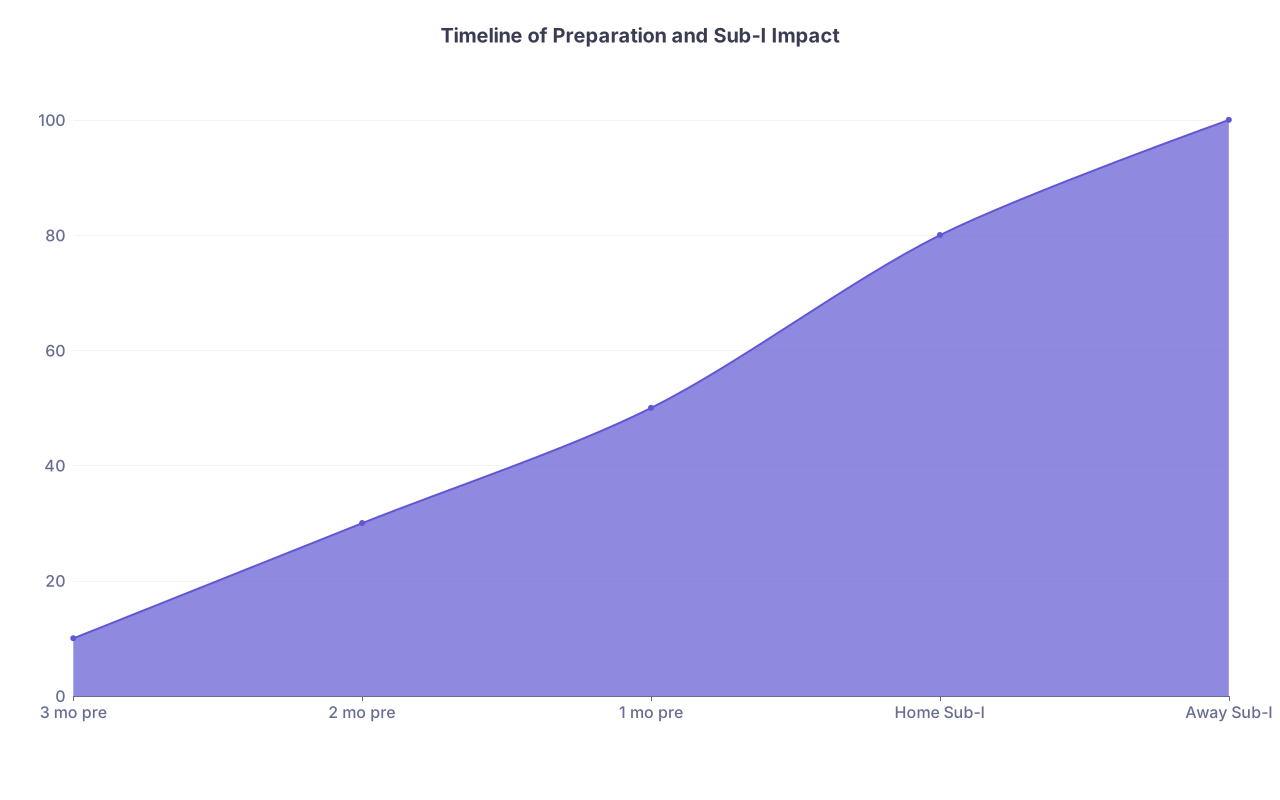
| Category | Value |
|---|---|
| 3 mo pre | 10 |
| 2 mo pre | 30 |
| 1 mo pre | 50 |
| Home Sub-I | 80 |
| Away Sub-I | 100 |

Key Takeaways
- Sub-internships are your main tool to counter low Step scores, but only if you treat them like high-stakes auditions: pick sites strategically, prepare aggressively, and function like an intern from day 1.
- Your real “score repair” comes from three things: consistent ownership of patients, clear concise communication, and strong, specific letters from people who watched you work.
- Have a clean, practiced narrative for your low scores, but let your sub-I performance do most of the talking; programs will forgive a number if you give them daily evidence that you are the resident they actually want on their team.