
The obsession with Step scores is massively overblown—but if your score is low and you misplay your audition rotations, you will pay for it.
This is where people either rescue their application or quietly sink. I have seen students with Step 1 barely passing and Step 2 in the 220s match into solid IM and EM programs because they absolutely crushed their audition rotations. I have also seen students with similar scores show up, “work hard,” stay quiet, and walk away with generic comments and zero interviews.
The difference was not luck. It was a strategy.
This article is that strategy.
1. Accept The Reality: What A Low Step Score Actually Means
Let me be blunt. A low Step score (or a Step fail) does three things to your residency application:
- Triggers automatic or near-automatic screening filters at many programs.
- Creates a narrative problem: programs assume “lower ceiling,” “poor test taker,” or “red flag.”
- Forces you to prove, in person, that you are much better than your score suggests.
Audition rotations (away rotations, sub‑Is, visiting student electives—same idea) are your best weapon against all three.
But only if you use them correctly.
What programs really use audition rotations for
Programs do not bring you in to “see if you are smart enough.” Your score already answered that (in their mind). They are testing:
- Can they trust you with their patients and their name?
- Are you teachable or defensive?
- Are you someone they want to be stuck with at 2 a.m. on a bad call night?
- Do you raise the floor of the program or drain everyone’s energy?
For low Step scorers, the bar is higher. They are asking a fifth question:
- Was the low score a one‑off, or a preview of future problems?
Your behavior on an audition rotation answers that question loudly.
2. Choose Rotations Strategically, Not Emotionally
Most students with low scores make their first mistake before they even show up: they pick the wrong rotations.
Your goal is not bragging rights
Stop chasing big-name places that will auto-screen you anyway. If your Step 2 is 220 and you are applying EM, “Let me audition at the hyper‑competitive urban academic program” is not ambition. It is poor risk management.
You want programs where:
- They actually interview and rank students with your profile.
- Audition rotation performance heavily influences their rank list.
- Your presence is not one of 30 auditioners fighting for 2 spots.
You can figure this out with some basic research.
| Priority | Program Type | Why It Helps You |
|---|---|---|
| 1 | Mid-tier community | Values work ethic, fit, reliability |
| 2 | University-affiliated | Mix of academics and service |
| 3 | Home program sub-I | Known quantity, easier advocacy |
| Avoid | Elite academic only | Strict filters, brand over person |
Concrete steps to pick the right rotations
Pull past match lists from your school (or online) for your specialty.
- Where did low-average students actually match?
- Which programs appear frequently for “average” applicants?
Email recent grads with similar or slightly better scores.
- “Where did you rotate?”
- “Where did performance on audition matter the most?”
- “Where did you feel like they really evaluated you fairly?”
Use VSLO/VSAS intelligently.
- Prioritize 2–3 programs where your stats are within or just below their historical match range, not 50–60 points below.
Schedule smartly.
- Do not make your first ever rotation in that specialty your most important away.
- Ideally:
- 1st: Home or local rotation – learn the basics, make mistakes where you are forgiven.
- 2nd: First away at a realistic target program.
- 3rd: Second away at another realistic target or “reach but not delusional” program.
3. Pre‑Rotation Preparation: Fix The Easy Weaknesses Before Day 1
You cannot change your Step score now. You can absolutely change how prepared you look clinically.
Most students walk into audition rotations with “I will work hard and be nice” as their plan. That is the floor, not the strategy.
Build a 2–3 week pre‑rotation prep plan
You do not need a massive curriculum. You need targeted competence.
For every specialty, lock down:
- Top 20 diagnoses you will see constantly
- First 3 steps in evaluation and management for each
- Common orders and basic note templates
Example for Internal Medicine:
- Chest pain, SOB, sepsis, DKA, GI bleed, AKI, CHF exacerbation, COPD flare, pneumonia, etc.
- For each:
- What labs and imaging do you order first?
- What are the life-threatening “do not miss” conditions?
- What are your first-line treatments?
Use one solid, high-yield resource for your specialty. Not five.
- IM: MKSAP for Students, Step Up to Medicine, OnlineMedEd
- EM: EMRA basics, CORD student curriculum
- Surgery: Surgical Recall + a pocket manual
Then do this:
- Spend 60–90 minutes a day for 2 weeks:
- 30 minutes reading one or two conditions.
- 30 minutes doing questions or cases.
- Optional: 15–30 minutes practicing oral presentations out loud.
This is not about memorizing obscure guidelines. It is about walking in on Day 1 looking like you have done this before.
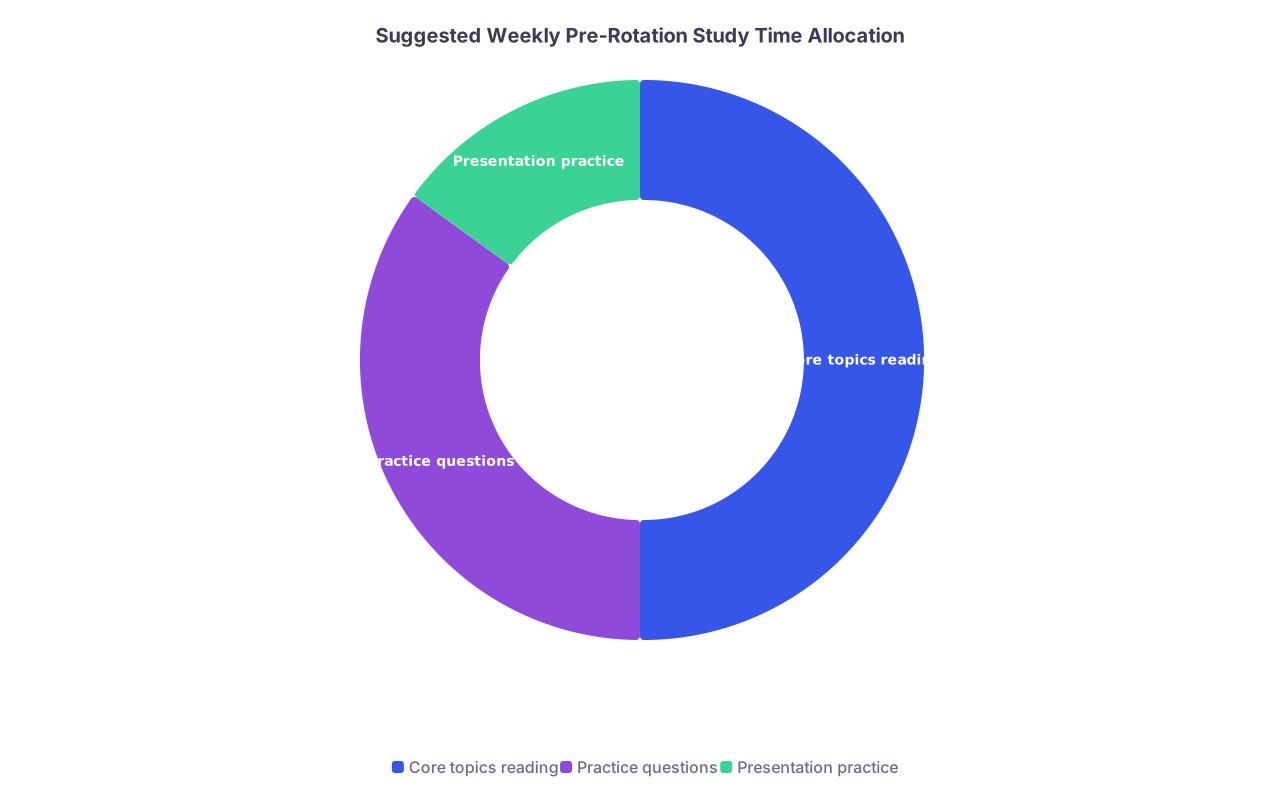
| Category | Value |
|---|---|
| Core topics reading | 50 |
| Practice questions | 35 |
| Presentation practice | 15 |
4. Day 1–3: Set The Tone Intentionally
Most low Step students try to hide their scores and hope nobody notices. Bad idea. People can read ERAS. They already know.
Your job is to control the narrative from the first 72 hours of the rotation.
Script your introduction
You do not need a confessional. You need a confident, straightforward summary of who you are and what you want.
You will typically meet the clerkship director, site director, or senior resident early. Use something like this:
“I am strongly interested in [specialty], and I know audition rotations are a chance to show what kind of intern I would be. My Step score is not the strongest part of my application, and I have worked hard to make sure my clinical performance and reliability are. I really appreciate any feedback along the way—I want to leave here better than I arrived.”
Short. Direct. Mature.
You just:
- Acknowledged the elephant in the room.
- Showed insight and accountability.
- Invited feedback (which evaluators love).
Master the basics instantly
In the first 72 hours, you must show that you are:
- On time (early). Every day.
- Dressed appropriately.
- Prepared with:
- A small notebook or note-taking app.
- A running patient list if you are expected to maintain one.
- Basic tools (penlight, stethoscope, etc., depending on specialty).
Show up 15–20 minutes before sign‑out. Figure out:
- Where to find charts and labs.
- How to page people.
- Where protocols and order sets live in the EMR.
The student who spends week 1 “learning the system” and asking the same workflow question four times does not get a rescue narrative for their low Step score. They get labeled as slow.
5. Daily Performance System: How To Look Like A Strong Intern
Here is the part nobody hands you: a daily operating system that reliably turns into strong evaluations. This is where you beat your Step score.
Your three core goals every day
- Be clinically useful.
- Be low‑maintenance.
- Be obviously improving.
Let’s break those down into behaviors.
1. Be clinically useful
Concrete ways to do that:
Pre‑round like it matters.
- Actually see your patients early.
- Write down overnight events, new labs, vitals trends.
- Have a first‑pass plan (even if you know it will be adjusted).
Present with structure.
- SOAP or specialty-appropriate structure.
- One sentence summary, then relevant overnight events, then focused assessment and plan.
- Flag your uncertainties: “I was unsure whether to… so I looked up X and thought Y, but I want your input.”
Volunteer for specific tasks.
- “Can I call the family with the update and then present what they said?”
- “Can I put in the initial orders and save them for you to sign?”
- “Would it help if I called radiology about the CT timing?”
Being useful is not “I am available if you need anything.” It is: “I see three things that need to be done; let me help with those.”
2. Be low‑maintenance
No one wants to train a resident who constantly creates extra work.
Low‑maintenance looks like:
- Writing everything down once. Not asking the same process question repeatedly.
- Clarifying expectations early:
- “On this team, how many patients is ideal for me to follow?”
- “Do you prefer I write full notes or just addend your notes?”
- Adapting to each resident/attending style without complaining. Some like long presentations; some want bullet points. Learn quickly.
If your Step score is low, people are already half‑expecting you to struggle. Your job is to be less work, not more.
3. Be obviously improving
Supervisors will forgive initial roughness if your improvement curve is steep.
Use a simple loop every 2–3 days:
Ask for one specific piece of feedback:
- “Is there one thing I could do tomorrow to make my presentations more helpful?”
- “Am I picking appropriate patients to follow or should I change that?”
Implement it obviously and tell them:
- “Yesterday you suggested I shorten my one‑liner; I tried to keep it to one sentence today—let me know if that is closer to what you want.”
That shows teachability and self‑awareness, two traits that instantly soften concerns about a low board score.

| Step | Description |
|---|---|
| Step 1 | Work Day |
| Step 2 | Ask Specific Feedback |
| Step 3 | Adjust Behavior Next Day |
| Step 4 | Signal That You Implemented Change |
| Step 5 | Supervisor Sees Improvement |
6. Turn Your Low Step Score Into A Strength (Yes, Really)
Some of the best residents I have worked with had ugly Step stories—fails, 210s, 220s. The ones who matched well did one thing: they converted that weakness into a visible strength on rotation.
The “resilience and reliability” narrative
Programs worry that a low Step equals:
- Poor work ethic
- Poor coping skills under pressure
- Poor ability to learn independently
You must demonstrate the opposite. Over and over.
Specific behaviors that create this narrative:
Consistency under fatigue.
- Do not unravel on long days. Stay level.
- Avoid complaining in front of anyone who has a say (this includes residents—assume everything gets back to leadership).
Owning your mistakes.
- “I missed that potassium this morning. I have checked all labs again and added it to my checklist so it does not happen again.”
- That is how an intern talks. That is how you erase “low score = unsafe.”
Visible self-study on the rotation.
- After an interesting case, read one article or UpToDate summary.
- Next day, mention one key point:
- “I read about upper GI bleeds last night, and one thing that stuck with me was…”
- You are signaling: “My baseline might not be 260, but my slope is steep.”
When (and how) to reference your Step score in person
Do not bring it up constantly. Once at the start (as I outlined) is enough, unless someone asks.
If they do ask—especially in the context of “I see you struggled on Step; what happened?”—do this:
Own the problem briefly.
- “I underperformed. I did not manage my time well, and I did not ask for help early enough.”
Demonstrate insight and process change.
- “Since then I have changed how I study: daily question blocks, weekly review, and earlier practice tests. That is how I improved on shelf exams and my Step 2 score.”
- Even if Step 2 is still not great, talk about more consistent shelf performance if you have it.
Pivot to clinical performance.
- “My focus now is on being the kind of resident who is dependable on the wards, and that is what I hope to show you on this rotation.”
Short. Controlled. Mature.
7. Build Deliberate Relationships (Not Fake Networking)
Here is the hard truth: letters from audition rotations can carry enormous weight for low Step scorers. But only if the letter writer actually knows you.
Saying “I really enjoyed having [Student] on the team” is noise. You need “I would rank this student at the top of our list.”
Who you must impress
- Program director or associate PD.
- Clerkship or rotation director.
- At least one attending who worked with you closely for >1 week.
- One senior resident or chief who will casually advocate for you.
You do not need to be best friends. You do need to be memorable.
Practical ways to do this:
Request to work with key faculty.
- If there is a known PD or influential attending:
- “If possible, I would love to spend some time on a team with Dr X; I am very interested in your program long‑term.”
- If there is a known PD or influential attending:
Ask good, specific questions once you have earned it.
- End of week 2 or 3, something like:
- “I am strongly interested in [Program]. From what you have seen so far, is there anything I should improve if I want to be a competitive applicant here?”
- End of week 2 or 3, something like:
Signal genuine program interest.
- “This is my top‑choice type of program” is stronger than “I like it here.”
- Mention specific reasons: culture, patient mix, teaching style.

8. Letters Of Recommendation: Ask, Structure, Follow Up
If you underperform on Steps, your audition LORs are not optional. They are salvation.
When and how to ask
Ask in the final week of the rotation, not by surprise on the last day at 4:55 p.m.
Use something like:
“I have really appreciated working with you this month. I am applying to [specialty], and I hope to be the kind of resident who fits well in programs like this. Based on what you have seen of my work, would you feel comfortable writing a strong letter of recommendation for my residency applications?”
That word “strong” gives them an out. If they hesitate, you do not want that letter.
Give them ammo
Attendings are busy. Many will write a better letter if you hand them:
- Your CV.
- A short paragraph outlining:
- Why you are interested in the specialty.
- Specific examples of feedback you received and integrated.
- Cases or patients you were particularly involved with (as a reminder).
You can send this by email:
“Thank you again for agreeing to write on my behalf. I attached my CV and a short summary of my experience this month and my interest in [specialty] in case it is helpful as you write.”
Do not script the letter. Just give them memory triggers.
9. Closing The Loop: Turn Rotations Into Interviews And Ranks
You are not doing audition rotations for the experience. You are doing them to secure interview invites and a strong rank position.
Immediately after the rotation
Within 24–72 hours of finishing:
- Send a brief thank-you email to:
- PD / APD (if you met them).
- Clerkship/rotation director.
- Key attendings who worked with you.
Example:
“Thank you again for the opportunity to rotate with your program this month. I learned a tremendous amount from your team, particularly about [specific case or theme]. The culture and teaching style I saw here have made [Program Name] one of my top choices. I look forward to applying this cycle and hope to have the chance to return as a resident.”
- Document specifics while they are fresh.
- Write down:
- Who you worked with.
- Cases you took ownership of.
- Feedback themes you received.
- These details will feed:
- Your ERAS experiences descriptions.
- Your personal statement.
- Your answers to “Why this program?” on interview day.
- Write down:
During application season
When ERAS is submitted and interviews are going out, circle back.
- If you have not received an invite yet from an audition site by mid‑season:
- A short, respectful email to PD or coordinator:
- “I rotated with your program in [month]. I wanted to reiterate my strong interest in [Program Name] and hope I might be considered for an interview if positions remain available. My ERAS AAMC ID is [ID].”
- A short, respectful email to PD or coordinator:
You are not begging. You are reminding them: “I am not random; you know my work.”
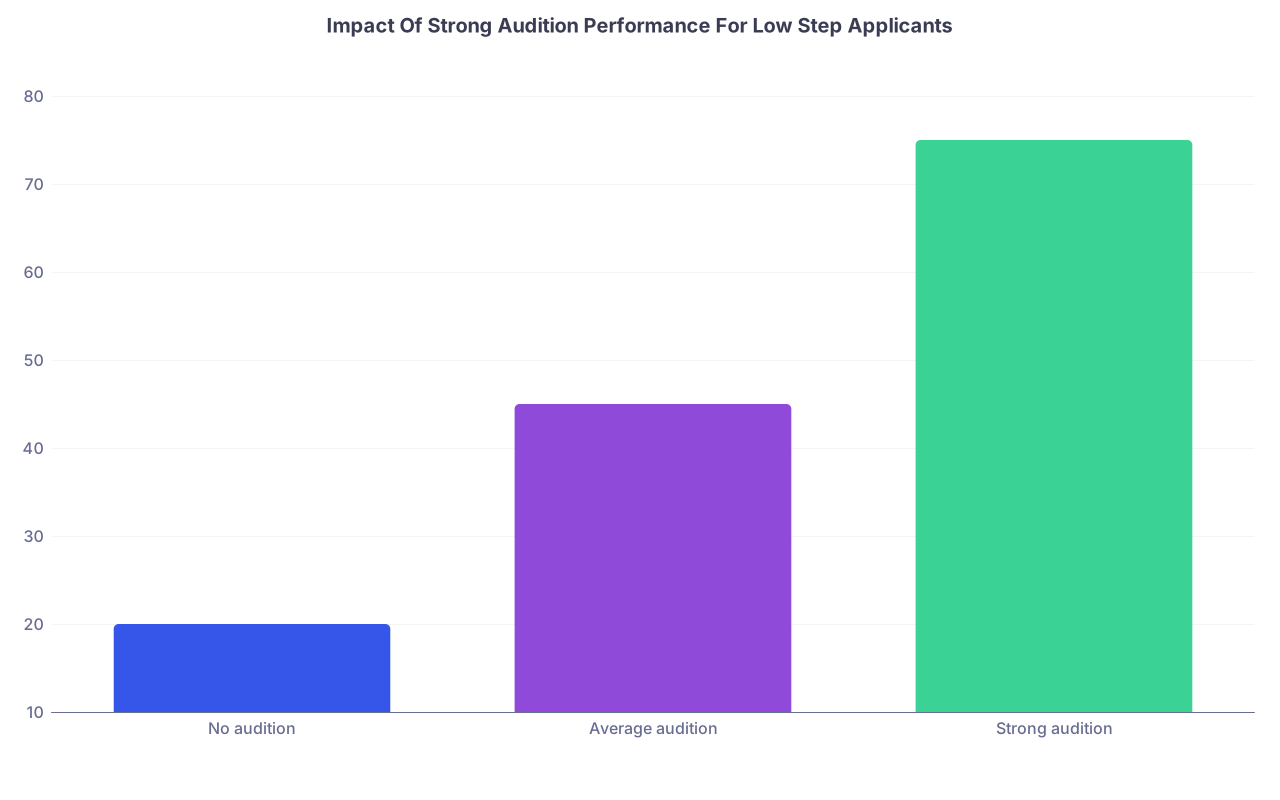
| Category | Value |
|---|---|
| No audition | 20 |
| Average audition | 45 |
| Strong audition | 75 |
(Imagine those numbers as percentage chance of getting at least one interview at that program. Not exact data, but directionally accurate from what I have seen.)
10. Common Ways Low Step Students Sabotage Their Auditions
Let me quickly call out the patterns I see over and over that destroy chances:
Trying to impress with knowledge instead of reliability.
- Long, rambling differentials; quoting obscure studies; correcting interns.
- Instead: short, accurate basics + clear “this is what I would do first.”
Over‑sharing Step anxiety.
- Do not bring up your score every week. Do not trauma‑dump about testing.
- Show you have moved past it.
Tight‑knit cliques with other students.
- If you are always talking/laughing with the other rotator in the corner, you look disengaged.
- Be approachable, but your primary team is the residents and attendings.
Invisible work.
- Reading a lot but never speaking up, never volunteering, never owning tasks.
- You do not get credit for what people cannot see.
Unclear career interest.
- “I am between three specialties” on an audition for one of them? Red flag.
- For that month, you are all‑in on the specialty you are auditioning in.

11. If You Already Did A Weak Rotation With A Low Step Score
You might be reading this after one rotation that did not go well. Maybe the eval was “fine” but not glowing. That is not game over.
Here is how you recover:
Analyze concretely.
- Ask one trusted resident or attending for honest feedback:
- “If I want to be a strong sub‑I next month, what are the top one or two things I must change?”
- Ask one trusted resident or attending for honest feedback:
Over‑correct on the next rotation.
- If they said you were quiet → force yourself to present first, ask one question per day.
- If they said you were disorganized → build a patient list, checklist, and triple‑check your notes.
Be transparent (in the right way).
- On the next audition:
- “I got feedback last month that I needed to [X]. I have worked hard to improve that, and I would appreciate you letting me know if I am making progress this month.”
- That shows growth mindset and maturity.
- On the next audition:
One mediocre audition does not kill your cycle. Three will.
12. Put It All Together: Your Audition Rotation Playbook
Let me condense this into a simple, actionable structure.
Before the rotation (2–3 weeks)
- Pick programs that actually match students with your stats.
- Build a 2‑week high-yield reading and question schedule.
- Practice oral presentations for your specialty.
- Clarify logistics: housing, commute, EMR training.
Week 1
- Arrive early, learn systems fast.
- Introduce yourself with a clear statement of intent and openness to feedback.
- Focus on:
- Not missing tasks.
- Clear, structured presentations.
- Asking for one piece of feedback by end of week.
Week 2–3
- Take ownership of a manageable number of patients.
- Volunteer for calls, admits, procedures, or extra tasks when appropriate.
- Demonstrate visible improvement based on prior feedback.
- Build real rapport with at least one attending and one senior resident.
Week 4 / End of rotation
- Ask for strong letters from those who know your work best.
- Verbally express your interest in the program clearly.
- Send short, specific thank‑you emails within 2–3 days.
- Document stories and cases for ERAS and interviews.
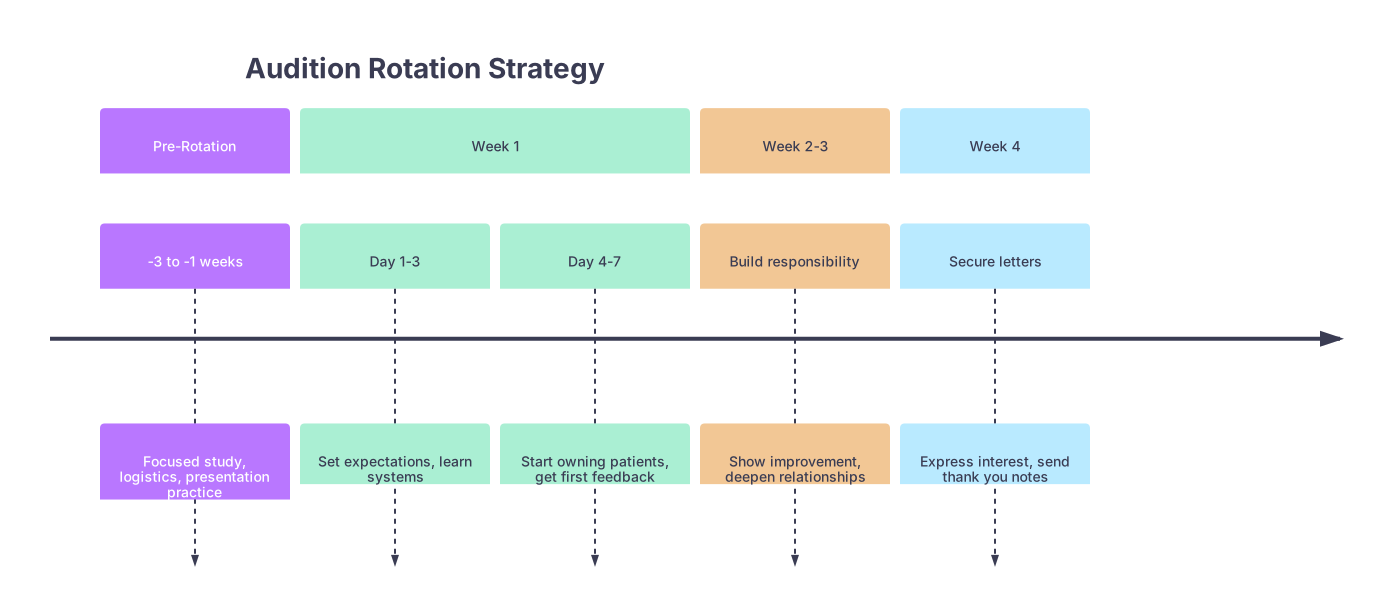
| Period | Event |
|---|---|
| Pre-Rotation - -3 to -1 weeks | Focused study, logistics, presentation practice |
| Week 1 - Day 1-3 | Set expectations, learn systems |
| Week 1 - Day 4-7 | Start owning patients, get first feedback |
| Week 2-3 - Build responsibility | Show improvement, deepen relationships |
| Week 4 - Secure letters | Express interest, send thank you notes |
Here is your next step:
Open your calendar right now and block off 30 minutes today to do two things—identify three realistic audition targets for your Step profile and sketch a 2‑week pre‑rotation study plan for your next rotation. Do that, and you are no longer just “the low Step score applicant.” You are the person with a recovery strategy.