
The panic you feel after a low Step 2 CK score is real—but wasting 2 weeks spiraling will hurt you more than the score itself.
You need a plan. Fast. And not a vague “stay positive and work hard” plan. A concrete, hour-by-hour, email-by-email, rotation-by-rotation response that turns a weak test day into a stronger overall application.
This is exactly what we will build.
Step 1: Get Oriented – Is Your Score Actually “Low” For Your Goals?
Before you blow up your specialty list or start drafting a heartfelt personal statement about “resilience,” figure out what your score means in context.
1. Know your number relative to the match
Use recent NRMP program data and specialty-specific score ranges (they shift, but the pattern is stable). Here is a rough idea:
| Specialty | Very Competitive Range | Mid Range Target | Concerning for Match |
|---|---|---|---|
| Dermatology | 255+ | 245–255 | < 240 |
| Orthopedic Surgery | 250+ | 240–250 | < 235 |
| General Surgery | 245+ | 235–245 | < 230 |
| Internal Medicine | 240+ | 225–240 | < 220 |
| Family Medicine | 230+ | 215–230 | < 210 |
If your score sits in the “concerning” column for your specialty, treat this as a signal, not a death sentence.
2. Score vs specialty competitiveness
Ask yourself, bluntly:
- What specialty were you aiming for?
- What is your Step 1 situation? (Pass only, marginal pass, or strong pass?)
- How strong are your clinical evaluations and shelf scores so far?
- Do you have any red flags: fail, LOA, professionalism concerns?
If you are:
- MS3 just finishing core rotations: you still have some flexibility to adjust specialty choice and load your schedule with strategic rotations.
- Rising MS4 or already MS4: the window is narrower, but you can still influence letters, away rotations, and your narrative.
Do not make any big decisions yet. But you do need data.
Step 2: Immediate 72-Hour Protocol – What To Do This Week
The first 72 hours after seeing a bad score is where people either stabilize or implode. Here is the stabilization protocol.
1. Stop the information blackout
You are tempted to hide the score. That is a mistake.
Within 72 hours, you should:
- Tell your academic advisor (formal school advisor or dean’s office).
- Tell a trusted mentor in your chosen specialty if you already have one.
- Tell your current rotation attending or clerkship director only if:
- You are struggling clinically, and
- You may need accommodations (e.g., schedule change) or advice.
Script for emailing an advisor:
Subject: Step 2 CK Score – Request for Advising
Dear Dr. [Name],
I recently received my Step 2 CK score, which was lower than I was aiming for. I would appreciate the opportunity to meet and discuss how this may impact my residency plans and what concrete steps I can take from here to strengthen my application.
I am currently an MS[3/4] interested in [specialty], and I want to be proactive about my next moves.
Best regards,
[Your Name]
You are not asking for sympathy. You are activating your support structure.
2. Freeze any impulsive decisions
Do not in the first week:
- Panic-switch to a specialty you hate.
- Sign up for 3 new aways in a field you do not understand.
- Email 20 program directors apologizing for your score.
- Rewrite your entire personal statement around the exam.
You do not have a strategy yet. You are just reacting.
Give yourself 3–5 days for:
- Advisor input
- A cold look at your full record
- An honest conversation with yourself about your ceiling and your priorities
Step 3: Damage Assessment – Build Your Realistic Profile
Now we move from “this feels bad” to “this is the exact situation.”
1. Construct your application snapshot
On a single page (Word, Google Doc, whatever), summarize:
- Step 1: Pass only; any issues?
- Step 2 CK: Your score, date taken; any fail attempts?
- Clerkship grades: Honors/High Pass/Pass breakdown for core rotations.
- Shelf exams: Pattern—strong, average, or weak?
- Research: Number of projects, pubs, posters; are any relevant to your target field?
- Letters of recommendation: Who could write for you right now? Quality and specialty relevance.
- Other strengths: Leadership, teaching, nontraditional background, significant prior career, etc.
- Red flags: Failures, remediation, professionalism notes, large gaps.
This is the document you bring to every advisor/mentor meeting.
2. Identify which category you fall into
Very roughly, you will land in one of these buckets:
| Type | Step 2 CK | Other Application Pieces |
|---|---|---|
| Type A – Strong Overall | Low-ish | Great clinical evals, strong letters, research |
| Type B – Mixed | Low | Some honors, some passes, limited research |
| Type C – Fragile | Low | Multiple issues: weak evals, minimal support |
Your strategy depends on which type you are. Type A can often stay the course in competitive fields with adjustments. Type C usually needs a more conservative application plan.
You cannot fix your Step 2 CK score itself. But you can absolutely shift which type you are viewed as by programs in the next 3–6 months.
Step 4: Specialty Strategy – Stay the Course or Pivot?
This is where most students either double down irrationally or give up too early. Both are bad.
1. Questions to answer with your advisor and a specialty mentor
Use these exact questions in your meetings:
- With my Step 2 CK and overall file, what tier of programs in [specialty] is realistic?
- Am I more likely to go unmatched if I apply only to [specialty]?
- If I love [specialty] but my risk is high, what is a smart backup specialty?
- If I add a backup specialty, how many programs in each would you recommend?
You want actual numbers. Not vibes.
2. Realistic outcomes by situation
Some patterns I have seen repeatedly:
Strong IM-bound student with 215–225 on Step 2 CK
- Still matches internal medicine.
- Needs: more community and mid-tier university programs on list, strong letters, possibly a home or away sub-I in IM.
Ortho/Neurosurgery hopeful with Step 2 CK < 235 and no major research
- Very high risk.
- Needs: brutal honesty. Often the best path is a solid backup (e.g., general surgery, transitional year attached to a surgical program, or even a complete specialty shift).
Pediatrics or Family Medicine applicant with Step 2 CK around 210–215
- Match still very possible.
- Needs: strong clinical evaluations, sincere interest shown to programs, and not an overly top-heavy rank list.
3. Pivoting smartly, not emotionally
If you pivot:
- Do it early MS4 if possible, not one month before ERAS.
- Switch your upcoming rotations to get:
- 1–2 rotations in the new specialty.
- At least 1 strong letter in that specialty.
- Build a real narrative:
- “I changed from surgery to anesthesia after direct experience with both environments,”
not - “I failed my exam so I picked something easier.”
- “I changed from surgery to anesthesia after direct experience with both environments,”
Programs can smell panic pivots. Your job is to make it clear the pivot is about fit, not running from a score.
Step 5: Repair and Reinforce – What You Can Still Change
You cannot retake a passing Step 2 CK just to improve your number. But there are many concrete levers left.
1. Maximize every remaining rotation
From now until ERAS submission, every clinical day is part of your repair job.
On each rotation:
Identify a potential letter-writer in week 1–2.
Someone who:- Works with you frequently.
- Is known as supportive.
- Is in or adjacent to your specialty of interest.
Tell them early you want to excel:
“Dr. X, I am really hoping to grow as much as possible this month. I am especially working on [clinical reasoning / presentations / procedures]. Please let me know if you see specific ways I can improve.”Ask for feedback mid-rotation:
“I would really value specific feedback on what I need to do in the next 2 weeks to be in the top group of students you work with.”
Show coachability. That repairs a lot.
2. Target high-impact letters
Aim for:
- 1–2 letters in your target specialty (or closely related).
- 1 letter from a rotation where you drastically overperformed, regardless of specialty.
- If available, a department chair or program director letter in your field (especially for more competitive specialties).
A mediocre letter that says “hardworking and pleasant” does nothing for you. A letter that clearly states:
- “Top 10% of students I have worked with in the last 5 years.”
- “Excellent bedside manner and clinical reasoning.”
…will blunt the impact of a weaker Step 2 CK.
Step 6: Fix the Academic Narrative – How You Present the Score
Now we deal with the story your application tells. You control more of this than you think.
1. Personal statement: do you mention the score?
Rules of thumb:
One low but passing Step 2 CK, no fail, and otherwise solid record
→ Usually do not highlight it. You are amplifying a negative.Low Step 2 CK plus earlier academic issues or a fail
→ Consider a brief, direct explanation in your secondary essay sections or personal statement, only if:- You can point to concrete changes in behavior.
- You have evidence of improvement afterward (later strong rotations, shelves, etc.).
Bad version:
“I have struggled with standardized tests my entire life, but I am hardworking and resilient…”
Better version (if truly needed):
“During my Step 2 CK exam, I underperformed relative to my practice scores and my clinical performance. I reflected with my advisor, changed my approach to test prep, and have since [earned honors on subsequent clerkships / improved on later standardized exams / completed a focused remediation plan]. This experience reinforced the value of deliberate, structured preparation, which I now apply to my clinical work.”
If you do not have a clear upward trajectory to highlight, do not dwell on the exam.
2. ERAS “additional info” / adversity sections
Use them for:
- Minimal, factual context if there were genuine, serious outside factors (illness, family crisis) that clearly affected your test performance.
- Do not overshare. One small paragraph is enough.
Step 7: Program List Strategy – Where You Apply Matters More Now
A mediocre score with a smart program list beats a decent score with a fantasy list. Every time.
1. Build a three-tiered list
For your chosen specialty, you want:
- Reach programs: A few places slightly above your profile. Maybe 10–15% of your list.
- Realistic programs (core): Majority of community and mid-tier university programs where:
- Your score is near their average.
- Your school has matched there before.
- Safety/”floor” programs: Programs that typically interview and match applicants with lower scores and/or more red flags.
For many students, that looks like:
- Total programs: 40–80 in IM, 30–60 in peds/FM, 60–80+ in more competitive fields, depending on risk.
- At least 25–40% of your list should be “safety + realistic” tier.
2. Geographic flexibility
This is non-negotiable now:
If you insist on:
- Only one region (e.g., Northeast major cities)
- Only “brand-name” hospitals
- Only programs with strong research reputations
…you are choosing to stay unmatched or SOAP.
Tell your advisor plainly:
“I am willing to go anywhere in the country to match in [specialty]. Please help me identify programs that are realistic with my score.”
3. Leverage your school’s match history
Your dean’s office knows where your school’s “borderline” students have matched before. Ask for:
- A list of programs that regularly interview and match students from your school with similar profiles.
- Honest feedback on which programs historically screen out at certain Step 2 CK cutoffs.
That is how you avoid sending 30 applications into a black hole.
Step 8: Communication with Programs – When and How To Address It
You do not send a mass email to all PDs apologizing for your score. That just highlights your weak spot.
But there are targeted situations where you do want to communicate.
1. When reaching out makes sense
You have a strong connection to a program:
- Home institution
- Away rotation site
- Family or significant geographic tie
You have strong supporters in that department:
- An attending who will personally contact the PD.
- A chair who has a relationship with programs.
A concise, professional email after you apply might say:
Dear Dr. [PD Name],
My name is [Your Name], an MS4 at [Your School] applying to [specialty]. I recently submitted my application to [Program Name]. I had the privilege of working with Dr. [Faculty Name] on [specific rotation/project], and my experience there confirmed my desire to train in a program with strong [specific program feature].
I recognize that my Step 2 CK score is below the typical range for your program. However, my clinical evaluations, especially in [relevant rotations], and my commitment to [specific aspect of the field] reflect my capabilities more accurately. I would be grateful if you would consider my full application.
Thank you for your time and consideration.
Sincerely,
[Your Name]
You are not begging. You are acknowledging the elephant in the room and redirecting attention to your strengths.
2. How involved should faculty be?
You want:
- 1–2 well-placed champions who will personally email or call a small number of programs where you are a good fit.
- Not 10 faculty sending generic “please interview this student” notes to 40 programs. That dilutes your profile.
Ask your mentor directly:
“Given my Step 2 CK score, are there a few programs where you would feel comfortable reaching out on my behalf?”
Step 9: Mental and Practical Stability – Avoiding Self-Sabotage
I have watched students with modest scores match into solid programs because they stayed functional. I have also watched people with better scores derail themselves through burnout, avoidance, and denial.
1. Protect the next 3–6 months
You must:
- Maintain baseline sleep. Chronic 3–4 hour nights will show up on rotations and interviews.
- Avoid letting shame push you into isolation. Keep at least one person in the loop who can call you out if you start disappearing.
Block your week like this:
- Clinical time: Show up early, stay engaged, ask to see more patients.
- Application time (2–4 hours per week initially):
- Drafting personal statement.
- Listing programs, researching them.
- Keeping track of letters and ERAS tasks.
- Maintenance time:
- One form of exercise 3–4 times weekly.
- Something non-medical that reminds you you are a human being.
2. If you feel yourself spiraling
Signs:
- You keep putting off email responses to advisors or PDs.
- You “forget” important paperwork or deadlines.
- You start missing reading, showing up late, or checking out on rotations.
Do not wait.
Tell someone in your dean’s office:
“I am more overwhelmed by this than I expected, and I am struggling to stay on top of things. I need help structuring the next few weeks.”
There is no extra prize for white-knuckling it alone and then crashing into SOAP.
Step 10: Looking Beyond the Score – Long-Term Reality Check
One last truth: the match cares about numbers. Your career cares much less.
Plenty of physicians out there:
- Matched with “borderline” or low Step scores.
- Trained hard, crushed residency, built excellent careers.
- Now read applications themselves—and they care more about who you are in the hospital than a 3-digit number you got at 24.
Your job right now is not to rewrite the past.
Your job is:
- Understand exactly where you stand.
- Optimize every controllable part of your application.
- Build a sane, diversified, and realistic match strategy.
- Keep functioning at a high level clinically so that when someone does give you a shot, you prove them right for choosing you.
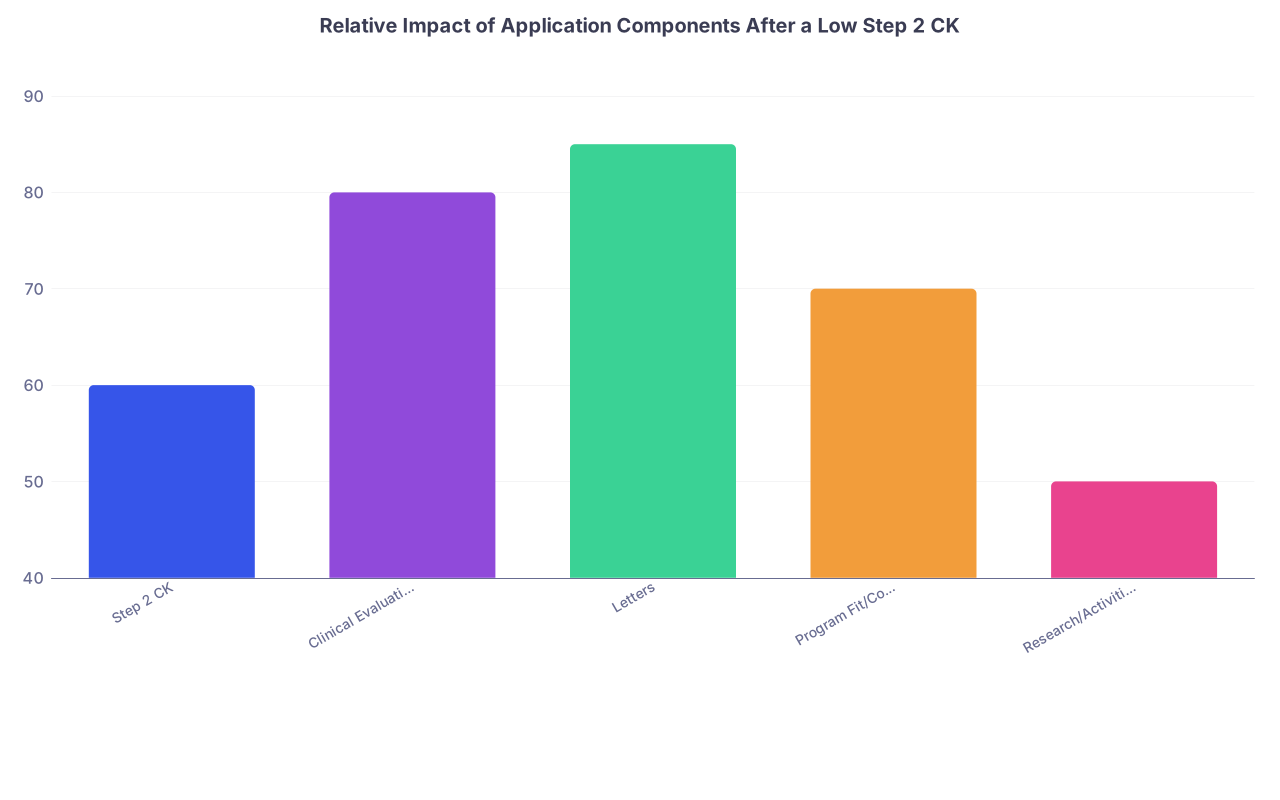
| Category | Value |
|---|---|
| Step 2 CK | 60 |
| Clinical Evaluations | 80 |
| Letters | 85 |
| Program Fit/Communication | 70 |
| Research/Activities | 50 |

| Step | Description |
|---|---|
| Step 1 | Receive Low Step 2 CK Score |
| Step 2 | 72 Hour Stabilization |
| Step 3 | Advisor Meeting |
| Step 4 | Build Application Snapshot |
| Step 5 | Strengthen Rotations and Letters |
| Step 6 | Plan Smart Pivot |
| Step 7 | Program List Strategy |
| Step 8 | Targeted Communication to Programs |
| Step 9 | Submit Applications with Clear Narrative |
| Step 10 | Stay in Specialty? |