
It is August. You are staring at your Step 2 CK score report and the number is… underwhelming. Below the average for your target specialty. Maybe solidly below.
You flip back to your school’s match list. Only a handful of people have matched into your specialty in the last five years. Your school does not have a home residency program in it. No built-in chair to vouch for you. No “our PD will call their PD” safety net.
You are not imagining it. You are disadvantaged.
But you are not doomed—if you approach this like a systems problem, not a self-worth problem.
This is your playbook to manufacture what others inherited: advocates who will go to bat for you despite a low Step score and no home program.
Step 1: Get Clear on What You Are Up Against
First fix: stop hand-waving the problem. Define it.
Here is what “low Step + no home program” usually means in practice:
- You are at risk of auto-filters based on score cutoffs
- You lack a department that “owns” you in your specialty
- You have fewer natural letter-writers known in the field
- You have less structured advising about where you can realistically match
- You are easier for programs to ignore because no one calls about you
So your job is to:
- Get over as many automated and informal screens as possible
- Put your application in front of human eyes who are primed to like you
- Get those humans to talk about you to other humans (advocacy)
To do that, you need to understand how programs actually weigh your profile.
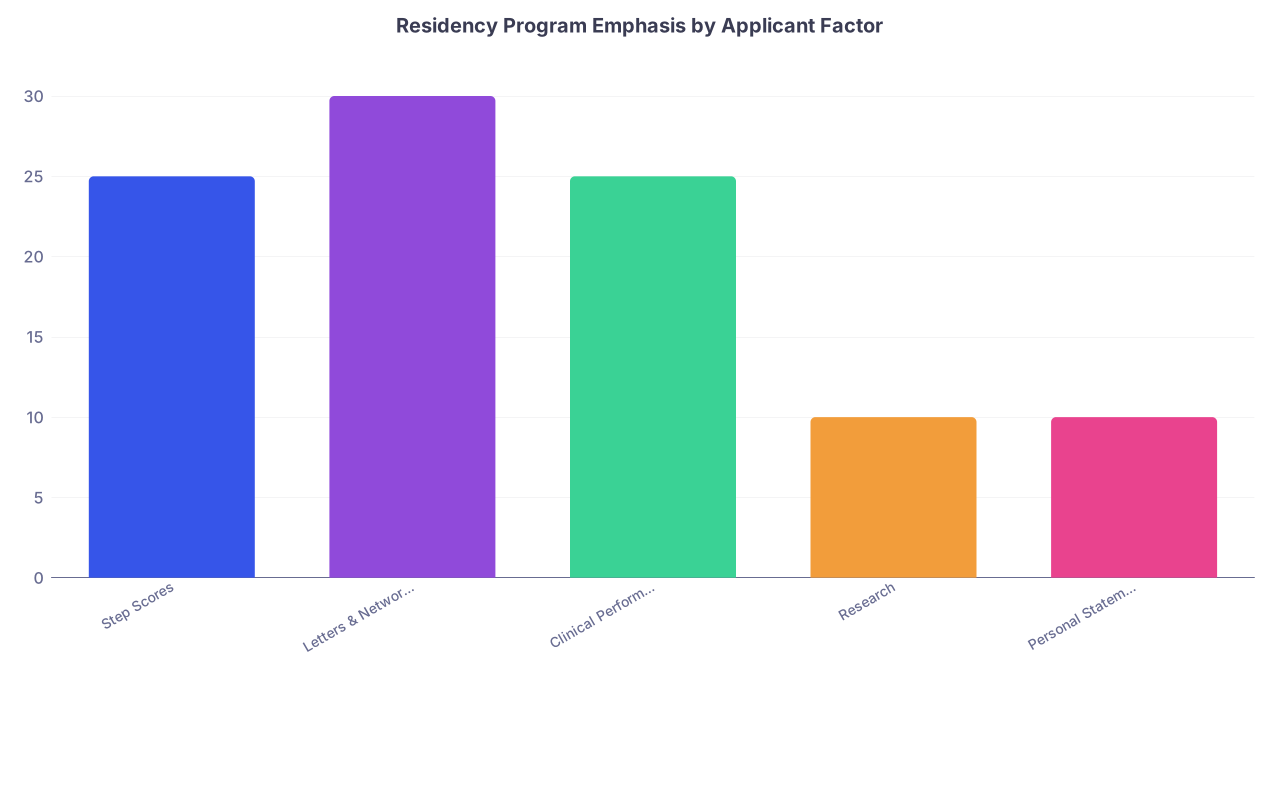
| Category | Value |
|---|---|
| Step Scores | 25 |
| Letters & Networking | 30 |
| Clinical Performance | 25 |
| Research | 10 |
| Personal Statement | 10 |
Those percentages are not exact, but they are honest enough: scores matter, but relationships and clinical performance can outweigh them if you build them right.
Step 2: Control the Narrative Around Your Step Score
You cannot hide a low score. You can frame it.
Here is the mistake I see constantly: people pretend the score never happened and hope PDs do not notice. They do. Instantly.
You want a tight, boring explanation that lowers anxiety and then moves on.
Your explanation must:
- Be short (2–4 sentences max)
- Be specific (generic excuses look weak)
- End with evidence of current competence
Here is a template that actually works:
“My Step 1 performance (2XX) was below my expectation. During that period I struggled with [brief, concrete factor—e.g., balancing a heavy family responsibility and difficulty adjusting my study approach]. Since then, I made specific changes, including [new study method / faculty support / dedicated schedule], which led to [improved performance—e.g., strong shelf scores, Honors in core clerkships, and improved Step 2 CK (2XX)]. I am confident the habits I use now better reflect my ability to learn and perform as a resident.”
Adjust the parts in brackets, keep the structure.
Where can this go?
- Personal statement (one short paragraph, not the opening)
- Secondary application fields that ask about academic difficulty
- Rarely, a brief line in an MSPE addendum if your dean is willing
What you do not do:
- Blame the exam
- Blame your school, your friends, or “COVID disruption” with no specifics
- Write a full essay about your suffering
Own it. Prove it is not who you are now. Move on.
Step 3: Build a “Pseudo-Home” Department Around Yourself
You do not have a home program. Fine. You are going to create one.
Think of a home department as three things:
- A small group of faculty who know you well and believe in you
- A chair or senior person whose name carries weight
- A system that feeds you opportunities (research, away rotations, letters)
You can replicate a lot of this with a deliberate approach.
3.1. Identify your anchor institution(s)
You need at least one institution where people actually know you and are willing to claim you.
Candidates:
- Places where you did a sub-I or away rotation
- Nearby academic centers where your school sends students frequently
- Research collaborators’ institutions
Your goal: become “their” student, even if your med school is elsewhere.
Concrete actions:
- Stay in touch with attendings you impressed on rotations via brief update emails every 6–8 weeks
- Ask explicitly: “Would you be comfortable considering me one of your students for advising and advocacy purposes as I apply in [specialty]?”
- Seek a designated “sponsor” (more on that later) who will call for you
3.2. Turn rotations into home-turf
On any away or sub-I, you are auditioning for two things:
- A letter
- Future advocacy phone calls and emails
Stop treating aways like “I hope they like me.” Treat them like: “I am here to make it impossible not to remember me positively.”
Non-negotiables on every away:
- Show up early, consistently. Faculty do notice patterns.
- Know your patients cold. If someone asks a lab and you are surprised, you are behind.
- Volunteer for the unsexy work (discharges, calling families). That is where trust is built.
- Ask for feedback by week 1–2, not at the end when it is too late to adjust.
End of rotation script (you say this to attendings you want as advocates):
“I have really valued working with you. I know my Step scores are not as strong as many applicants in [specialty]. My goal is to match into [specialty] despite that, by showing I will be a reliable, hard-working resident. Do you feel you have seen enough of my work to write me a strong letter of support, and, if so, would you be open to advocating for me with program directors when appropriate?”
Yes, you say the quiet part out loud. It signals maturity and makes the ask clear.
Step 4: Manufacture Advocates: Letters, Sponsors, and Callers
You do not just need letters. You need advocates. Different category.
Advocates do three things:
- Write a strong, specific letter
- Communicate directly with program directors about you
- Attach their reputation to your success
4.1. Choose potential advocates strategically
A few rules:
- One big-name advocate beats three generic “excellent student” letters
- Program directors and associate PDs in your specialty are top-tier
- Division chiefs and chairs (even from related specialties) can still help
- Alumni or faculty with national leadership roles are useful if they actually know you
| Advocate Type | Typical Impact Level |
|---|---|
| PD / Associate PD in specialty | Very High |
| Department chair in specialty | Very High |
| Core faculty at target program | High |
| Research PI known in the field | Moderate–High |
| Non-specialty faculty mentor | Moderate |
Your goal: 2–3 people in the top two rows, not 6 “meh” letters at the bottom.
4.2. Make it easy for them to go to bat for you
If you want someone to advocate, give them ammunition.
When you ask for a letter or for advocacy, provide:
- Updated CV
- USMLE/COMLEX transcript
- Draft of your personal statement
- Short “advocacy brief”: 1 page, bullet-pointed, with:
- Your story in 3–4 bullets
- Your strengths (with concrete examples)
- Why you are applying to this specialty
- Any specific programs you are targeting or ties you have
Sample outreach email (trim to your style):
Dr. Smith,
I wanted to thank you again for the opportunity to work with you on the [service/rotation/project]. I learned a great deal, especially from [one specific thing].
I am applying to [specialty] this cycle. My Step scores are not as strong as many applicants (Step 1 2XX, Step 2 CK 2XX), so I am relying heavily on strong clinical performance and advocacy from mentors who know my work well.
Would you feel comfortable writing a strong letter of recommendation for me, and, where appropriate, reaching out to colleagues at programs you know to support my application? I have attached my CV, Step transcript, and a short summary of my experiences and goals.
I completely understand if this is not something you are able to commit to.
Thank you for considering,
[Name]
You are being explicit without being pushy. You are also giving them an easy “out” if they cannot be strong.
4.3. Get specific about calls and emails
Advocacy is not vague “I support you.” It is targeted.
You should create a short, prioritized list:
- 10–15 top priority programs
- 10–20 “mid-tier but realistic” programs
- 5–10 safety programs where you are above their usual floor
Then with each sponsor, do something like:
“Here are 8 programs where I am especially interested and where I think I may be near the margin because of my Step scores. If you know anyone at any of these and feel comfortable reaching out, I would be very grateful.”
Make it easy:
- Put the list in a table with program name, location, any tie (family, prior rotation)
- Add a note: “I am from [state], my partner works in [city], etc.” so they can mention genuine ties
Step 5: Use Away Rotations as Political Capital, Not Vacation
If you have a low Step score and no home program and you are applying to a competitive specialty, away rotations are not optional. They are your primary weapon.
But the way people pick and run aways is often terrible.
5.1. Choose aways for advocacy potential, not just prestige
Your away choices should be driven by three questions:
- Where are my stats below average, but not laughably off?
- Where are there known connections I can leverage (alumni, mentors’ recommendations)?
- Where would I realistically be happy to train?
Do not waste an away at a hyper-elite program where your Step is 25+ points below their typical matched cohort unless a heavyweight advocate tells you they will personally sell you there.
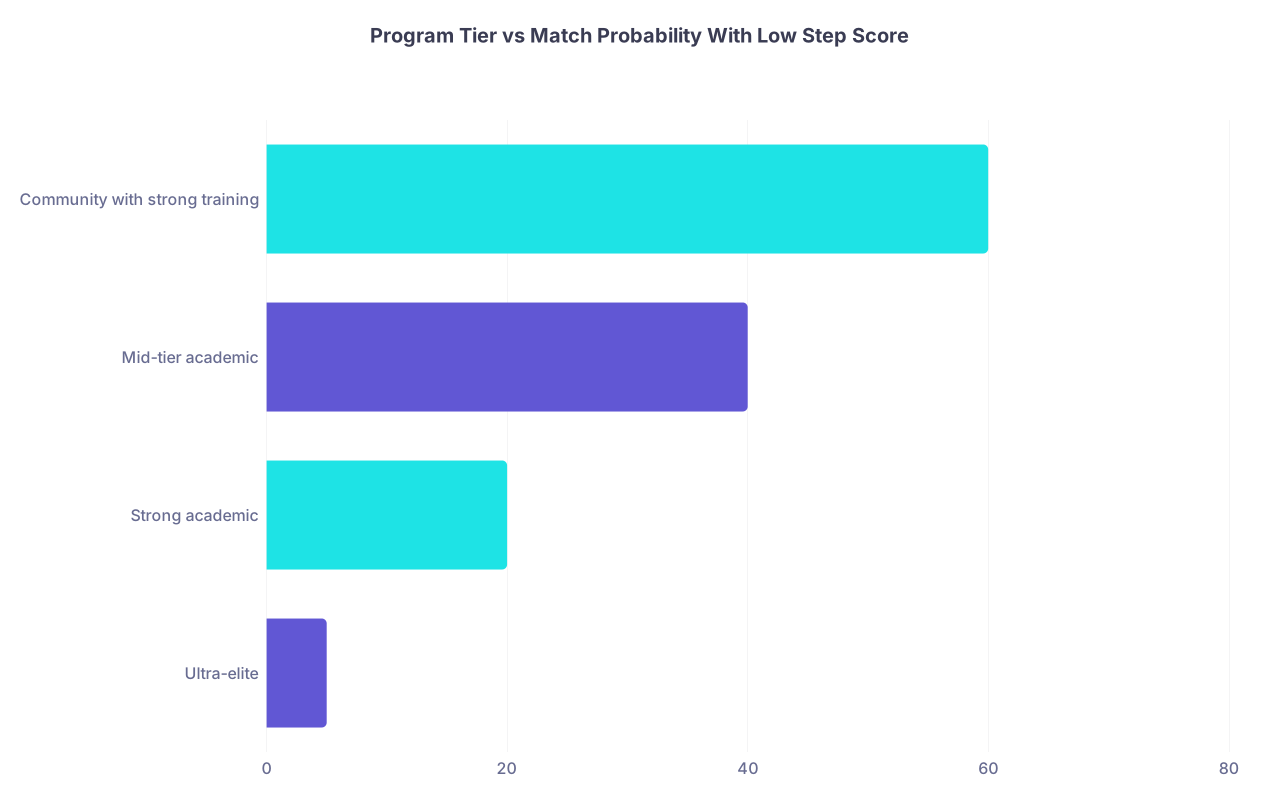
| Category | Value |
|---|---|
| Ultra-elite | 5 |
| Strong academic | 20 |
| Mid-tier academic | 40 |
| Community with strong training | 60 |
You can match at strong programs with a low score. But your odds explode when you include well-regarded community and mid-tier academic sites that are more holistic.
5.2. Treat each away like a month-long interview
Practical checklist for every away:
Week 1:
- Learn names of all attendings and chief residents
- Identify 1–2 attendings you want as potential letter writers
- Ask the senior resident how students get high marks on this service
Week 2:
- Request mid-rotation feedback: “Is there anything I can do differently to be performing at the level of your top students?”
- Start a running list of specific cases and contributions to reference later
Week 3–4:
- Tighten any feedback points (notes, presentations, efficiency)
- Have the “strong letter and advocacy” conversation with attendings who are clearly supportive
Your behavior needs to scream “safe, hard-working, teachable resident,” not “trying to impress.” There is a difference, and everyone on the team can feel it.
Step 6: Target Programs Like a Statistician, Not a Romantic
Your Step score defines your realistic range. You may not like that. Irrelevant. You build a list that respects the data and uses advocates to stretch higher.
6.1. Do a brutal, honest assessment
You need three inputs:
- Your Step 2 CK score
- Your school’s match history in your specialty
- Specialty-specific match data (NRMP Charting Outcomes, docs from your specialty society)
Then categorize yourself:
- Below-average but within range: within ~10–15 points of the median matched applicant
- Significantly below range: >15–20 points below median
If you are “within range,” advocates can push you into competitive programs.
If you are “significantly below,” advocates are for access, not prestige shopping.
6.2. Build a tiered application list
Here is how I would structure it:
| Program Tier | Approx. % of Applications | Purpose |
|---|---|---|
| Reach / Dream | 10–15% | Stretch with strong advocacy |
| Realistic Academics | 35–45% | Core target programs |
| Strong Community | 30–40% | High interview yield |
| Safety / Non-competitive | 10–15% | Protect against no-match |
And for each program, mark:
- A: I have an advocate with a direct tie here
- B: I have a regional or personal tie but no direct advocate
- C: No tie, cold application
You should have several As in each non-reach tier. If everything is C, you have a networking problem, not just a score problem.
Step 7: Communicate Like a Resident, Not a Student
Programs are not just avoiding low scores. They are avoiding headaches.
Every interaction you have—emails, meetings, interviews—is a chance to show you are low-drama, high-reliability.
7.1. Reaching out to programs the right way
Cold emails rarely change outcomes by themselves. Warm emails attached to an advocate do.
Scenario A: Your sponsor knows the PD.
- You send your sponsor your program list.
- Sponsor emails PD: “We have a strong applicant, low Step but excellent clinically, I recommend a close look.”
- Then you send a brief email:
Dr. Johnson,
I am a fourth-year student at [School] applying to [specialty]. I completed a sub-internship with Dr. Smith at [Institution], who encouraged me to reach out, as she kindly said she would be reaching out to some colleagues on my behalf.
I have a particular interest in [2 specific aspects of their program], and I have strong geographic ties to [region, if true]. My Step scores are below the mean for many applicants (Step 2 CK 2XX), but I have focused on being a reliable and effective team member clinically, as reflected in [Honors in core clerkships, sub-I evaluations, etc.].
I would be very grateful if you would consider my application when reviewing this season.
Sincerely,
[Name, AAMC ID]
Short, honest, and anchored to advocacy and specifics.
Scenario B: No direct advocate, but real ties.
- You still can send a carefully written email, but do not expect miracles.
- Use it for programs where you have real ties (grew up there, spouse job, etc.).
Do not mass-email 50 PDs generic notes. That just makes you look desperate.
Step 8: Use the Interview (and Post-Interview) to Cement Advocates
You are not done once you get an interview. That is when real advocacy becomes decisive.
8.1. On interview day
Your priorities are:
- Be normal. Not overcompensating, not apologizing constantly.
- When appropriate, briefly frame your Step score the way we structured earlier.
- Show that you understand the grind of residency and are not naive.
If an interviewer mentions knowing one of your advocates: good. Reinforce that.
“Yes, working with Dr. Smith really shaped how I approach [X]. She was very candid with me about needing to overcome my Step scores with clinical performance, and her feedback has been invaluable.”
You are reinforcing a shared narrative.
8.2. After interviews: activate your sponsors again
Post-interview, you can absolutely ask major advocates to follow up with your top 3–5 programs.
Email to your sponsor:
Dr. Smith,
I wanted to update you that I interviewed at [Program A], [Program B], and [Program C] over the last month. These are among my top choices, and I would be thrilled to train at any of them.
If you know the leadership at any of these programs and feel comfortable doing so, I would be very grateful for any additional support you can provide at this stage.
Thank you again for all of your help,
[Name]
You are not asking them to lie. You are asking them to reiterate their honest endorsement at the crucial time when rank lists are forming.
Step 9: Backstop Plan: Rebuild and Reapply Intelligently
You need to hear this: even with all of this, you may not match. That is not failure. That is a data point.
What is failure? Doing the exact same thing again the next cycle.
If you do end up unmatched or SOAPed into something you do not want long term, have a plan.
9.1. If you SOAP into a prelim or different specialty
Your mission in that year:
- Be the hardest-working, least-complaining intern on the service
- Find advocates in your residency who respect your clinical work
- Use off-service time for:
- Research in your target specialty
- Targeted rotations at programs where you want to end up
Document everything:
- Procedures, leadership roles, teaching moments
- Any written feedback or awards you get
That becomes the core of your reapplication narrative: “My original metrics were weak, but here is how I actually function as a doctor.”
9.2. If you go unmatched and take a research or prelim year
Smart moves:
- Choose research with a PI embedded in your target specialty
- Get clinical exposure during research year if allowed (clinics, shadowing)
- Sit for Step 3 and crush it if possible. That is one of the few concrete ways left to demonstrate academic rebound.
Avoid disappearing for a year doing random non-clinical work with no clear link to your target field. That looks like you gave up.
Step 10: Protect Your Headspace While You Do All This
You are not a Step score. You know this intellectually. Your body does not care. It feels like judgment.
You will perform worse—clinically and in interviews—if you walk around radiating shame.
A few grounding rules:
- Hang out with at least a few people not obsessed with match stats
- Limit doom-scrolling Reddit/SDN “what are my chances” threads; those are anxiety amplifiers, not data sources
- Tell 2–3 trusted people your actual application strategy so you are not carrying it alone
- If this process is triggering depression or serious anxiety, get professional support early, not after you start missing deadlines
You are doing something hard. You do not get bonus points for suffering silently.
Your Move Today
Do one concrete thing right now that moves you toward having real advocates:
- Open your email and draft a message to one attending you trust, asking for a meeting about your application strategy and potential advocacy. Do not overthink it.
- Subject line: “Request for residency advising and support – [Your Name]”
- Ask directly: “I have a low Step score and no home program in [specialty]. I would value your honest assessment of my chances and how I can best position myself, including whether you might be able to support me with a strong letter or advocacy.”
Send that email. That is how you start building the network most of your classmates take for granted.