Most applicants with low Step scores talk themselves out of a spot before the program ever does.
If you walk into an interview without a tight, rehearsed way to handle your score, you are giving away leverage. Programs will not fix this for you. You need a clear strategy and a script you can actually say out loud.
This guide gives you both.
You will get:
- Exact phrases you can use word-for-word
- Modular “plug-and-play” scripts for different scenarios
- A structure for answering score questions without rambling or sounding defensive
- Practice drills so you do not freeze when the topic comes up
If you have:
- Step 1 just above pass
- Step 2 CK in the low 210s–220s
- A fail or significant drop between exams
…this is for you.
1. The Core Framework: How to Talk About Any Low Step Score
Most people fail this part because they improvise. They start explaining. Justifying. Over-talking.
You are going to follow a simple 4-part structure every time the score comes up:
- Own it succinctly.
- Give a concise, non-dramatic reason.
- Show the correction with evidence.
- Redirect to your strengths and fit for that program.
Think: Own → Reason → Evidence → Redirect.
Here is the skeleton:
“I know my Step [X] score is below what you typically see. The main issue was [brief reason, no excuses]. Since then, I have [specific changes / improvements], and you can see that in [concrete evidence: later grades, second exam, clinical performance]. What matters more to me now is [how this translates into residency value], and I think that aligns with [specific aspect of their program].”
You will customize this, but you will not deviate from the structure.
What you must avoid saying
Cut these from your vocabulary:
- “The exam was unfair…”
- “I am just not a good test taker…” (you can think it; you do not say it)
- “My score does not reflect who I am…” (overused and empty)
- A five-minute saga about family, illness, and drama
You are not on trial. You are interviewing for a job. Act like it.
2. Script Templates for Common Low Step Scenarios
We will go through the main buckets:
- Low Step 1, better Step 2
- Low Step 2, decent Step 1 / strong clinicals
- Step failure (Step 1 or Step 2)
- Large drop from Step 1 to Step 2
- Both Step 1 and 2 weak, but strong clinical / non-test strengths
Use these as baseline scripts. Adjust the details to sound like you.
Scenario A: Low Step 1, Improved Step 2 (Classic Redemption Arc)
Profile:
- Step 1: 201 / barely pass / bottom quartile
- Step 2 CK: 232
- Strong third-year evaluations
This is the easiest to reframe, if you do it cleanly.
Likely question: “Can you tell me about your Step 1 score?” or “We noticed a big difference between Step 1 and Step 2—what changed?”
Script:
“Step 1 was a wake-up call for me. I passed, but I underperformed.
The short version is that I was using a very passive study style—too much reading, not enough questions—and I underestimated how different the exam was from our preclinical tests. I also tried to study while juggling too many commitments instead of protecting focused time.
After that, I completely overhauled my approach. For Step 2 I moved to a question-first strategy, used NBMEs and UWorld self-assessments weekly, and treated every incorrect as a mini-lesson. I also cut back on nonessential activities during dedicated.
The result was a 30-point jump. More importantly, that same system is what I now use to prepare for rotations and in-service exams. You can see it in my third-year comments—attendings consistently described me as well-prepared and strong on clinical reasoning.
Residency will demand that kind of structured improvement, and I am actually grateful I learned how to rebuild my approach early.”
Short, specific, and focused on corrective action and transferable process.
Scenario B: Low Step 2, Acceptable Step 1, Strong Clinicals
Profile:
- Step 1: 225
- Step 2 CK: 216
- Shelf exams mostly strong, good rotation comments
You need to make it very clear this was not a pattern of decline in real-world performance.
Likely question: “We noticed your Step 2 score is lower than your Step 1. What happened there?”
Script:
“You are right, my Step 2 is lower than my Step 1, and I made some mistakes in how I approached that exam.
I scheduled Step 2 too close to a heavy stretch of rotations and underestimated how much fatigue would affect my performance. I tried to combine full-time clinical work with heavy dedicated review, and I ended up not doing either as well as I should. That was poor planning on my part.
What I would want you to focus on, though, is the consistency of my clinical performance. My shelf scores in medicine and surgery were in the top quartile of my class, and my rotation evaluations repeatedly comment on strong clinical reasoning and preparation. Those are the same domains Step 2 is trying to capture.
Since that exam, I have changed how I plan high-stakes assessments—spreading study over a longer period, protecting rest, and integrating questions into my daily routine. I have already used that new system for our in-house exams and seen much more stable performance.
At the end of the day, residency success will depend on how I function on the wards every day, and the feedback I get in that setting is much more representative of the physician I am now.”
Notice the structure:
- Own it.
- No drama.
- Emphasize clinical performance as the “true” metric.
Scenario C: Step Failure (1 or 2)
This is the hardest conversation, but it is not a death sentence if the rest of your file is strong.
You must:
- Take full responsibility
- Show a clear change in behavior and outcome
- Avoid victim language
C1: Failed Step 1, Passed Strongly on Second Attempt and on Step 2
Profile:
- Step 1: Fail, then 220
- Step 2 CK: 233
- Clinicals solid
Program question: “Can you tell us about your Step 1 attempt and what happened?”
Script:
“I failed Step 1 on my first attempt. That is documented, and I take full responsibility for it.
I did not treat the first attempt like a true board exam. I studied inefficiently, relied on group sessions that were more social than productive, and I did not use objective benchmarks like NBMEs to test readiness. I convinced myself I was ‘close enough’ when I was not.
After failing, I sat down with our learning specialist and built a very structured plan—daily question blocks, weekly self-assessments, and dedicated review time with accountability. I also cut out the distractions that were taking time away from real work.
On the retake I passed comfortably, and I carried that same system into Step 2, where I scored over 230. My clinical instructors have seen the same change—my evaluations after that point are consistently strong, especially in preparation and reliability.
The failure was a serious setback, but it forced me to build disciplined habits that I now use every day. That is exactly the mindset I bring into residency: measure, adjust, and improve until performance matches the standard.”
You are not begging for forgiveness. You are showing how you operationalized the lesson.
C2: Failed Step 2 with Reasonable Context
Profile:
- Step 1: 225
- Step 2: Fail → 221 on retake
- Documented family crisis or health issue during first attempt
You do not need a tearful story. Just enough context.
Script:
“I failed Step 2 on my first attempt. The failure coincided with a significant family medical emergency that pulled my attention away from preparation. I chose to sit for the exam anyway instead of postponing, and that was the wrong call. I accept that decision fully—that is on me.
For the retake, I did two things differently. First, I waited until the family situation was stable so I could focus. Second, I rebuilt my study plan with questions and timed blocks at the center, and I got regular feedback from faculty mentors on my progress.
I passed on the second attempt with a 221. My shelf scores and clinical evaluations during the same period were consistently in the upper half of my class, which reassured me that the failure was not due to a lack of clinical understanding but to poor timing and planning.
I have taken that forward into how I manage stress and workload now. I am much faster to ask for help and to adjust my schedule early, rather than trying to push through and hoping it works out. I think that growth is crucial for a safe and reliable resident.”
Do not overshare details. You are not trying to win sympathy. You are showing judgment learned.
Scenario D: Big Drop from Step 1 to Step 2
Profile:
- Step 1: 240
- Step 2 CK: 221
Programs worry about burnout, distraction, or loss of discipline. You must address that head-on.
Program question: “We noticed a significant drop between Step 1 and Step 2. Can you talk about that?”
Script:
“Yes, the drop from Step 1 to Step 2 is real, and I understand why that raises questions.
After Step 1 went well, I assumed I could handle Step 2 with a much more relaxed approach. I took on too many extracurricular responsibilities, underestimated how much time I needed for high-quality review, and I did not track my progress with self-assessments the way I had before. My preparation lacked the discipline that got me the Step 1 score.
That was a wake-up call. Since then, I have gone back to the habits that made me successful initially—structured schedules, UWorld and NBME benchmarks, and weekly review time blocked on my calendar. You can see the impact in my later clinical evaluations and in-service scores, which have been consistent with my Step 1 performance instead of Step 2.
The big lesson for me was that past success does not give you a shortcut on the next challenge. Residency will require sustained discipline, and I am now very intentional about protecting the habits that support that.”
The message: “I got cocky. I fixed it. Here is proof.”
Scenario E: Both Step Scores Weak, Stronger Non-Exam Profile
If both Step 1 and 2 are on the low side, you will not “spin” the numbers into looking great. You will reframe the meaning of the numbers and emphasize all the other performance signals.
Profile:
- Step 1: 205
- Step 2 CK: 215
- Excellent clinical comments, strong letters, good research or leadership
You are selling a clinical learner, not a test champion.
Program question: “Can you tell us about your board scores and how you have approached standardized exams?”
Script:
“My Step scores are lower than what you typically see in this pool. I want to be direct about that.
Standardized tests have consistently been a relative weakness for me. I tend to perform better in applied, real-world settings than on one-day multiple-choice exams. That said, I do not accept that as an excuse. For both Step 1 and 2, I built structured study plans with question banks and review, and I did improve compared with my earlier standardized tests, but not to the level I would have liked.
Where I believe my application gives a more accurate picture of my potential as a resident is in my clinical work. My medicine and surgery attendings commented on my preparation, reliability, and ability to synthesize information on rounds. I was selected to be a sub-I in [X], and my letters speak strongly to my day-to-day performance and teamwork.
I have also continued to work on exam strategy with our learning specialist because I know there are in-training exams and boards ahead. We have identified concrete tactics that help—shorter, more frequent timed blocks, active error logs, and earlier scheduling of practice tests. I am applying those now and seeing more stable practice scores.
So while my Step scores are not my strength, the habits I have built and my clinical evaluations convince me I can meet the testing requirements and be a very dependable resident on your team.”
You are not pretending to be what you are not. You are presenting a realistic but confident package.
3. Delivery: How to Sound Competent, Not Defensive
The script is worthless if your delivery is off. The resident who sounds ashamed or angry about their score loses the room instantly.
Here is how to fix your delivery.
Keep it under 90 seconds
If your answer goes longer than about a minute and a half, you are rambling.
Practice with a timer. Out loud. Not in your head.
Structure:
- 1–2 sentences: Acknowledge the score
- 2–3 sentences: Cause / what went wrong
- 3–4 sentences: What you changed + evidence
- 1–2 sentences: Why this matters for residency / their program
Voice and body language
- Speak slightly slower than your normal rate. Rushing = nervous.
- Do not drop your volume when saying the score or “failed.” Say it plainly.
- Maintain eye contact during the “I take full responsibility” line. That single moment sells credibility.
- Do not fidget or look away when you pivot to your strengths.
If you can, record yourself on video once. You will catch the awkward parts instantly.
4. Anticipating Specific Interview Questions: Ready-Made Responses
Some programs will ask directly. Others will circle around the topic. You should have clear scripts for the most common phrasings.
| Question Style | Your Primary Goal |
|---|---|
| Direct: "Explain your Step score." | Use full 4-part framework |
| Comparative: "Why the difference?" | Focus on what changed and got better |
| Predictive: "How will you handle future boards?" | Show concrete system and recent results |
| Concern-based: "Should we worry about tests?" | Acknowledge, then reassure with data |
Question 1: “Can you explain your Step 1/2 score?”
Use your scenario-specific script with the 4-part structure. Keep it tight.
Question 2: “Should we be concerned about your ability to pass in-training exams and boards?”
This is where many applicants panic. They start guessing what the program wants to hear.
Use this:
“That is a fair concern given my Step scores. I have thought seriously about it as well.
I would say two things. First, I now have a specific system for exam preparation that has already produced better consistency—regular timed questions, spaced review, and early practice tests to confirm readiness. Second, my performance on [recent in-house exams / NBME subject exams / later coursework] has been much more stable and closer to where I want it.
I am not the person who will casually walk into an exam and ace it without preparation. I am the person who builds a structured plan, follows it, and gets the result needed. I am confident I can do that for your in-training exams and boards, and I am happy to be held accountable to clear benchmarks along the way.”
You are not promising 99th percentile. You are promising reliability.
Question 3: “What did you learn from your Step experience that will make you a better resident?”
Translation: “Convince us this pain will result in value for us.”
“The main lesson was that intention is worthless without a measurable system.
Before Step, I would say things like ‘I am studying hard’ or ‘I am going to do well,’ but I did not have objective checkpoints. Now, I operate with specific targets—X questions per week, Y practice tests, and Z review sessions—and I track if I am actually hitting them.
That carries directly into residency. For example, on my sub-I I created a simple checklist for each patient—labs, imaging, follow-ups—and reviewed it before rounds. It reduced dropped tasks and made my days more predictable. The same mindset that turned around my exam preparation is what keeps me organized and reliable on the wards.”
You have tied the exam story to clinical behavior. That is the bridge most applicants miss.
Question 4: “If you could redo your Step prep, what would you do differently?”
Do not list 10 resources. Focus on 2–3 strategic changes.
“Three things.
First, I would start consistent questions much earlier instead of trying to ‘finish content’ first.
Second, I would schedule NBMEs regularly and use them to decide whether I was actually ready, instead of going by gut feeling.
Third, I would be more aggressive about protecting time—saying no to extra commitments during dedicated instead of trying to do everything.Those changes alone would have made the biggest difference, and they are exactly how I now approach any major assessment.”
Shows insight, not just regret.
5. Practice Protocol: What To Do This Week
You do not “wing” this in a real interview. You drill it.
Step 1: Write your custom script (today)
- Pick your scenario above.
- Copy the script.
- Replace bracketed details with your data and story.
- Edit until it sounds like you would actually speak.
Step 2: 10-rep drill (tomorrow)
- Stand up.
- Set a 90-second timer.
- Answer the Step question out loud, using your script as a guide but not reading it.
- Stop at 90 seconds, even if mid-sentence.
- Do this 10 times.
By rep 5–6, it will start sounding natural. That is the point.
Step 3: Peer or mentor test (this week)
Ask a trusted resident, faculty mentor, or advisor:
- “Ask me directly about my Step score.”
- “Ask me if you should worry about my future board performance.”
- “Ask anything that concerns you after hearing my answers.”
Record the session if possible. Fix anything that sounded:
- Defensive
- Overly emotional
- Confusing or too detailed
Step 4: Final polish
Write one sentence you will use to pivot away from Step and back to your strengths. For example:
“I am happy to answer any details about my testing history, but I would also love to share what my attendings say about my day-to-day work on the wards, because that is where I bring the most value.”
Memorize that sentence. It is your way out of getting stuck in the score conversation.
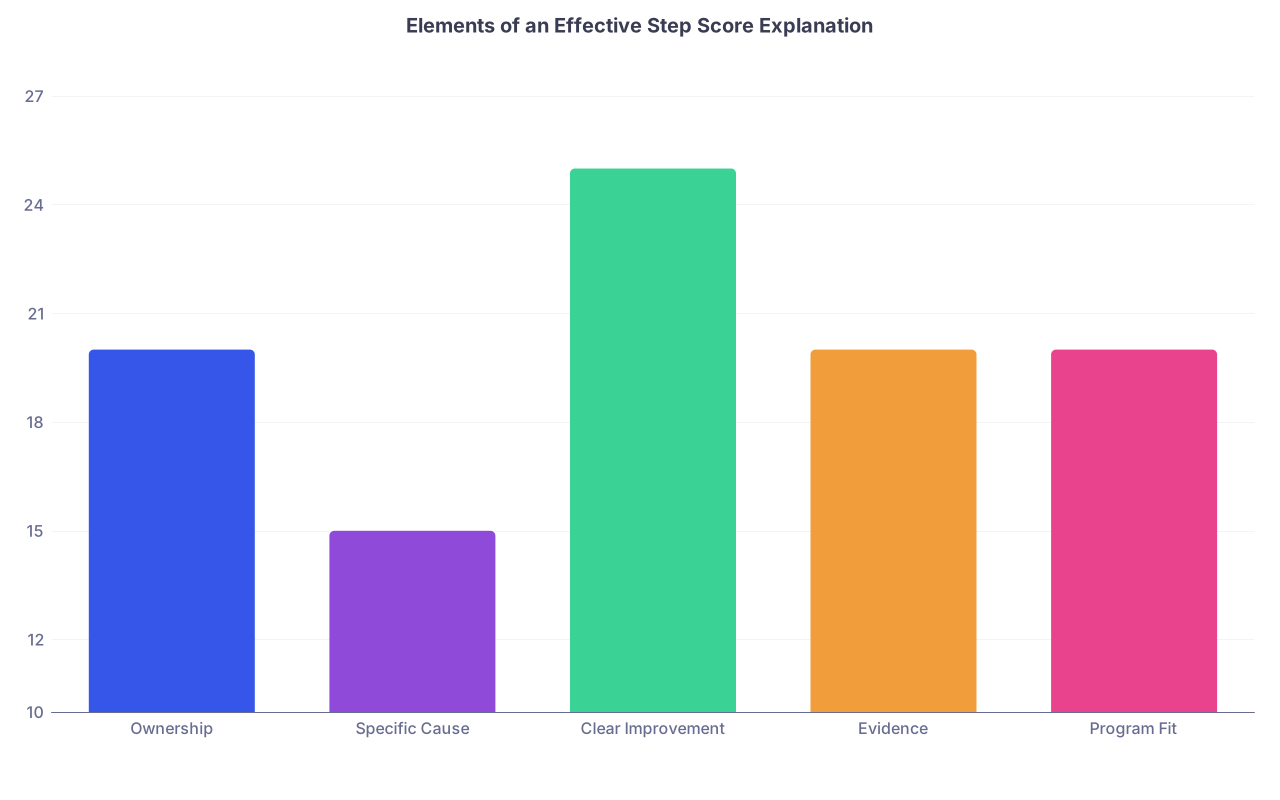
| Category | Value |
|---|---|
| Ownership | 20 |
| Specific Cause | 15 |
| Clear Improvement | 25 |
| Evidence | 20 |
| Program Fit | 20 |

| Step | Description |
|---|---|
| Step 1 | Interviewer asks about Step score |
| Step 2 | You acknowledge score directly |
| Step 3 | Brief explanation of cause |
| Step 4 | Describe changes and new system |
| Step 5 | Give concrete performance evidence |
| Step 6 | Connect to residency value and fit |
| Step 7 | Pivot to strengths or program specific topic |
6. Common Mistakes That Kill Your Reframing
I have watched strong candidates sabotage themselves in under 60 seconds. Do not do any of this:
Over-explaining personal crises.
One line is enough: “I had a family medical crisis during that time; I chose not to postpone, and that was the wrong decision.”Trashing the exam.
Complaining about unfair questions or test design makes you sound immature.Blaming the school or faculty.
“We did not get enough dedicated time” is not a good look.Saying ‘I am not a good test taker’ and stopping there.
If you go there, you must immediately follow with: “…so I built a system to compensate for that, and here is how it has worked.”Talking in vague inspirational phrases.
“I grew a lot as a person” without specifics is noise. Tell me exactly what you changed.
Your goal is simple: come across as a person who had a problem, diagnosed it realistically, fixed it with a system, and now functions at a high, stable level.
FAQ (Exactly 4 Questions)
1. Should I bring up my low Step score myself if the interviewer does not mention it?
Generally, no. Do not volunteer negatives that the interviewer has chosen not to focus on. Your job is to be prepared with a strong, concise explanation if they ask or if there is an obvious context (for example, a failure). The exception is a very low score or failure that is clearly a major part of your file; in those cases, addressing it once, confidently and briefly, early in the interview can show maturity. But do not dwell on it—acknowledge, explain, show improvement, and pivot.
2. How honest should I be about personal issues that affected my score?
Be honest but not graphic. One or two sentences is enough: name the category (family illness, personal health, financial strain), own your decision if you chose to test anyway, and then move quickly to what you changed afterward. Interviewers are not your therapists. They need to know you take responsibility and have developed better judgment, not every detail of the situation.
3. Can I say I want to retake Step 2 to improve my score?
If retaking is a realistic option and allowed by your school and licensing body, you can briefly mention that you are exploring it. But be careful: programs care more about whether you will reliably pass required exams than about chasing marginal score increases. If you mention a retake, pair it with a concrete plan you are already executing and make it clear that your primary focus is being a strong resident, not just chasing numbers.
4. What if my Step scores are low and I do not have strong shelf scores either?
Then your interview strategy must lean harder on other concrete strengths: outstanding clinical comments, clear examples of initiative and reliability, meaningful research or QI work, and strong letters of recommendation that emphasize judgment, work ethic, and teachability. You still use the same 4-part framework for discussing scores, but you put extra weight on how your day-to-day work and feedback support your readiness. You should also be very explicit about the exam-preparation system you now use and any recent indicators—practice tests, institutional exams—that suggest your performance is stabilizing.
Open a blank document right now and write your 60–90 second Step explanation using the 4-part framework. Then say it out loud three times. If you cannot get through it smoothly in under two minutes at home, you will not fix it in front of a program director.