
The residency application system does not care about your feelings. A low Step score and thin research section will absolutely hurt you—if you let them stand alone. The fix is not magical. It is methodical. You build the rest of your ERAS profile so strong, so coherent, that your weaknesses become background noise instead of the headline.
You are not going to “hide” a 214 on Step 2 or zero publications. Programs see everything. Your job is simpler and harder: accept the data, then construct a file that makes them say, “We should at least interview this person.”
Here is how you do that.
1. Get Real About Your Numbers and Target the Right Programs
Before you even think about “crafting a narrative,” you need a blunt assessment of where you stand.
Step 1: Categorize your situation
Low scores and limited research are not all equal. Rough guide:
| Score Range | Category | Strategy Level |
|---|---|---|
| 250+ | Strong | Broad targeting |
| 235-249 | Solid | Standard targeting |
| 220-234 | Borderline | Strategic targeting |
| 210-219 | Weak | Highly selective, backup heavy |
| <210 | Very Weak | Heavy backup, consider prelim/TY |
If Step 1 is Pass only, your Step 2 is the main numeric filter. In competitive specialties, 230 can be a problem. In less competitive fields, you can absolutely match in the 210s with a smart strategy.
Research:
- “Limited research” =
- 0–1 poster/abstract
- No publications
- No substantial longitudinal project
In anything research-heavy (derm, rad onc, some academic IM), that is a real handicap. In FM, psych, community IM, prelim/TY? It matters far less than applicants think.
Step 2: Align specialty choice with your record
If you are sitting on:
- Step 2 CK 214
- No research
- Mid-tier clinical grades
Then aiming only at dermatology or integrated plastics is fantasy, not grit. You either:
- Pivot to a more realistic primary specialty, or
- Commit to a multi-year retooling plan (research year, score improvement, etc.) with eyes wide open.
If you are already in the application cycle, the realistic fix is usually:
- Choose one realistic core specialty (IM, FM, psych, peds, etc.).
- Add:
- A mix of academic, mid-tier university-affiliated, and community programs.
- Geographic “home turf” and places where you have any connection.
- A few prelim/TY lines if you might need a bridge year.
You cannot out-personal-statement a percentile problem in the most competitive specialties. You can, however, beat the odds in reasonable fields with a disciplined strategy.
2. Decide Your Narrative: What Are They Buying?
Programs are not buying your score. They are buying:
- Reliability at 3 a.m.
- Ability to function on a busy ward
- Zero drama
- A colleague they can stand for 3+ years
Your ERAS must make one clear, consistent argument about you. Pick a primary identity and commit:
Examples:
- “Clinically strong, team-first workhorse who will carry more than his share.”
- “Late bloomer with clear improvement, deeply committed to underserved care.”
- “Nontraditional candidate with prior career, mature, calm, excellent with patients.”
Everything in your application should support one of these.
Weak narrative:
“I love research, global health, advocacy, education, leadership, and innovation.”
Strong narrative:
“I am the resident you trust with your sickest ward patients and the interns who are drowning.”
You cannot sound like a scattered menu of buzzwords. With low scores and light research, you do not win by being everything. You win by being sharply, credibly one thing.
3. Letters of Recommendation: Your Single Biggest Lever
I have watched borderline applicants match at solid programs on the backs of two or three nuclear-strong letters. Not “good” letters. Attack-dog strong.
Programs will forgive a lot if someone they trust writes:
“We would be thrilled to have her as a resident here. She functions at or above the level of many of our current PGY-1 residents.”
Your job is to engineer those letters.
Step 1: Pick the right writers
Rank order:
- Faculty in your chosen specialty who directly supervised you on core rotations or sub-Is.
- Program leadership (PD/APD/Clerkship Director) who actually know your work.
- Other attendings with significant direct clinical experience with you.
Do not chase big names who barely know you. A “famous” PD who says you are “pleasant and eager to learn” is weaker than a mid-level faculty saying you are “top 5% of students I have worked with in 15 years.”
Step 2: Make their job easy
When you ask:
- Ask in person or on video, not just email, if at all possible.
- Use this line:
“Would you feel comfortable writing me a strong letter of recommendation for internal medicine residency?”
Then shut up and watch their face.
If they hesitate, pivot. You cannot afford tepid with your scores.
Provide a letter packet:
- Updated CV
- ERAS personal statement draft
- Bullet list of 4–6 specific things you did with them:
- “Took ownership of 4–6 patients daily on wards.”
- “Frequently stayed late to help with cross-coverage.”
- “Led goals-of-care discussion with Mr. X’s family.”
- “Completed mini-review on hyponatremia and presented on rounds.”
This packet nudges them to write the kind of letter you need: concrete, performance-focused, and comparative.
Step 3: Get at least one “anchor” letter
Your anchor letter is the one that screams: “Whatever the scores say, this person is safe to hire.”
From an anchor writer, you want phrases like:
- “One of the hardest-working students I have worked with.”
- “Shows excellent clinical judgment for her level.”
- “Already functions like an intern in terms of reliability and follow-through.”
You cannot write those words yourself. But you can give people the raw material by how you performed on their service and the reminders you send.
4. Clinical Experience: Turn Rotations into Evidence
With low scores and limited research, your clinical work becomes center stage. You need your transcript, MSPE, and narrative comments to collectively say: “Whatever test-taking issues exist, this person performs well where it counts.”
Step 1: Maximize performance on sub-Is and audition rotations
This is your most important “second chance.” On sub-I or away rotations in your chosen specialty:
- Show up early. Absurdly early if you must.
- Be the one offering to stay late when the list explodes.
- Ask to present brief, organized patient summaries.
- Own tasks. If you say you’ll follow up on an MRI, ensure the result is in, written, and communicated before sign-out.
You want attendings to say on your eval:
- “Very reliable.”
- “Strong work ethic.”
- “Works well with team, nurses specifically mention him positively.”
Those words are gold. Straight-up gold with a 218.
Step 2: Build a “clinical strengths” profile
You cannot invent honors you do not have, but you can highlight the pattern of what you do have.
On ERAS experiences and in your personal statement, show concrete clinical behaviors:
- “Regularly pre-rounded on 8–10 patients on internal medicine wards, prepared to present overnight events, vitals, and labs.”
- “Led interdisciplinary huddle with nursing, PT/OT, and case management during my sub-internship.”
- “Managed 3–4 new admissions independently before presenting to resident and attending.”
It is subtle, but this language separates you from the “average” student and anchors your narrative as the workhorse.
5. Personal Statement: Use It to Reframe, Not Beg
The personal statement will not rescue you by itself. But it can do two very practical jobs:
- Frame your weaknesses so they do not scream.
- Hammer home your main identity.
What you do not do
- You do not spend three paragraphs apologizing for your Step score.
- You do not write a generic story about “always wanting to help people” without specifics.
- You do not attempt to overcompensate with dramatic trauma narratives.
What you do write
Structure that works:
Short, specific opening
- One moment or scenario that illustrates how you actually behave in the hospital.
- No “I remember the first time I walked into a hospital…” nonsense.
Middle: Evidence-based portrait
- 2–3 brief clinical vignettes that show your strengths: taking responsibility, calming a chaotic situation, owning follow-up.
- One paragraph on what draws you to the specialty, with real specifics (not “I like continuity of care” in FM—everyone writes that).
Acknowledging the elephant (scores) briefly, if needed
- One short paragraph:
- Take responsibility.
- Show growth or context.
- Move on.
- One short paragraph:
Closing: How you will function as a resident
- Concrete. “I will bring X, Y, Z to your program.”
Example of addressing a low score without groveling:
“My Step 2 CK score does not reflect the standard I hold for myself. During that period I underestimated the transition from pre-clinical to clinical studying and overrelied on passive review. Since then, I have overhauled my approach: I completed over 3,000 UWorld questions, raised my shelf scores by an average of 12 points, and consistently took on higher patient loads on wards. The feedback from my sub-internships better reflects the physician I am becoming.”
That is enough. Then you pivot back to your strengths.
6. Turning “No Research” into “Value-Add” Experiences
Let me be clear: if you are applying to a heavily academic field or top-tier academic IM, limited research hurts. You cannot spin it into a positive. What you can do is:
- Avoid letting the empty “Research” box on ERAS define you.
- Fill Experiences with projects that show initiative and follow-through.
Step 1: Reframe what counts as “scholarly”
ERAS cares less about what you call it and more about what you actually did. If you have:
- Quality improvement projects
- Case reports (even if not published yet)
- Curriculum work
- Patient education tools you developed
- A massive coaching role in student-run clinic
You can frame these as:
- “Clinical Quality Improvement”
- “Educational Project”
- “Systems-Based Initiative”
Be honest, but do not undersell.
Example ERAS entry for a non-research project:
Title: “Reducing 30-Day Readmissions in Heart Failure Patients – QI Project”
Description (bullet style):
- Collected data on 75 consecutive admissions for heart failure on general medicine service.
- Identified gaps in discharge med reconciliation and follow-up appointments.
- Developed checklist incorporated into discharge workflow; presented outcomes at department meeting.
- Preliminary data showed 8% absolute reduction in 30-day readmissions over 3 months.
That is more compelling than “poster at minor student conference” with no real impact.
Step 2: Quick, high-yield scholarly wins (if you have time)
If you have 3–9 months before ERAS submission, you can realistically add:
- 1–2 case reports (if you are aggressive about finding cases and partners).
- 1 small QI project on your ward or clinic.
- 1 poster at a regional meeting.
This will never equal a 3-year NIH-funded project. It does not need to. The point is to show you can:
- Start something
- Finish it
- Present it
Clinical fields like FM, psych, and community IM will respect that.
7. ERAS Experiences: Stop Wasting Space
Low scores mean the miscellaneous parts of ERAS now matter more. Many applicants waste them with fluff.
Your goal: turn every Experiences entry into an argument for your value.
Step 1: Choose the right “Most Meaningful” experiences
Your top 3 “Most Meaningful” should not be:
- Random undergrad club
- High school tutoring
- One-day health fair
They should be:
- A major clinical or service activity that shows durability (multiple years, leadership, or heavy involvement).
- A project where you took ownership and changed something (QI, clinic, curriculum).
- Something that reveals you are a decent human who can talk to patients, families, or colleagues when things are hard.
Step 2: Describe with outcomes, not duties
Weak ERAS bullets:
- “Volunteered at a student-run clinic.”
- “Participated in health fair.”
- “Served as treasurer for club.”
Stronger versions:
- “Served as primary student provider for 4–6 patients per evening at student-run free clinic, managing chronic disease follow-up under resident supervision.”
- “Coordinated blood pressure screening for 120 community members; referred 32 with elevated readings to follow-up clinic.”
- “Managed $15,000 annual budget for global health organization, maintained zero budget shortfalls across 2 years.”
Your scores already suggest “maybe not top test-taker.” You want your experiences to scream “but absolutely gets things done.”
8. Strategic Program List: Quantity, Quality, and Fit
The other brutal truth: with weaker metrics, you usually need more applications. But not just more. Smarter.
Step 1: Understand program types
Quick breakdown:
| Program Type | Typical Competitiveness | Research Emphasis |
|---|---|---|
| Top academic university | Very high | High |
| Mid-tier university-affiliated | Moderate to high | Moderate |
| Large community hospital | Moderate | Low to moderate |
| Small community / regional | Lower | Low |
If you have:
- Step 2 = 215
- Limited research
Your primary hunting ground is:
- Large community programs
- Smaller university-affiliated programs
- Regionally focused programs where you have ties
Not the top 10 brand-name university hospitals in each city.
Step 2: Use geography and ties as leverage
Programs love people who might actually stay:
- Did you grow up in their state?
- Have family within a few hours?
- Trained for med school in that region?
Mention this clearly in ERAS geographic preferences and, where appropriate, in short, targeted program signals or emails:
- “I grew up in [City], attended high school in [Nearby Town], and hope to return to this region to be near my family.”
This often trumps marginal score differences among applicants.
Step 3: Application numbers
Rough, opinionated guidelines for less competitive specialties (IM/FM/psych/peds) if you have low scores and limited research:
- US MD, Step 2 in 220s, average clinicals: 40–60 programs.
- US MD, Step 2 in low 210s or red flags: 60–80 programs.
- US DO with similar metrics: add 10–20 more, especially DO-friendly and community programs.
- IMG: often 100+ targeted, but focus more heavily on IMG-accepting programs and those with past IMG residents.
This is not about “spray and pray.” It is about respect for how many files programs get and where you realistically fall.
9. Communication and Interviews: Control the Narrative
If you get an interview with low scores, understand what has happened: someone already decided you are worth a closer look despite your metrics. Do not sabotage that.
Before the interview: pre-emptive, selective outreach
For programs where you have a real tie or rotation:
- A short, focused email to PD or coordinator can help, if done right.
- Two or three sentences, max:
“Dear Dr. X,
I am a fourth-year at [School] applying to internal medicine. I completed my sub-internship at [Your Hospital] and greatly valued the team culture on 6 South. I grew up in [Region], plan to build my career here, and your program is one of my top choices. Thank you for considering my application.
Sincerely, [Name, AAMC ID]”
No long paragraph about your scores. No attachments they did not ask for.
During interviews: own your weaknesses once, then move on
If they ask about your low score or lack of research, your script:
- Own it cleanly
- “I was disappointed in that score.”
- Brief explanation without excuses
- “I underestimated how much active question practice I would need and leaned too heavily on passive review.”
- Evidence of change
- “For my shelves and Step 2, I switched to daily question blocks, tracked missed concepts, and improved my clinical exam scores.”
- Tie back to your strengths
- “On the wards that has translated into stronger clinical reasoning and more confident patient management.”
Then stop. Do not spiral.
10. If You Do Not Match: Salvage and Rebuild Strategically
Sometimes, even with all of this, the numbers and the cycle do not go your way. Panic is useless. A structured salvage year is not.

| Step | Description |
|---|---|
| Step 1 | No Match |
| Step 2 | Enter SOAP |
| Step 3 | Plan Gap Year |
| Step 4 | Start Residency |
| Step 5 | Secure Clinical Job |
| Step 6 | Obtain Strong New LORs |
| Step 7 | Add QI or Research Project |
| Step 8 | Reapply Strategically |
| Step 9 | SOAP Eligible |
| Step 10 | Matched in SOAP |
Salvage priorities:
Stay clinical if at all possible
- Transitional/prelim spots
- Clinical research coordinator roles with real patient contact
- Hospitalist scribe, preferably with chances to impress faculty
Fix the fixable
- If Step 2 was low and Step 3 is available to you, a solid Step 3 can partially rehabilitate your numeric profile.
- Add 1–2 strong new letters that say, “In the last year, this person has functioned more like a PGY-1 than a student.”
Double down on the narrative
- “I had a setback; I worked; I improved; here is proof.”
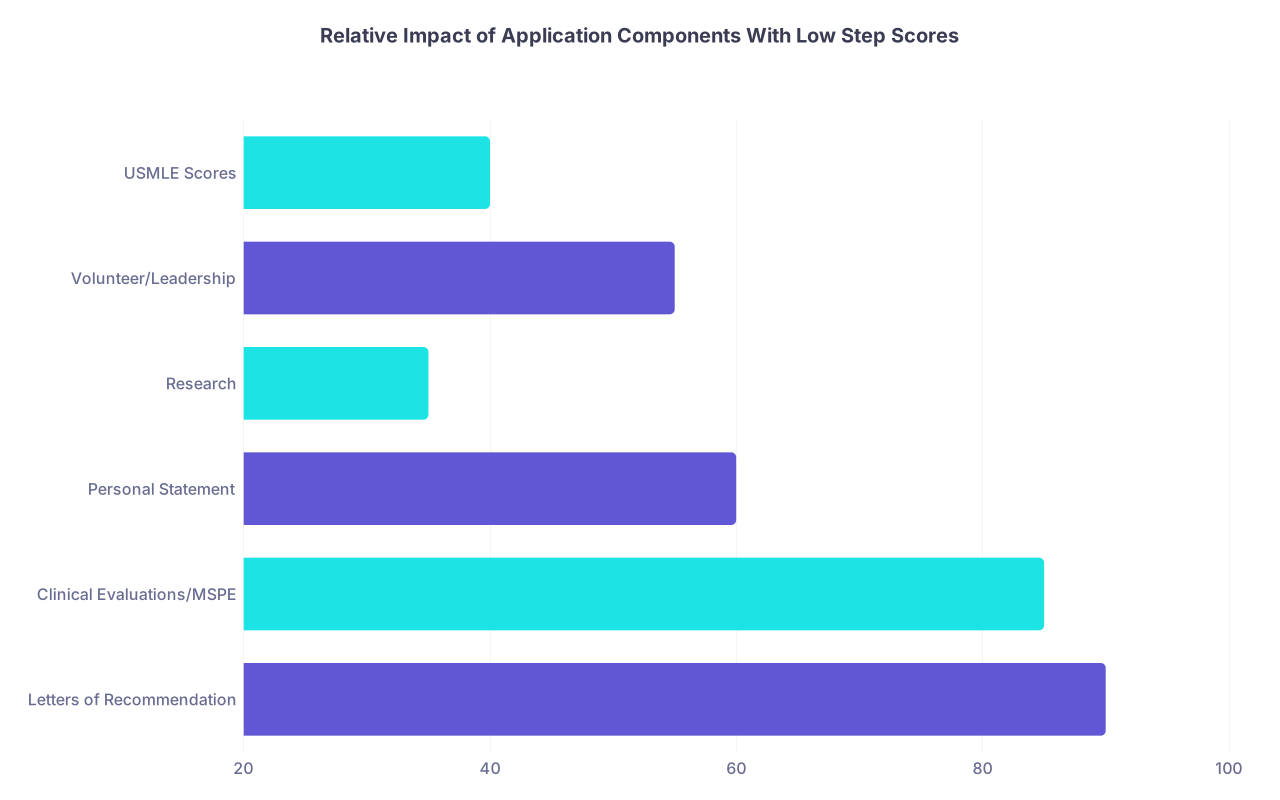
| Category | Value |
|---|---|
| Letters of Recommendation | 90 |
| Clinical Evaluations/MSPE | 85 |
| Personal Statement | 60 |
| Research | 35 |
| Volunteer/Leadership | 55 |
| USMLE Scores | 40 |
Key Takeaways
- You do not “hide” low scores and thin research. You outcompete them with clinical strength, elite letters, and a sharp, credible narrative.
- Every ERAS section—letters, experiences, personal statement, program list—must be engineered to answer one question: “Can we trust this person to be our resident?”
- If you are willing to be brutally honest about your position and equally disciplined about your strategy, you can still build a compelling ERAS profile that gets you in the door.