
The biggest mistake applicants make is treating the interview day as a one-time performance instead of a series of experiments to refine.
If you are not debriefing—systematically—after every residency interview, you’re wasting data you’ll never get back.
Below is a tight, time-anchored system: what to do in the first 30 minutes, the same day, next morning, and then week-by-week as interview season rolls. At each point I’ll tell you exactly what to write down, what to fix, and what to ignore.
The Moment You Leave the Building (First 30–60 Minutes)
At this point you’re walking to your car, subway, or hotel. Your brain is flooded with details. This is the most valuable, most perishable part of the whole process.
Do not wait until tonight to “journal about it.” You’ll forget specifics. You always do.
0–10 minutes: Voice memo triage
Before you open Instagram. Before you text the group chat. Do this:
- Open your phone’s voice recorder.
- Record a 3–5 minute brain dump answering these prompts:
- What 3 words describe the program culture?
- What did I like most? Least?
- One moment I felt very comfortable?
- One moment I felt thrown off or awkward?
- Any red flags? (Be blunt. “Seemed malignant,” “Residents looked exhausted,” etc.)
- What questions did they ask that I wasn’t ready for?
This doesn’t need to be polished. Just talk like you’re venting to a friend.
10–30 minutes: Quick written score + facts
Now, while you’re still near the hospital or on the train:
- Open a running Interview Tracker (Google Sheet, Notion, whatever).
- Log right away:
- Program name
- Date and format (virtual/in-person, half day/full day)
- Main interviewers (names/roles if you remember)
- Any strong “fit” signals (research, geography, specific track)
- Any clear deal-breakers
Then give it gut-level scores (1–10) on:
- Program fit
- Resident happiness
- Faculty vibe
- Location/lifestyle
- Training/education
You’ll refine impressions later, but this snapshot matters.
Here’s a simple structure that works:
| Field | Example Entry |
|---|---|
| Program | University Hospital – Internal Med |
| Date | 11/14/2025 |
| Format | Virtual AM session |
| Overall Gut Score | 7/10 |
| Culture Keywords | Academic, intense, research-heavy |
| Top Pro | Strong cardiology fellowship pipeline |
| Top Con | Residents looked exhausted on Zoom |
At this point you should have:
- A voice memo with raw impressions.
- A basic entry in your tracker with scores and key facts.
Only now can you text your friends or call your partner.
Same Day Evening: Structured Debrief (30–45 Minutes)
Once you’re back at your hotel or home and have had food and water, you do the real work. Not before. Interview-day exhaustion makes people overly negative and reactive in the first hour.
Step 1: Transcribe and sort your raw thoughts (10–15 minutes)
Play your voice memo and convert it into quick bullet points in your debrief document for that program.
Create a template you’ll reuse for every program. Something like:
- Overall vibe (3–5 sentences)
- Evidence for that vibe (specific moments)
- Strengths of my performance
- Weak spots / things that felt off
- Questions I want to refine for next time
- Follow-up items (thank-yous, specific people to email, info to research)
Fill it in fast. Do not edit the language. You want honesty here, not diplomacy.
Step 2: Grade your performance (not just the program) (10–15 minutes)
At this point you should zoom in on how you did, not how they did.
Rate yourself on:
- Storytelling / coherence of your answers
- Energy and warmth
- Specificity (did you answer with real examples vs clichés?)
- Question asking (were your questions generic or tailored?)
- Technical content (clinical/academic depth when needed)
Then answer, in writing:
Best 2–3 moments of the day
Examples:- “Explained my QI project to PD – saw her nod and write notes.”
- “Resident social: they laughed at my story about my first code.”
Worst 2–3 moments of the day
Examples:- “Fumbled when asked about a time I failed – rambled.”
- “Asked an attending a question I’d already been told in the intro session.”
One thing I’ll intentionally change for the next interview
Make this ultra-specific:- “Prepare a tighter 60-second snapshot for ‘Tell me about yourself.’”
- “Practice 3 examples of handling conflict instead of winging it.”
Write exactly one “change item.” Not six. You’ll actually do one.
Step 3: Program-specific follow-up list (5–10 minutes)
Before you move on, lock in the logistics:
- Who deserves a thank-you email? (names, roles, email if you have it)
- Any research you want to read before ranking?
- Any questions you didn’t get to ask and should email about later?
Make a micro-checklist like:
- Thank-you to PD
- Thank-you to chief resident from breakout 2
- Read Dr. X’s paper on sepsis bundle
- Look up call schedule specifics on website
At this point you should have:
- A complete written debrief for that program.
- One clear behavior to change for your next interview.
- A small, actionable follow-up list.
Next Morning: Calm Reassessment (15–20 Minutes)
You’ve slept. Your adrenaline is lower. Some programs that felt amazing at 3 p.m. look different at 9 a.m. the next day.
Step 1: Re-score the program
Open your tracker and ask yourself:
- Would I change any of last night’s 1–10 scores?
- Did I overreact to one comment or one awkward resident?
It’s common to bump a score up or down by 1–2 points with a clearer head. Do it now, not three months from now when details blur.
Step 2: Extract reusable insights
Look back at your “worst moments” from yesterday and translate them into reusable prep tasks, not vague regrets.
For example:
Bad moment: “Didn’t have a strong answer to ‘Why this city?’”
- Prep task: Write 3 specific reasons for each city I’m interviewing in and practice saying them out loud.
Bad moment: “Got stuck on the ‘biggest weakness’ question.”
- Prep task: Choose ONE consistent weakness story and script the outline.
Add those tasks to a running improvement list you’ll tackle between interviews.
At this point you should:
- Have refined, calmer ratings for the program.
- Have extracted 1–2 concrete prep items to do before your next interview.
Between Interviews: Weekly Pattern Review
If you’re in peak season, you might have 2–4 interviews per week. That’s a lot of data. Once a week, usually on a low-interview day, you step back and do pattern recognition.
Weekly (or every 3–4 interviews): Spot recurring problems
Look across your last several debriefs and ask:
- What questions keep tripping me up?
- Where do I keep writing “rambling” or “too generic”?
- Are there programs where I felt consistently low energy in the afternoon?
- Am I repeatedly finishing interviews without asking strong questions?
You’re looking for themes, not one-off bad moments.
Then formalize your findings in a small table like this:
| Pattern | Evidence from Debriefs | Fix for Next Week |
|---|---|---|
| Weak “Why this program?” | Wrote this 3 times in 5 interviews | Create program-specific 2–3 sentence pitch |
| Low energy after 2nd hour | Noted “tired, flat” on 4 afternoons | Build 10-min breaks + snacks between sessions |
| Weak follow-up questions | “Asked generic questions” x3 | Pre-write 5 strong questions per program |
Weekly: Upgrade your prep plan
At this point you should convert patterns into a short, focused prep plan for the following week:
- Choose 2–3 “core stories” to polish (leadership, conflict, failure).
- Draft or refine 3–5 strong questions you can rotate, then layer program-specific ones on top.
- Script and practice:
- “Tell me about yourself”
- “Why this specialty?”
- “Why our program?”
This takes far less time than trying to “review everything” before each interview. You’re only fixing what’s actually going wrong.
Building a Reusable Debrief Template (Use After Every Interview)
Let me give you a simple template that saves you from reinventing the wheel. You’ll fill this out every single time.
You can copy/paste this into a doc or note:
Program Snapshot
- Program:
- Date:
- Format:
- Interviewers (names/roles if possible):
- Rank List Initial Gut Placement (Top / Middle / Bottom tier):
1. Culture & Fit (5–10 bullets)
- 3 words that describe the culture:
Evidence/moments that showed this:
-
2. My Performance
What I did well (3 bullets):
- -What went poorly / felt off (3 bullets):
- -One specific behavior I will change for the next interview:
3. Questions Asked (for future prep)
Questions they asked that surprised me:
-Questions I answered well and want to reuse:
4. Questions I Asked (and how they landed)
Strong questions that seemed to engage them:
Weak/redundant questions to retire:
5. Program Pros/Cons
Pros:
- -Cons / red flags:
6. Follow-Up
Thank-you emails to send (who + why):
Info to research before ranking:
At this point you should:
- Paste this template for each program, then quickly fill in.
- Stop trying to keep this all in your head. You won’t.
Virtual vs In-Person: Timing Tweaks
The debrief process is the same, but the timing rhythm changes.
Virtual interview day
You usually have less travel time and more mental fatigue from the screen.
- Immediately after logging off:
- 5-minute voice memo.
- Quick tracker scores.
- Within 2 hours:
- Full written debrief.
- Start but don’t send thank-you drafts (send next morning when your brain is clearer).
In-person interview day
You may have commute time that’s perfect for the first steps.
- On the way back to hotel/train:
- Voice memo brain dump.
- Jot down names of people you spoke with while you still remember.
- That evening back at hotel:
- Full debrief + emails list.
- Next morning after travel:
- Re-score + pattern extraction.
The key: debrief within 24 hours. After that, details decay fast.
Simple Debrief Timeline for an Average Interview Week
Here’s how this fits when you’re in the thick of things.
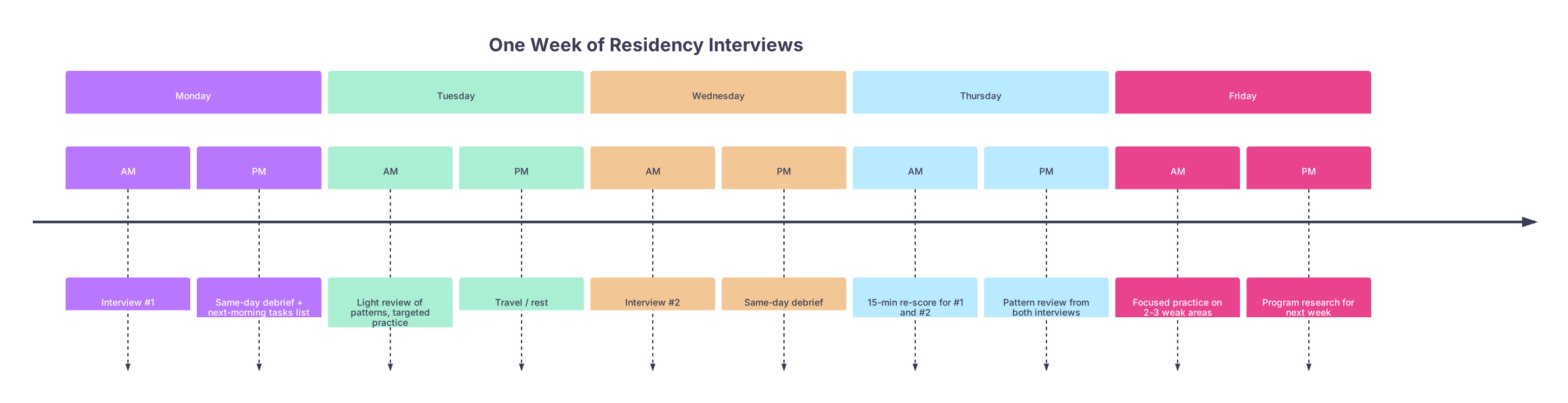
| Period | Event |
|---|---|
| Monday - AM | Interview #1 |
| Monday - PM | Same-day debrief + next-morning tasks list |
| Tuesday - AM | Light review of patterns, targeted practice |
| Tuesday - PM | Travel / rest |
| Wednesday - AM | Interview #2 |
| Wednesday - PM | Same-day debrief |
| Thursday - AM | 15-min re-score for #1 and #2 |
| Thursday - PM | Pattern review from both interviews |
| Friday - AM | Focused practice on 2-3 weak areas |
| Friday - PM | Program research for next week |
At this point in the season, your rule should be:
- No interview goes undocumented.
If you talked to a PD, there should be a debrief file.
Using Debriefs to Shape Your Rank List
Debriefing is not just about getting better at interviews. It’s also how you avoid panicking in February when you’re staring at a list of 15 programs that now blur together.
Month-by-month: How debriefs feed your rank list
Early interview season (Oct–Nov):
- Goal: Capture detailed impressions.
- Action: Be exhaustive. Log everything. You don’t yet know what will matter.
Mid-season (Dec–Jan):
- Goal: Compare programs against each other.
- Action: Start labeling programs as “Top / Middle / Bottom” tier right in your tracker based on your debriefs.
Late season (Jan–Feb):
- Goal: Final ranking decisions.
- Action: Re-read debriefs, not just your numeric scores. Look at:
- Culture keywords you wrote in the moment.
- Repeated pros/cons (call schedule, fellowship match, geography).
- That “would I be happy here?” line you jotted down at 11 p.m. after the interview. Those first impressions are usually honest.
Quick Visual: Where Your Improvement Actually Comes From
Most applicants think improvement comes from doing more mock interviews. That helps. But the real acceleration comes from a tight feedback loop.
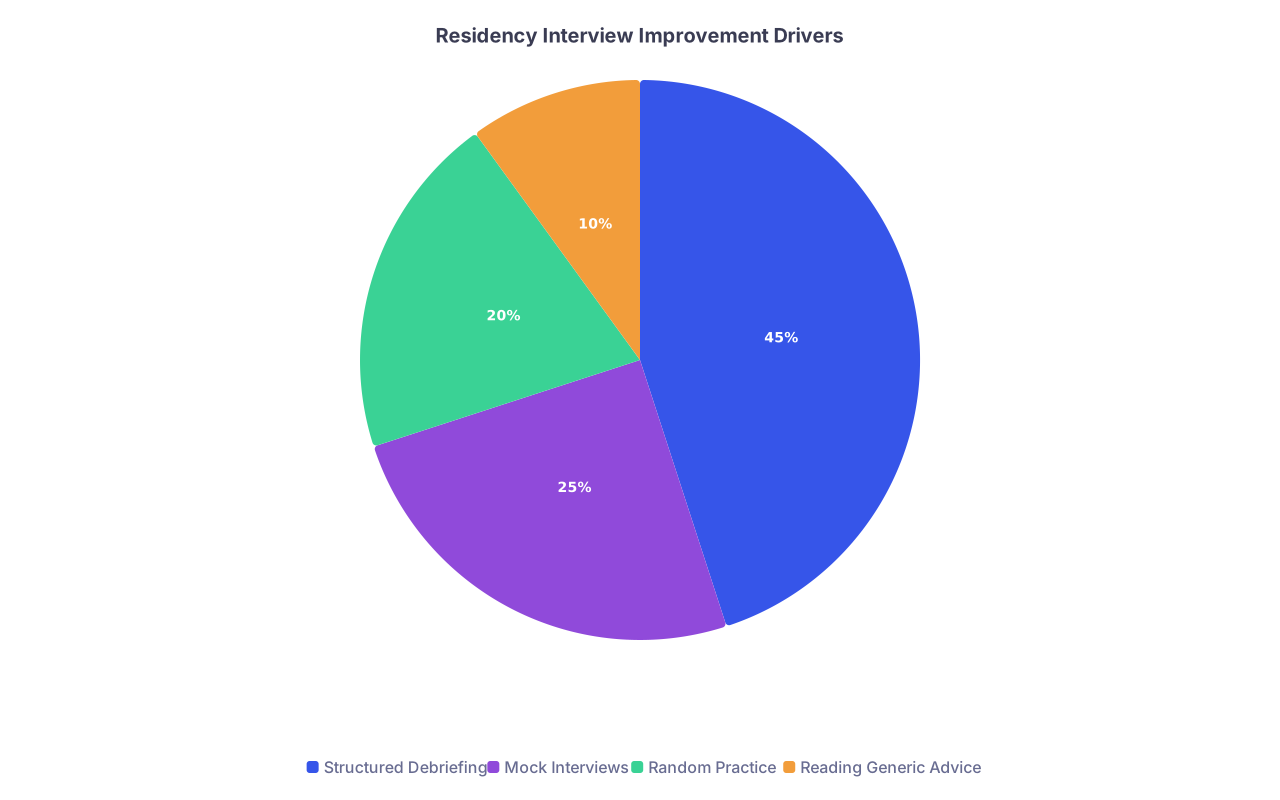
| Category | Value |
|---|---|
| Structured Debriefing | 45 |
| Mock Interviews | 25 |
| Random Practice | 20 |
| Reading Generic Advice | 10 |
Structured debriefing gives you the highest yield per minute because it’s built from your real data, not someone else’s.
Common Debriefing Mistakes (And When You Should Ignore Yourself)
At this point you should also be aware of ways you’ll sabotage your own debriefs.
1. Overweighting one awkward moment
You blew one question and now you’ve decided the entire interview was a disaster.
Fix:
- Force yourself to write three positives for every negative you log.
- Ask: “If my friend described this same day to me, would I call it a disaster or just normal?”
2. Emotion-based scoring on travel/food/etc.
I’ve watched applicants tank a program’s score because:
- Their flight was delayed.
- The lunch was bad.
- It rained all day.
None of that is part of the program. Note your mood, then recalibrate scores next morning.
3. Writing debriefs only for the “big name” programs
People meticulously debrief MGH, UCSF, Mayo. Then they wing their notes for solid mid-tier or community programs they might actually end up at.
Treat every interview as data. You don’t know how the Match will shake out.
Exactly What You Should Do Today
Set up the system before your next interview. Here’s the move:
- Create:
- One Interview Tracker (spreadsheet).
- One Debrief Template document you can duplicate per program.
- Add columns for:
- Date, program, format, gut score, culture keywords, top pro, top con, tier (Top/Mid/Bottom).
- Load the voice recorder app on your phone and put it on your home screen.
- Block 30 minutes on your calendar after your next interview labeled: “DEBRIEF – non-negotiable.”
Open your calendar right now and reserve that 30-minute slot after your next interview. If it’s not scheduled, it will not happen.