
Your clinical vignette answers will make or break how programs rate your judgment. Not your Step score. Not your research. Your judgment.
Let me be blunt: most applicants butcher vignette questions. They ramble, they flex knowledge, and they completely miss what faculty are actually scoring—pattern recognition, prioritization, risk awareness, communication, and knowing your lane as a supervised trainee.
You are not being tested on whether you can “solve” the case better than UpToDate. You are being tested on whether you think like a safe intern.
Let’s break this down precisely.
What Programs Are Really Testing With Vignettes
Programs do not ask clinical scenarios in interviews to see if you can recall the dose of furosemide. They are screening for:
- Will this person be safe with partial information at 3 a.m.?
- Will this person call for help appropriately?
- Does this person understand systems, not just diseases?
- Do they communicate in a way that makes others trust them?
And they evaluate those questions through your behavior with a short, messy clinical story.
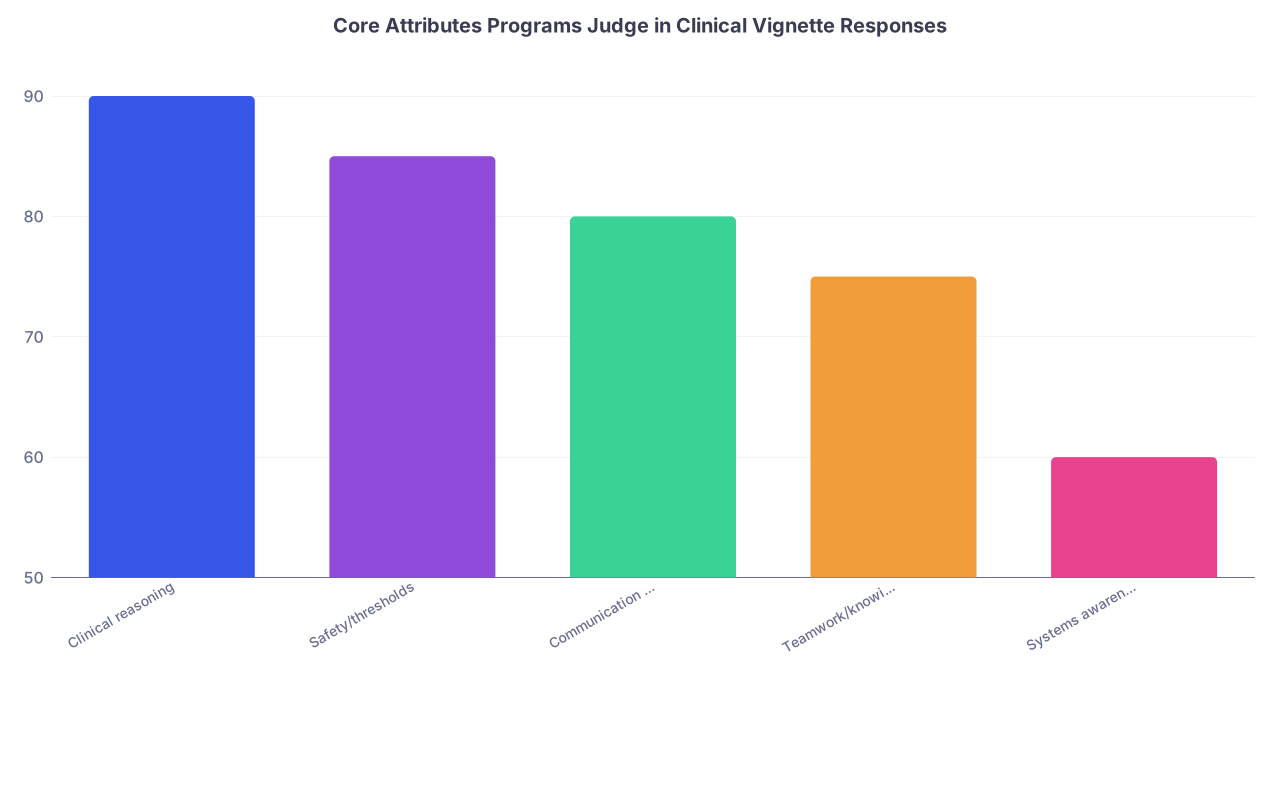
| Category | Value |
|---|---|
| Clinical reasoning | 90 |
| Safety/thresholds | 85 |
| Communication clarity | 80 |
| Teamwork/knowing limits | 75 |
| Systems awareness | 60 |
Here is what seasoned interviewers care about:
- Clinical reasoning: Do you structure the problem? Differential, key data, plan.
- Safety: Do you recognize red flags and escalation points?
- Communication: Can you be concise, organized, and understandable to a colleague?
- Humility and boundaries: Do you know when to say, “I would call my senior/attending”?
- Systems thinking: Do you factor in nursing, social work, handoffs, documentation, follow-up?
If your answers do not show these five, your knowledge level almost does not matter.
The 5-Part Framework For Answering Clinical Vignette Questions
If you do not have a structure, you will ramble. And once you ramble, the faculty silently mark you down for “disorganized” and “unsafe”.
Use this five-part framework every time you get a vignette:
- Clarify and restate
- State immediate concerns and red flags
- Give a prioritized differential or problem list
- State immediate management and escalation
- Address communication, follow-up, and your role
Let me walk you through it in a very concrete way.
1. Clarify and Restate (10–15 seconds)
You get something like:
“You are the intern on night float. A nurse calls about a 67-year-old man with chest pain…”
Most students either freeze or jump straight into “I’d get troponins, ECG, aspirin…”
Wrong starting point.
You start with a brief, controlled restatement and any critical clarifications:
- “So this is a 67-year-old man with new chest pain on the floor. First, I want to know: current vitals, appearance (ill vs comfortable), location and quality of pain, associated symptoms like dyspnea, diaphoresis, nausea, and the context (post-op, known CAD, etc.).”
You are showing that you do not react blindly. You ask for the right data first. That is judgment.
2. State Immediate Concerns and Red Flags
Next: identify what you are most worried about. Not everything. The top threat.
For chest pain:
- “My first concern is an acute coronary syndrome or another life-threatening cause of chest pain such as PE or aortic dissection. I want to very quickly determine whether this is unstable and requires urgent escalation.”
For a confused post-op patient:
- “My immediate concern is whether this is delirium due to something dangerous—like sepsis, hypoxia, stroke, or a medication issue—versus benign sundowning.”
You are telling the interviewer: I know what can kill the patient first.
3. Give a Prioritized Differential or Problem List
Here is where most people overcomplicate things with a textbook differential. Do not. You are not writing an UpToDate article, you are triaging a real person at 2 a.m.
Keep it focused and ranked:
For chest pain on the floor:
- Acute coronary syndrome (especially if risk factors, typical symptoms)
- Pulmonary embolism (if recent immobility, surgery, cancer)
- Aortic dissection (if tearing pain, radiation to back, hypertension, connective tissue disease)
- Non-cardiac causes (GERD, musculoskeletal, anxiety) as lower priority
Then one sentence to justify:
- “Given his age and chest pain, ACS is my top concern; I would keep PE and dissection on my radar depending on vitals and exam, but non-cardiac causes are lower priority until emergent etiologies are ruled out.”
That is enough. You have just shown you can prioritize and think like a clinician, not a search engine.
4. State Immediate Management and Escalation
This is where faculty are very unforgiving. If the case is unstable and you keep calmly ordering labs, you are done.
You must explicitly mention:
- What you will do right now in the next 1–5 minutes
- When and whom you will call
- What level of care you think they might need
For the chest pain case:
- “If the patient is unstable—hypotensive, tachycardic, hypoxic, or in acute distress—I would ask the nurse to activate the appropriate rapid response/code protocol while I head immediately to the bedside.
- At bedside: quick ABCs, focused exam, get an immediate ECG, and ensure IV access, O2 as needed.
- I would simultaneously notify my senior or the cross-covering resident and present concisely, and if ACS is suspected, begin guideline-directed therapy per our hospital protocol and with attending input.”
Notice the sequence: safety and help first. Then interventions. You are not a cowboy.
If the patient is stable:
- You can afford a little more systematic workup
- But you still mention time-sensitive tests (ECG, troponin, vitals) and senior notification
5. Address Communication, Follow-Up, and Your Role
Strong answers do not end with “I would give aspirin”. They end with:
- How you would communicate with the team
- What you would document
- How you would ensure follow-up and handoff
Example:
- “After stabilizing and initiating workup, I would update my senior and attending with a concise summary, document the key findings and management, and ensure the patient and family understand the plan. If this occurs near sign-out, I would clearly hand off the active issues and pending results to the oncoming team, including what to watch for and what would trigger escalation.”
That is how you sound like a safe PGY-1, not a student guessing at buzzwords.
Common Types of Clinical Vignette Questions And How To Handle Them
Programs reuse the same basic archetypes. You can absolutely prepare for these.

1. The “Night Float Call” Scenario
Example:
“You are the night intern. A nurse calls about a 75-year-old woman with dementia who is more agitated and trying to climb out of bed. What do you do?”
What they are testing:
- Delirium vs dementia understanding
- Non-pharmacologic vs pharmacologic management
- Safety, falls, and sitter/restraints reasoning
- How you work with nursing
Good structure:
- Clarify: “I would ask the nurse about vitals, orientation compared to baseline, any recent medication changes, pain, urinary symptoms, hypoxia, and whether this is a change from earlier today.”
- Red flags: “I am concerned for acute delirium potentially due to infection, metabolic issues, hypoxia, or medication effects.”
- Problem list: delirium vs behavioral symptoms of dementia vs pain/anxiety.
- Immediate management:
- Go to bedside. Check vitals, exam.
- Non-pharmacologic first: lights, reorientation, family, glasses/hearing aids, mobilize, toileting, minimize tethers.
- Only then consider low-dose antipsychotic if they are at risk of harm and not redirectable—and mention you would do this with your senior’s guidance and consider EKG/QTc.
- Systems: Workup cause (labs, UA, CXR if indicated), avoid benzodiazepines in most older adults, discuss sitter vs restraints based on hospital policy and fall risk, and partner with nursing rather than ordering from a distance.
If you jump straight to “I’d give haloperidol”, you just told the committee you are a liability.
2. The “Ethically Messy” Scenario
Example:
“You are the intern on medicine. A patient with metastatic cancer who is DNR tells you they do not want any more chemo but their family insists you should ‘do everything.’ What do you do?”
What they are testing:
- Respect for patient autonomy
- Comfort with goals-of-care conversations at your level
- Knowing when to involve senior/attending and palliative
Strong answer pattern:
- Clarify: Does the patient have capacity? What have they already been told? What is the code status and documented advance directives?
- Identify the key ethical principle: “My primary responsibility is to respect the patient’s autonomy if they have decision-making capacity.”
- Immediate action:
- Speak with the patient in private, explore their understanding, values, and what “no more chemo” means to them.
- Clarify goals: focus on comfort vs prolonging life vs specific trade-offs.
- Team engagement:
- “I would discuss this with my senior and attending promptly. This is not a decision I would handle alone as an intern.”
- Suggest involving palliative care and possibly an interdisciplinary family meeting to align understanding.
- Communication:
- With family: “I would communicate empathetically, explain the patient’s wishes, and frame the plan as honoring those wishes while providing the best care aligned with their goals.”
If you take sides immediately (“I would tell the family they are wrong”) or avoid the conflict (“I’d just let the oncologist handle it”), that shows poor judgment.
3. The “Systems and Safety” Scenario
Example:
“You notice one of your co-interns is documenting physical exams that you suspect they did not actually perform. What do you do?”
They are not asking whether you “like conflict”. They want to know if you protect patients and the institution.
Good response bones:
- Frame the concern: “Falsifying documentation could jeopardize patient safety and is a serious professionalism issue.”
- First step: “I would speak to my co-intern privately, in a non-accusatory way, to clarify what is happening. There may be miscommunication or a documentation shortcut that needs correction.”
- If confirmed:
- “If I become convinced that exams are being documented without being performed, I have a duty to escalate. I would discuss the situation with a trusted senior resident or chief resident for guidance on next steps, and if necessary, program leadership—while maintaining discretion and focusing on patient safety, not punishment.”
- Emphasize: You are not ignoring it, and you are not blasting them in front of the team.
That balance is judgment.
4. The “I Have No Idea” Scenario
You will get at least one question where the clinical content is unfamiliar.
If you try to fake expertise, faculty will know in 10 seconds.
Better approach:
- Explicitly acknowledge limits: “This is not something I have managed directly, but I can walk you through how I would think about it and what I would do as an intern.”
- Then use the same structure: immediate safety, what you would check, when you would call for help, how you would look up guidelines or involve consultants.
Programs love this answer when it is done honestly and thoughtfully. It shows humility and process, not just content.
How To Practice Clinical Vignettes The Right Way
Most students “prepare” by skimming random question banks or reading ethics PDFs. That is not interview preparation. That is passive guilt relief.
You need live reps with structure and feedback.
Step 1: Build a Small Core of Go-To Structures
Have 4–5 mental “templates” ready for common situations:
- Chest pain / SOB / hemodynamic instability: ABCs, bedside, rapid response thresholds
- Acute mental status change: vitals, bedside, delirium workup, non-pharmacologic first
- End-of-life / goals-of-care: capacity, autonomy, clarify values, involve team, palliative
- Systems/professionalism: private clarification, patient safety lens, escalation chain
- Resource or social issues: social work, case management, medication access, follow-up
Write these out once. Not paragraphs. Just skeletons.
Step 2: Use Timed, Out-Loud Practice
You will not sound organized the first 5 times you speak through this.
You need to practice like this:
- Have a friend, resident, or mentor read you a vignette.
- You get 10–20 seconds to think.
- Then you answer out loud for 2–3 minutes, using the 5-part framework.
- Record yourself on your phone.
What you are listening for:
- Rambling “word salad” vs clear, stepwise structure
- Throwing random tests and meds vs prioritizing safety and escalation
- Saying “I guess” too much vs owning a plan with appropriate “I would discuss with my senior”
Do this 10–15 times and your brain will start defaulting to structure under stress. That is what you want on interview day.
Step 3: Get Targeted Feedback From Residents
Faculty will give you vague “That was fine.” Residents are more blunt.
Ask them:
- “What would make that answer sound more like a PGY-2 versus a medical student?”
- “Did I miss any obvious unsafe things?”
- “Where did I sound like I did not know my role / limits?”
Write down 3–4 specific corrections and integrate them into the next round.
| Aspect | Strong Response | Weak Response |
|---|---|---|
| Structure | Clear, stepwise, 2–3 minutes | Disorganized, jumps around |
| Safety/Escalation | Names thresholds, calls senior/rapid | Orders tests, delays help |
| Role Awareness | Knows when to involve senior/attending | Acts like independent attending or freezes |
| Systems Thinking | Mentions nursing, documentation, handoff | Focuses only on orders and medications |
| Humility | Admits limits, uses guidelines/team | Overconfident or vague |
Step 4: Practice Under “Cognitive Load”
In real life you will not get vignettes in a quiet library.
Simulate:
- After a long day on the wards
- With a timer visible
- Back-to-back questions, like MMI stations
Your mental bandwidth shrinks under interview stress. Structure keeps you from falling apart when that happens.
How To Use Your Own Clinical Vignettes To Show Judgment
So far I have focused on hypothetical scenarios. But you should also be ready with 2–3 real clinical stories from your clerkships and sub-I’s that highlight your judgment.
Programs want concrete examples of:
- Times you recognized something was wrong
- Times you called for help appropriately
- Times you handled a difficult communication scenario
- Times you learned from a near-miss or mistake
Use this formula to build those:
- Brief context (1–2 sentences): setting, your role, who the patient was.
- The problem: what did not feel right / what was the conflict?
- Your actions: how you assessed, prioritized, escalated, or communicated.
- The result: what happened, good or bad.
- The reflection: what you learned and how you changed afterward.
Example skeleton (judgment in escalation):
- “On my medicine sub-I, I was covering a panel including a 58-year-old man with pancreatitis. Toward the evening, the nurse reported a new tachycardia and increasing oxygen requirement.
I reviewed recent vitals, quickly re-examined him, and saw he looked more dyspneic and confused than before. I was concerned for possible sepsis or respiratory decompensation.
I immediately notified my senior, we repeated labs and imaging, and escalated his level of care. He ultimately required ICU transfer for worsening ARDS.
That case reinforced my threshold for pulling in my senior early when a patient’s trajectory changes suddenly, even if the numbers are not yet ‘code-level’ scary. As an intern, I plan to err on the side of early escalation and clear documentation of those inflection points.”
You just showed exactly the kind of judgment they want: pattern recognition, situational awareness, humility.
Red Flags That Kill You In Clinical Vignette Answers
I have heard versions of these in real interviews. They are instant credibility killers.
Cowboy independence:
- “I would probably just handle it myself and tell my senior later.”
That screams poor judgment.
- “I would probably just handle it myself and tell my senior later.”
Overconfidence beyond training level:
- Talking about doing complex procedures alone as a brand-new intern.
- Presenting final-sounding treatment decisions without any mention of team input.
Ignoring nursing or other staff:
- Acting like the nurse is an obstacle, not a partner.
- Not acknowledging their observations or concerns.
No safety net / no contingency plans:
- Only describing Plan A, with no “If they worsen, I would…”
- Failing to mention monitoring or follow-up.
Ethical tone-deafness:
- Dismissing patient autonomy.
- Prioritizing “making the family happy” over patient’s expressed wishes without capacity discussion.
Spot these tendencies in your practice answers and crush them early.
A Simple Mental Checklist For Interview Day
You do not need 20 frameworks in your head while you sit in front of a PD. You need one tight mental checklist.
Use this 6-word anchor:
Clarify → Concern → Causes → Care → Call → Communicate
When you get a vignette, mentally walk down that line:
- Clarify – What data do I still need?
- Concern – What am I most worried about?
- Causes – Top few diagnoses or problems?
- Care – What do I do right now? (bedside vs phone, ABCs, tests, treatments)
- Call – Who do I involve and when? (senior, attending, rapid, consultants)
- Communicate – How do I document, hand off, and talk to patient/family/team?
You will not say those words out loud, but your answer will naturally reflect them. And that is exactly what programs interpret as “good clinical judgment”.

| Step | Description |
|---|---|
| Step 1 | Hear vignette |
| Step 2 | Clarify key info |
| Step 3 | State main concern |
| Step 4 | Prioritized differential / problems |
| Step 5 | Immediate actions & escalation |
| Step 6 | Communication & follow-up |
FAQs
1. How long should my clinical vignette answers be in an interview?
Aim for 2–3 minutes. Under 90 seconds usually means you are oversimplifying and skipping safety, escalation, or systems details. Over 4 minutes and you are probably rambling, listing every test you can think of, or repeating yourself. Practice with a timer and train your internal clock.
2. What if I completely disagree with how my attending handled a case I am describing?
You do not need to throw anyone under the bus. You can say something like: “At the time, the plan was to do X. In retrospect, and with more reading and experience, I might have considered Y as well. As a trainee, I would bring that up respectfully with my senior to understand their reasoning.” That shows growth, respect, and judgment instead of arrogance or blind obedience.
3. Should I quote exact guidelines or evidence in my answers?
Only if it comes naturally and does not derail you. Saying “I would follow sepsis bundle principles” is fine. Reciting numerically precise guideline thresholds like a multiple-choice exam usually backfires and makes you sound robotic. Programs care far more that you recognize sick vs not sick, time-sensitive conditions, and when to escalate than whether you recall the exact MAP target from a trial.
4. How honest should I be about not knowing something in a vignette?
Very honest. The right move if you are unsure is: “I have not directly managed this scenario yet, but here is how I would approach it as an intern…” Then walk through safety, what you would check, and when you would call for help or look things up. That answer scores better than pretending to know and suggesting something unsafe. Programs are hiring someone they can trust at 3 a.m., not someone who will bluff under pressure.
Key points:
- Clinical vignette questions are judgment tests, not trivia quizzes—programs want to see safety, prioritization, escalation, and role awareness.
- Use a simple structure every time: clarify, state main concern, give a focused differential, outline immediate management and escalation, then cover communication and follow-up.
- Practice out loud, under time pressure, and with resident feedback until your responses reliably sound like a thoughtful, supervised intern—not a panicked student guessing at the “right” answer.