
Crafting High-Yield Residency Interview Stories Using the STAR Method
You are sitting across from a PD and an associate program director. Third interview of the week. You have slept badly in three different hotel beds. Then the APD smiles and says the question you knew was coming but still dread:
“Tell me about a time you made a mistake with a patient.”
Your mind flashes through 20 half-formed memories. The room is quiet. Your heart rate ticks up. You start talking… and three minutes later you are still in the background of the story, lost in context, and you watch their eyes glaze over.
This is exactly where the STAR method either saves you or exposes you.
Let me be blunt: most residency interview stories are terrible. Too long. Vague. No clear point. No evidence you learned anything. Programs remember the rare applicant who can deliver tight, specific, high-yield stories. That is what we are going to build.
1. What “High-Yield” Actually Means for Residency Stories
Before you worry about STAR, you need to understand what you are optimizing for. A good story in normal life is not automatically a good story in a residency interview.
A high-yield residency story does three things:
- Proves you have the core behaviors programs care about.
- Shows you have clinical maturity and insight, not just emotion.
- Makes your interviewer’s job easy when they sit down to rank you.
Think like an interviewer filling out their evaluation form. They are not writing: “Told a nice story about a time they were sad.” They have checkboxes: professionalism, communication, teamwork, resilience, ethical judgment, response to feedback, self-awareness.
Your stories are evidence. Mini-OSCEs. They are scoring you silently on:
- Can you recognize your role in problems without blaming everyone else?
- Do you actually change your behavior after feedback or mistakes?
- Can you handle conflict or stress without imploding?
- Do you have a “resident brain” starting to form, or are you still a passive student?
If a story does not clearly demonstrate a desirable behavior and a learning outcome, it is low-yield. Even if it makes everyone feel warm and fuzzy.
You need a portfolio of stories that map to the common competency domains:
| Competency | Example Story Themes |
|---|---|
| Teamwork/Leadership | Difficult nurse interaction, code team |
| Communication | Angry family, breaking bad news assist |
| Professionalism | Owning mistake, staying late, boundaries |
| Ethics/Judgment | Questionable order, unsafe discharge |
| Resilience/Grit | Failing exam, rough rotation, burnout |
| Adaptability | COVID shifts, EMR crash, short staffing |
If your story bank does not hit at least 4–5 of these clearly, you are underprepared.
2. The STAR Method: What It Is, And How People Butcher It
STAR = Situation, Task, Action, Result. You have seen that before.
The problem is that most students interpret it as:
“Talk for three minutes about the background, one sentence about what you did, and then say it turned out fine.”
That is not STAR. That is rambling with a label.
Let’s strip it down to what actually matters.
- Situation – 1–2 sentences. Just enough so we know where we are and why we care.
- Task – What you were supposed to do or what problem you were facing. 1 sentence.
- Action – What you actually did. This is the meat. 60–70% of your airtime.
- Result – What happened and what you learned/changed. At least 2 layers: outcome + reflection.
Think of it as proportions, not four equal chunks.
For residency interviews, you should almost always tack on an explicit Reflection line at the end. Interviewers are trained to look for growth. If you do not spell it out, they will assume you did not think about it.
I tweak STAR into:
STARR = Situation – Task – Action – Result – Reflection
Example skeleton in your head:
- “On my medicine sub-I at X Hospital… (Situation)”
- “My role was… / The challenge was… (Task)”
- “I decided to… so I… (Action)”
- “Because of that… (Result)”
- “Since then, I… (Reflection)”
You can do that in 90 seconds if you are disciplined. Two minutes if it is a complex ethical scenario. Beyond 3 minutes and you are losing them.
3. The 8–Story Core: What You Need Ready Before Interview Season
Do not walk into interview season with “I’ll just wing it.” You will default to your most emotionally charged but structurally messy stories and regret it halfway through December.
You should have at least 8 pre-engineered STAR stories ready:
- A team conflict or difficult colleague story
- A mistake / failure story
- A difficult patient or family story
- A leadership or initiative story
- A feedback and improvement story
- A resilience / setback story (non-clinical is fine: exam, personal)
- An ethical or professionalism challenge story
- A proudest accomplishment story (ideally clinically adjacent)
You will reuse and re-angle these for dozens of questions:
- “Tell me about a time you had a conflict with a team member.” → #1
- “Tell me about a time you failed.” → #2 or #6
- “Tell me about a difficult patient.” → #3
- “Describe a time you showed leadership.” → #4
- “A time you received critical feedback.” → #5
- “Biggest challenge in medical school.” → #6
- “An ethical dilemma you faced.” → #7
- “What are you most proud of?” → #8
One story can cover multiple competencies if framed correctly. But you need them defined and sharpened before the interview trail, not on the flight between cities.
4. Turning a Messy Memory into a STAR Story (Step-by-Step)
Let’s take a very typical raw memory and walk it into STAR format.
Raw memory (how students usually start)
“I was on my medicine rotation and we had this older patient with sepsis who kept getting worse and the family was angry and the resident was busy and I felt really bad and I tried to help.”
That is useless as-is. It is feelings plus vague context.
Now, let’s structure it ruthlessly.
Step 1: Lock down the Situation in one line
Where, who, and why we should care.
“During my internal medicine sub-internship at a large county hospital, I cared for a patient with septic shock whose daughter was extremely frustrated with our team.”
Done. We know setting, patient acuity, and the emotional tension.
Step 2: Define the Task clearly
What problem did you face, in your role?
“As the sub-intern, I was the team member she saw most often, and it became clear that she felt ignored and did not understand our plan of care.”
Or:
“My task was to help rebuild trust and clarify our plan while respecting my role as a student.”
Now we have a problem statement.
Step 3: Detail the Action – specific, behavior-focused, not generic
Bad: “I communicated better and helped the family.”
Better:
“I first asked my resident for permission to spend extra time with the daughter and to clarify what I could and could not promise. Then I sat down with her at the bedside and started by asking what she understood so far. She believed we had “given up” because we had not escalated to the ICU that day. I explained, in plain language, how we were monitoring her mother hour to hour, what the ICU triage criteria were at our hospital, and why the attending felt she was still appropriate for the step-down unit.
I noticed she got more upset whenever I used medical jargon, so I consciously switched to shorter sentences and metaphors we had learned in our communication workshop. When she expressed anger that the attending was not there, I validated her frustration and offered to ask the resident to join us later that afternoon. I then debriefed with my team, shared her concerns, and we made a plan for the resident and attending to round with her present the next morning.”
This is “Action.” Clear, observable behaviors, not inner thoughts.
Step 4: State the Result with outcomes and nuance
You do not need some Hollywood happy ending. You need evidence of impact and a realistic arc.
“By the end of our conversation, she was still anxious but no longer yelling at staff. The next morning, she joined rounds and asked focused questions instead of expressing global distrust. My resident later told me that my detailed note about her concerns helped them structure that conversation more effectively.”
You showed effect on behavior, team dynamics, and care.
Step 5: Add Reflection that matures you
Here is where many applicants give a lazy line: “I learned the importance of communication.” Which is nothing.
Better:
“That experience made me much more deliberate about checking understanding rather than just delivering information. Since then, on other rotations, I have tried to proactively identify families who seem disengaged or confused and flag them for longer bedside discussions with the team. It also taught me to clarify my scope as a student upfront, so I do not accidentally overstep when families are desperate for assurances.”
Now the interviewer sees a trajectory, not a one-off event.
5. Time, Depth, and When to Shut Up
Programs are listening for judgment in how you allocate time within your story.
- Background (S+T) – 15–25%
- Action – 60–70%
- Result + Reflection – 15–25%
If your background takes more than ~30 seconds, you are probably indulging yourself.
Use mental flags:
- If you find yourself listing every lab value, you have lost the plot.
- If you are naming every person on the team (“the PGY-2, the fellow, the pharmacist, the case manager…”), you are wasting airtime.
- If you narrate long stretches of time (“then over the next two weeks…”), your story is too broad.
Zoom in on one turning point. One decision. One conversation. High-yield stories live in tight time windows.
A practical guideline I use when I mock-interview people:
- Simple behavioral question → ~90 seconds
- Complex ethical / mistake story → 2 minutes
- Absolute maximum → 3 minutes, and it had better be worth it
If you routinely run long, script and practice with a literal timer. Out loud. Not in your head during a podcast.
6. Clinical Judgment vs. Emotional Diary
Another common failure: confusing emotional vulnerability with insight.
Programs do not want you to be a robot. But they also do not want an open therapy session on Zoom.
The key distinction:
Good stories link emotions to professional growth and judgment.
Bad stories wallow in feelings without converting them into decisions or changes.
Example – weak reflection:
“I was devastated when the patient died. It made me realize how fragile life is and that I really care about my patients.”
Example – stronger reflection using STAR:
“I was devastated when he died. My attending pointed out that my documentation and communication with the night float had been solid, and that sometimes the disease wins despite appropriate care. That shifted my focus from ‘I must prevent all bad outcomes’ to ‘I must be thorough, honest, and present, even when outcomes are poor.’ Since then, when I feel guilt creeping in, I consciously review what I actually did and seek feedback rather than just spiraling.”
See the difference? You are showing how your internal experience now affects how you practice. That is what residency programs expect by PGY-1: feelings that are integrated, not raw.
7. Common Question Types and How to Re-Skin STAR Stories
You do not need 50 different stories. You need 8–10 versatile ones and the ability to rotate the angle.
Let’s map some:
“Tell me about a time you had a conflict with a colleague.”
Use your team conflict story. Emphasize: listening, de-escalation, finding common ground, not winning.“Tell me about a time you received critical feedback.”
Use either a rotation evaluation or a specific attending encounter. Emphasize: initial reaction, concrete change, long-term impact.“Tell me about a time you made a mistake.”
Must be specific and owned. Emphasize: your role, disclosure, fix, and systems-thinking reflection (how you prevent it now).“Describe a time you went above and beyond for a patient.”
Use difficult patient/family story or something from night float / cross-cover experience as a student.“Tell me about a time you had to learn something quickly.”
Adapt a story involving a new EMR, COVID policy changes, or being thrown into a new role.
Every time you re-use a story, adjust:
- The Task line to match the skill they are really asking about.
- Which Actions you highlight.
- The Reflection, so you do not sound like you are pressing play on the same moral.
This is where practice matters. You are not memorizing monologues; you are knowing your cases well enough to pull different “teaching points” on demand.
8. Bad STAR Habits That Will Cost You
I have to call out a few patterns I see constantly that interviewers quietly hate.
1. The “I” that vanishes into “we”
Programs are hiring you, not your entire M3 medicine team.
Bad: “We decided… we talked… we realized…”
Better: “Our team decided X, and my specific role was Y. So I did Z.”
You can acknowledge the team without erasing your own contribution.
2. The hero complex
If your story paints everyone else as unreasonable and you as the lone enlightened savior, you look difficult.
If the nurse, the resident, the attending, and the patient are all wrong in your story, I assume the problem is you.
Balance. Describe genuine challenges without trashing colleagues. If someone truly acted badly, focus more on your response and less on character assassination.
3. The fake failure
Programs can smell it instantly.
- “I care too much.”
- “I work too hard.”
- “Sometimes I am too thorough.”
These are not failures. They are transparent attempts to humble-brag.
Pick a real, bounded failure. Late note. Missed lab result. Mishandled conversation. Poor time management on a rotation. Then show how you fixed it. This builds trust.
4. The non-ending
Some applicants trail off with, “So yeah, that was that situation.” No explicit result, no reflection. Interviewer is left doing interpretive work.
Always land the plane yourself: outcome + what changed in your behavior.
9. Building Your Story Bank: A Practical Workflow
Here is how I tell people to actually prepare, not just mentally “plan.”
Step 1: Brain-dump raw experiences
Take 30–45 minutes and list:
- Rotations where you had real responsibility (sub-Is, acting internships, away rotations).
- Times you felt: proud, ashamed, scared, angry, exhausted, deeply satisfied.
- Feedback moments – especially the ones that stung initially.
You will over-generate, that is fine.
Step 2: Map each to a competency
Next to each memory, mark what it could show:
- T (teamwork), L (leadership), P (professionalism), C (communication), R (resilience), E (ethics/judgment).
Pick the 8–10 that give you the broadest coverage and the clearest narrative arc.
Step 3: Write bullet-point STAR skeletons
Not essays. Bullets.
For each story, jot:
- S: 1 line – setting + patient/issue.
- T: 1 line – your problem/role.
- A: 3–5 bullets – concrete steps you took.
- R: 1–2 bullets – outcome.
- R2: 1–2 bullets – reflection/behavior change.
You should be able to glance at the page before an interview day and recall each story quickly.
Step 4: Say them out loud, standing up
This sounds minor. It is not. Your brain processes language differently when speaking than when reading silently.
Practice with:
- A mirror or camera
- A co-student or mentor
- A mock interview session at your school
Record at least a couple. Watch yourself. You will hate it. Then you will fix pacing, filler words, and your tendency to look down or away.
Step 5: Track what you actually use
During interview season, after each day, jot which questions came up and which stories you used. Pattern will emerge. You may find one story is getting overused or falling flat. Tweak it.
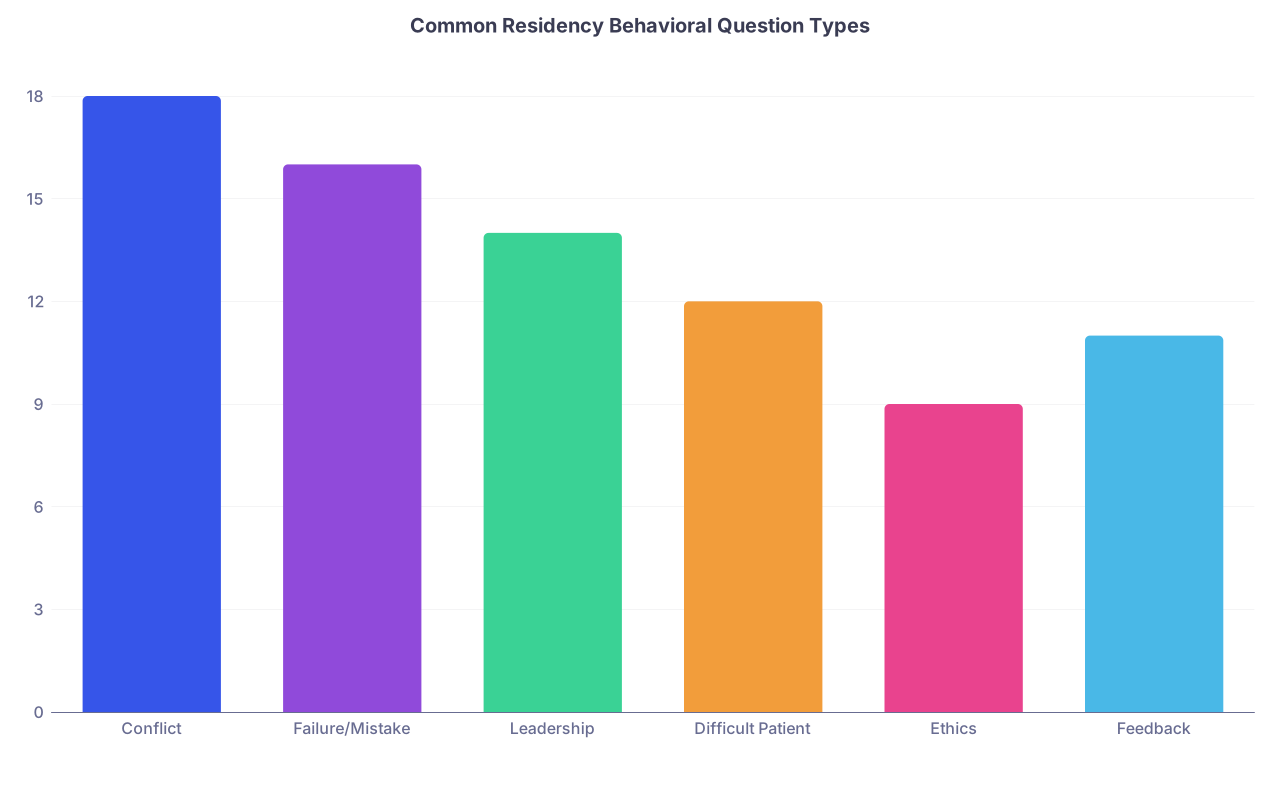
| Category | Value |
|---|---|
| Conflict | 18 |
| Failure/Mistake | 16 |
| Leadership | 14 |
| Difficult Patient | 12 |
| Ethics | 9 |
| Feedback | 11 |
(This kind of distribution is what I actually see when students debrief across 10–15 interviews.)
10. Specialty-Specific Adjustments (Because Not All Programs Think Alike)
You are not telling the same story to a surgery PD and a psychiatry PD in the same way. Or at least you should not.
For Surgical and Procedural Specialties
They care more about:
- Grit and work ethic
- Coachability
- Performance under pressure
- Procedural mindset and comfort with hierarchy
So in your STAR stories:
- Emphasize times you stayed late, took extra cases, helped with scut but also with clinical load.
- Show how you responded to blunt feedback from attendings without sulking.
- Include at least one story involving a rapid response, code, or high-acuity event where you remained functional.
For Psych, FM, Peds
They care more about:
- Longitudinal relationships
- Communication nuance
- Interdisciplinary collaboration
- Boundaries and self-awareness
So in your stories:
- Emphasize complex conversations, motivational interviewing, patient narratives.
- Highlight times you navigated cultural or language barriers.
- Include at least one story about managing your own emotional response to a patient.
For Internal Medicine and Subspecialties
They want:
- Clinical reasoning
- Systems thinking
- Ownership of patients and follow-through
So tilt your STAR content toward:
- How you synthesized data, communicated with consultants, followed up pending studies.
- How you interfaced with case management, pharmacy, or social work in a specific case.
- How an error or near-miss changed how you approach cross-cover or sign-out.
The STAR structure stays the same. The content you choose to emphasize shifts with the culture of the specialty.
11. A Fully Built Example: “Tell Me About a Time You Failed”
Let me give you a complete, interview-ready answer so you can hear how this all fits.
Question: “Tell me about a time you failed and how you responded.”
Answer:
“On my first month of internal medicine, I failed to follow up an important lab result in a timely way.
(S) I was the MS3 assigned to a patient admitted for decompensated cirrhosis. The team was concerned about possible infection, and we had sent blood cultures and a diagnostic paracentesis.
(T) My role was to track results and update the resident so we could adjust antibiotics if needed.
(A) Late that afternoon, I saw a notification that one of the blood cultures had flagged positive, but I was in the middle of preparing a new admission and I told myself I would look at it after I finished the H&P. I got pulled into sign-out, then a cross-cover issue, and by the time I remembered, it was the next morning. When I checked, the Gram stain showed gram-negative rods, and our current regimen did not adequately cover that organism.
I immediately told my resident what had happened and that I had seen the result but failed to act on it. We reviewed the chart together, updated the attending, and broadened antibiotics. The patient fortunately remained hemodynamically stable and did not require ICU transfer.
(R) My resident was direct with me: the system notification had done its job; I had dropped the ball. That conversation stung, but it was fair. That evening, I sat down and thought through why I had missed it. I realized I had no systematic way of tracking pending results; I was relying on memory in a chaotic environment.
(R2) Since then, on every rotation, I have created a simple “pending results” checklist for each patient I follow and I block specific times during the day—usually right after lunch and before sign-out—to review new studies and labs. On my medicine sub-I a year later, my senior actually commented in my evaluation that my follow-up on pending results was one of my strengths. That failure early on has made me much more disciplined about closing the loop on data before I leave the hospital.”
That is under two minutes when spoken at a normal pace. Specific. Clear ownership. Concrete change.
This is what you are aiming for.
12. Final Tuning: Delivery > Perfection
Once your stories are built, the last piece is delivery.
Pay attention to:
- Tone – Calm, matter-of-fact, not defensive. Even when describing conflict.
- Eye contact – With the person asking the question, then include others briefly.
- Filler words – “Like,” “you know,” “sort of” destroy confidence. You reduce them only by hearing yourself.
And one more thing: do not panic if your story does not come out exactly as rehearsed. Interviewers are not grading you on your ability to recite a script. They are judging substance and coherence.
If you get lost mid-story, you can literally reset:
“Let me summarize the key actions I took there, since I got a bit into the weeds.”
That kind of meta-awareness actually makes you look more composed, not less.

| Step | Description |
|---|---|
| Step 1 | Brain-dump Experiences |
| Step 2 | Map to Competencies |
| Step 3 | Select 8-10 Core Stories |
| Step 4 | Outline STAR Bullets |
| Step 5 | Practice Out Loud with Timer |
| Step 6 | Refine Based on Feedback |
| Step 7 | Track Questions During Season |
| Step 8 | Adjust Stories and Emphasis |
Key Takeaways
High-yield residency stories are not about drama; they are about evidence. Use STAR (really STARR) to prove specific competencies with clear actions, outcomes, and growth.
Build a deliberate story bank of 8–10 cases that cover conflict, failure, difficult patients, leadership, feedback, resilience, ethics, and a proud moment. Then practice them out loud until the structure feels natural.
Cut the fluff. Background short, actions concrete, reflections honest. Own your role, avoid fake failures, and tailor emphasis to the culture of your chosen specialty.