
“Tell me about a failure” is not a personality test. It is a clinical reasoning exam disguised as a behavioral question.
Most applicants miss that.
They ramble about a group project in college, toss in a cliché “but I learned a lot,” and think they are done. Meanwhile, the interviewer is silently scoring you on something completely different: your capacity for reflective practice, insight, and systems thinking. In other words—the exact same mindset you are supposed to use for M&M, QI, and patient safety.
Let me break this down specifically.
What Interviewers Are Actually Testing With This Question
They are not trying to embarrass you or force a confession. They are checking whether you can think like a practicing physician about your own mistakes and near-misses.
The “failure” question probes:
- Insight: Do you recognize your own contribution to a bad outcome, or do you reflexively blame others?
- Reflective practice: Can you analyze the event the way you would a case at M&M—factually, non-defensively, with a learning focus?
- Emotional regulation: Can you talk about something uncomfortable without falling apart, joking it away, or going rigidly robotic?
- Growth trajectory: Did you actually change your behavior, or did you just “feel bad” and move on?
- Safety mindset: Do you think in terms of systems, communication, redundancy, and prevention?
Programs know: if you cannot process your own failures, you are a risk. To patients, to team dynamics, and to their email inbox when complaints roll in.
So the goal is not to “minimize” your failure. The goal is to demonstrate that you already function like a resident who uses reflective practice.
The Single Biggest Mistake: Telling the Wrong Kind of “Failure”
Most applicants default to one of three bad categories:
The Non-Failure:
“I got a B+ in organic chemistry after always getting As.”
No one cares. That is not a professional failure. That is a humblebrag. It tells the interviewer nothing about how you practice.The Catastrophic, Unprocessed Failure:
A story involving major patient harm which you clearly have not emotionally or cognitively digested. You describe the event, then say, “It was hard,” and stop. No coherent learning, no structured reflection, lots of unresolved guilt. You just made the room uncomfortable and gave the PD doubts about your resilience.The Blame-Shift Story:
“The nurse forgot to…”
“The attending did not listen when I…”
You think you are describing a system issue. What they hear is: “I center my own righteousness and externalize responsibility.”
If you remember nothing else, remember this:
Pick a real failure, with moderate stakes, that you have clearly thought about using a reflective, structured lens.
Not a disaster. Not a nothing-burger. Something in between.
Reflective Practice: The Language of Grown-Up Clinicians
You already know this style of thinking, even if no one put a name on it. It is the tone of a good M&M presentation:
- Specific
- Non-defensive
- Curious
- System-aware
- Future-focused
The language is different from “I messed up, I felt bad, I tried harder.” It sounds more like:
- “My initial framing of the situation was too narrow…”
- “I missed the discordant data point that should have made me reconsider my plan…”
- “I relied on informal verbal handoff instead of using the structured tools available…”
- “There was an anchoring bias in how I interpreted the information…”
- “I have since built a forcing function into my workflow to prevent this.”
This is reflective practice language. It is what faculty look for in residents during feedback, 360s, and CCC reviews. Programs know they will spend three years trying to get you to think this way. If you already do it—even clumsily—you are ahead.
A Simple Framework: The “Mini-M&M” for Interview Answers
You need structure. Without it, you will ramble, over-share, or under-analyze.
Here is a concrete template that borrows directly from M&M and QI thinking. Use this to answer “Tell me about a failure” in 3–4 minutes, cleanly.
- Context & Stakes (brief)
- What Actually Happened (the failure)
- Contributing Factors (your role + context)
- Reflection Using Clinical Reasoning / Systems Language
- Concrete Changes & Outcomes
Let me show you exactly what this looks like.
1. Context & Stakes (15–25 seconds)
You give just enough context that a non-specialist interviewer can follow. No deep dive.
Bad:
“I was on my surgery rotation. There was this Whipple case…” (then 3 minutes of anatomy and step-by-step OR detail)
Better:
“On my third-year internal medicine clerkship, I was covering four patients independently for the first time. One of them was an older adult with multiple comorbidities admitted with pneumonia.”
One or two sentences. Clear mental image. Move on.
2. What Actually Happened (the failure) (30–45 seconds)
Describe the failure directly. Do not euphemize it into nothing.
Weak:
“Communication could have been better.”
This is mush. It tells me you are either avoiding responsibility or you never really analyzed what went wrong.
Stronger:
“I failed to clarify a concerning overnight lab value, and as a result the patient’s condition worsened before appropriate escalation.”
Notice: specific action, specific consequence. You are not saying you single-handedly killed someone. You are showing that your decision or omission had a real, undesirable outcome.
Example:
“I was responsible for following up an elevated creatinine that came back near the end of the day. I noted it but did not re-examine the patient or escalate my concern. Overnight, the patient became hypotensive and was transferred to the ICU with acute kidney injury. My failure was not appreciating the urgency of that lab change and not closing the loop.”
That is the level of candor you are aiming for.
3. Contributing Factors: Your Role + Context (45–60 seconds)
This is where most students either self-flagellate or blame the system. Both are lazy.
You want a balanced, analytic description: your cognitive errors, plus any system issues that made them more likely.
Use language that maps to clinical reasoning:
- Cognitive biases: anchoring, premature closure, availability bias.
- Situational factors: workload, interruptions, transitions of care.
- Knowledge gaps: misclassification of risk, lack of familiarity with guidelines.
Example:
“Looking back, two things contributed. First, my framing error: I anchored on the fact that the patient had been clinically improving, and I treated the lab change as an isolated data point rather than a potential early warning. Second, this happened at the end of a busy call day. I was behind on notes and allowed my task list to drive me, instead of pausing to ask which items represented time-sensitive risk.”
You have now done more sophisticated self-assessment than many PGY-2s. Interviewers notice that.
4. Reflection Using Reflective Practice Language (60–90 seconds)
This is the heart of the answer. This is where you prove you can think like a reflective practitioner, not just tell a sad story.
You want to answer questions like:
- How did this change the way you conceptualize your role?
- What models or frameworks do you now use to prevent similar errors?
- How did feedback from others shape your learning?
Use “I” statements, but in an analytic, not emotional-dump way:
- “I realized I had been treating lab review as a checklist rather than as clinical information requiring synthesis.”
- “I recognized a pattern in myself: when I am behind, I default to speed over depth.”
- “I sought out feedback from my senior resident on how they prioritize abnormal results at the end of the day.”
Example:
“That event forced me to rethink how I approach data. Before, I saw lab review as a separate task at the end of the day. After debriefing with my senior, I recognized that any unexpected change—especially in renal function—should trigger me to reassess the patient and ask, ‘Does this require action now?’ It also made me aware of a personal tendency: under time pressure, I move faster but think narrower. Simply being aware of that has allowed me to build in small pauses to counteract it.”
That is reflective practice language in action.
5. Concrete Changes & Outcomes (45–60 seconds)
If your story ends with “I learned the importance of communication,” you have wasted the whole thing.
Programs want to see:
- Behavioral change
- Process change
- Evidence that this stuck, not just a one-off insight
Make it operational.
The key phrases here:
- “Since then, I always…”
- “I added a step to my own workflow…”
- “In subsequent rotations, I… and received feedback that…”
Example:
“Since then, I built a very simple rule into my practice: when a lab result is unexpectedly abnormal, I must do three things before I sign out—re-examine the patient, check vital signs, and discuss with a senior or attending. On my sub-internship, this helped me catch an early GI bleed in a patient whose hemoglobin dropped unexpectedly but was still technically in the ‘normal’ range. My senior specifically commented on my thoroughness in flagging that change early. That feedback reinforced that this was not just about avoiding one past mistake, but about improving my pattern of thinking.”
Now your failure is not a red flag. It is evidence of upward trajectory.
How to Choose the Right Failure Story
You need to be strategic. Some stories are better than others purely for how they showcase your thought process.
A useful way to sort options:
| Type of Failure | Good Choice? | Why / Why Not |
|---|---|---|
| Mild academic setback | Usually No | Too low-stakes, little clinical relevance |
| Repeated unprofessionalism | No | Signals risk to program culture |
| Single, bounded clinical lapse | Often Yes | Shows growth in clinical judgment |
| Interpersonal conflict mishandled | Yes, if owned | Reveals insight into teamwork and communication |
| Catastrophic harm with unresolved guilt | No | Too emotionally raw, hard to process in interview |
In plain language:
Prefer a clinical or team-based failure that:
- Involves your judgment, prioritization, or communication.
- Has clear learning points that generalize to residency.
- Did not end in irreversible catastrophe or massive disciplinary action.
Avoid:
- Integrity violations (cheating, lying).
- Unprofessional behavior that required formal remediation, unless thoroughly resolved and strategically framed—and even then, it is high risk.
- Overly graphic, tragic clinical events that turn into a trauma narrative instead of a learning narrative.
If you are unsure, test your story: Can you clearly articulate three concrete changes in your behavior that followed this event? If not, it is not a good failure story. It is just a bad memory.
Weaving Explicit Reflective Practice Language Into Your Answer
You want to sound like you are already using frameworks residents are expected to use. Do not overdo it—this is not a buzzword contest—but a few key phrases show that you are thinking at the right level.
Here is some language you can borrow and adapt.
Cognitive process terms:
- “My initial hypothesis was… and I failed to update it when new data emerged.”
- “I realized I had prematurely closed on a diagnosis/plan.”
- “I was anchored on the prior team’s assessment and did not generate my own differential.”
Systems / process terms:
- “There was no clear trigger in our sign-out system for X, so it was easy to overlook…”
- “We were relying on verbal handoffs without a standardized structure.”
- “There was a gap between policy and what actually happens on the floor.”
Self-reflection terms:
- “I noticed a pattern in my own behavior under stress…”
- “Feedback from my attending highlighted that what I saw as ‘being efficient’ was actually creating blind spots.”
- “This forced me to confront that my threshold for asking for help was too high.”
Behavioral change terms:
- “I now build in a deliberate pause before…”
- “I use a personal checklist for…”
- “I asked my senior/attending to observe me specifically on this point and give targeted feedback.”
You are not reciting a script. You are signaling: “I understand how clinicians think about errors and growth, and I am already doing a version of that.”
Example Answer: Weak vs Strong (Side by Side)
Let me show you how this actually plays out.
Weak, Typical Answer
“On my surgery rotation I had a patient whose labs were getting worse and I did not really pay attention, and she ended up having complications. I felt really bad about it and realized how important it is to always double-check labs and communicate with your team. Since then I have made sure to stay on top of my patients’ data and be better at communication.”
What a PD hears:
- Vague story, unclear what actually happened.
- No ownership of specific actions.
- No insight beyond “do better.”
- No evidence of structured change.
Strong, Reflective Practice Answer
“I will tell you about a failure from my internal medicine clerkship that changed how I approach abnormal results.
I was following an older adult admitted for pneumonia who had been improving clinically. Late one afternoon, his creatinine came back significantly higher than baseline. I noticed the trend but, because he looked well on morning rounds, I mentally filed it as ‘mild AKI to watch’ and moved on to finishing my notes. I did not re-examine him or discuss it with my senior. Overnight he became hypotensive, his urine output dropped, and he was transferred to the ICU with acute kidney injury and sepsis.
My failure was twofold. First, I anchored on his earlier improvement and treated that elevated creatinine as a secondary issue, instead of a potential early warning. Second, under time pressure at the end of the day, I let my task list dictate my actions rather than asking, ‘What here is time-sensitive risk?’ I essentially decoupled lab review from real-time clinical reassessment.
Afterward, my senior debriefed the case with me. That conversation made me recognize a pattern in myself: when I am behind, I move faster but think more narrowly, and I am less likely to escalate concerns. Since then, I have built a simple rule into my workflow: any unexpected abnormal result, especially in vitals, troponin, creatinine, or hemoglobin, triggers three required steps—see the patient, review current vitals and trends, and discuss with a senior or attending before sign-out.
On my sub-internship, that change directly impacted care. A patient’s hemoglobin dropped from 12 to 9.2 over 24 hours, still technically ‘normal,’ but discordant with his story. Using that rule, I re-examined him, noticed new melena, and escalated early; he had an upper GI bleed and went for endoscopy before decompensating. My attending later commented that my attention to that lab trend likely prevented a rapid response overnight. That case reassured me that I had not just felt bad about the earlier failure but had actually changed my thinking and behavior.”
This answer does several things:
- Names the failure clearly.
- Uses clinical reasoning language: anchoring, framing, discordant data.
- Shows emotional impact without collapsing into drama.
- Demonstrates concrete, testable behavioral change.
- Ends on an example that shows that growth is durable and portable.
That is how you turn a liability into a signal of maturity.
Practice Strategy: Turning Stories into Scripts You Can Actually Deliver
You cannot improvise this in the moment. You will ramble, or you will redact so heavily that the answer becomes meaningless.
Here is how to prepare, stepwise.

| Step | Description |
|---|---|
| Step 1 | Brainstorm 3-4 failures |
| Step 2 | Select 1-2 with best learning |
| Step 3 | Map to Mini-M&M structure |
| Step 4 | Write bullet-point outline |
| Step 5 | Say it out loud 5-10 times |
| Step 6 | Trim jargon & tighten timing |
Step 1: Brainstorm 3–4 potential stories
Write down, without editing, a few times you:
- Missed a detail.
- Mishandled a team interaction.
- Failed to follow up on something.
- Over- or under-estimated your ability and it mattered.
Step 2: Pick 1–2 you can actually analyze
For each, ask:
- Can I explain how my thinking was flawed?
- Can I describe what I changed afterward?
- Is this appropriate for an interview audience?
Keep the best one. Maybe a backup if the first feels too similar to something you already discussed.
Step 3: Map your story into the 5-part structure
Context → Failure → Contributing factors → Reflection → Concrete changes.
Use bullets, not a novel.
Step 4: Practice out loud until it is 3–4 minutes
You want it to feel conversational, not memorized. But you do want to have your anchor phrases down cold.
Step 5: Get feedback from someone who actually knows clinical reasoning
If you have an attending, chief, or thoughtful resident you trust, ask them:
“Does this sound like I am taking appropriate ownership and thinking about this the way you would expect a good intern to?”
That feedback is worth more than ten generic mock interviews.
How This Question Intersects With Program Culture
One last layer. Programs differ in how they hear these answers.
Highly academic, QI-heavy programs (think big university hospitals) love structured reflective language. They live in M&M, ACGME milestones, PDSA cycles.
Community programs may care relatively more about interpersonal dynamics and less about formal jargon. But they still want:
- Accountability
- Humility
- Evidence that you do not repeat the same mistake indefinitely
So you dial the vocabulary slightly up or down based on the vibe, but the core structure stays the same. You are still showing: “I screw up like everyone else. The difference is that I insist on learning from it.”
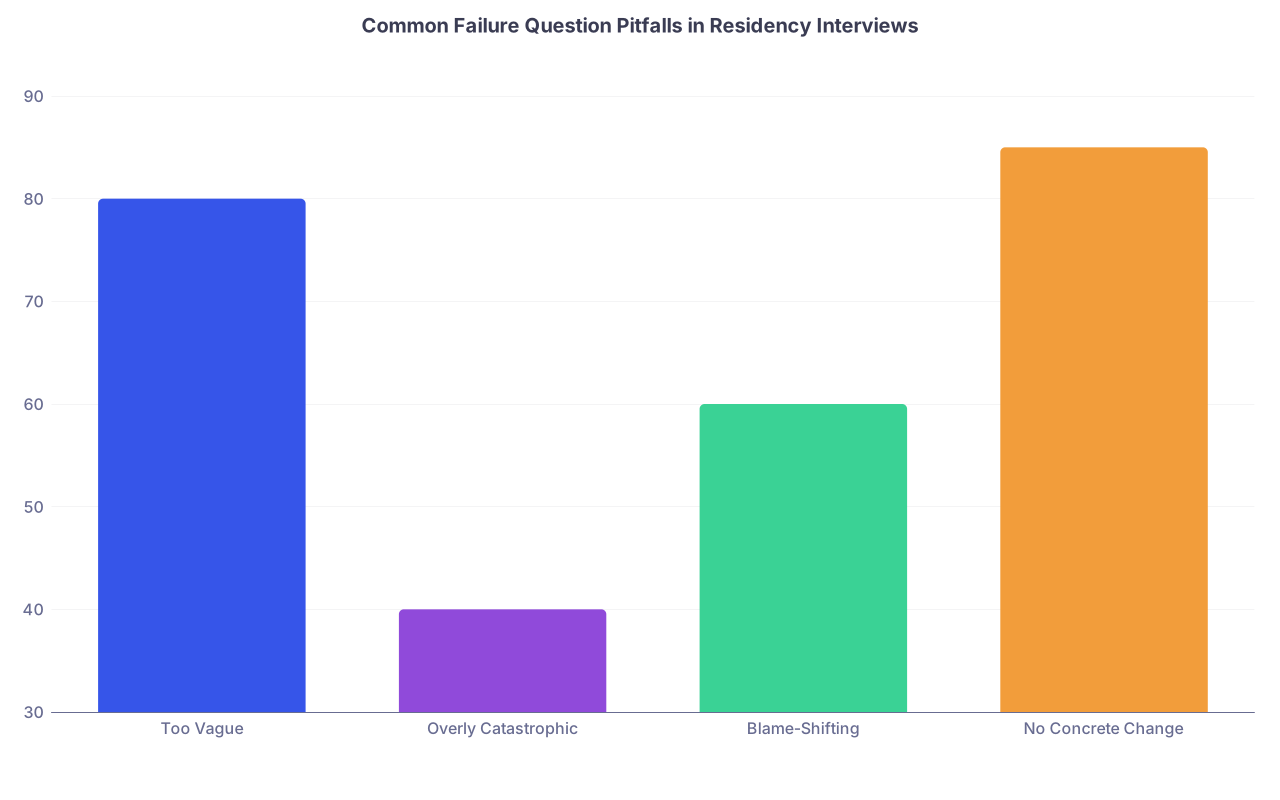
| Category | Value |
|---|---|
| Too Vague | 80 |
| Overly Catastrophic | 40 |
| Blame-Shifting | 60 |
| No Concrete Change | 85 |

FAQs
1. How “bad” should the failure be?
Moderate. If it is trivial, you look superficial. If it is catastrophic, you risk derailing the interview or raising real concerns. Choose something where there was a meaningful negative consequence (clinical delay, strained team interaction, extra work for others), but not something that suggests you are unsafe or unprofessional at baseline.
2. Can I use a non-clinical failure, like research or leadership?
You can, but for residency interviews, a clinical or team-on-the-wards example usually lands better. If your most authentic failure is research-related, make sure the learning clearly maps to residency-relevant skills: project ownership, communication, reliability, conflict management.
3. Should I mention specific cognitive biases like “anchoring bias” by name?
Use them if they are natural to you and you can explain them simply. Dropping “anchoring bias” without context sounds performative. Saying, “I stuck with my initial impression even when the data changed” is fine English and shows the same insight. If you use the formal term, pair it with a plain-language explanation.
4. How much emotion is appropriate when talking about a failure?
You are allowed to care. Saying, “I felt awful about the outcome” is human. The line you do not cross is losing composure, apologizing repeatedly, or turning the story into a therapy session. They are assessing whether you can hold distress and still think clearly. Show impact, then pivot quickly to analysis and growth.
5. What if the failure was mostly the system’s fault, not mine?
Then your task is to show you can see both. A purely system-blaming answer signals defensiveness. A purely self-blaming answer signals lack of systems awareness. For example: “There was no automatic flag in the EMR for X, and I also did not build my own workaround or escalate my discomfort.” Shared responsibility, with focus on what you changed in your own practice.
Key points, distilled:
- The “failure” question is a test of reflective practice, not confession.
- Use a mini-M&M structure: context, failure, contributing factors, reflection, concrete change.
- Pick a real, moderate-stakes clinical or team failure and show how it permanently upgraded your thinking and behavior.