
You are sitting in a residency interview room. The faculty interviewer leans back, scans your file, and then drops the question that makes half of applicants panic internally:
“Tell me about a medical error or near miss you were involved in.”
Your mind jumps to three different events. One feels too minor. One makes you look careless. One is so bad you are afraid to say it out loud. You have 2 seconds to decide how to answer without sounding unsafe, evasive, or rehearsed.
Let me be direct: programs absolutely judge you on how you handle this question. Not on whether you have been involved in errors (you have; we all have), but on whether you understand safety, own your role, and think like someone they can trust with real patients at 3 a.m.
This is not a “tell me about a time you were stressed” fluff question. This is a patient safety and professionalism stress test.
Let me break down exactly how to handle it.
1. Why Programs Ask About Errors (And What They Are Really Testing)
Programs do not ask about medical errors because they want horror stories. They ask because they are screening for three things:
- Insight – Do you actually recognize what an error or near miss is?
- Accountability – Do you own your part without self-destruction or blame shifting?
- Systems thinking – Do you see beyond “I messed up” and actually understand process, communication, and prevention?
You are being evaluated on your safety mindset, not the severity of the case.
What interviewers are quietly scoring you on
Here is what is going through a seasoned PD’s mind while you answer:
- Does this person recognize risk factors and warning signs?
- Do they hide behind “team issue” or “communication breakdown” without ever saying “I could have done X differently”?
- Are they catastrophizing and making themselves sound unstable or reckless?
- Do they understand basic safety behaviors (read-backs, cross-checks, escalation, double-checks)?
- Did they actually learn anything that changed their future behavior?
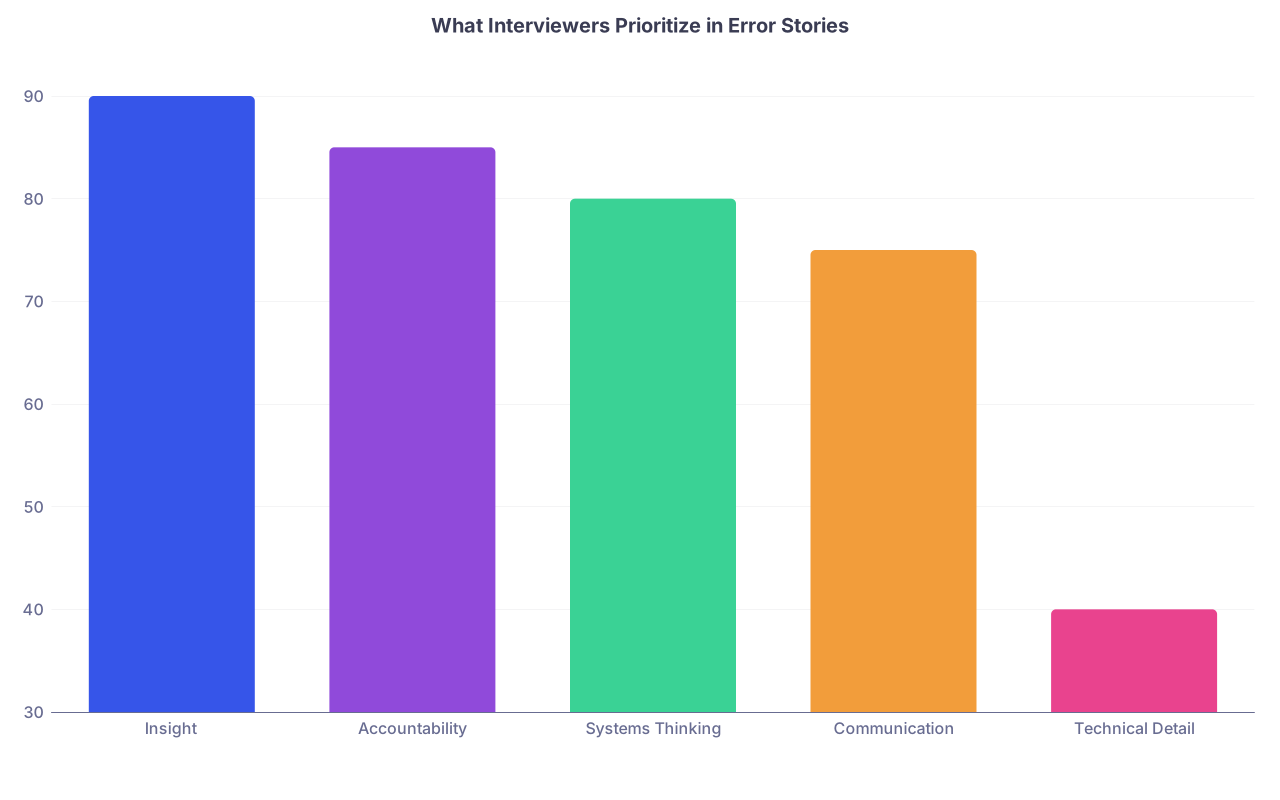
| Category | Value |
|---|---|
| Insight | 90 |
| Accountability | 85 |
| Systems Thinking | 80 |
| Communication | 75 |
| Technical Detail | 40 |
Notice what is not at the top: technical brilliance. Nobody cares if you can quote five RCTs about VTE prophylaxis while dodging responsibility for missing it.
The right mindset: “This is my chance to show I am safe, coachable, honest, and system-aware.”
2. Choosing the Right Case: What Works, What Backfires
The case you pick matters. Some scenarios are much easier to discuss safely than others.
Good types of cases to choose
You want something:
- Real – Fabricated or sanitized-to-death stories sound fake. Interviewers can smell this.
- Clear – A discrete error or near miss with a clear chain of events.
- Fixable – You can realistically describe what you changed afterwards.
- Not catastrophic – You do not need a code or death to make this powerful.
- With shared responsibility – Ideal cases show individual + system issues.
Gold-standard examples:
- Missed allergy → near miss with medication order caught by pharmacist.
- Wrong dose written (or almost given) → nurse or system double-check prevents harm.
- Delay in escalation to senior after subtle vital sign changes.
- Incomplete handoff → confusion on rounds, delay in consult or test.
- Incorrect labeling / almost-wrong-patient event caught before harm.
Bad examples:
- A major event where the patient died and your actions were central, and you have not processed it well.
- Stories where you were blatantly disregarding policy (e.g., knowingly forging a signature).
- Stories where your takeaway is basically “everyone else messed up.”
You do not get extra points for drama. You get points for judgment.
3. The Safest Narrative Structure: A-STAR for Errors
You need a clear framework so you do not wander into self-sabotage. For error and near-miss questions, I use a slightly modified structure:
A-STAR:
- A: Assignable context (role, level, setting)
- S: Situation (brief, focused)
- T: Turning point (the error / near miss)
- A: Analysis (what you learned – individual + system)
- R: Response (what you changed and how you act now)
This keeps you from spending 3 minutes on background and 10 seconds on insight.
Let’s walk through the pieces.
A – Assignable context
You start with: Who were you, where were you, and what was your scope?
Example:
“I was a third-year medical student on my internal medicine clerkship at a large academic hospital, following 4–5 patients under the supervision of a senior resident and attending.”
Why this matters: It calibrates expectations. Interviewers will not expect you to act like an attending if you clearly frame yourself as an MS3 or sub-I.
S – Situation (concise, clinical, not dramatic)
You give just enough clinical detail to make sense of the error.
- Chief complaint / key diagnoses.
- A few key data points (vitals, labs) if they relate to the error.
- The workflow or process where the failure occurred (rounds, handoff, order entry, night cross-cover).
Example:
“One of my patients was a 68-year-old man admitted with decompensated heart failure and CKD. He was on multiple medications, including high-dose diuretics. I was following his daily labs and intake/output.”
This should be 2–4 sentences, not the length of a full H&P.
T – Turning point (the error / near miss itself)
Spell out clearly: What was supposed to happen vs what actually happened.
Avoid vague language like “things fell through the cracks.” Say what the crack was.
Example (near miss):
“When reconciling his medications, I transcribed his home lisinopril dose incorrectly—writing 40 mg instead of 10 mg. I placed it in the note and suggested resuming it. The resident entered the order at 40 mg, and it was caught by the pharmacist during verification because of his renal function.”
Contrast that with the classic weak answer:
“There was some confusion around his medications, and the team and I learned the importance of double-checking.”
That second one tells the interviewer nothing. It sounds like you are hiding.
A – Analysis: Where you prove you actually learned anything
This is the heart of the answer. Most applicants mess this up.
You need to walk very specifically through:
What factors contributed to the error?
- Individual (fatigue, assumptions, inexperience).
- System (EMR interface, workflow, culture, supervision, handoffs).
What, precisely, was your responsibility?
Not “I guess I should have been more careful.” That is noise.
Something like: “I failed to cross-check the dose against the med list” or “I did not speak up when I felt uncertain.”What safety principles apply here?
Use actual concepts:- Closed-loop communication.
- Read-backs.
- Independent double-checks.
- Forcing functions.
- High-alert medications.
- Human factors / cognitive bias.
Example:
“Looking back, there were several contributing factors. I wrote the wrong dose because I relied on my memory of the verbal history instead of checking the printed med list in the chart. I was also rushing to finish notes before rounds, so I prioritized speed over accuracy. On the system side, the EMR medication reconciliation screen displayed home meds and proposed inpatient meds separately, and I focused on one without cross-referencing the other. Most importantly, I did not view myself as someone who could ‘stop the line’ if something felt off.”
This is the exact kind of reflective thinking programs want.
R – Response: How your practice changed
If your “learning point” is not obviously connected to a concrete change in behavior, your answer falls flat.
You need 2 layers of response:
Immediate response in the moment
- How was the error addressed?
- Did you disclose it? To whom?
- How did the team respond?
Long-term behavior change
- Specific habits and strategies you use now.
- Times you have applied this learning since then.
Example:
“In the moment, once the pharmacist called the team with the discrepancy, I went back to the chart, saw my error, and immediately owned that I had written the incorrect dose in my note. The resident corrected the order to his home dose and adjusted for renal function. We monitored his blood pressure and labs closely, and he did not experience any harm.”
“Since then, I have changed how I handle medication reconciliations. I now always have the EMR med list open when I am documenting, and I do a conscious ‘dose and indication’ check for ACE inhibitors, anticoagulants, and insulin. On my sub-internship, there were a few times when this double-check caught minor discrepancies in doses before orders were signed, and I felt more comfortable speaking up even when I was the least experienced person in the room.”
That last sentence is what interviewers remember: a specific, durable change in behavior tied to patient safety.
4. What You Must Avoid Saying (If You Want to Sound Safe)
There are some phrases that immediately raise red flags. I have heard them too many times in interviews.
Here is the short list of things that make you look clueless or unsafe:
Blame-shifting with no ownership
- “The nurse forgot to…”
- “The intern did not tell me…”
- “The consult service was slow…”
You can mention system and team factors, but you must still own your contribution and your response.
Vague, content-free reflection
- “I learned the importance of communication.”
- “It showed me how important attention to detail is.”
That is like saying water is wet. Useless. Be specific.
Minimizing the error
- “It was not a big deal because nothing bad happened.”
- “Thankfully, it did not matter.”
Near misses matter. Treat them as serious learning moments, even without harm.
Catastrophic self-flagellation
- “I still feel sick thinking about how badly I failed this patient.”
- “It made me question whether I should go into medicine.”
You can express appropriate regret, but then show stability and growth. Programs are not looking to adopt an emotional wreck.
Revealing unresolved or active legal/disciplinary cases in detail
You do not need to give identifying details, chart screenshots, or mention ongoing litigation. Talk about your role and learning, anonymize the patient, and focus away from sensational specifics.
5. Concrete Example Answers (With Commentary)
Let me give you two full examples. One for a near miss, one for an actual error with minor harm. I will annotate the structure so you can see A-STAR in action.
Example 1: Near Miss – Insulin Dosing
“During my surgery sub-internship, I was covering overnight with a senior resident on a busy vascular surgery service. One of our patients was a middle-aged woman with poorly controlled type 2 diabetes who was NPO for an early-morning procedure. I was responsible for writing the pre-op orders.”
“I placed NPO orders and adjusted some of her medications. For her insulin, I continued her home long-acting dose but failed to adjust her sliding-scale regimen. Our usual practice was to reduce or hold prandial insulin when patients are strictly NPO. I wrote the orders late in the evening, somewhat rushed, and did not re-evaluate them with the resident before sign-out.”
“The near miss occurred during the 11 p.m. nursing medication pass. The nurse paged me because she noticed that the patient was scheduled to receive both her usual long-acting insulin and a higher-than-typical correction dose despite being NPO with a glucose in the low 100s. When I re-checked the orders, I realized I had simply copied her prior regimen forward without modifying it. We promptly held the prandial component, kept the basal dose, and set parameters for more frequent glucose checks. She did not become hypoglycemic and remained stable throughout the night.”
“Analyzing it afterwards, I identified a few factors. I was mentally on ‘autopilot’ with pre-op order sets and allowed the default pathways and previous-day MAR to drive my decision-making, rather than pausing to ask, ‘What has actually changed for this patient tonight?’ I also did not make use of the safety net available to me: I could have explicitly reviewed the insulin plan with my resident before finalizing orders, especially given that insulin is a high-alert medication. From a systems perspective, our pre-op order set at that time did not proactively flag insulin dosing changes for NPO patients, so it was easy to overlook unless you were deliberately scanning for it.”
“Since then, I have built two habits. First, for patients who are NPO or have significant changes in diet, I now do a focused check on medications that can cause harm when intake changes—specifically insulin, sulfonylureas, and certain antihypertensives. I literally stop at the computer and run through that short mental checklist. Second, I am much more explicit in using nurses’ concerns as safety triggers. In this case, the nurse’s attention prevented an error, and on later rotations I have told nurses, ‘If something feels off to you, I want to hear about it, even if you think it is minor.’ That has led to multiple catches of small discrepancies before they became bigger issues.”
Why this works:
- Clear role and level (sub-I, overnight, busy vascular service).
- Specific error (copying insulin regimen without adjusting for NPO).
- Explicit near miss (nurse catch prevented harm).
- Serious safety analysis, both cognitive and systems level.
- Concrete, believable practice changes.
Example 2: Actual Error – Delay in Escalation
“On my internal medicine rotation, I took care of a 72-year-old man admitted with community-acquired pneumonia and sepsis. He initially responded to fluids and antibiotics and was on the general medicine floor, but he remained somewhat tenuous from a respiratory standpoint. I was the third-year medical student following him daily.”
“On one of the evenings, I checked on him before leaving. His respiratory rate was in the low 20s, oxygen requirement had increased slightly, and he mentioned feeling ‘a little more short of breath’ but did not appear in obvious distress. I noted the change in my progress note, but I did not directly bring my concern to the senior resident, partly because the resident was busy with a new admission and I felt hesitant to add to the chaos with what I viewed as a ‘soft’ finding.”
“Overnight, his respiratory status worsened, he became more tachypneic and hypoxic, and the night team ultimately transferred him to the ICU for closer monitoring and escalation of care. He stabilized and did well, but the next day, when we reviewed the course, it was clear that his early signs of deterioration were present during the day and I had noticed some of them.”
“I genuinely struggled with that, because I realized that I had recognized a deviation from his prior baseline but had not acted with the urgency it deserved. My reasoning at the time was influenced by a few cognitive traps. I anchored on the idea that he was ‘improving overall’ based on earlier days, so I downplayed the new data that did not fit that narrative. I also underestimated my role as a student, telling myself, ‘If this were really bad, the nurse or resident would already be worried,’ instead of asking, ‘What is my responsibility when something does not sit right?’”
“In our team debrief, the attending modeled exactly the kind of culture I want to train in. There was no shaming, but he was very clear: regardless of formal role, if you see a concerning trend, you speak up. Since then, I have changed how I handle subtle clinical changes. On subsequent rotations, if I am even mildly uneasy about a patient’s trajectory, I explicitly verbalize it to the resident: ‘I am a bit concerned that his work of breathing and oxygen needs have ticked up; can we reassess whether he needs a higher level of care?’ That has led to earlier respiratory therapy evaluations and, in one case, a daytime ICU transfer before an acute decompensation. I have also started using objective tools like early warning scores when available, as a prompt to escalate rather than waiting for dramatic vital sign changes.”
“That experience taught me that ‘near misses’ are not always about orders or doses; sometimes the error is in delayed escalation. I now see speaking up early as part of my role in patient safety, not as ‘bothering’ the team.”
Again, no melodrama. Clear regret, clear growth.
6. Talking About Errors Safely: Legal, Ethical, and Cultural Boundaries
You also need to stay within some professional lines.
Protect patient privacy
You already know this, but people still mess it up in interviews.
- No names, initials, or overly specific demographics that clearly identify a patient.
- Generalize time and place: “during my surgery rotation” vs “at X Hospital in March 2024 in the SICU.”
- Avoid rare-disease-case-level detail; it is unnecessary.
Avoid sounding like you violated confidentiality or policy
Do not mention:
- Sneaking into charts you were not assigned to.
- Discussing cases in obviously inappropriate places (elevator, social media).
- Sharing identifiable details with friends or family.
If those things happened and were part of an error, you can frame them in general terms and focus on the corrective action, but be careful with specifics.
Do not litigate your institution’s failures
Programs want to see that you understand systems, yes. But if your answer turns into a long rant about how your school’s EMR, attendings, or nurses are incompetent, you will look toxic.
Balance:
- Acknowledge system limits (template issues, workflow problems).
- Own your role and your ability to adapt.
- Show that you participated in constructive solutions if appropriate (e.g., M&M, safety report, suggesting template changes).

7. Training Yourself: How to Practice These Answers Before Interview Day
You will not pull off a polished, honest, composed error story the first time you say it out loud. You need reps.
Here is a simple three-step way to prep.
Step 1: List 3–5 real events
Do not start by writing polished stories. Start by making a raw list:
- Times you almost gave / wrote the wrong med.
- Times you missed or downplayed a vital sign or lab.
- Times handoff information was incomplete and caused confusion.
- Times you hesitated to speak up and later wished you had.
Then, for each, jot down:
- Harm vs. no harm.
- How emotionally loaded it still feels.
- How clearly you can articulate what changed afterward.
Pick 1–2 that are emotionally processed enough that you can speak calmly, and that have clean learning points.
Step 2: Draft using A-STAR, then slash the fluff
Write out a full answer using the A-STAR skeleton:
- A: 1–2 sentences.
- S: 2–4 sentences.
- T: 2–3 sentences.
- A: 4–6 sentences (this is where the depth lives).
- R: 4–6 sentences (immediate fix + long-term change).
Then, read it and cut any sentence that:
- Repeats the same point in softer language.
- Adds technical detail that is not relevant to the error.
- Over-explains basic concepts (they are attendings; they understand sepsis).
Aim for about 1.5–2 minutes spoken. Past that, you lose people.
Step 3: Say it out loud, get someone to interrupt you
Practice with:
- A resident you trust.
- A faculty mentor.
- A friend in your class who will not just say “sounds great.”
Ask them to interrupt you mid-story and ask:
- “What exactly was the error?” (If they ask this, you were too vague.)
- “What did you do differently the next time you were in a similar situation?” (If you do not have an answer, your learning is too theoretical.)
- “What would your attending say you learned from this?” (Good test of whether your reflection is grounded in reality.)
You want this stress-testing now, not at your first interview.

| Step | Description |
|---|---|
| Step 1 | List 3-5 real events |
| Step 2 | Select 1-2 with clear learning |
| Step 3 | Draft using A-STAR |
| Step 4 | Cut fluff and over-detail |
| Step 5 | Practice out loud |
| Step 6 | Get critical feedback |
| Step 7 | Refine and rehearse final version |
8. How This Plays Out Across Different Specialties
Same question, slightly different emphasis depending on what you are applying to.
| Specialty | Emphasis in Error Story |
|---|---|
| Internal Medicine | Systems thinking, escalation, handoffs |
| Surgery | Technical steps, checklist use, team communication in OR |
| Pediatrics | Family communication, dosing safety |
| Emergency Medicine | Triage, time-critical decisions, disposition |
| Anesthesiology | Monitoring, pre-op assessment, crisis response |
You should not reinvent your entire story for each specialty, but you can tilt the emphasis:
- For surgery, highlight communication in high-acuity environments, pre-op checks, counts, or ICU handoffs.
- For EM, emphasize early recognition, triage, escalation to higher level of care.
- For peds, discuss weight-based dosing, parental involvement, and clear communication.
The underlying structure stays the same. You just choose the pieces to shine a bit more light on.
9. Handling Follow-Up Questions Without Getting Flustered
Strong interviewers will not just nod and move on. They will probe. Expect follow-ups like:
“Would you handle this differently today?”
You should have a crisp, behavior-level answer ready.“What did your attending say about this at the time?”
If your recollection shows insight and a coaching mindset, that is a plus.“Have you ever reported an event or near miss through a formal safety reporting system?”
If yes: briefly describe one and what happened.
If no: you can say, “We used M&M and team debriefs more often than formal anonymous reporting, but I see the value of both, and I plan to use the systems my residency provides.”“What would you teach an intern about this scenario?”
Describe a simple, practical rule or checklist item you would pass down.
If you know your story well and your reflection is genuine, you will not get thrown by these. If your story is fake or over-rehearsed, the follow-ups will expose the cracks.
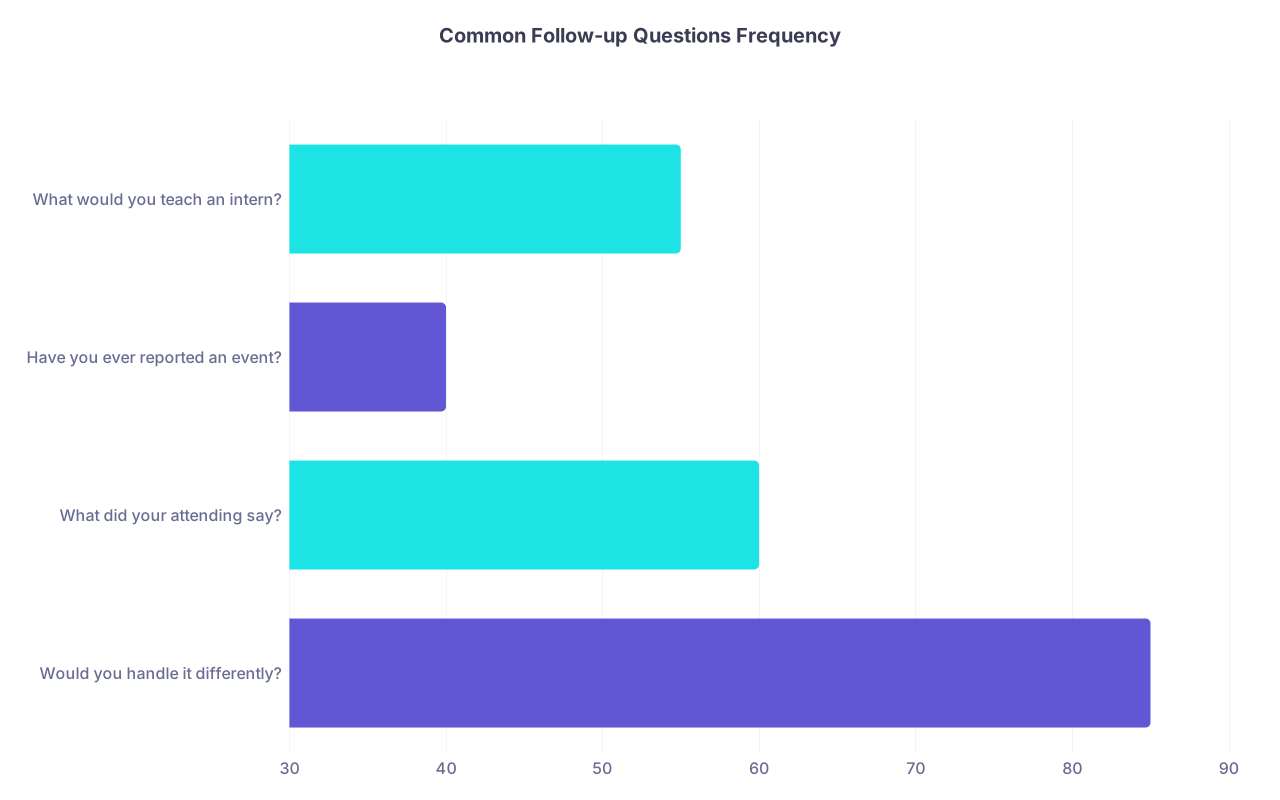
| Category | Value |
|---|---|
| Would you handle it differently? | 85 |
| What did your attending say? | 60 |
| Have you ever reported an event? | 40 |
| What would you teach an intern? | 55 |
You are going to sit in more than one interview room where someone will ask you about an error or near miss. That is guaranteed. What is optional is whether your answer sounds like a vague, defensive monologue or a confident, specific demonstration that you understand patient safety the way a future resident should.
You have the raw material already: the real moments where you felt your stomach drop, where a nurse caught something you missed, where you realized silence is also a decision. Your job now is to pick one or two of those moments, strip away the drama, and rebuild them into clear stories that show insight, accountability, and growth.
Do that work before interview season actually starts, and this question shifts from “minefield” to “opportunity.” With that foundation in place, you are far better positioned for the rest of the clinical and behavioral questions that will come at you on the residency trail—how you handle conflict, uncertainty, and sick patients in real time. Those are next on your path, and you will be ready to tackle them.