
Most residency applicants butcher ethical questions because they improvise instead of using structure.
If you “go with your gut” on bioethics during interviews, you will sound either naïve, rigid, or unsafe. Programs know this. That is why they love ethical scenarios: they expose whether you can think clinically, legally, and humanly under pressure.
Let me walk you through a structured way to handle ethical dilemma questions that actually sounds like a resident, not an undergraduate in a philosophy seminar.
Why Programs Care So Much About Ethical Dilemmas
Ethical questions are not trivia. They are stress tests.
Programs use them to see:
- Will you panic and ramble when there is no clear right answer?
- Can you balance patient autonomy with safety, law, and team reality?
- Do your instincts scream “cowboy,” “doormat,” or “steady physician-in-training”?
What they absolutely do not want:
- Pure emotion: “I would just do what feels right for the patient.”
- Pure legalism: “I’d check the policy and do that.”
- Pure obedience: “I’d just follow the attending.”
They want a structured, defendable process. Something that shows: this person can be trusted with complex situations at 3 a.m. on call.
The Core Framework: A Practical 4-Step Bioethics Structure
Forget memorizing every version of “four principles” or 20 acronyms. You need something you can actually run in real time.
Here is the structure I recommend you internalize:
- Clarify the Scenario and Missing Information
- Identify Stakeholders and Principles
- Generate and Weigh Options
- State a Clear Plan + How You’d Communicate It
That is it. But you must execute it with discipline.
Step 1: Clarify the Scenario and Missing Information
Most candidates jump straight to a conclusion. That is how you look unsophisticated.
Instead, show that you understand clinical reality: ethical decisions depend on details.
You should explicitly:
- Restate the core tension in 1–2 sentences.
- Name what information you would need before acting.
- Flag any safety or legal red flags immediately.
Example response fragment:
“This is fundamentally a conflict between patient autonomy and our concern for her safety. Before deciding, I would clarify her decision-making capacity for this specific choice, confirm what risks have been explained, and check whether there are any legal constraints such as an involuntary hold criteria in our state.”
That already signals: this person thinks like a clinician, not a philosopher.
Step 2: Identify Stakeholders and Principles
Now you bring in bioethics explicitly, but in plain language.
Stakeholders usually include:
- The patient (obvious, but specify their perspective)
- Family / surrogate decision-maker
- The clinical team (nurses, residents, attending, consultants)
- The institution (policies, risk management)
- Occasionally: society / public health (e.g., infectious disease, resource allocation)
The big four principles (you should name them at some point in at least one answer):
- Autonomy – Respecting patient choices when they have capacity.
- Beneficence – Acting in the patient’s best interest.
- Non-maleficence – Avoiding harm.
- Justice – Fairness in distribution of resources and treatment.
You do not need to recite definitions every time. Instead, weave them in.
Example line:
“Here I see autonomy pulling in one direction and non-maleficence and beneficence in the other, with some justice concerns if we are allocating a scarce resource.”
Notice: short, pointed, and connected to the case.
Step 3: Generate and Weigh Options
Bad answers leap to “I’d do X.” Good answers lay out 2–3 realistic options, analyze trade-offs, then choose.
You are not brainstorming fantasy options. You are choosing between concrete, plausible paths in an actual hospital:
- Accept the patient’s decision now vs. reassess capacity vs. involve surrogate vs. escalate legal steps.
- Continue full treatment vs. transition to comfort focus vs. time-limited trial.
- Report vs. not report vs. clarify first with patient or supervisor.
Give a quick pros/cons analysis grounded in the principles and practical reality.
This is where you show maturity:
“Option one is to respect her refusal and discharge her. That respects autonomy but may violate non-maleficence if she clearly lacks understanding of the risk of death.
Option two is to detain her temporarily for further evaluation under the hospital’s emergency hold policy. That restricts autonomy but prioritizes safety and could be ethically justified if she lacks capacity.”
You are not writing an essay. Two sentences per option is enough.
Step 4: State a Clear Plan + How You’d Communicate It
Interviewers hate vague endings: “I’d try to do what’s best.” That is nothing.
You must:
- Commit to one option.
- Justify it in 1–2 sentences using ethics + clinical reasoning.
- Explicitly say how you would talk to the patient/family/team.
Example closure:
“Given those factors, I would support a brief involuntary hold to complete a capacity assessment and stabilize any reversible issues, prioritizing safety. I would explain to her that I am concerned she may not fully grasp the severity of the risk and that my duty is to prevent serious, imminent harm while we clarify her wishes under more stable conditions.”
Clear. Concrete. You picked a lane and you owned it.
Anatomy of a Strong Ethical Answer: Concrete Example
Let me show you the entire structure in action on a classic scenario.
Scenario:
“A 55-year-old man with metastatic cancer is in significant pain. He is asking for increasing doses of opioids. The nursing staff is concerned he is becoming over-sedated. How would you handle this?”
Walkthrough, step by step.
1. Clarify and Frame
“This is a tension between relieving suffering and avoiding harm from oversedation or respiratory depression. I would first clarify how impaired he actually is: vital signs, level of consciousness, whether he is experiencing side effects like confusion or falls, and what his overall goals of care are.”
You just did step 1 in two sentences.
2. Stakeholders and Principles
“Stakeholders include the patient, who is clearly suffering; the nursing staff, who are rightly concerned about safety; and the team managing his cancer, who may have a palliative plan. Ethically, beneficence pushes us to treat his pain, while non-maleficence and respect for his long-term goals and dignity limit how much risk we can accept.”
You are signaling awareness that nurses are not “in the way”; they are key players.
3. Options + Weighing
Now you give actual options. For instance:
“One option is to continue escalating opioids as requested. That may best relieve his pain but risks oversedation, respiratory depression, and loss of meaningful interaction time with family.
A second option is to refuse dose escalation and keep current dosing. That may feel safer but ignores his suffering and could damage trust.
A third option is to adjust the pain regimen in a more nuanced way: reassess his pain pattern, involve palliative care, consider adjuvants like neuropathic agents or non-opioids, and perhaps change the route or schedule while setting clear safety limits.”
This shows: I do not think in binary. I understand real palliative medicine is creative and collaborative.
4. Plan + Communication
“I would pursue the third option. I would go see him, validate his suffering, and explain that my goal is to relieve his pain while also keeping him safe and awake enough for the time he values with family. I would suggest involving palliative care to optimize his regimen, adjust dosing to a scheduled baseline with careful breakthrough dosing, and work with nursing on clear parameters for when to hold doses due to oversedation. Then I would huddle briefly with the nurses to acknowledge their concerns and make sure the plan is explicit and documented.”
You hit ethics, communication, and interprofessional respect in under a minute.
That is how you sound like a senior resident, not a first-year med student.
High-Yield Ethical Themes You Will See in Interviews
Most ethical scenarios you will be asked fall into a handful of buckets. Know the buckets cold so you can recognize what you are dealing with and plug into the framework fast.

1. Autonomy vs. Safety (Capacity, Refusal of Care)
Classic: patient wants to leave AMA, refuses transfusion, refuses surgery, refuses psych meds, refuses C-section, etc.
Key moves:
- Immediately ask: Does the patient have decision-making capacity for this decision?
- Capacity is task-specific and time-specific:
- Understands relevant information?
- Appreciates consequences?
- Can reason about options?
- Can communicate a choice?
- If capacity intact → autonomy is strong.
- If capacity impaired → you can ethically justify more paternalistic action, sometimes invoking emergency or legal authority.
You should say the word capacity explicitly. Interviewers listen for it.
2. Confidentiality vs. Risk / Duty to Warn
Scenarios: minor requests confidential contraception; patient with HIV refuses to tell partner; patient threatens violence; impaired colleague.
Show that you understand:
- Confidentiality is central but not absolute.
- There are exceptions: serious imminent harm to self or others, abuse, specific reportable conditions, driving restrictions, etc.
- You would:
- Try to persuade patient to share or accept help.
- Limit disclosure to minimal necessary parties.
- Follow institutional and legal requirements.
A line that works well:
“Confidentiality is the default, but there are narrow, legally defined circumstances where I am obligated to breach it to prevent serious harm. I would first try to work with the patient to address this collaboratively, but if that fails and the threshold for duty to warn is met, I would follow the reporting requirements.”
3. End-of-Life, Futility, and Surrogate Decision-Making
These are extremely common. Example: family wants “everything done” for a terminal, ventilated patient; unclear code status; conflict between siblings; suspected non-beneficial care.
Your priorities:
- Check for:
- Advance directive, POLST/MOLST.
- Documented prior conversations.
- Clarify if the surrogate is following substituted judgment (what the patient would want) vs. best interests.
- Recognize that “futility” is a medical judgment, not a family vote.
- Emphasize:
- Clear, compassionate communication.
- Time-limited trials of therapy when appropriate.
- Involving palliative care and ethics consult when stuck.
4. Resource Allocation and Justice
These spiked during COVID but still show up: one ICU bed left, who gets it; one liver, two candidates; uninsured patient requiring high-cost drug.
You are not expected to be a health economist. You are expected to acknowledge:
- Individual vs. population-level obligations.
- Need for transparent, fair, policy-based decisions rather than ad hoc favoritism.
- Your role as a resident:
- Apply institutional criteria.
- Document clearly.
- Avoid discriminatory assumptions.
5. Professionalism, Impaired Colleagues, and Team Conflict
Examples: attending asks you to alter a note; resident comes in intoxicated; nurse refuses to carry out an order.
Key signaling:
- Patient safety is non-negotiable.
- You address concerns up the chain of command.
- You avoid public shaming; you document objectively.
- You use institutional resources (GME office, hotline) if needed.
Do not say: “I would confront them aggressively in front of everyone.” That sounds reckless.
Quick Comparison: Weak vs. Strong Ethical Answers
| Aspect | Weak Answer Example | Strong Answer Example |
|---|---|---|
| Structure | Rambling narrative | Explicit 3–4 step reasoning |
| Capacity Mentioned | Ignored or assumed | Explicitly assessed and named |
| Stakeholders | Only patient | Patient, family, team, institution |
| Principles Used | Vague “do what’s best” | Autonomy, beneficence, non-maleficence, justice |
| Plan | “I’d try to talk to them” | Concrete steps, escalation, documentation |
You do not need to be perfect. But you cannot sound improvisational.
How to Practice: Turning Theory into Muscle Memory
You will not “think of this on the spot” the first time in an interview. You need reps.
Here is how to drill this efficiently.

| Step | Description |
|---|---|
| Step 1 | Select ethical scenario |
| Step 2 | Read and identify core tension |
| Step 3 | Apply 4-step structure |
| Step 4 | Speak answer out loud in 2-3 minutes |
| Step 5 | Self-critique: missing capacity? principles? |
| Step 6 | Refine and repeat with new case |
1. Build a Small Bank of Scenarios
You do not need 100. Pick 10–15 that cover the common buckets:
- AMA discharge with high risk.
- Jehovah’s Witness refusing blood.
- Teen requesting contraception, parents unaware.
- Family demanding “everything” for dying patient.
- Resident sees attending falsify a note.
- Limited ICU bed scenario.
- Patient refusing life-saving C-section.
- Colleague suspected of drug diversion.
- Patient requesting medically inappropriate opioids.
- Suspected child abuse.
Cycle through them.
2. Use a Timer and Record Yourself
Two rules:
- Max 2–3 minutes per answer.
- Record audio or video.
After each attempt, ask yourself:
- Did I:
- Clarify the scenario and missing info?
- Name stakeholders and at least 2 principles?
- Generate at least 2 options with trade-offs?
- Land on a clear plan and communication strategy?
If “no” to any, redo it. Yes, it is tedious. That is how you stop rambling.
3. Practice One-Sentence “Ethics Hits”
Sometimes interviewers throw a mini-ethics probe mid-conversation. You do not need the full framework every time. You need clean, high-yield sentences.
Examples to have ready in your muscle memory:
- “I would first assess the patient’s decision-making capacity for this specific decision.”
- “My default is to respect autonomy, unless there is a serious concern about capacity or imminent harm.”
- “I would try to align the plan with the patient’s previously stated values, using the surrogate in a substituted judgment role.”
- “I would escalate up the chain of command while documenting objectively and avoiding personal attacks.”
These phrases make you sound like you have actually worked through these issues on the wards. Because you have—just in practice.
Common Pitfalls That Instantly Red-Flag You
There are patterns that make interviewers quietly write “concerning judgment” on their sheet.
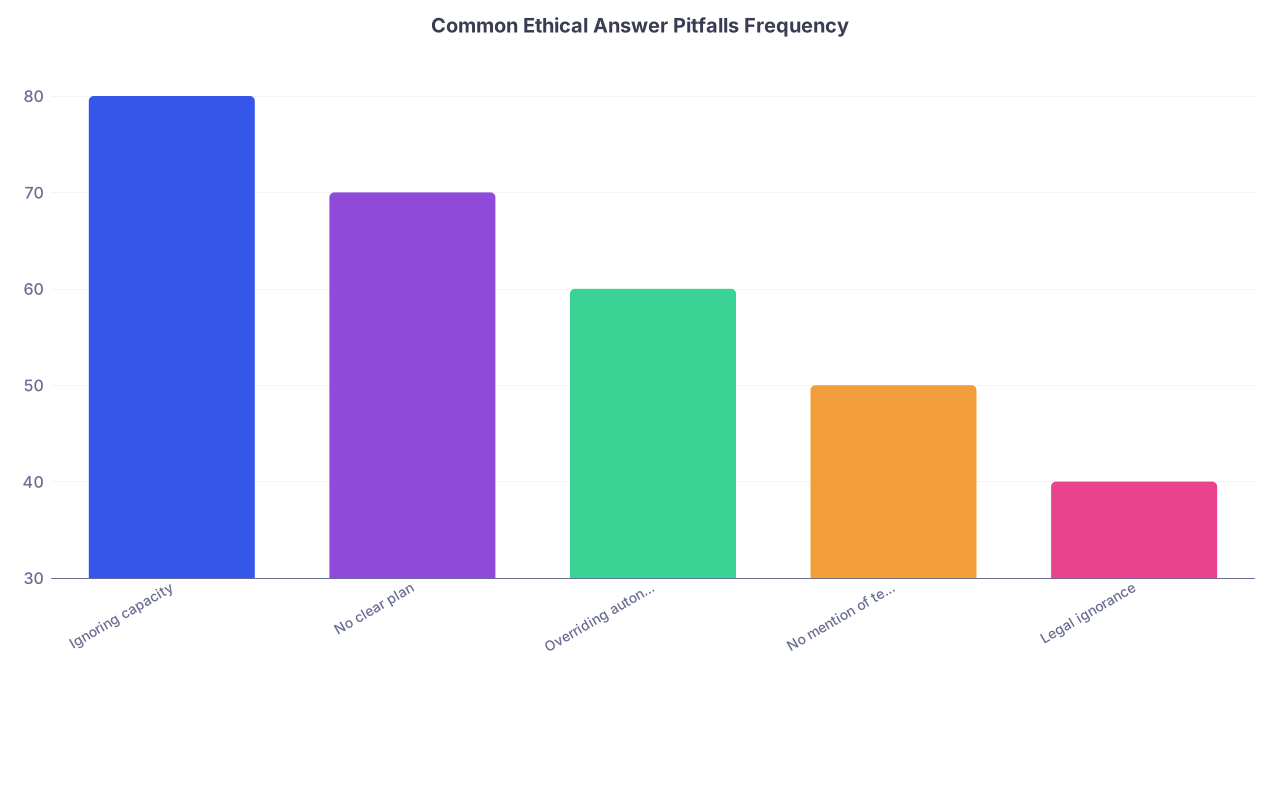
| Category | Value |
|---|---|
| Ignoring capacity | 80 |
| No clear plan | 70 |
| Overriding autonomy casually | 60 |
| No mention of team | 50 |
| Legal ignorance | 40 |
1. Ignoring Capacity Completely
If you discuss refusal of care, AMA, psych holds, or high-risk decisions without mentioning capacity, you sound unsophisticated.
At least say:
“I would assess and document his capacity to make this decision, including his understanding of the risks and alternatives.”
2. Casual Overriding of Autonomy
Lines like:
- “I would just sedate him and do it anyway because it is best for him.”
- “I would call security and force treatment.”
Unless it is an actual emergency with no time and clear lack of capacity, that is a problem.
You can override autonomy, but only with:
- Clear rationale (capacity / imminent harm).
- Clear statement that this is an exception, not your default.
3. Total Deference: “I Just Do What the Attending Says”
Programs want independent thinkers who still respect hierarchy. If you say:
- “I would just follow whatever my attending decides.”
You sound passive and unsafe. Frame it differently:
“I would discuss my concerns with the attending and understand their reasoning, but I also have an obligation to advocate for the patient and raise any serious ethical or safety concerns through appropriate channels.”
4. Zero Awareness of Law or Policy
You are not a lawyer, but you should not sound oblivious:
- Implied understanding: there are laws about reporting abuse, duty to warn, involuntary holds, and confidentiality limits.
- Phrases that help:
- “I would follow our state’s criteria for involuntary hold.”
- “I would review our hospital’s policy and consult risk management or legal if needed.”
5. Emotional Overidentification
Saying:
- “I would always do whatever the family wants.”
- “If I felt really bad for them, I would bend the rules.”
This worries interviewers. Compassion is good. Boundary collapse is not.
How This Plays Out Across Specialties
The core framework is the same, but interviewers lean on different themes depending on the field.
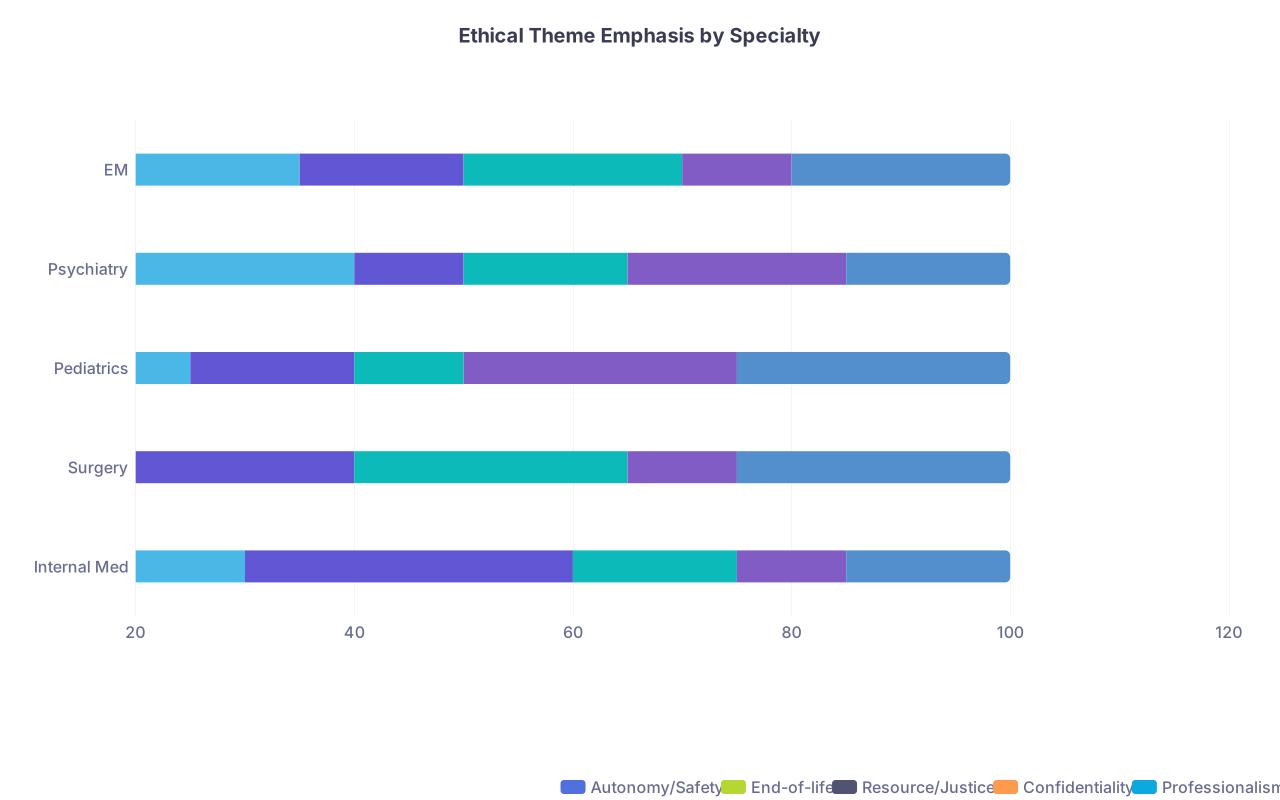
| Category | Autonomy/Safety | End-of-life | Resource/Justice | Confidentiality | Professionalism |
|---|---|---|---|---|---|
| Internal Med | 30 | 30 | 15 | 10 | 15 |
| Surgery | 20 | 20 | 25 | 10 | 25 |
| Pediatrics | 25 | 15 | 10 | 25 | 25 |
| Psychiatry | 40 | 10 | 15 | 20 | 15 |
| EM | 35 | 15 | 20 | 10 | 20 |
You do not need to memorize distributions. Just be aware:
- Psych: autonomy vs. safety, involuntary treatment, suicide risk.
- Peds: parents vs. child’s best interest, confidentiality in adolescents, vaccines.
- Surgery / OB: consent, capacity, high-risk procedures, C-sections vs maternal autonomy.
- EM: consent in emergencies, AMA, triage.
- IM / ICU: code status, futility, goals of care.
Use the same 4-step engine, but tune examples and language to your specialty.
How to Signal “Resident-Level” Thinking Without Overreaching
You are not an attending. Do not pretend to be one. Strong answers balance ownership with humility.
Consistently:
- Use phrases like:
- “I would discuss with my attending…”
- “As the resident, my role would be to…”
- “I would consider involving an ethics consult or palliative care.”
- Show you know you are in a system, not solo practice:
- Nurses.
- Social work.
- Case management.
- Risk management.
- Ethics committee.

Statements like:
“I would bring this to a brief multidisciplinary huddle with nursing and social work to make sure we have a unified approach and are aware of any prior documentation of the patient’s wishes.”
That makes you sound like someone who fits into residency reality.
Putting It All Together: A Template You Can Run Every Time
You do not need to say this verbatim. But keep the skeleton in your head.
Frame
“This is a conflict between X and Y. Before deciding, I would clarify A, B, and C.”Stakeholders + Principles
“Stakeholders include [list]. Ethically, we are balancing autonomy, beneficence, non-maleficence, and possibly justice.”Options + Trade-offs
“One option is… The upside is… The downside is…
A second option is… This respects… but risks…”Decision + Communication
“I would choose [option] because… I would explain this to the patient/family by… and involve [attending/consults] as needed, documenting the discussion and rationale.”
Practice that 20–30 times with different cases. You will walk into interviews with an unfair advantage.
FAQs
1. Should I ever say “I’m not sure” in an ethics answer?
You should not end with “I’m not sure,” but it is reasonable to acknowledge uncertainty while still committing to a process. For example: “The exact legal thresholds can be complex, and as a resident I would verify them with my attending and our hospital policy, but my approach would be to prioritize safety while respecting autonomy as much as possible.” That shows humility without paralysis.
2. How “philosophical” should I get with bioethics theory?
Keep the heavy theory out. Name the four principles once or twice across the day, mention concepts like substituted judgment, but stay grounded in clinical realities: capacity assessments, goals-of-care discussions, specific hospital roles. Interviewers want to see practical ethical reasoning, not a dissertation.
3. What if my personal beliefs conflict with the ethically accepted approach?
You do not need to advertise every personal belief, but you must show you can provide standard-of-care, unbiased care. A strong line is: “Regardless of my personal beliefs, in my professional role I am obligated to follow evidence-based, patient-centered standards of care and to refer appropriately if I cannot do so without bias.” Programs are watching for whether you can separate personal values from professional duties.
4. How long should my ethical dilemma answers be in an interview?
Aim for 1.5–3 minutes. Under a minute usually means you skipped nuance; over 3 minutes often turns into rambling. If you use the 4-step structure—frame, stakeholders/principles, options, decision/communication—you will naturally land in the right range.
Key points:
You win ethical questions by using a repeatable structure, not clever improvisation.
Always anchor your answer on capacity, core principles, and a concrete plan with clear communication.
Sound like a resident on a real ward, not a student in a debate club, and you will stand out in residency interviews for the right reasons.