Why You Are Ranking Programs Based on Where You Think You'll Fit (and How to Fix It)
You walked out of the interview day feeling electric. The program coordinator knew your name, the residents laughed at your jokes, and the faculty panel seemed genuinely interested in your research from three years ago. The hospital atrium had a grand piano. There was a smoothie bar.
You've already ranked them number one. You haven't even looked at the case logs.
That gut feeling, that warm, glowing sense of belonging, is precisely why you are about to sabotage your own career. You are not ranking programs. You are chasing a mirage of friendship manufactured by a system designed to recruit you. And you're falling for it like clockwork.

Before you finalize your selections, consider checking out designing a residency ranking rubric that matches your real values to ensure your choices align with your actual career goals rather than superficial traits.
The 'Vibe' Trap: Why You're Falling for the Familiarity Fallacy
Your brain is a terrible judge of residency quality. It's a survival mechanism, not a career counselor. When you sit in a conference room and a chief resident offers you a warm croissant, your amygdala stops scanning for threats. You've been stressed, sleep-deprived, and terrified for months during application season. Into that emotional vacuum steps a program that simply acts nice. Your brain mistakes relief for fit. It mistakes a lack of overt hostility for a supportive culture.
This is the Familiarity Fallacy.
Programs know this. Let me be blunt: interview season is a masterclass in performative hospitality. I've seen toxic, malignant programs with 20% annual resident attrition roll out the red carpet with expensive catering and curated "hangouts" with the three residents who haven't quit yet. They hide the 80-hour workweek violations behind a cheerful smile from a program director who won't remember your name by July 2nd.
You cannot audit a program's soul in six hours of structured Zoom calls or a single in-person visit. You can only audit the show they've rehearsed.
How do you avoid this? You need to perform a hostile audit of your own rank list. Look at your current top five. For each one, ask yourself: is this rank driven by an objective career metric (fellowship match rate, procedural volume, graduation confidence), or is it driven by the memory of a pleasant conversation? If you can't point to a hard number you verified outside of their own presentation, you are ranking based on vibes. And vibes won't teach you how to run a code.
Red Flag Alert: Ignoring Volume and Complexity for Comfort
Here's a mistake I see destroy careers in slow motion: an applicant ranks a tiny, low-acuity community program above a gritty, high-volume university center because the community residents seemed "chill" and "less tired."
Of course they seemed less tired. They are managing four patients on a general medicine floor while the university residents are drowning in 14 complex transfers from the ICU step-down. You are confusing a lack of workload with a good training environment.
The danger zone isn't the first year. As an intern, you're just trying to survive. You won't notice the deficit. The real terror arrives in your third year or, god forbid, your first attending week. You are the one in charge now, and you've never managed a crashing myasthenic crisis alone. You never saw it. Your program shipped those patients to the ivory tower downtown. You traded three years of comfort for a lifetime of clinical anxiety.
<chart-data-api config='{"type":"scatter","title":"Case Volume vs. Program 'Vibe' Correlation","labels":["Program A","Program B","Program C","Program D","Program E","Program F","Program G","Program H"],"values":[{"x":7.8,"y":34},{"x":8.1,"y":38},{"x":8.5,"y":42},{"x":5.2,"y":130},{"x":5.8,"y":120},{"x":9.2,"y":22},{"x":3.1,"y":210},{"x":4.5,"y":180}],"yAxisLabel":"Subjective Comfort Score (1-10)","xAxisLabel":"Annual Central Line Placements"}'>
See the pattern? The data doesn't lie. The places that felt suspiciously comfortable often carry the lightest clinical load. You aren't looking for a spa retreat. You are looking for a place that will break you down and rebuild you as a competent physician.
Look at the raw case minimums. Don't just ask if they meet ACGME requirements. Meeting the minimum is failure. If the ACGME requires 40 central lines, and the average resident graduates with 41, you are a single equipment failure away from being inadequately trained. Demand volume. Demand complexity. A resident who is "nice" but incompetent cannot protect your license.
Mapping the Danger Zones: Where Applicants Self-Sabotage Their Rank Lists
Let's trace the exact thought process that sinks an otherwise stellar applicant.
It starts a week after the interview. You vaguely remember a Reddit thread about Program X having a nasty divorce with a surgical department. You recall a spreadsheet comment about outdated EMRs. Three red flags. They are concrete, documented, and worrying.
Then you log into the virtual second-look. A senior resident named Sarah laughs at your comment about hiking. She DMs you privately to say "we'd love to have you." That single pleasant interaction, that micro-dose of validation, triggers a dopamine hit strong enough to override those three red flags. You've just let a stranger's momentary kindness blind you to systemic dysfunction.
Then there is the geography trap. I'm going to say something harsh: ranking a mediocre program in a "fun city" over a powerhouse program in a "less desirable" location is a financial and professional unforced error.
You are paying a massive long-term tax on your competency. If you want to do Cardiology, and Program A in Manhattan sends 30% of its residents to community cardio gigs while Program B in the Midwest sends 80% to university fellowships, choosing Manhattan is stealing one hundred thousand dollars of future earnings from yourself. You are buying three years of good restaurants with a decade of limited career mobility.
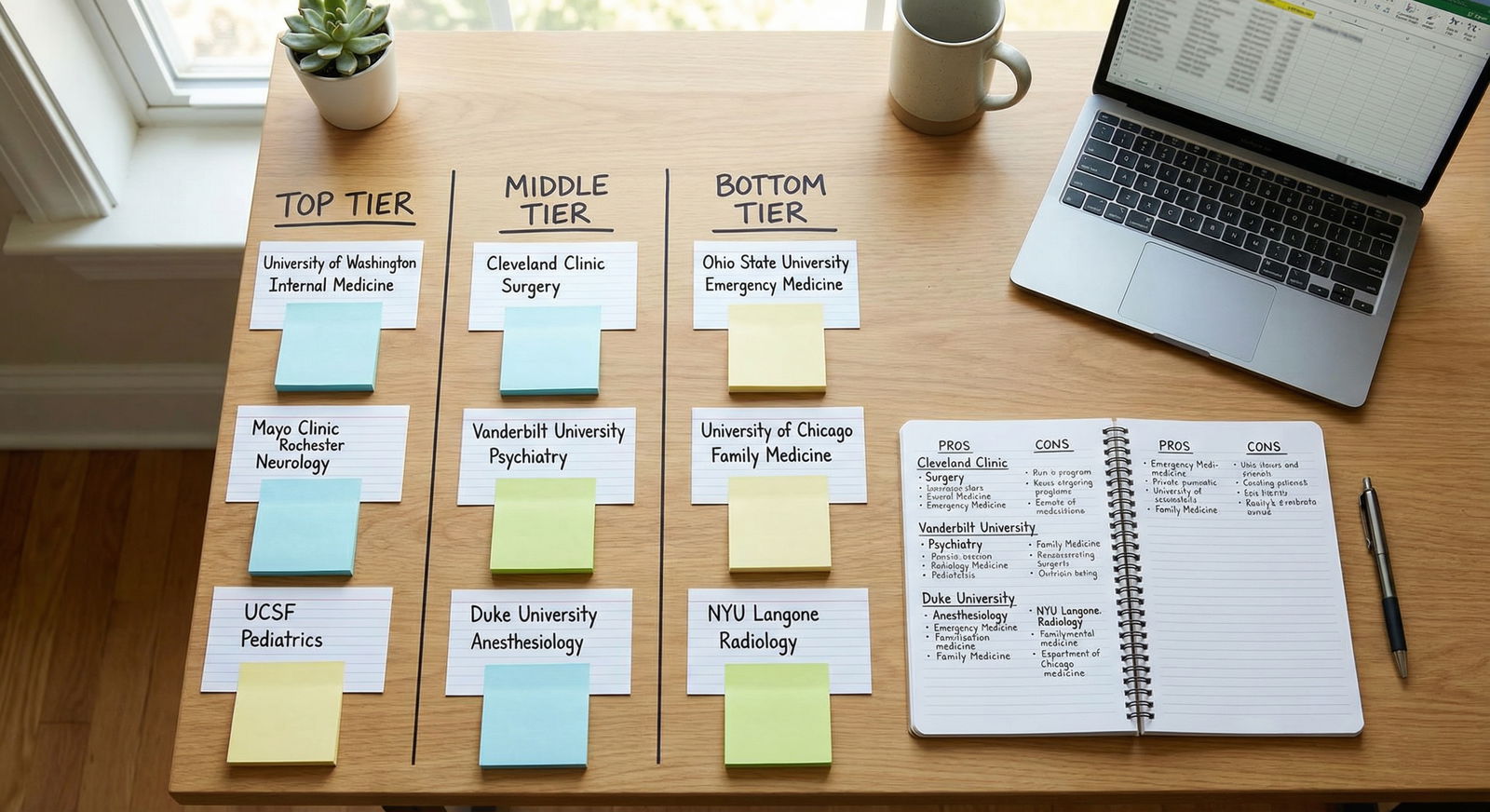
Building a Bulletproof Rank List: Data Over Despair
You need to stop asking "Where will I be happiest?" That question is unanswerable right now. You don't know what makes you happy in residency because you've never done it. You need to ask: "Where will I be most rigorously trained?"
Rigorous training creates happiness. Confidence creates satisfaction. Being the go-to resident in a code, knowing exactly what to do because you've done it seventy times, that feels better than any pre-interview dinner.
To fix your list, you need to build a protective matrix. Strip the emotion from the process.
- Board Pass Rates: If it's below 85%, that program is failing its residents. Full stop.
- Attrition: If anyone has left the program in the last three years for reasons other than a maternity leave or a discrete health issue, you need to find those people. Message them. If you can't, assume the worst.
- Where Do the Grads Go?: If a program claims "diverse outcomes," it means they don't have a strong pipeline to competitive fellowships. You want granular, named placements.
- Pathology Logs: Ignore the "state-of-the-art simulation center." Look at raw, patient-facing procedural numbers.
I want you to create a spreadsheet. Rank these objective indicators from 1 to 10 for each program. Only after you have input the hard data are you allowed to put a subjective score in the last column. If your subjective score wildly contradicts the objective data, you are the error. Not the data.