

The way most people rank residency programs is lazy and dangerous.
They “vibe check” interviews, skim location, glance at prestige, then throw together a list that will shape the next 3–7 years of their life. That is not strategy. That is gambling.
You need a residency ranking rubric that actually matches your real values. Not what you think you should care about. Not what your classmates brag about. What you actually live with at 2 a.m. on a call night in February.
Let me show you how to build that. Step by step. No fluff.
Step 1: Strip Away Everyone Else’s Priorities
Before you design any rubric, you have to amputate the noise: advisors, Reddit, classmates, parents, faculty who trained in 1995.
Here is the core problem:
Most applicants use someone else’s values as their scoring system.
- Your advisor: “You must prioritize academic prestige.”
- Your co-applicant: “Lifestyle above all. I want a chill program.”
- Your parents: “Name brand. So grandma understands where you matched.”
- Program directors: “We offer unparalleled exposure to complex pathology.”
You internalize all of that and then pretend it is your own. It is not.
So you start here: define your non-negotiables and your real trade-offs.
1.1 Do the “Bad Day Test”
Forget the Instagram version of residency. Ask:
“On my worst, most exhausted, most burned-out day, what will matter most about this program?”
Common real answers I hear:
- “I need to be near at least one real friend or family member.”
- “I cannot commute an hour each way. It will destroy me.”
- “I want faculty who will know me well enough to pick up the phone for fellowship.”
- “I need a program that does not routinely violate duty hours and laugh about it.”
Write down 3–5 answers. Those are the seeds of your rubric categories.
1.2 Separate “Signal” From “Status”
Some factors are signal (they affect your daily or long-term reality). Others are pure status or ego.
Signal:
- Call schedule
- Culture (how juniors are treated)
- Case volume and autonomy
- Fellowship and job placement support
- City cost of living and safety
- Support for pregnancy, illness, caregiving
Status:
- USNWR ranking
- Program brand name outside your specialty
- “My med school classmates will be impressed”
- City cool factor for Instagram
Be honest: status is not evil. Just do not pretend it is something else. If prestige genuinely matters to you (for future academic goals or your own pride), include it as a category. But call it what it is.
Step 2: Define Your Core Categories
Now translate those gut-level priorities into clear rubric categories.
You are not building a 40-item survey. Overcomplicated rubrics are how people avoid making real decisions. You want 6–10 meaningful categories.
Here is a solid starting set most applicants can adapt:
- Training Quality & Autonomy
- Culture, Support, and Wellness
- Location, Cost of Living, and Community
- Schedule, Call, and Workload
- Career Outcomes (Fellowship/Job/Academic)
- Fit with Personal Life & Identity
- Program Reputation / Opportunities
- Gut Feel / “Would I be happy here?”
You will not weight them equally. And you should not.
Step 3: Assign Weights That Match Your Real Values
This is where people lie to themselves.
They say, “Well, obviously training quality is most important,” then prioritize location in every actual decision. Your job is to make your math reflect your real behavior.
You will assign each category a weight that represents its importance to you, adding up to 100%.
Example for someone who wants fellowship in a competitive field but also cares about location and culture:
| Category | Weight (%) |
|---|---|
| Training Quality & Autonomy | 20 |
| Culture, Support, and Wellness | 20 |
| Location & Cost of Living | 15 |
| Schedule, Call, and Workload | 10 |
| Career Outcomes (Fellowship/Job) | 15 |
| Fit with Personal Life & Identity | 10 |
| Program Reputation / Opportunities | 5 |
| Gut Feel / Overall Happiness | 5 |
The numbers are not the point. The trade-offs are.
Try this exercise:
- List 8 categories.
- Give each 10 points to start (total 80).
- You now have 20 extra points.
- Force yourself to take those 20 from some categories and give them to others, until you hit 100.
If you increase “Location” from 10 → 20, you must steal 10 from somewhere else. That is reality. There are no free upgrades.
Step 4: Build Simple, Concrete Scoring Scales
A weighted rubric is useless if your scoring is vague.
You need a 1–5 scale for each category, but more importantly, you need what 1 vs 5 actually means in practice.
4.1 Example: Culture, Support, and Wellness (1–5 scale)
5 – Exceptional
- Residents uniformly describe faculty as approachable.
- PD/APDs know resident names and career plans.
- Clear response to mistreatment; residents can name examples where it was handled well.
- Genuine wellness initiatives (not pizza plus burnout).
- Residents actually go to doctor’s appointments, therapy, etc.
4 – Strong
- Mostly positive descriptions.
- Some complaints, but nothing systemic.
- Good mentorship match; residents can identify multiple go-to faculty.
- Wellness is more than a slogan.
3 – Mixed / Average
- Split opinions between classes.
- “It depends on your rotation/attending” vibes.
- Some cliques, some faculty you avoid, but survivable.
2 – Concerning
- Repeated mentions of toxic attendings who are never addressed.
- Laughing stories about routine duty hour violations.
- Residents warn you “we are working on culture” a bit too often.
1 – Red Flag
- Multiple residents actively discourage you from coming.
- Visible fear or tension talking about leadership.
- Retaliation stories, unaddressed abuse, scapegoating.
Do this level of specificity for at least your top 4–5 categories. It prevents you from overrating a place just because you had a good lunch.
Step 5: Build the Actual Tool (Spreadsheet, Not Vibes)
You are going to need a spreadsheet. Google Sheets, Excel, Notion table—whatever you can access on your phone during interview season.
Core columns to include:
- Program name
- City / State
- Specialty track (if relevant)
- Each rubric category score (1–5)
- Weighted score for each category
- Total composite score
- Free-text comments
- Red/green flags
Structure like this:
| Column | Type |
|---|---|
| Program | Text |
| City/State | Text |
| Training Quality (1–5) | Number |
| Culture (1–5) | Number |
| Location & COL (1–5) | Number |
| Schedule & Call (1–5) | Number |
| Career Outcomes (1–5) | Number |
| Fit / Identity (1–5) | Number |
| Reputation (1–5) | Number |
| Gut Feel (1–5) | Number |
| Weighted Total (0–5 or 0–100) | Formula |
| Red / Green Flags | Text |
| Notes | Long text |
Then:
- Convert your category weights into decimals (e.g., 20% → 0.20).
- Use a formula:
Total = (Training*0.20) + (Culture*0.20) + (Location*0.15) + ...
You can scale it to 0–100 by multiplying the 1–5 composite by 20.
Now your “feels good” impressions are forced into a comparable, consistent metric.
Step 6: Decide Your Red Lines and Auto-Fails
Not everything should be averaged out by math.
Some issues are disqualifying, no matter how good everything else looks. This is where most applicants cave. They tell themselves, “Well, the call schedule sounds horrible, but the name is amazing and the city is fun…”
You need explicit red-line criteria that either:
- Drop a program entirely from your list
or - Cap the maximum score they can get.
Examples of red lines:
- Repeated duty hour violations seen as “part of the culture”
- Clear resident mistreatment that leadership minimizes or laughs off
- Significant safety concerns in the hospital or surrounding area
- No meaningful support for pregnancy, parental leave, or caregiving when you know that matters for you
- A program that openly dismisses your identity (race, gender, orientation, disability)
Create a simple rule system:
- If a red flag is triggered → program is flagged and cannot be in your top 3 (or top 5, whatever you decide).
- If multiple red flags → program is removed from your rank list entirely.
Yes, even if it is famous. Especially if it is famous and gets away with bad behavior because of that.
Step 7: Collect Real Data During Interviews (Not Just Smiles)
A rubric is only as good as the data you feed it. So you need to interview with intention.
7.1 Prep Questions Aligned With Your Rubric
Do not ask generic nonsense like “What is the culture like?” Everyone will say “collegial, supportive.”
Instead, design questions that map directly to your categories and 1–5 scales.
Examples:
Training Quality & Autonomy
- “On a typical ward month, what decisions do interns make independently versus needing attending sign-off?”
- “Can you give an example of a case where a senior resident ran things almost entirely?”
Culture and Support
- “When a resident is struggling academically or personally, what happens next? Can you walk me through a recent situation (without names)?”
- “Have there been any significant conflicts between residents and leadership in the last few years? How were they handled?”
Schedule & Workload
- “How often do you actually get out on time on non-call days?”
- “What percentage of your weeks would you consider ‘brutal’ versus ‘busy but manageable’?”
Career Outcomes
- “Where did your most recent graduates go for fellowship or jobs? Any trends?”
- “Who helps you with fellowship applications—formal mentor, PD, random attendings?”
Write these down. Use the same set across programs so your comparisons are based on consistent intel.
7.2 Debrief Within 24 Hours
Memory decays fast. By the third interview, they all blur.
After each interview day:
- Open your spreadsheet.
- Fill in every category score that night or next morning.
- Write 5–10 bullet point notes:
- 2 specific positives
- 2 specific negatives
- Any red/green flags
- Write one line: “If I matched here, I would feel: [relieved / neutral / mildly disappointed / thrilled].”
Do not trust your brain to reconstruct this a month later.
Step 8: Let the Numbers Speak—Then Let Your Gut Cross-Check
Once interview season is done and your scores are filled in, sort by total weighted score high to low.
You will usually see:
- 2–3 programs clearly at the top
- A dense middle pack where small differences feel arbitrary
- A few obvious bottom-tier options
Do not immediately override the math because you “liked” someplace. First ask:
- Did I score something too generously or too harshly because of recency bias or charm?
- Does any category need re-weighting now that I have seen the reality of programs?
It is fair to adjust your weights once after interviews. For example, many people:
- Increase weight on culture after seeing how different programs feel.
- Decrease weight on prestige when they see how miserable some big-name places are.
What you do not do: tweak weights repeatedly until your favorite “vibe” program magically appears at #1.
8.1 The Sanity Check Round
Once your ranking by score looks reasonable:
- Look at your top 5 programs.
- Imagine you match at each one.
- For each, write one sentence:
“Three years from now in this program, I am most grateful for ______ and most frustrated by ______.”
If there is a program where you cannot honestly finish that sentence without cringing, downgrade it.
Your final rank order should be:
- Primarily driven by the rubric
- Moderated by a clear-eyed version of your gut feeling
- Bounded by your red-line rules
Not driven by what your classmates will think on Match Day.
Step 9: Adapt the Rubric by Specialty and Personal Situation
Different specialties need different emphases. Same for different life stages.
9.1 Competitive Fellowship Path (e.g., Cards, GI, Heme/Onc)
You probably increase weights on:
- Training Quality & Autonomy
- Career Outcomes
- Program Reputation
And reduce:
- Location & Lifestyle
- Gut Feel (a bit, not entirely)
You also add a sub-metric under Career Outcomes:
- Number of fellows from this program matching into your target field in last 3–5 years.
9.2 Primary Care / Community Practice Focus
You probably increase:
- Location & Cost of Living
- Fit with Personal Life
- Schedule / Workload
- Community exposure and continuity clinic quality
You reduce:
- National prestige
- Research output
9.3 Partners, Kids, Caregiving Responsibilities
You add or emphasize:
- Partner Job Market: realistic opportunities in their field?
- Schools / Childcare: residents with kids—what do they say?
- Schedule Flexibility: part-time options, accommodation history
- Leave Policies: parental leave actually used, not just written
Be ruthless here. A “great” program that explodes your home life is not great for you.
Step 10: Use Visuals to Expose Your Real Priorities
One trick that helps expose self-deception: visualize where your values actually landed.
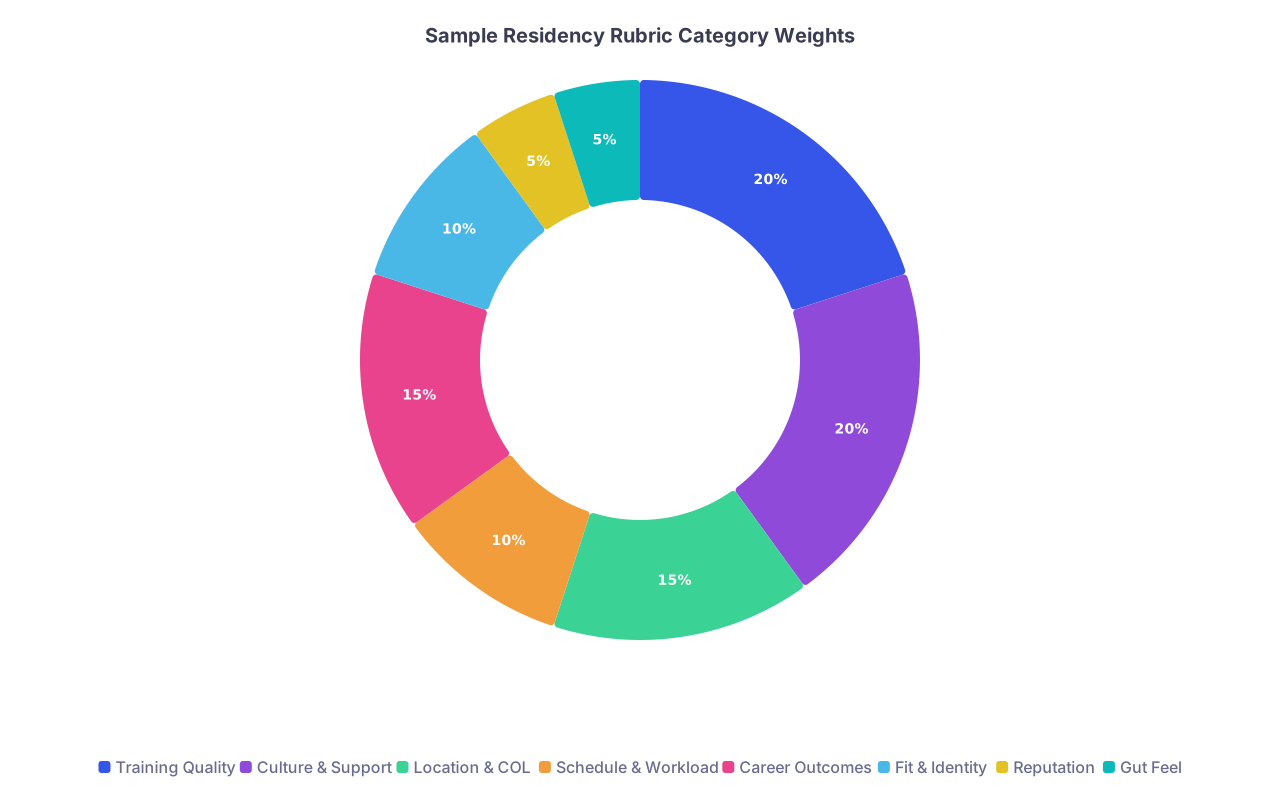
| Category | Value |
|---|---|
| Training Quality | 20 |
| Culture & Support | 20 |
| Location & COL | 15 |
| Schedule & Workload | 10 |
| Career Outcomes | 15 |
| Fit & Identity | 10 |
| Reputation | 5 |
| Gut Feel | 5 |
Look at that distribution. Ask yourself:
- “Would I sign a 3–7 year contract where my happiness is this weighted?”
- “Did I give more points to ‘Reputation’ than I am willing to admit out loud?”
- “Did I undervalue ‘Fit & Identity’ when I know being the only ______ in the room matters to me?”
If the chart does not match your actual values, fix it before you finalize rankings.
Step 11: Handle the Emotional Pressure Around Rank List Time
When you get close to certifying your list, everyone suddenly has strong opinions:
- PDs hinting you should rank them highly.
- Residents joking “See you here next year.”
- Parents pushing specific cities.
- Classmates flexing about “top tier” programs.
Your rubric is your shield.
When someone pushes you, mentally come back to these questions:
- Does their opinion change my category weights? If yes, do I agree with that change?
- Are they the ones working nights in this program? No? Then they do not get the final vote.
You designed the rubric before the pressure peaked for a reason. Trust that work more than last-minute noise.
Step 12: Example—Walking Through Two Hypothetical Programs
Let me show you how this plays out with concrete numbers.
Assume your weights are:
- Training Quality – 20%
- Culture – 20%
- Location – 15%
- Schedule – 10%
- Career Outcomes – 15%
- Fit/Identity – 10%
- Reputation – 5%
- Gut Feel – 5%
You score Program A vs Program B:
| Category | Weight | Program A (Urban, Prestigious) | Program B (Smaller, Supportive) |
|---|---|---|---|
| Training Quality | 0.20 | 5 | 4 |
| Culture | 0.20 | 2 | 5 |
| Location | 0.15 | 4 | 3 |
| Schedule | 0.10 | 2 | 4 |
| Career Outcomes | 0.15 | 5 | 3 |
| Fit / Identity | 0.10 | 2 | 4 |
| Reputation | 0.05 | 5 | 3 |
| Gut Feel | 0.05 | 2 | 4 |
Now calculate weighted scores (1–5 scale → composite):
Program A composite
= (5×0.20) + (2×0.20) + (4×0.15) + (2×0.10) + (5×0.15) + (2×0.10) + (5×0.05) + (2×0.05)
= 1.0 + 0.4 + 0.6 + 0.2 + 0.75 + 0.2 + 0.25 + 0.1
= 3.5 / 5 → 70 / 100Program B composite
= (4×0.20) + (5×0.20) + (3×0.15) + (4×0.10) + (3×0.15) + (4×0.10) + (3×0.05) + (4×0.05)
= 0.8 + 1.0 + 0.45 + 0.4 + 0.45 + 0.4 + 0.15 + 0.2
= 3.85 / 5 → 77 / 100
Program B wins on your own terms, even though A is “fancier.”
If, after seeing this, you still desperately want Program A on top, ask why. Maybe your real weight for “Reputation” is not 5% but 20%. Or maybe you are just seduced. Your call—but at least you are choosing consciously.
To make it even clearer, you can graph the two:
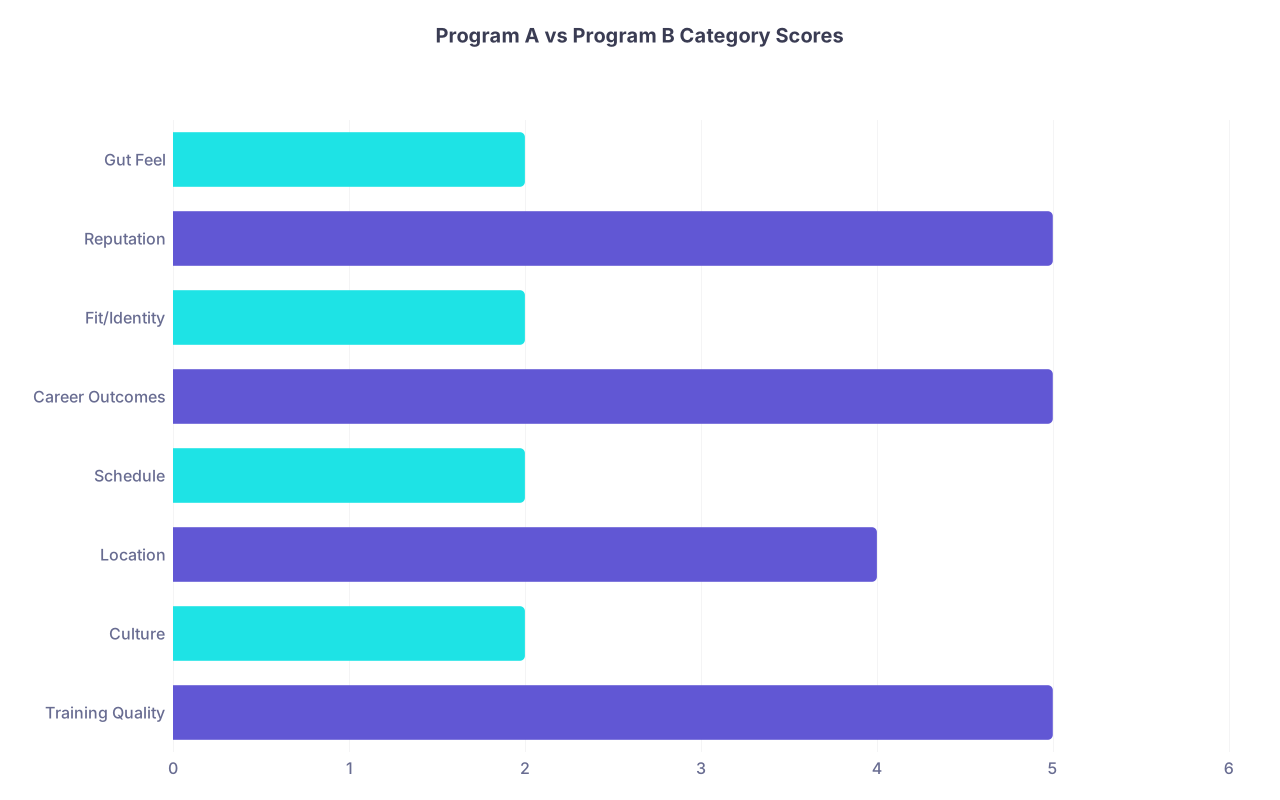
| Category | Value |
|---|---|
| Training Quality | 5 |
| Culture | 2 |
| Location | 4 |
| Schedule | 2 |
| Career Outcomes | 5 |
| Fit/Identity | 2 |
| Reputation | 5 |
| Gut Feel | 2 |
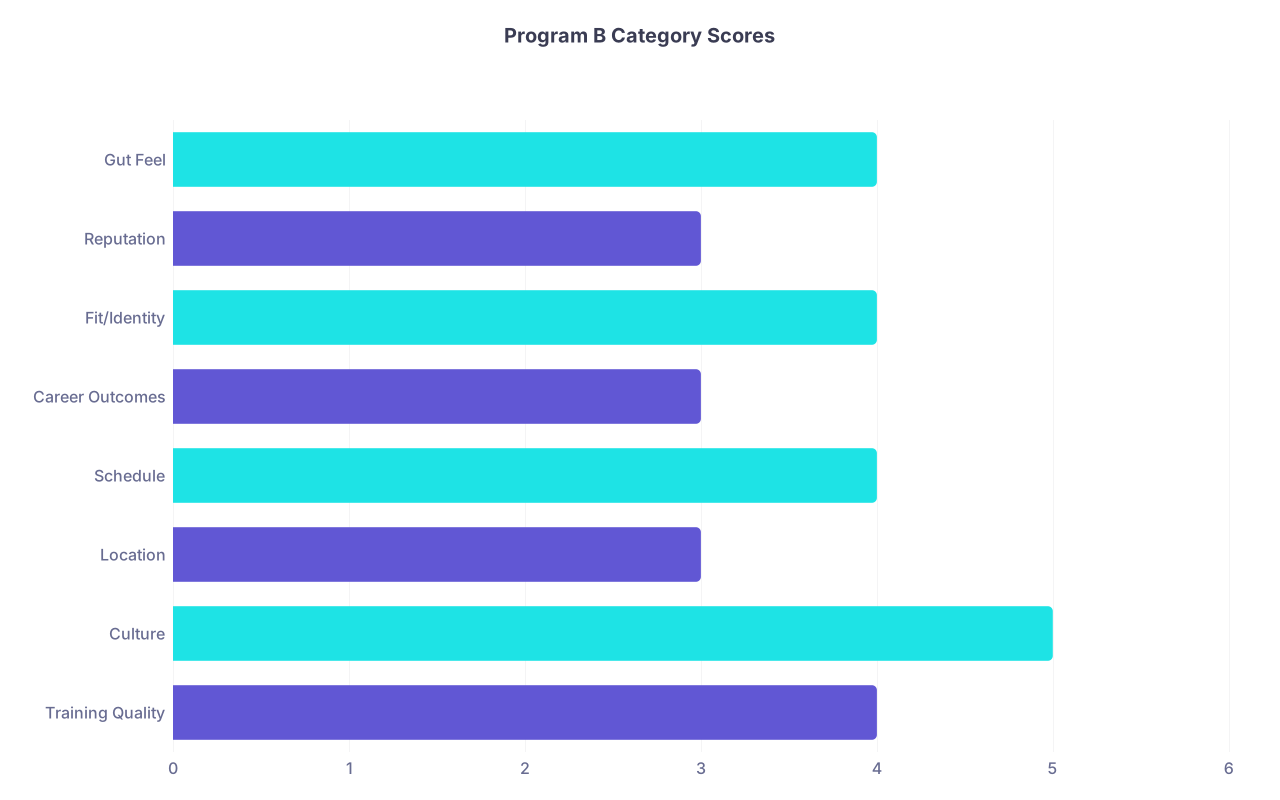
| Category | Value |
|---|---|
| Training Quality | 4 |
| Culture | 5 |
| Location | 3 |
| Schedule | 4 |
| Career Outcomes | 3 |
| Fit/Identity | 4 |
| Reputation | 3 |
| Gut Feel | 4 |
You see instantly: A is extreme—high highs and low lows. B is balanced and human. That visual alone has changed rank lists for more than one applicant I have worked with.
Step 13: Protect Future-You, Not Match-Day-You
Match Day is loud. Everyone stares at envelopes. Social media explodes.
You will be tempted to optimize for that one day’s story instead of the thousand days that follow.
A good rubric does the opposite.
It forces you to prioritize:
- Where will I learn the way I want to practice?
- Where will I be treated like a human being?
- Where will my relationships and health survive?
- Where will future opportunities still be open?
Your goal is not to impress your class on a single Friday in March. Your goal is to wake up in PGY-2 and not hate the person who made your rank list.
Your Next Step Today
Do this now, before you forget:
- Open a blank Google Sheet.
- Create columns for 8 categories that actually matter to you.
- Force your weights to add to 100%.
- Draft 1–5 definitions for at least “Training Quality,” “Culture,” and “Location.”
- Save the sheet with a serious name:
Residency_Rubric_[YourName].xlsx—not “random list.”
If you already interviewed somewhere, fill out one program from memory tonight. See what the numbers say. Let that be your first reality check.


