
Scared I Ranked a Toxic Program Too High: How Worried Should I Be?
You’re not crazy for panicking about this. You are overestimating how doomed you are.
Let me say this bluntly: the horror stories you’ve heard about “toxic” programs are real. There are places with malignant cultures, gaslighting attendings, endless scut, and zero support. And yes, you could end up at one even if you don’t want to.
But here’s the part nobody on Reddit says loudly enough: most of the time, the situation is not as irreversible, inevitable, or life-destroying as your 2 a.m. brain is telling you.
Let’s walk through this like two people who’ve both doomscrolled r/Residency and regretted it.
First: How the Match Actually Treats That “Too High” Rank
If you’re terrified you ranked a toxic program too high, what you’re really asking is: “Did I just trap myself?”
Short answer: no, not exactly. The algorithm doesn’t punish you for aiming high; it actually favors you. But you might have made your preference to go there more binding than you actually feel now.
Here’s the uncomfortable reality:
If you ranked them #2, that means:
- If your #1 ranks you high enough to match there, you’ll go to #1.
- If your #1 doesn’t rank you high enough, and that “toxic” #2 ranks you high enough, you will go there over every program below it.
- You cannot go to #3–#15 if #2 wants you and #1 doesn’t.
That’s what your anxiety is reacting to. Your list is locked. You can’t email NRMP and say, “Hey I changed my mind, that one felt weird, can you bump them down?”
You can’t.
But that doesn’t mean you’re completely helpless if you match there. We’ll get to that.

| Step | Description |
|---|---|
| Step 1 | You submit rank list |
| Step 2 | NRMP tries to place you at #1 |
| Step 3 | You match at #1 |
| Step 4 | NRMP tries #2 |
| Step 5 | You match at #2 |
| Step 6 | NRMP tries #3, then #4, etc. |
| Step 7 | Does #1 rank you high enough? |
| Step 8 | Does #2 rank you high enough? |
What’s done is done. The only useful question now isn’t “Did I screw up?” It’s:
If I do match there, how bad is it really—and what can I do about it?
Reality Check: How Toxic Are We Talking?
Let’s separate what you think might be toxic from what’s actually a nuclear red flag. Your brain loves to mash them all into one catastrophic mess.
Here are some examples I’ve seen or heard from applicants:
- Scenario A: “The PD seemed cold. I didn’t really click with residents. Interview day felt stiff. But they had decent fellowship matches and people seemed busy but fine.”
- Scenario B: “Residents kept saying ‘we’re like family’ but looked exhausted. A chief quietly said ‘it’s survivable.’ One person hinted there was a lot of yelling but ‘you get used to it.’”
- Scenario C: “Two residents independently warned me not to rank them high. One said people cry in the stairwell routinely. There’s known bullying, retaliation for speaking up, recent mass exodus, or probation.”
Those are not the same.
If your nervous system is melting down over Scenario A, that’s anxiety doing its usual “let’s assume the absolute worst” trick. Is it your dream program? Probably not. Is it high risk of being truly malignant? Probably not either.
If you’re closer to Scenario C, ok—this is more serious. That’s what I’d call a high-risk environment that could genuinely harm your mental health, career trajectory, or both.
The problem is: right now, before Match, you actually don’t know which one you’re in. You’re reconstructing from a 6-hour contrived interview day on Zoom plus gossip.
So be honest: are you reacting to hard evidence or your brain replaying 3 awkward silences and one bad vibe?
How Common Is It to End Up Somewhere “Not Great”?
More common than people admit. A lot of residents are not at their #1 dream program. Some aren’t thrilled. Some are outright unhappy. And still:
Most people complete residency.
Most people survive.
A non-trivial number actually end up liking places they originally doubted.
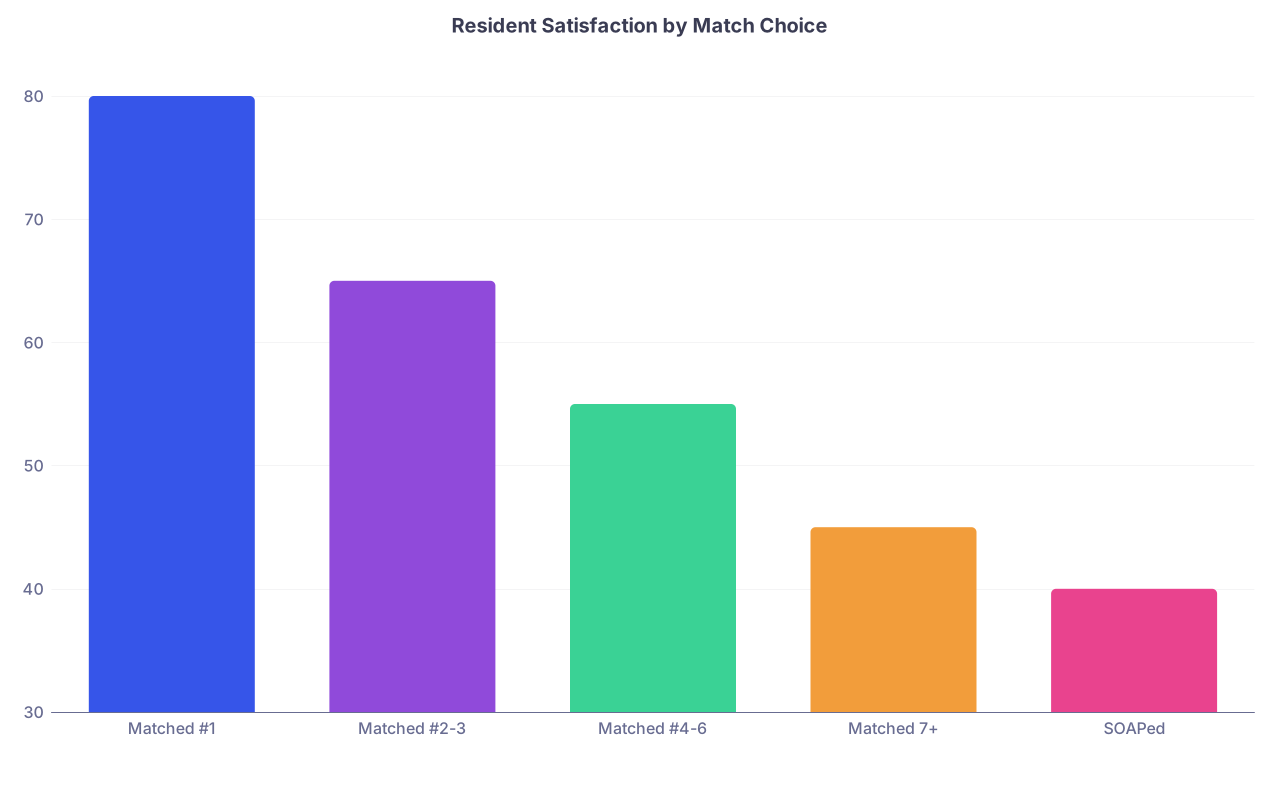
| Category | Value |
|---|---|
| Matched #1 | 80 |
| Matched #2-3 | 65 |
| Matched #4-6 | 55 |
| Matched 7+ | 45 |
| SOAPed | 40 |
Those numbers are fake but the pattern is real: satisfaction drops the further down your list you go, but it’s not 0. And even people who SOAP end up okay more often than your anxiety will ever allow you to believe.
Your nightmare scenario is: “I matched at this toxic program, I can’t get out, my life is over.”
The reality is usually more like:
- “This place is rougher than I wanted.”
- “There are some toxic people and systems.”
- “I’m not thriving, but I’m learning, and I’m starting to plan my exit/next step.”
Is that fun? No. Is it the end of your career? No.
Worst-Case Scenario: You Match at the Program You’re Scared Of
Let’s go straight into the fear, because that’s where your brain is living anyway.
Imagine: Match Day comes. You open your email. It’s them.
Stomach drops. Everyone’s yelling around you. You’re trying to fake a smile while a part of you is screaming, “Oh God I’m stuck.”
You’re not stuck.
You are committed to starting there PGY-1 (barring extreme circumstances). But you have more power and options than you think.
Here’s what residents at difficult programs actually do in real life:
They find the safe people early.
Every malignant program still has a few attendings or upper-levels who are normal, kind, or at least not insane. You cling to them. You ask them for advice. You use them as references later.They document.
If something truly abusive or unsafe happens, you keep dates, times, emails. Not because you’re going to war every day, but because your future self might need a record if things get bad enough to consider transferring or reporting.They protect their sanity in small, almost boring ways.
Good therapist. Sleep the moment you get a chance. Eat actual food sometimes. One non-medicine thing that is yours—gym, music, TV trash, whatever. Not because “wellness,” but because you need your brain intact.They keep their long game in sight.
You are not signing a 20-year contract. You’re talking 3–7 years depending on specialty. Painful? Yes. Permanent? No. There are residents who’ve come out of terrible programs and still matched into solid fellowships, academic roles, private practice positions.Sometimes, they transfer.
Transfers are not common and they’re not easy. But they happen. Usually after PGY-1, sometimes later. It requires PD support (or at least not sabotage), open positions, and a lot of work. But it is not impossible.

None of this makes toxicity okay. It just means that if the worst happens and you end up there, you’re not helpless. You’re not being thrown into a dungeon with no keys.
You’d be in a bad situation that you can strategize around.
How Much Damage Can a Toxic Program Actually Do?
You’re probably imagining three specific disasters:
- It will destroy my mental health.
- It will ruin my fellowship/job prospects.
- It will make me hate medicine forever.
Let’s be brutally honest.
1. Mental Health
A bad program can absolutely wreck you if you go in with no boundaries, no support, and no exit plan. I’ve seen interns lose weight, hair, relationships, all of it.
But here’s the nuance: residency itself is brutal, even at “good” programs. A toxic program increases the risk, but your outcome isn’t predetermined.
Residents who make it through with some sanity intact usually:
- Stop trying to impress everyone and focus on survival + competence.
- Accept that they might not be their best selves for a few years.
- Talk to someone outside the program regularly who can remind them they’re not crazy.
2. Fellowship / Career
Program reputation matters. But it’s not everything.
If you’re at a rough community program with a sketchy culture, it can still produce strong clinicians. If you show up, do good work, build a couple of real relationships, and maybe do a project or two, you can still match into a good fellowship or get a solid job.
If you’re going into something super competitive (Derm, Ortho, Plastics), then yeah, being at a malignant, no-research, no-support program is a bigger hit. But you already knew that when you applied. Many people in those fields come from less-than-ideal residencies and compensate by hustling for connections, case logs, and external research.
3. Losing Your Love for Medicine
This is the fear under all the other fears.
Could it happen? Yes. Residency everywhere pushes people to that edge. A toxic environment makes it worse.
But your love for medicine is not a fragile thing that evaporates after one bad block or one screaming attending. It bends. A lot. Sometimes almost to breaking. And then, annoyingly, some tiny good moment (a patient, a procedure, a thank-you) pulls you back just enough to keep going.
I’m not going to sugarcoat it: a malignant program makes everything harder. But it doesn’t erase who you were before Match. Or who you can still become after it.
What You Can Actually Do Right Now (Pre-Match)
You can’t change your rank list. But you can change how you’re going to handle whatever envelope you open on Match Day.
Focus on three things:
1. Get Clear on What You’re Afraid Of
Write it out. Literally. “If I match at Program X, I’m scared that ___ will happen.”
Then ask yourself: which of those are:
- Confirmed by actual data or repeated reports?
- Just gaps in info that my brain is filling with the worst-case scenario?
- Completely made up catastrophes (“I’ll never match a job, nobody will ever respect me”)?
Naming it doesn’t fix it. But it shrinks the monster from “my life is ruined” to “ok, here are 3–4 concrete risks I might have to manage.”
2. Identify Your Non-Negotiables
If you do land there, what are your lines?
- “If my safety is compromised, I’ll report and/or look into transferring.”
- “If my depression/anxiety spirals past X point, I’ll get professional help and loop in someone I trust.”
- “If I’m being persistently abused by a specific person, I won’t gaslight myself into thinking I deserve it.”
You’re allowed to set boundaries, even as an intern. They may not always be respected externally, but they matter internally.
3. Build Your Support Team Before Match
Text 2–3 people you trust and say something like: “Hey, Match is coming up and I’m kind of scared I may end up somewhere I’m not thrilled about. If that happens, I might need you to remind me I’m not a failure and help me think through next steps.”
That way, if the worst happens, you’re not starting from zero. You already have people queued up to help pull you out of the spiral.

The Thing Nobody Tells You About “Toxic” Programs
Some of the strongest, most capable, battle-tested physicians I’ve met trained at what they openly call “garbage fire” programs.
They didn’t like it. They don’t romanticize it. But they also aren’t broken beyond repair.
You know what they have?
- Thick skin (the healthy kind, not the shut-down kind).
- Very sharp clinical instincts because they were constantly in the trenches.
- A crystal-clear idea of what not to recreate wherever they end up working.
Would I choose that path for you? No. If we could rewind and help you reorder your list, maybe we would. But we can’t.
What we can do is accept this:
Even if you accidentally ranked a truly bad program too high, that mistake does not equal “I ruined my life.” It equals “I might have a rougher training experience than I wanted, and I’ll need a strategy to get what I can out of it and get out.”
You’re allowed to be scared. Just don’t confuse “this will be hard” with “this will be fatal.”
Tiny But Concrete Things You Can Do Today
- Write down the 3 programs on your list you’d feel okay about. Not ecstatic, just okay. Remind yourself that there’s a real chance you’re going to one of those instead of the nightmare scenario your brain is locked onto.
- Draft a short, compassionate note to your future self on Match Week: “If we matched somewhere we don’t love, it doesn’t mean we failed. It just means the path is messier. We’re still going to become a doctor.” Save it on your phone.
- Decide one person you’ll text the moment you see your Match result—no matter what it is.
That’s how you take some control back.
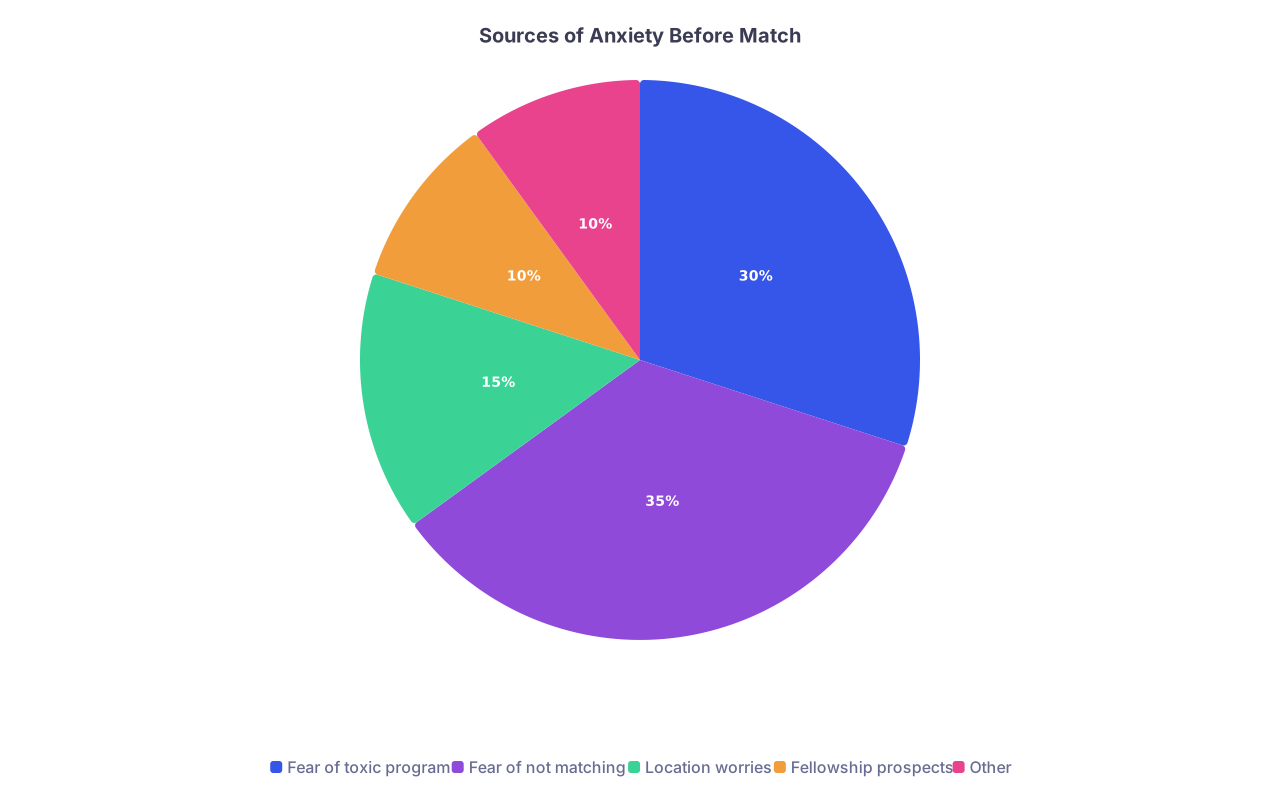
| Category | Value |
|---|---|
| Fear of toxic program | 30 |
| Fear of not matching | 35 |
| Location worries | 15 |
| Fellowship prospects | 10 |
| Other | 10 |
FAQ: Scared I Ranked a Toxic Program Too High
1. Can I change my rank list after the deadline if I realize a program is toxic?
No. Once the NRMP rank order list certification deadline passes, it’s locked. They don’t make exceptions because you “changed your mind” or heard new gossip. It sucks, but it’s also what keeps the system from becoming chaos. Your energy is better spent planning how you’ll cope if you land there, not fantasizing about appealing the algorithm.
2. If I match at a malignant program, can I realistically transfer?
Yes, but it’s not simple or guaranteed. Residents do transfer, usually after PGY-1, often into open spots created by attrition at other programs. You’ll need: reasonably clean record, someone willing to vouch for you, an open position, and a receiving PD who believes you. It’s possible, especially in larger, less competitive fields. It’s just not something you can bank on as Plan A.
3. Will a bad program ruin my chances at a good fellowship?
Not automatically. Fellowship directors care about: strong letters, your performance, any projects/research, and how you interview. Coming from a less prestigious or tough program means you might need to hustle more for mentorship and scholarly work, and you may need to explain your context. But plenty of people from mid-tier or even chaotic residencies still land great fellowships. It’s harder, not impossible.
4. How do I know if I’m overreacting versus genuinely at risk?
Ask yourself: do I have concrete, repeated red flags (multiple residents warning me, known probation, consistent stories of abuse), or mostly vibes and what-ifs? Anxiety will treat both like five-alarm fires, but they’re not equal. If it’s all based on one awkward Zoom interview and a vague rumor, you’re probably catastrophizing. If you’ve heard the same serious concern from several independent sources, then yes, it’s a higher-risk environment—but still one you can survive with support and a plan.
Open your rank list screenshot on your phone right now. Look at that one program you’re fixated on and then ask yourself: “If I do end up there, what’s my survival and exit strategy?” Write down three concrete moves you’ll make in your first three months there. Don’t wait until Match Day panic to figure it out.