
It’s late. Like 1:37 a.m. late.
Your rank list is submitted. ERAS is closed. NRMP says “Certified.” Green check mark. Done.
But your brain? Absolutely not done.
Now you’re lying in bed replaying that list in your head on a loop:
“Why did I rank that program #2? Should I have put my home program higher? What if I hate my #1? What if I don’t match because I was too aggressive? Can I change it? Is it over?”
Let me just say it out loud: you are not the only one who has stared at that green check mark and immediately felt sick.
Let’s walk through what’s actually possible, what’s fantasy, and what to do if the regret spiral is already at full speed.
First: Can You Actually Change Your Rank List?
Short answer: sometimes yes, often no, and it depends where you are in time.
The only real line in the sand is the NRMP Rank Order List Certification Deadline. Before that deadline, your “certified” list is not sacred. It’s just the latest version.
If you’re before the official NRMP deadline:
- You can log back in.
- You can un-certify, change the list, and re‑certify.
- You can do this as many times as you want.
If you’re after the certification deadline:
- You cannot change it.
- You cannot email and ask them to “fix one small thing.”
- You cannot call and say, “I clicked the wrong thing” and expect them to rearrange it.
They treat that deadline like a brick wall. I’ve seen people beg. It doesn’t move.
Here’s how this usually plays out:
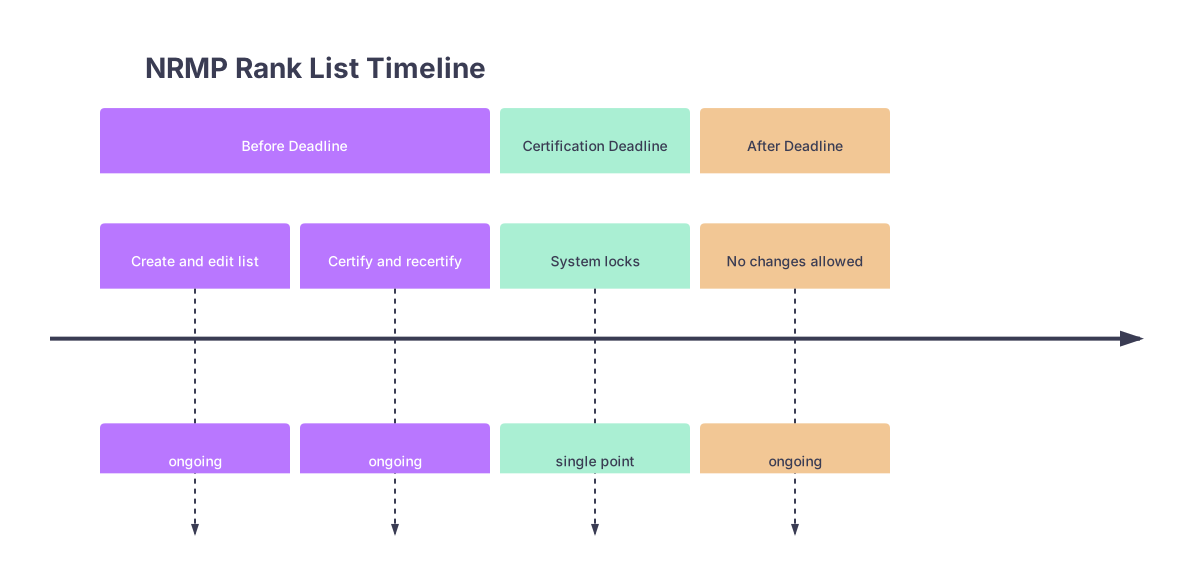
| Period | Event |
|---|---|
| Before Deadline - Create and edit list | ongoing |
| Before Deadline - Certify and recertify | ongoing |
| Certification Deadline - System locks | single point |
| After Deadline - No changes allowed | ongoing |
So your first job, before spiraling too far:
Check the actual deadline and current date. Not what you think the deadline was. The real one, on NRMP.
If you’re still before that time, you’re not “stuck” yet. If you’re past it, yeah, we’re talking about a different kind of problem.
If You’re Before the Deadline and Panicking
Let’s say it’s three days before the deadline and you suddenly feel like your list is totally wrong.
You have three main categories of anxiety:
- “I ranked too aggressively; I won’t match.”
- “I ranked too conservatively; I’ll match but be miserable.”
- “I put the wrong program first; my true favorite is lower.”
Here’s the harsh but useful piece: the match algorithm is actually on your side if you’re honest about your preferences.
You don’t lower your chances of matching by ranking your true favorite #1. You only lower your happiness if you lie to yourself.
The thing that messes people up is fear of “wasting” a top spot. Like:
“If I rank this reach program #1 and don’t match there, I’ve screwed myself.”
No. That’s not how it works. If that program doesn’t want you, the algorithm acts like you never ranked them and moves on to #2. You lose nothing by swinging for your actual top choice.
So if your regret is:
“I ranked Program X higher because I thought it was safer, but I actually like Program Y more”…
you should fix that. Before the deadline, fix it.
Not because of some magical optimization trick. Because five years from now, when you’re rounding at 4:30 a.m., you don’t want to be thinking, “I never even gave myself a chance to be at the place I actually liked.”
What I usually tell people:
- If your change is driven by new real information (program lost accreditation, leadership changed, resident horror stories from trusted sources): that’s a good reason to adjust.
- If your change is driven by pure fear of not matching but nothing new about the programs themselves: be very cautious about rearranging everything.
You’re sleep-deprived, stressed, and emotionally frayed. That is not the version of you that should completely redesign your rank list at 2 a.m. Sometimes the right move is: touch nothing, close the laptop, walk away.
If You’re After the Deadline: You’re Actually Stuck. Now What?
Okay. This is the worst-case scenario running on repeat in your head:
- “I submitted the wrong list.”
- “I forgot to rank my home program.”
- “I left a program off on accident.”
- “I put my #3 as #1 because I was rushing.”
And the deadline is gone. System locked.
No sugar-coating: you cannot change the certified list once that deadline passes. NRMP is extremely strict about this because if they start making exceptions, the whole system becomes a mess. I’ve seen:
- People claim a “technical glitch” when it was just user error.
- People try “I was having a panic attack” as a reason.
- People get their dean to email NRMP.
It doesn’t work. They will quote policy, politely but firmly, and that’s it.
So you’re left with two buckets of problems:
- I regret the order, but it’s still a valid, reasonable list.
- I made a truly catastrophic mistake (e.g., left off every realistic backup).
For bucket 1:
This is emotional pain, not a structural disaster. You might end up at your #2 instead of your #1. Or #4 instead of #2.
You will not like this sentence, but it’s true: years later, most residents can’t imagine having gone anywhere else. People grow into their programs. The “second choice” becomes “my program.” I’ve watched that happen over and over.
For bucket 2 (the true nightmare scenario):
You may have seriously increased your risk of not matching. But that’s not the same as guaranteeing it. You only need one program to like you enough.
And if you really don’t match? There’s SOAP. It’s not pretty, it’s not fun, but it’s not the end of a career either. I’ve seen SOAPed residents become stellar attendings in competitive subspecialties.
None of that makes this feel better tonight. But it does mean this isn’t “I ruined my entire life” territory, even if your brain insists it is.
How Common Is Regretting Your Rank List?
More common than people admit out loud.
You only see the loud, confident ones on Reddit and group chats:
“Locked my list last week, 100% happy, no regrets.”
Cool. Good for them.
But privately?
- I’ve had students sob in my office the morning after locking their list.
- I’ve seen people re-open their list six times before the deadline, then still question it.
- I’ve watched chiefs say, “If I had known how much I’d love this city, I would’ve ranked this program higher.”
Here’s the reality: you are choosing a future self with incomplete information. Of course it feels awful. You don’t really know what your priorities will be in two years. Or what programs will be like after leadership changes. Or how it’ll feel to be 2000 miles from your support system.
You did the best you could with the data you had at the time. That’s not a comforting cliché; that’s literally the process.
To put some structure on the fear:
| Regret Type | How Bad It Usually Is |
|---|---|
| Ranked #2 higher than true #1 | Annoying, rarely fatal |
| Left off one mid-tier backup | Small increase in risk |
| Overweighted prestige | Quality of life hit possible |
| Underweighted location/support | Harder but survivable |
| Very short reach-heavy list | Real increased no-match risk |
The only really dangerous pattern is: very short list + mostly reach programs. That’s when the regret about “I should’ve added more safeties” might translate into actual non‑match.
But again, that’s risk. Not destiny.
What If I Matched at a Program I Regret Having Ranked High?
This is next-level anxiety: pre-regretting your match.
“I just know I’m going to match at the one program I’m freaking out about now.”
Two hard truths:
- Once you match at a program, you’re expected to go there.
- Trying to back out after matching is messy, can burn bridges, and sometimes involves NRMP violations.
Can people ever change programs later? Yes, but it’s rare and ugly. You’re talking about:
- Finding an open PGY-2 spot in the specialty.
- Your current program agreeing to let you leave.
- The receiving program willing to take a transfer.
- No gap in funding or training.
Most people don’t move. They make it work where they are.
But “make it work” is often better than you think. Residents:
- Build their friend group in unexpected places.
- Discover they like community programs more than big names.
- Realize being near family is worth more than the research infrastructure.
- Grow into a specialty or program culture they weren’t originally obsessed with.
There’s a quiet truth program leadership will admit when the doors are closed: a lot of residents end up happy at places that were not their original dream program.
Rank regret feels huge now because the match is the entire universe of your life at the moment. Once you’re actually a resident, the universe becomes patients, co-residents, attendings, sleep (what’s left of it). The emotional volume on “I wish I had ranked X over Y” usually drops.
Coping With the Spiral: Concrete Things You Can Do Tonight
You’re not going to fully stop worrying. Let’s be honest. But you can redirect it into something slightly more rational.
If you’re still before the deadline:
- Re-read your rank list once, slowly, when you’re not exhausted. Daylight hours if possible.
- For each program, ask yourself: “If I wake up on Match Day and see this program’s name, will I be more relieved or disappointed?”
Order them by that. - Make any changes you feel confident about when you’re calm. Not changes driven by 3 a.m. doomscrolling.
- Re-certify. Screenshot. Step away.
If you’re already past the deadline:
You’re in damage-control + perspective mode.
- Write down what scared you into regretting it: location, program vibe, reputation, whatever.
- For each fear, force yourself to write one way you could cope if that worst-case scenario happened. Not fix it completely. Just cope.
Example: “If I’m far from family → I’ll schedule regular Facetimes and plan visits with my first three weekends off.”
It sounds stupidly small, but your nervous system wants you to believe “If X happens, I will be completely helpless.” When you write out real, practical coping options, that lie loses some power.
Also, this is big: stop hunting for absolute certainty on Reddit or SDN. You’ll find some PGY‑3 somewhere saying, “Matching at my #4 ruined my life,” and your brain will glue itself to that one story.
People who hate their situation shout louder online than the ones who are quietly fine.
How the Match Algorithm Actually Treats Your “Mistakes”
Let’s tackle one more persistent fear:
“I messed up the order and the algorithm will punish me.”
The algorithm does not punish you for over-ranking a program that doesn’t want you. It just skips past them.
Where you can hurt yourself is by ranking a place you don’t actually want above a place you do want. Because if both would have ranked you high enough to match, the algorithm will give you the higher-ranked one, even if your real self would’ve preferred the other.
So yes, if you forced yourself to rank that “prestige” program above your true favorite community program purely out of ego, you might end up somewhere you don’t love as much.
But that’s not a mathematical trap. That’s a values trap. And if you’re already past the deadline, all you can do is:
- Acknowledge that you made the best decision you could at the time with the identity you had then.
- Commit that once you land somewhere, you’re going to squeeze every ounce of training, mentorship, and opportunity out of that place.
The contrarian thing no one says: a lot of “lower tier” programs have phenomenal teaching and very humane cultures. A shiny name on paper doesn’t fix a malignant environment.
Quick Reality Check: Your Chances Probably Aren’t As Ruined As You Think
You may be silently doing this calculation in your head:
“I changed my list like an idiot → I’ll probably not match → I’ll never practice medicine → my life is over.”
Look at how your brain just skipped twenty steps and assumed the absolute worst outcome in every single one.
Actual pathways look more like:

| Step | Description |
|---|---|
| Step 1 | Submit Rank List |
| Step 2 | Start Residency |
| Step 3 | Train and Graduate |
| Step 4 | Adjust, Cope, Seek Changes |
| Step 5 | SOAP or Reapply |
| Step 6 | Start Different Program |
| Step 7 | Research/Prelim/Gap Year + Reapply |
| Step 8 | Match? |
| Step 9 | Love It? |
| Step 10 | SOAP Match? |
There are multiple off-ramps that still end in you being a practicing physician.
We can throw some numbers at your anxiety too:
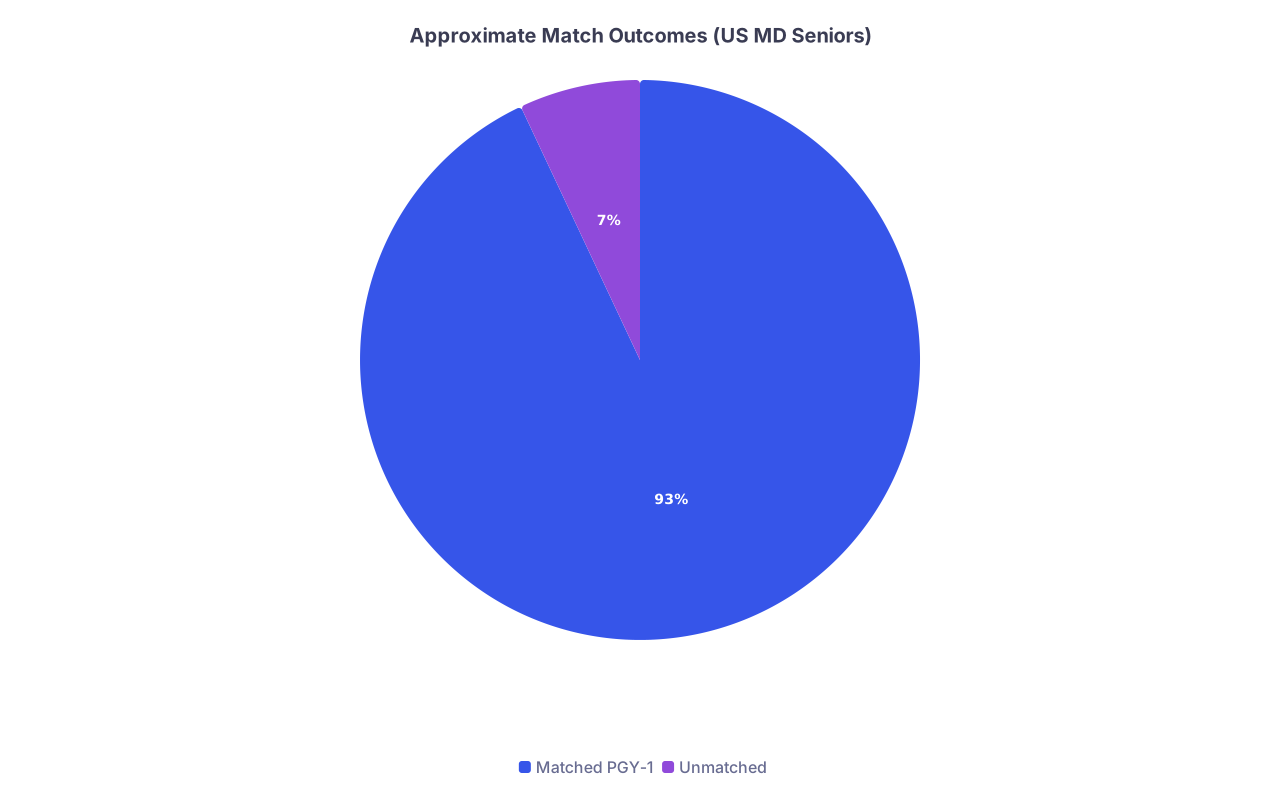
| Category | Value |
|---|---|
| Matched PGY-1 | 93 |
| Unmatched | 7 |
These numbers shift a bit year to year and are different for DO and IMG applicants, but the point stands: the majority of people match somewhere.
Does a risky rank list increase your odds of being in that 7%? Possibly. But 7% is still 7%, not 70%.
FAQs
1. Can I email or call NRMP to change my rank list after the deadline?
You can contact them. They will almost certainly say no. They are bound by their own policies, and they enforce them strictly to keep the system fair. The only exceptions are true system errors on their end, not regret or user mistakes. I’ve yet to see “I clicked the wrong button” lead to a changed rank list.
2. What if I realize after the deadline that I forgot to rank a program I really liked?
Then that program cannot match you. Period. It’s painful, but that’s the rule. Your focus needs to shift from “I lost that one program” to “Do I still have enough reasonable options on my list to likely match somewhere?” Torturing yourself over the one that got away won’t change the algorithm’s behavior.
3. Will programs know how I ranked them or that I regret my list?
No. Programs never see your actual rank order list. They only know whether you matched there or not. They don’t see “You ranked us #5” or “You meant to put us #1.” Regret lives entirely in your head; it doesn’t leak into the official process unless you start emailing things you shouldn’t (don’t do that).
4. What’s one concrete thing I can do to feel less terrified right now?
If you’re before the deadline: log into NRMP tomorrow during the day, read your list once, ask yourself honestly if the order matches where you’d actually want to go, fix only the things you’re sure about, re-certify, and close it.
If you’re after the deadline: write down your top three “what if” fears about where you might match, and for each one, list two specific ways you would cope or build support if that happened. Put the paper in a drawer. You just proved to yourself that even your worst-case scenarios have survivable paths.
Open your rank list (or your memory of it) right now and pick just one program that scares you the most. Ask: “If I end up here, what’s one thing I can do in the first month to make this livable?” Write that down. Give your brain a plan instead of a blank space to catastrophize into.