
Last February, a classmate pulled me into an empty call room, shut the door, and whispered, “I think I screwed up my rank list. I didn’t rank my home program high enough. Am I basically unmatched now?” She’d already submitted. No take-backs. And you could see it in her eyes—that sickening “I broke my whole future with one click” panic.
If you’re here, you’re probably doing the same math in your head. Replaying what you should have done. Trying to figure out if not ranking your home program higher just detonated your chances of matching at all.
Let’s walk straight into the scary part and untangle it.
First: Are You Actually Screwed?
Let me be blunt: not ranking your home program “high enough” almost never ruins your match by itself.
Home programs are not magical safety nets that only work if you put them in your top 1–3. The algorithm doesn’t say, “Oh, your home program is low on your list? Goodbye, you’re doomed.”
The match doesn’t care what’s “home.” It only cares about:
- Your rank list (your order of preference)
- Programs’ rank lists (their order of preference)
- Where there’s mutual interest high enough on both sides
That’s it. No sentimental bonus points for where you did your core rotations. No penalty for hurting your PD’s hypothetical feelings.
Where things feel terrifying is this: your home program is often the place most likely to rank you high. So the fear sounds like:
“I put them at #8. If I don’t match at 1–7, what if they already filled their spots before it even gets to my #8?”
That’s not how it works.
The algorithm tries to give you the most preferred program that also wants you. It tentatively matches you higher on your list first, and if those fall through, it slides down. A program doesn’t “fill” before your lower options get a chance if they’ve ranked you.
If your home program likes you enough to rank you in a spot that would have matched you at all, you’ll still match there even if they’re #8 on your list—as long as all your #1–7 fall through.
So the honest version is:
- If you’re rankable at your home program, you haven’t “lost” them just because they’re not near the top.
- If they weren’t going to rank you high enough to match, putting them #1 wouldn’t have saved you anyway.
That doesn’t mean there are no consequences. It just means it’s not the apocalypse your 3 a.m. brain is screaming about.
How the Algorithm Actually Treats Your Home Program
Let me spell this out in painful detail because this is where everyone’s anxiety comes from.

| Step | Description |
|---|---|
| Step 1 | Applicant Rank List |
| Step 2 | Try #1 Program |
| Step 3 | Temporary Match at #1 |
| Step 4 | Try #2 Program |
| Step 5 | Try #3, #4, etc... |
| Step 6 | Temporary Match at lower choice |
| Step 7 | Re-check as programs fill |
| Step 8 | Final Match Result |
The algorithm is applicant-proposing, which is a nerdy way of saying: it favors you more than programs.
Here’s what that means in real life:
- It starts with your #1. If that program also ranked you high enough and still has a slot, you’re tentatively matched there.
- If later, that program “prefers” another student over you, you might get bumped—but then you drop to #2, and it tries that.
- This continues down the list, always trying to keep you at the highest possible choice where both sides rank each other high enough.
Your home program is just another name on that list. If you ranked it 8th:
- The algorithm doesn’t care that you rotated there or know all the residents.
- It only cares: does your home program’s list put you high enough to claim a spot once you get down to #8?
If yes: you get them.
If no: you weren’t getting them no matter where you put them.
So the fear of “they’ll fill before they even get to me” is usually code for: “I don’t really understand the algorithm and my brain filled in the gap with catastrophe.”
You’re not wrong to worry. You’re just imagining the wrong mechanism of failure.
Real Consequences of Ranking Home Lower (When It Can Hurt)
Now the part you probably actually want to know: when can ranking your home program lower cause real damage?
Two main scenarios.
1. When you treated home as “too safe”
This is the classic trap:
- You think: “They know me. They’ll rank me high. I’m basically guaranteed there if everything else fails.”
- So you rank a bunch of reach or “aspirational” programs ahead of them.
- You assume your home program is your floor.
But sometimes your home program isn’t that into you. Or they like you, but not “above all the other strong internal and external applicants” like you thought.
So what happens?
- You don’t match at your higher choices (too competitive, too few spots, etc.).
- You slide down to your home program, but on their list, you’re lower than you imagined.
- By the time the algorithm checks if you fit there, they’re already committed to other applicants they ranked higher.
- You continue sliding down to #9, #10, #11…
Here’s the brutal twist: this would have happened even if your home program was #2. Because the limiting factor was their rank of you, not where you put them.
Where it can matter slightly is the probabilistic mess of who else they matched first. But the main pain is miscalibrating your whole list around an assumption: “home will catch me.” When it’s not actually that solid.
2. When your entire list is very top-heavy
This is where I really see things crack:
- Step scores on the lower side for the specialty
- Limited interview numbers
- Mostly very competitive academic programs high on the list
- Home program somewhere mid–low because “I wanted to shoot my shot”
You might still be fine. But if both of these are true:
- You have fewer interviews than your specialty’s usual “safe” range
- You used your home program as emotional backup instead of realistic backup
…then yeah, ranking them lower increases the anxiety and the theoretical risk.
Not because the algorithm punishes you. But because you’ve given more “priority space” to programs that were never going to rank you high enough in the first place—while the one program that might is sitting lower down.
That said, this is still probability, not destiny. People in that situation match every year. I’ve watched students with 8–10 interviews in IM match their #6 or #7 and still end up perfectly okay.
The Emotional Terror: Will My Home Program Hate Me?
This is the part nobody says out loud but everybody thinks:
“What if my PD somehow finds out I ranked them low and then they’re offended and drop me down or don’t rank me at all?”
Here’s the unvarnished version.
- Do not see your rank list. Ever.
- Are too busy to play mind-reader about where you put them.
- Care way more about: how you performed, what their residents said about you, how your letters look, and whether they see you as a good fit.
The paranoia is understandable. You had dinner with the residents. Someone said, “We’d love to keep you here.” The PD said, “You’d be a great resident for us.” You smiled and nodded and then… put them at #7.
It feels disloyal. Like they’re going to somehow “know.”
They’re not. The match system is specifically designed so no one knows how anyone ranked them. On purpose. To prevent exactly this kind of emotional blackmail.
Could a program try to infer based on signals? Sure, sometimes they guess. But by the time they submit their list, they’re ranking you on their priorities, not on some imagined slight.
So, no, you didn’t quietly nuke your home program’s affection by putting them lower. That’s your guilt talking, not the system.
What If I Don’t Match at My Home Program?
This is where the late-night doom spiral usually ends:
“I didn’t rank my home program high enough → I won’t match there → I’ll end up somewhere awful → I’ll hate my life → I’ll never fellowship → career over.”
Let’s slow that chain reaction down.
Here are a few anchored truths:
Not matching at home ≠ failure.
There are residents all over the country who did rank their home #1 and still didn’t match there. Or never even got an interview there. They’re doing just fine at places they barely knew existed before ERAS.Most programs are not secretly terrible.
You’ve probably built this internal tier list where your home is “safe and familiar,” 1–3 are “dream,” and everything below feels like social death. That’s not how your future self will see it. Your day-to-day life will be shaped by your co-residents, leadership, and culture, not by whether your badge has your med school’s logo on it.Fellowships do not care as much as you think where you did residency, as long as you train well.
I’ve seen cardiology fellows who trained at community IM programs. I’ve seen derm and ortho folks from “no-name” residencies. What mattered: performance, letters, and sometimes research. Not whether they stayed home.If things really go sideways (SOAP, etc.), it’s humiliating but survivable.
Worst-case scenario does not equal “game over.” I’ve watched SOAP-ers land in solid programs, grind hard, and end up exactly where they wanted specialty-wise.
So if you don’t end up at your home program, even if part of you wanted that comfort, that doesn’t mean you misplayed your entire career. It just means your path isn’t the straight, tidy version.
Welcome to medicine. None of our paths are tidy.
Some Numbers, Just to Ground Your Panic
You don’t need a full stats lecture. Just a reality check.
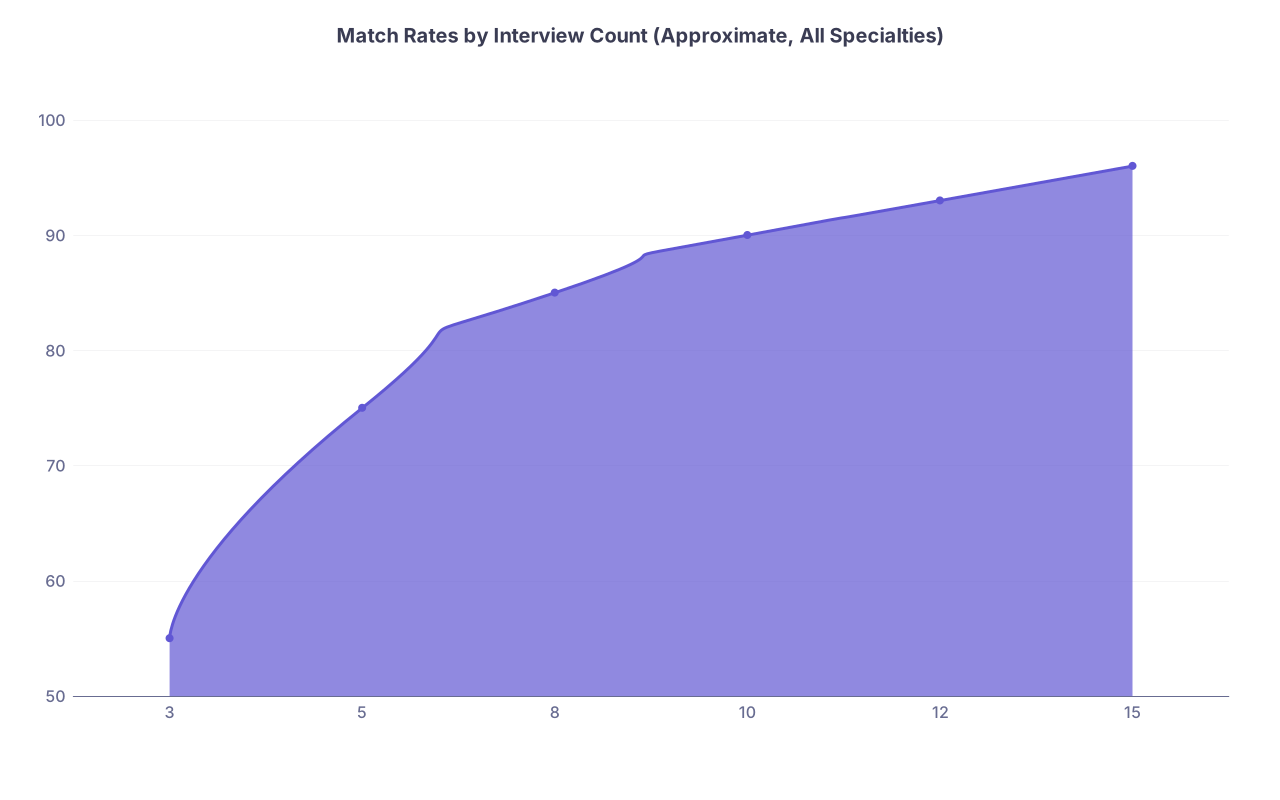
| Category | Value |
|---|---|
| 3 | 55 |
| 5 | 75 |
| 8 | 85 |
| 10 | 90 |
| 12 | 93 |
| 15 | 96 |
This is rough, but consistent with NRMP data over the years:
- Around 8–10 interviews for most non-ultra-competitive specialties = very high chance of matching somewhere.
- Where you match on your list is heavily influenced by your preferences, not just “where will take me.”
Your home program is one node in that system. Valuable, yes. But not your only lifeboat.
If You’ve Already Submitted Your Rank List
If you’re reading this after the deadline, stomach in freefall, here’s the part you probably need the most.
You cannot change it now. So the only useful questions are:
- “Did I rank programs in my true order of preference?”
- “Do I have at least a reasonably sized list for my specialty?”
- “Is my home program on there somewhere I’d actually be willing to go?”
If yes to those three, here’s the uncomfortable but honest answer:
You probably did it right.
People mess up their lists most often when they:
- Rank where they think they’re “supposed” to go (prestige, pressure, partner, family guilt), not where they’d actually be happiest training.
- Overestimate how “safe” certain programs are.
- Second-guess themselves into a weird Frankenstein list that reflects fear, not preference.
If you genuinely put your home program where it honestly belongs—for you—then you followed the actual rule of the match: rank in genuine order of preference.
Will your brain still torture you? Yes. But that doesn’t make it a strategic mistake.
If You Haven’t Submitted Yet and You’re Panicking
Let’s say you’re still before the deadline, cursor blinking over the rank order, and the main anxiety is: “How high should I put my home program?”
Here’s how I’d think about it.
Ask yourself two questions:
- “If I matched at my home program, would I be content—maybe not thrilled, but not devastated?”
- “Is my home program realistically one of the stronger options for me given my application?”
If the answer to both is yes, then ranking them reasonably high is not cowardly; it’s smart.
But “reasonably high” does not mean #1 by default. It means:
- Put it above any program where, if you opened your Match email and saw that name, you’d feel disappointed that you didn’t stay home instead.
- Put it below any program where you’d be truly, honestly happier training, even if it’s a little riskier.
The algorithm works best when you stop trying to outsmart it and just admit what you actually want.
Quick Reality Check Table
Here’s a simplified way to see how “dangerous” it is to rank home lower, assuming you’re rankable there.
| Situation | Realistic Risk Level |
|---|---|
| Strong app, 12+ interviews, home ranked mid-list | Low |
| Average app, 8–10 interviews, home mid–upper list | Low–Moderate |
| Borderline app, 5–7 interviews, home mid–lower list | Moderate–Higher |
| Very limited interviews (≤4), home not ranked or very low | Higher |
This isn’t science; it’s pattern recognition from watching this play out over and over. But if you’re in the first two rows, your anxiety is probably louder than the actual risk.
FAQ (Exactly 4 Questions)
1. If I put my home program at #8, can I still match there?
Yes. If your home program ranks you high enough that you fall into one of their available spots after the algorithm has tried all your 1–7 choices, you’ll still match there. The algorithm doesn’t “run out of spots” for you just because you put them lower; it only depends on where they ranked you and whether you’ve matched somewhere higher first.
2. Did I hurt my chances at my home program by not ranking them #1?
No. Programs never see where you rank them. They submit their lists without knowing yours. Your position on their rank list is what matters. If they rank you high, you can match there even if they’re not at the top of your list. If they rank you low, putting them #1 wouldn’t have magically fixed that.
3. What if I regret my rank list after the deadline—can I change it?
No. Once the deadline passes, your list is locked. There’s no backdoor email, no “special exception” form. Everyone has at least one wave of regret. That’s normal. At that point, the only productive move is to stop mentally editing and start accepting: your list reflected what you thought was right at the time.
4. Is it safer to always rank my home program #1?
Not automatically. The safest strategy is to rank programs in your true order of preference, not out of fear. If your home program is genuinely where you’d be happiest and you’re realistic about your competitiveness, then sure, rank it high. But ranking it #1 just because you’re scared, when you’d actually be happier elsewhere, is how people end up stuck somewhere they didn’t really want—then wondering for years if they sold themselves short.
If you remember nothing else, remember this: the match doesn’t punish you for honesty. Rank where you actually want to go. Your home program is one option, not your lifeline, and not your executioner.