

“Don’t worry, if you rank us, you’ll match here.”
That line gets thrown around every cycle. Pre-interview dinners, post-interview emails, “informal” phone calls from chiefs. Let me be blunt: as a promise, it’s mostly fiction. As a signal, it can mean something—but usually less than you think.
If you’re building your residency rank list around soft reassurances instead of hard realities, you’re playing a rigged game. Not by the algorithm. By your own wishful thinking.
Let’s tear this apart properly.
The Match Algorithm Does Not Care About Their Promises
The biggest myth: “If a program says they’ll rank me to match, that guarantees I’ll match there if I rank them high.”
Wrong on multiple levels.
The NRMP’s algorithm is applicant-proposing and preference-based. It does not have a “promise” input field. It does not care who “loves you” or who wrote you a glowing post-interview email. It only cares about two ranked lists and capacity.

| Step | Description |
|---|---|
| Step 1 | Applicant submits rank list |
| Step 2 | Program submits rank list |
| Step 3 | Algorithm proposes applicant to top choice |
| Step 4 | Provisionally placed |
| Step 5 | Replace lower-ranked applicant |
| Step 6 | Propose applicant to next choice |
| Step 7 | Repeat until no changes |
| Step 8 | Is there an open spot? |
| Step 9 | Is applicant preferred over someone already there? |
Stripped down, here’s what actually happens:
- You’re tentatively placed into your highest ranked program that will take you based on their list.
- If you’re too low on their list, you never get placed there, no matter what they told you.
- If they didn’t rank you at all, you have exactly 0% chance of matching there, regardless of any reassurance.
A “rank to match” promise only could matter if:
- They actually rank you high enough,
- You rank them above other places that would have taken you, and
- There isn’t a higher preferred program that ends up taking you first.
Notice how that depends entirely on where they truly put you, not what they say to your face.
What “Rank to Match” Actually Means (When It’s Used Correctly)
There is one narrow context where “rank to match” has a real technical meaning: the notion of ranking someone “high enough that, in past years, they would almost certainly have matched with us if they reciprocated.”
But programs are sloppy with language. “We’ll rank you to match” can mean any of the following:
- “We liked you; you’re on our list.”
- “You’re in the top half of our list.”
- “You’re in a range that probably would have matched here historically.”
- “You made an impression and we hope you rank us highly.”
- “Our PD tells us to reassure strong candidates so they don’t drop us.”
Those are wildly different statements.
And often, it’s none of the above. It’s just vague flattery with no specific ranking implication behind it. I’ve sat in rank meetings where: the PD says, “We told a few of them we’d rank them to match,” and then three of those same names get pushed down two dozen spots by the end of discussion.
No one goes back and updates the promise.
The Data: What The NRMP Actually Finds About Post-Interview Communication
Let’s get out of the fantasy world and look at data.
The NRMP surveys both applicants and program directors regularly. Over and over, a few patterns show up:

| Factor | What Data/Reports Show |
|---|---|
| Programs contacting applicants post-interview | Very common across most specialties |
| Applicants influenced by such contact | Majority report being influenced |
| Programs changing rank list based on contact | Many, but usually for small number of applicants |
| Effect on overall match outcome | Small compared to core application strength |
From NRMP Program Director Surveys and Applicant Surveys over multiple years:
- A large majority of applicants say they receive some form of “we’re ranking you highly” message.
- Programs admit they contact select applicants to increase the chance of being ranked highly.
- But the primary factors in rank decisions are still scores, interview performance, perceived fit, letters, and institutional needs. Not whether someone replied with “I will rank you #1.”
The NRMP is explicit in its Match Participation Agreement: any “rank to match” type statement is not binding, not enforceable, and should not be construed as a guarantee. They’ve said, flat out, applicants should not rely on those reassurances when making rank lists.
If you’re ignoring the people who literally run the algorithm because an associate PD was nice to you on the phone, that’s on you.
Why Programs Say It (And Why It Often Means Less Than You Think)
Here’s the unvarnished reality from the program side.
Programs have three incentives when they talk to borderline or top candidates:
- Avoid being a “backup” dumping ground on your list.
- Reduce the risk you fall in love with a slightly shinier name elsewhere.
- Signal genuine interest without breaking NRMP rules (or at least without getting caught).
So they use soft, plausibly deniable language:
- “We’d be thrilled to have you here.”
- “You’re a great fit for our program.”
- “You will be ranked very highly on our list.”
- “If you rank us highly, there’s an excellent chance we’ll match.”
Notice how carefully that’s phrased. They leave themselves room.
I’ve watched this in real time:
- Morning after interviews, faculty send feedback.
- Coordinator compiles “strong,” “good,” “maybe,” “no” buckets.
- Leadership reviews, shuffles, adds their favorites, downgrades others.
- Weeks later, the final rank list looks different from the warm fuzzies people got on interview day.
That “We will rank you to match” comment from a resident at dinner? They’re not even in the room when the list is finalized.
So is every reassurance meaningless? No. Sometimes explicit, personalized outreach from a PD or APD is a decent sign that you’re high enough to be competitive there. But it’s still not a guarantee, and it’s often over-interpreted by anxious applicants who really want to believe it.
The Only Legally Binding Rule: Rank Programs in YOUR True Order of Preference
This is the single rule people keep trying to outsmart: The safest, most rational way to rank is to list programs in the order you actually want to attend them, regardless of what you think they’re doing.
The NRMP designed the algorithm to reward truth-telling on the applicant side. If you lie to the algorithm to “game” someone’s promise, you’re the one taking on risk.
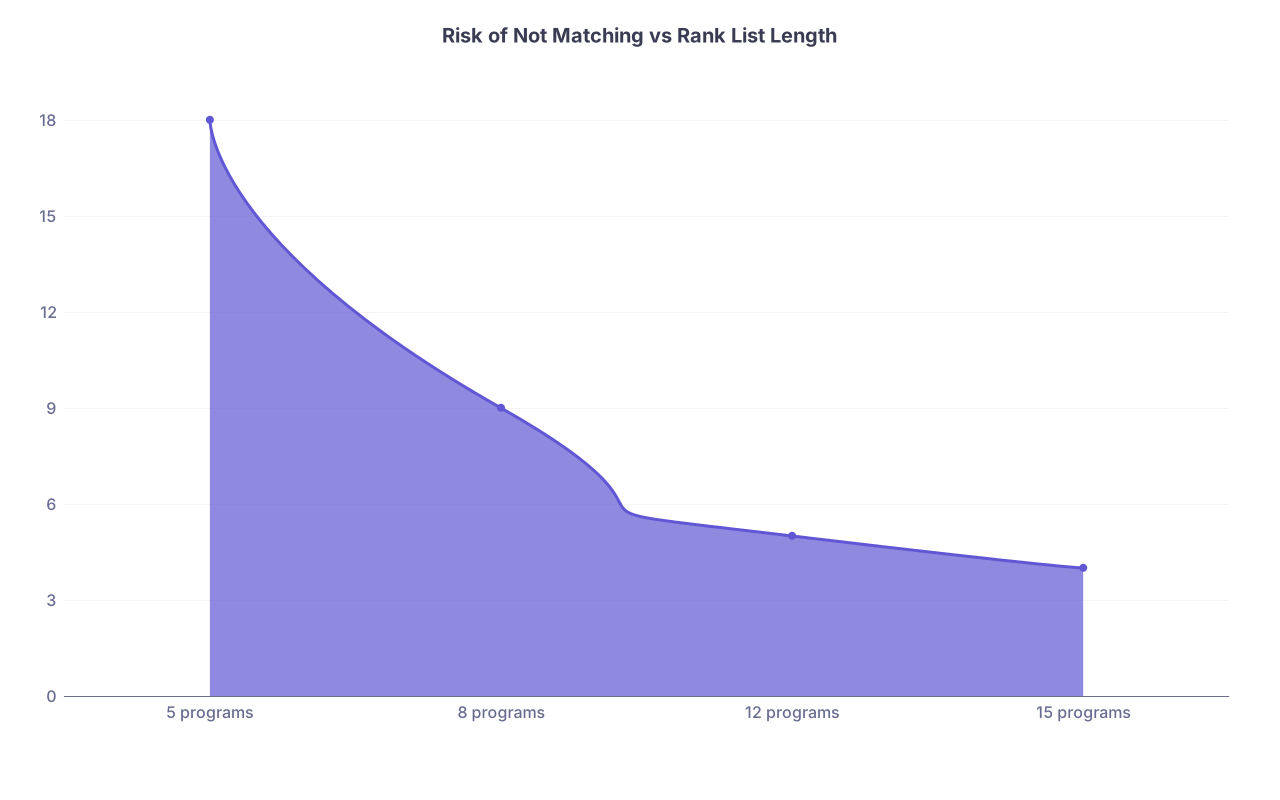
| Category | Value |
|---|---|
| 5 programs | 18 |
| 8 programs | 9 |
| 12 programs | 5 |
| 15 programs | 4 |
That chart is directionally aligned with historical NRMP data: as you rank more programs, your chance of going unmatched drops significantly. The bigger drivers of risk are:
- Too short a rank list
- Over-concentration in hyper-competitive programs
- Not enough geographic flexibility
Not “I didn’t trust that one program who told me they loved me.”
Here’s the trap I see every year: an applicant gets a very warm message from Program A, lukewarm/no message from Program B. Deep down, they like B more. But they convince themselves to rank A first because “they’ll rank me to match” and “I don’t want to end up somewhere worse.”
Two outcomes:
- They would’ve matched at B and been happier, but instead they match at A based on a non-binding promise.
- They wouldn’t have matched at B anyway, in which case ranking A first was irrelevant. A would still be their highest option. The promise did nothing.
In neither case did deviating from their true preference help them.
How To Actually Interpret Post-Interview Signals (Without Being Naive)
You should not ignore all communication. But you should downgrade its importance heavily.
Here’s a more rational hierarchy of what matters for your ranking strategy:
Your true preference
Fit, geography, training quality, gut feeling. Yes, gut feeling counts—but only after you’ve looked at objective factors.Program stability and training environment
Leadership turnover, accreditation history, case volume, resident burnout, board pass rates.Your realistic competitiveness at that tier
This was already baked in based on who interviewed you and across how many programs, not on what they tell you afterward.Signals from the program
Direct, specific outreach from PD/APD that shows they remember you and your details can suggest you’re somewhere above their cutoff line. It still shouldn’t reorder your top few spots if your own preferences are clear.
Let me give you an actual breakdown of signal strength, roughly:
| Type of Signal | Relative Strength (Reality) |
|---|---|
| Generic mass email to all interviewees | Almost none |
| Vague “you’re a strong candidate” note | Very low |
| Personalized email from faculty interviewer | Low to moderate |
| Personalized email/call from PD/APD | Moderate |
| Multiple follow-ups + specific comments | Higher, but still no guarantee |
Programs also lie by omission. You might hear nothing from a place that still ranks you decently high. Meanwhile, the place love-bombing you post-interview might still put you at spot #50 on a list of 60, because their own internal favorites pushed you down.
This is why making rank decisions around “who emailed me more” is childish. Professional, but childish.
Common Myths About “Rank to Match” That Need To Die
Let’s quickly execute the worst offenders.
Myth 1: “If a program says ‘you’ll match if you rank us high,’ that’s basically a guarantee.”
No. It’s garbage as a guarantee. At best, it’s a sign they expect to rank you high enough that the algorithm will likely pair you if you reciprocate. Too many ifs and unknowns.
Myth 2: “I shouldn’t rank a program #1 unless they strongly reassured me.”
Completely backwards. You should rank a program #1 if you want to train there the most and you’re not wildly out of their league. Their communication is secondary.
Myth 3: “If I tell a program they’re my #1, they’ll move me way up their list.”
Sometimes they bump you a few spots. Often they don’t. Programs hear this from lots of people. They know half of you are bluffing.
Myth 4: “If I don’t respond enthusiastically to their messages, they’ll drop me.”
A brief, polite, non-committal reply is fine. No one is running mass rank list surgery based on how many exclamation points you used.
Myth 5: “It’s okay to feel ‘safe’ if three programs told me I’m a great fit and to rank them high.”
You can feel encouraged. You should not feel safe. Safety comes from numbers: enough interviews, enough programs on your list, and enough geographic range.
So What Should You Actually Do?
Use reassurances as whispers, not as commands.
If three programs gave you genuinely strong, personal signals and you already liked all three, fine—push them a bit higher if they align with your own priorities. But do not leapfrog a place you clearly prefer just because someone else flattered you.
Focus on what will matter to Future You at 2 a.m. on call:
- Are the residents people you can stand?
- Is the training solid enough that you will not feel underprepared or destroyed?
- Can you live in that city without resenting your life for three to seven years?
- Does leadership seem stable and at least somewhat sane?
Those questions will decide your happiness, not how many times someone said “rank us to match.”
The Bottom Line
Three things to remember:
- “Rank to match” promises are non-binding marketing, not contracts. The NRMP algorithm does not care what anyone said to you.
- The only rational strategy is to rank programs in your true order of preference; trying to game promises almost never helps and can hurt you.
- Treat post-interview reassurances as weak signals at best, and never as a reason to outrank a program you genuinely prefer.


