

Two years ago, I watched a perfectly “average” applicant leap 40 spots overnight on a residency rank list. Same scores, same application, same interview day. The only thing that changed? One influential faculty member walked into the rank meeting and said six words: “I would work with this resident.”
The room paused. And the list moved.
You’re told the Match is an algorithm. Technically true. But before the algorithm ever sees your name, humans with coffee breath, pet preferences, and their own agendas are pushing your file up and down a spreadsheet. One voice in that room—just one—can change where you spend the next 3–7 years.
Let me show you exactly how that happens.
What Really Happens in the Rank Meeting (Not the PR Version)
Forget the glossy “we holistically review” lines. Let’s walk into an actual rank committee.
There’s usually a conference room. Long table. Someone’s half-broken speakerphone for the person Zooming in from home. On the screen: a big spreadsheet of applicants with columns for scores, interview ratings, “red flags,” and some cryptic comments like “quiet but solid” or “DO NOT RANK.”
Who’s in the room varies, but most programs have some version of this:
- Program Director (PD) – runs the show, sets the culture, heavily shapes the final list.
- Associate PDs / core faculty – the workhorses; they interviewed a lot of you.
- Chief residents / senior residents – their opinion matters more than you think.
- Program coordinator – not voting usually, but they remember who was a nightmare to schedule.
- Sometimes: Department Chair, especially in small or prestige-obsessed departments.
The official line is “we follow our rubric.” The real line is: we start with our rubric, then certain people bend it.
Every person in that room has:
- A shortlist of applicants they love.
- A shortlist they want blocked.
- Limited political capital to move people around.
The game is who spends that capital on you.
The Sequence: How Your Name Gets Argued Over
Let’s walk through what actually happens when they build the rank list.
Step 1: The Pre-Meeting Sort (Where Most Applicants Get Stuck)
Before the big rank meeting, the PD or an associate PD usually does a “pre-sort.”
They’ll pull in:
- Interview scores
- Any numeric filters (Step scores, class rank, etc., if they use them)
- Internal notes: “worked with us on rotation,” “faculty child,” “home student,” “prior research with Dr. X”
This gives them rough tiers. They won’t tell you this exists, but it does.
| Tier | Label | What It Really Means |
|---|---|---|
| 1 | Must Rank High | Protected favorites, political priorities |
| 2 | Strong | Likely to be ranked solidly if no red flags |
| 3 | Middle | Will rise or fall based on who speaks up |
| 4 | Borderline | One negative comment can erase you |
| 5 | Do Not Rank | Someone already decided you are a problem |
If you’re in Tier 3 or 4, that’s where a single person’s opinion can swing you wildly. Tier 1 and 5 are harder to move, but even those are not as locked as you think.
Step 2: Full-Committee Meeting: The “Official” Process
Picture this: projector shows the spreadsheet. PD at the head of the table.
They go applicant-by-applicant, or by small groups if there are many:
- PD: “Next is Smith, Alex. US MD, Step 1 pass, 2: 247, AOA, strong letters. Who interviewed Alex?”
- Faculty A: “I did. Solid, a bit quiet, but clearly prepared. Good insight into weaknesses.”
- Resident: “I remember Alex. Asked about night float and support for struggling interns. That was a good sign.”
- PD: “Any concerns?”
(silence)
“Okay, tentatively in our upper-middle group.”
That’s the “clean” version.
Now the real part.
How One Comment Changes Your Trajectory
The most powerful phrases in that room are short and deceptively simple. And they come from people whose opinions carry weight.
I’ve heard all of these swing careers:
- “I’d be comfortable with them on nights.”
- “I would not trust them alone in the ICU.”
- “This is a resident I’d fight to keep.”
- “They talked too much about fellowship prestige.”
- “Our nurses will hate their attitude.”
No flowery paragraphs. Just a crisp judgment from someone who has earned credibility.
The Positive Swing
Imagine you’re in Tier 3 – middle of the pack. Here’s how one advocate moves you.
PD: “So where does everyone feel Alex should roughly go? Middle third?”
Faculty B (who clicked with you): “I’d actually move Alex higher. I think they’ll overperform. Great insight into QI, strong teaching potential, and they handled my ethics question better than anyone this year. I’d be happy if they matched here.”
That last sentence is the trigger line: “I’d be happy if they matched here.”
What the room hears is:
- “I’m willing to put my name on this person.”
- “If they flop, I know I vouched for them.”
Most people do not burn that line casually. When they say it, the PD pays attention.
So PD bumps you from “middle third” to “upper middle.” In a medium program, that might be a 20–30 slot jump. That can absolutely be the difference between matching and never even being seen by the algorithm.
The Negative Swing
Now flip it.
The PD is neutral on you. Maybe you interviewed okay but didn’t stand out. Then this:
PD: “Thoughts on Jordan Lee?”
Resident: “Honestly, no. I got a bad vibe. Talked a lot about ‘I need a program that will support my research productivity’ and not once asked about our patients or our workflows. I don’t want to cover nights with them.”
There it is: “I don’t want to cover nights with them.”
That carries more weight than your gold-star letter from some big-name academic who doesn’t work there. Overnight, you go from Tier 2/3 to Tier 4. Or quietly slide to the bottom of the rank list, effectively dead.
Who Actually Has Power in That Room?
You probably overestimate the impact of the Chair and underestimate the residents.
Here’s the rough reality at many programs:
- PD: Can override most people but does not like to constantly bulldoze, or the faculty disengage. Think “weighted vote + veto power.”
- Associate PDs: Strong pull, especially if they interviewed you or work closely with residents.
- Chair: Often cares about department reputation and “superstars,” less about day-to-day functionality.
- Residents/Chiefs: Massive influence on “will this person sink the team?” questions.
- Random faculty who interviewed you once: Variable. If they are known for good judgment, their opinion matters. If they’re seen as difficult or out of touch, people discount them.
And then there is this unspoken hierarchy:
- If the most respected attending says, “I would not rank them,” that’s almost always the end of the story.
- If the PD really loves you and one attending mildly dislikes you, PD can still push you through.
- If residents as a group collectively say “Please no,” a smart PD listens. Because losing residents is a much bigger problem than losing an applicant.
I’ve watched a rising-star applicant—great board scores, glowing letters—get torpedoed because every resident who interviewed them used the same word: arrogant.
The PD: “We can’t afford a malignant class culture. Pass.”
That’s how fast it happens.
The Subtle Stuff You Don’t Realize Gets Remembered
Here’s what applicants consistently underestimate: the “small” interactions that feed into someone becoming your advocate or your enemy.
Pre-Interview and Post-Interview Behavior
Program coordinators and residents remember:
- How you handled scheduling conflicts
- Whether you were rude in emails
- Whether you blew off the social or showed up obviously drunk
- If you were gossiping about other programs on Zoom with your mic on (yes, it happens every year)
I have heard this exact line in a rank meeting:
Coordinator: “Just so you know, this is the one who sent me five emails insisting we move their interview for a ski trip.”
PD: “Okay, that’s a no from me.”
That candidate never knew. They thought coordinators were logistics only. Wrong. They’re often asked explicitly, “Any problem applicants?”
Away Rotations: The Ultimate Multiplier
If you did an away, you’re either at huge advantage or huge risk. Not neutral.
On one rank list I saw, there were three visiting students:
- Student A: technically average, but rounded with them. Showed up early, stayed late, kind to nurses. The senior resident: “I’d take three of them if we could.” They went from Tier 3 to Tier 1.
- Student B: strong on paper, brilliant in conference, but disappeared at 3 pm daily. Comment in the file: “Feels above scut work.” Dropped multiple tiers.
- Student C: good clinically but passive, nobody remembered them distinctly. They got ranked based on paperwork, not people. Middle of the road.
You think the “Chief liked you” is just nice. In reality, it’s: they will literally sit in that room and say, “This one is worth training. This one is not.”
The Algorithm Myth: Why “Trust the Algorithm” Is Only Half the Story
You’ve probably been told: “The algorithm favors the applicant. Just rank programs in your genuine order of preference, and you’ll get the best possible outcome.”
Partly true. But the algorithm can only work with what it’s fed.
If one influential voter pushes you from rank #8 to rank #24 on a 12-position list, here’s what that really means:
- At #8, you might match there even if you ranked that program #3 or #4, depending on how other applicants list them.
- At #24, you likely never hit their “match” window unless they drastically under-fill earlier.
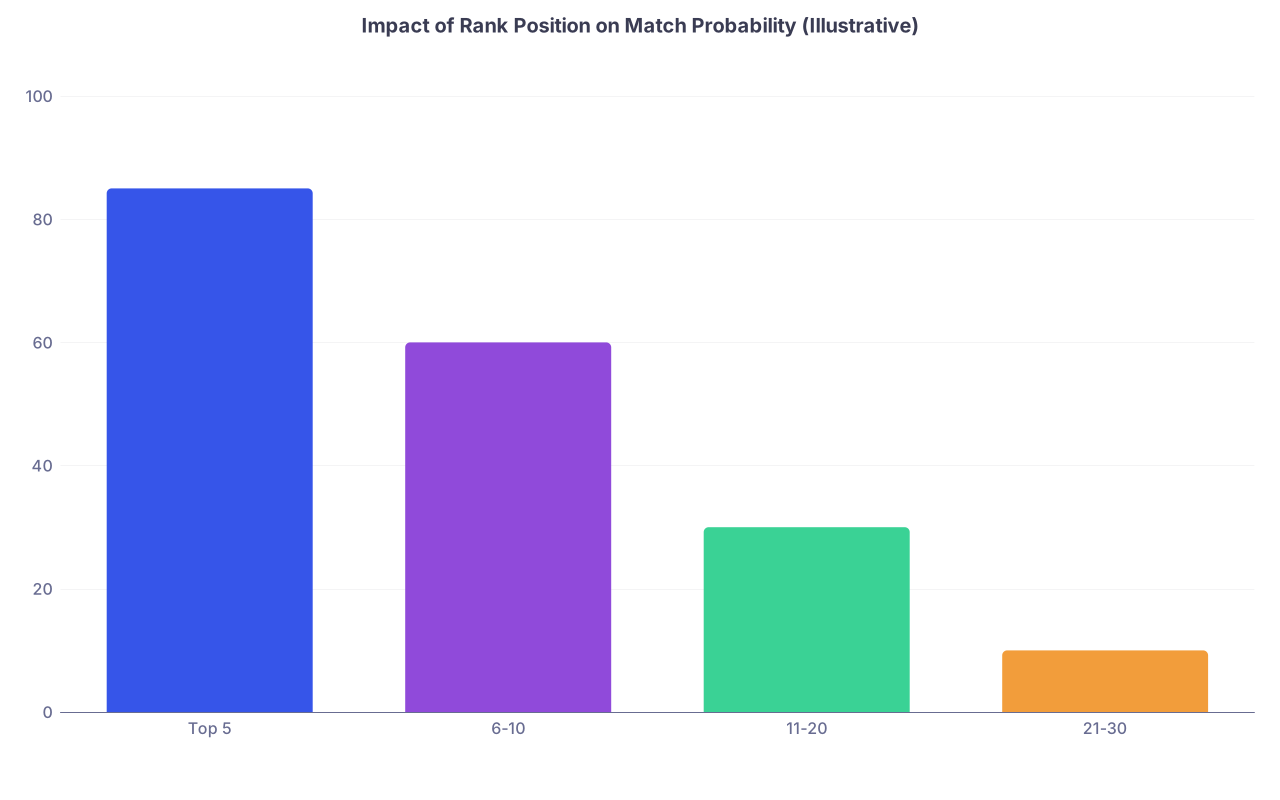
| Category | Value |
|---|---|
| Top 5 | 85 |
| 6-10 | 60 |
| 11-20 | 30 |
| 21-30 | 10 |
These are rough illustrative numbers, but the shape is right. Your chances drop fast once you fall outside the true “target zone” of a program’s list. And you don’t know how many positions they realistically expect to fill early on the list.
One advocate can keep you in that top critical band. One detractor can push you out of it.
How to Create an Advocate Before the Meeting Ever Happens
You can’t walk into a rank committee room. But your behavior months earlier can walk in for you.
Here’s how:
1. Make At Least One Person Willing to Say: “I’d Work With Them”
This is the golden sentence. You want at least one person—faculty or senior resident—to feel that way about you. They will not say it if:
- You were memorably self-centered in the interview
- You were vague about why their program specifically
- You sounded like you were using them as a “safety” or “backup”
They will say it if:
- You asked intelligent, specific questions about their workflow, culture, and support structures
- You showed insight about your weaknesses and how you’ve grown
- You came across as someone who will reliably show up, not implode, and not poison the team
The bar is not “be a genius.” The bar is “trusted teammate.”
2. Stop Trying to Impress; Start Trying to Be Predictable
Direct truth: most rank committee members are not hunting for superstars. They’re hunting for people who won’t blow up the service at 2 am.
They’re asking themselves:
- Will I be comfortable if this person is the only resident in-house on a Sunday?
- Will they call for help appropriately or try to hide mistakes?
- Will they make nurses’ lives easier or harder?
- Will they show up every day or be the one constantly “sick” on hard rotations?
You influence those perceptions with how you talk about:
- Difficult rotations you’ve been on
- Times you struggled—and what you did specifically to improve
- Feedback you’ve gotten and how you applied it
When you say, “I’ve never really struggled clinically,” seasoned interviewers hear: lack of insight or lack of honesty. Neither helps you in the rank room.
Stories from the Room: Three Real Shifts
Let me give you three composite stories that mirror real cases I’ve seen.
Case 1: The Quiet Climber
Applicant: Mid-tier MD, average scores, solid but not flashy application.
Reality: On the interview day, they formed a real connection with one associate PD talking about underserved care and their own background translating for family.
Rank meeting:
- Initial pre-sort: Tier 3 (middle)
- Associate PD in the room: “I’ll speak for them. Not the loudest, but they have the exact values we want. Their insight about burnout and boundaries was better than most of our current residents. I think we’re underestimating them.”
No one else loves or hates the candidate. So that one voice wins by default. PD nudges: “Okay, let’s pull them up into the top 10–12.”
They matched there. That one advocate decided where they trained.
Case 2: The Paper Rockstar, In-Person Red Flag
Applicant: 260+ Step 2, AOA, three first-author pubs, glowing letters from big names.
Interview: Did fine with attendings, came off as dismissive with residents. Complained about “low-acuity” patients at their home program. Asked only about research support and fellowship match rates.
Rank meeting:
- Chair: “This is a strong candidate. Would be good for our academic output.”
- Chief resident: “I don’t want them in my program. I got the sense they think they’re better than everyone. They were dismissive when I talked about night float and volume. Not a team player.”
Now the PD has a decision: impress the Chair with academic output or keep the residents from revolting?
In a healthy program, the residents win. Candidate drops from top 5 to somewhere around 20–30. Chances of matching there essentially die.
Case 3: The One Negative Email
Applicant: Strong interview, residents liked them, PD neutral-positive.
Problem: They sent a borderline entitled email to the coordinator about rescheduling, implying the program should be flexible because they had “higher-priority interviews” that day.
Rank meeting:
- Coordinator (upon being asked): “They were…a lot. Clearly not that invested in us. I got the sense we’re a backup for them.”
- PD: “Okay. We’ve got enough people who actually want to be here. Move them down.”
There was no dramatic “Do Not Rank” speech. Just a soft, quiet downgrade. And that was enough.
What You Can Control vs. What You Can’t
There’s a limit to how much of this you can manipulate. That’s the uncomfortable truth.
You cannot control:
- If a faculty member is having a bad day when they interview you
- The internal politics between PD, Chair, and residents
- Whether someone quietly champions another applicant over you for reasons you’ll never know
You can control:
- Whether you come across as someone people want on their team
- Whether you treat every human in the process—coordinator, resident, faculty—as someone whose opinion counts (because it does)
- Whether you give at least one person enough substance and connection that they’re willing to put their reputation behind you in that room
Most applicants try to be impressive. Very few try to be consistently trustworthy.
Guess which one carries more weight in a rank meeting.

| Step | Description |
|---|---|
| Step 1 | Applicant Behavior |
| Step 2 | Interview Impressions |
| Step 3 | Pre-Interview Interactions |
| Step 4 | Faculty Opinions |
| Step 5 | Resident Opinions |
| Step 6 | Coordinator Input |
| Step 7 | Advocate or Detractor |
| Step 8 | Rank Committee Discussion |
| Step 9 | Final Position on Rank List |
Final Thought: The One Sentence You’re Really Aiming For
Strip away the algorithm, the spreadsheets, the Step scores, the “holistic review” speeches. Inside that rank room, the decision boils down to a question people rarely say out loud but always feel:
“Would I be okay being on call with this person at 3 am when everything is going to hell?”
If, somewhere in that room, at least one person says “Yes. I’d actually feel better if they were there,” you’ve already tilted the Match in your favor far more than any score ever could.
Years from now, you won’t remember who sat around that table or what they said about you. But you will be living with the result of whether someone in that room decided you were worth fighting for.


