

Last January, a fourth‑year sat across from me after a long interview day at a big-name IM program. The PD shook his hand, smiled, and said the magic line: “We really love you here. I think you’d be a great fit.” The student walked out texting his friends, “I think I just locked this place.”
He ended up matching at his #4. That program? Never even ranked him high enough for a realistic shot.
Let me walk you through why that happened—and how not to be that person.
What “We Love You Here” Actually Means Behind Closed Doors
You hear some version of this constantly:
- “We really like you here.”
- “You’d fit in so well.”
- “If you rank us highly, you’ll be happy here.”
- “We hope to see you here in July.”
Different words. Same game.
Programs live in a gray zone between “no post‑interview communication rules” and “the arms race of love letters.” The official NRMP line is: programs should not make guarantees, should not solicit ranking info, should not pressure you. That’s the policy.
Now the reality.
After you log out of Zoom or leave the hospital, your name goes onto a spreadsheet or into an online ranking tool. Faculty fill out scores or impressions. There’s a meeting later—sometimes weeks later—where the actual list is built.
So when that PD tells you “we love you here” on interview day, here’s what that usually means internally:
- You didn’t bomb. They’re comfortable with you.
- You’re “rankable” barring something weird.
- They want you to feel positive enough to rank them decently.
It does not automatically mean:
- You’re top 5.
- You’re a “lock” if you rank them #1.
- They’ve actually discussed your position relative to other applicants (they haven’t; it’s too early).
I’ve sat in ranking meetings where a PD clearly barely remembered someone they told “we love you here.” They scroll through 100 faces and go, “Who’s that again?” Meanwhile that same applicant is at home building their rank list around that vague, warm phrase.
Programs are not lying, exactly. They’re just using non-committal, NRMP-safe language that sounds emotionally loaded to you and legally safe to them.
The Unspoken Truth: Why Programs Talk Like This
Programs have three competing motivations after interviews:
- Fill all their spots with people they actually want. Empty spots = disaster. Scramble/SOAP is headache and embarrassment.
- Protect their reputation. They want a good spread of US grads, DOs, strong scores, diversity, etc. They don’t want to look like a backup plan for everyone.
- Stay out of NRMP trouble. No explicit deals, no written promises that can be screenshot and emailed to the NRMP office.
So they develop a vocabulary of “legal affection.”
Phrases that signal interest, warmth, maybe enthusiasm—but stop short of “If you rank us #1, you will match here.”
Let’s make that more concrete.
| Program Phrase | Realistic Translation |
|---|---|
| "We really like you here." | You’re rankable; we’re comfortable with you. |
| "You’d fit in really well." | Your personality didn’t raise any red flags. |
| "We hope to see you here in July." | Please don’t tank us on your list. |
| "You’d be a great addition to our program." | You’re above the cut line, likely mid-pack. |
| "Let us know if you have any questions as you’re making your list." | Stay engaged; we’re still sorting our rank list. |
The line almost everyone fixates on is: “We love you here.”
Inside ranking meetings, that phrase covers a wide territory. I’ve seen it used for:
- An A++ rockstar they truly want to anchor their class.
- A pleasant, solid candidate who’s somewhere between #30–50 depending on how the list shakes out.
- Someone they know nothing negative about but also nothing exceptional.
Programs rarely say, “You’re probably mid‑list, but we’d be happy if you ended up here.” That’s the accurate version. It is also terrible recruiting language.
So they go with: “We’d love to have you.”
Warm. Vague. And very easy to overinterpret.
Signals That Actually Mean Something (Versus Fluff)
There are levels to these communications. You need to recognize which tier you’re in.
Tier 1: Genuine High-Interest Signals
These are rare and still not guarantees, but they carry more weight:
- Direct contact from the program director or associate PD after interviews, not just the coordinator.
- Specific, personalized references: “We discussed you at our committee meeting,” “Your research in X really impressed the faculty,” “Dr. Smith raved about you after your interview.”
- A message that feels like it could’ve only been sent to you, not 80 people.
Example:
“Hi Alex, after our ranking committee meeting I wanted to personally reach out and say how strongly we feel you’d be an excellent fit here. You stood out for your advocacy work and the way you handled our case discussion. We truly hope you’ll consider ranking us highly.”
Compare that with:
“Dear applicant, Thank you again for interviewing with us. We enjoyed getting to know you and hope you’ll consider ranking us highly. Please reach out with any questions.”
The first one? That’s real interest—though not a promise.
The second? That went to a mailing list.
Tier 2: Warm but Nonspecific
Most “we love you here” statements live here:
- Said to multiple applicants during the closing session.
- Included in a mass email.
- General “You seem like a great fit” with no real detail.
These basically mean: “You cleared our bar; we’d be happy if you came; we also told 60 other people this exact thing.”
Tier 3: Autofill Flattery
- Holiday cards to “Dear Applicant.”
- Generic thank-you emails with a tagline: “We hope to see you in July!”
- Social media likes on your posts.
These mean almost nothing for ranking. It’s branding, not choosing.
How Programs Actually Make Their Rank Lists (And Where Your “Love” Really Lands)
Forget the romantic fantasy that the PD is sitting at a desk with your photo deciding your fate by candlelight.
Here’s closer to the real sequence in many programs:

| Step | Description |
|---|---|
| Step 1 | Interview Day Complete |
| Step 2 | Faculty Submit Scores/Comments |
| Step 3 | Coordinator Aggregates Data |
| Step 4 | Preliminary Rank List by Committee Member or PD |
| Step 5 | Full Committee Meeting |
| Step 6 | Adjustments for Diversity/Needs |
| Step 7 | Final Rank List Submitted to NRMP |
In that full committee meeting, this is what actually drives your position:
- Step scores / COMLEX (still matters, even with Step 1 P/F)
- Class rank / med school reputation
- Strong letters, especially from known faculty
- Research fit if it’s an academic place
- Interview performance (yes, vibes matter, but they usually refine, not override the rest)
The phrase “we love you here” is not a column on that spreadsheet. Nobody is saying, “They got a 220, but I told them I love them, so put them top 5.”
The more brutal reality: by the time you’re obsessing over every word of your interview day, they’ve already mentally placed you in a band—top, middle, or lower cluster. Individual comments nudge you within that band, rarely out of it.
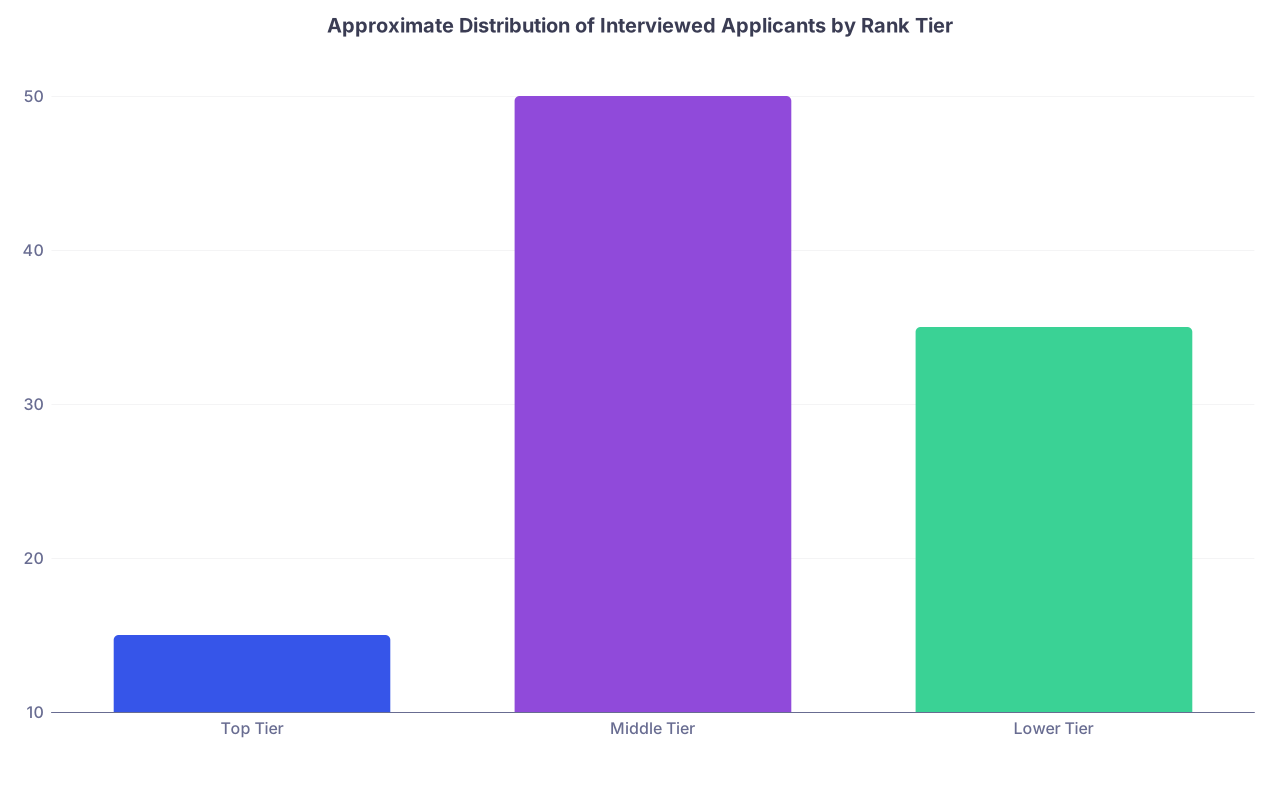
| Category | Value |
|---|---|
| Top Tier | 15 |
| Middle Tier | 50 |
| Lower Tier | 35 |
So when a candidate tells me, “They said they loved me, so I think I’m top 5,” I usually ask:
“What’s your Step 2? What’s your class standing? Do you have any home ties or research fit with them?”
If those things don’t scream “top-tier material for this specific program,” then no, you probably aren’t.
Reading Between the Lines: How to Interpret What You Hear
Let’s go phrase by phrase. This is the dictionary nobody hands you.
“We really enjoyed meeting you.”
Translation: You were normal. Not a weirdo. Baseline compliment.“You’d be a great fit here.”
Likely means your personality wouldn’t break the culture. Still broad.“I think you’d be very happy here.”
Good sign they consider you rankable. Doesn’t indicate rank position.“We’d love to have you.”
You’re in the “we’d be glad if you matched here” group. Could be rank #5 or #55.“Let us know if you have any questions as you make your rank list.”
Open communication line. They’re fine with you staying engaged. Not a promise.Radio silence post-interview.
Annoying, but common. I’ve seen people match at places that never contacted them again. Silence doesn’t automatically equal low rank; sometimes it just means they’re following NRMP rules strictly or they’re disorganized.
The only phrases that should materially influence your expectations are the extremely specific ones, from high‑authority people, that couldn’t obviously be mass‑sent. Even then, keep your ego in check. Programs overestimate their own pull; they’ll talk up a lot of people knowing only a fraction will rank them #1.
How You Should Actually Rank Programs (Ignoring the Noise)
You match based on your rank list first, not theirs. That algorithm favors the applicant, and yet every year, students sabotage themselves trying to “game” a system that’s already tilted in their favor.
Here’s the blunt rule:
Rank programs in your true order of preference, assuming you’d be happy working there for 3–7 years, and ignore the romance language.
Don’t push a program to #1 because:
- They sent you a warm email.
- The PD said “We love you here.”
- The chief resident told you, “We’re fighting for you.”
Push a program up (or down) your list based on:
- Training quality: case volume, autonomy, fellowship match.
- How the residents actually seemed when faculty weren’t hovering.
- Location, cost of living, family/support system.
- Your gut reaction at 10 pm after interview day when you were brutally honest with yourself.
If you need something more structured than “gut,” fine. Score them.
| Factor | Weight (1–5) |
|---|---|
| Training quality/autonomy | 5 |
| Resident happiness | 5 |
| Location/support | 4 |
| Fellowship/career outcomes | 4 |
| Schedule/call structure | 3 |
Notice what’s not in that table: “Amount of flattery received.”
If a program truly loves you, ranking them #1 will not hurt you. If they were blowing smoke, ranking them #1 still doesn’t hurt you—because you wanted to be there. The only way you lose is by moving a place you genuinely like lower, purely because you’re nervous they “didn’t seem that into you.”
Spotting Red Flags Hidden Behind “We Love You”
Here’s the part people don’t like to admit: the most enthusiastic programs sometimes are the ones struggling the most to fill.
When a program is chronically under‑ranked—bad reputation, malignant culture, weak city—what do they do? They double down on the affection.
Lots of “We really, really love you here,” “You’re exactly what we’re looking for,” “We’d be thrilled if you came.”
Sometimes they’re being honest. They really are desperate to upgrade their match list. But always ask yourself why they’re trying so hard to sell.
Look for these disconnects:
- Residents seem tired and guarded on social hour, but leadership is over-the-top positive.
- You hear, “We’re like a family,” repeatedly, but nobody can clearly explain how they support wellness beyond pizza.
- Faculty talk more about how nice everyone is than about actual training outcomes.
If a program “loves you” but residents privately tell you, “Honestly, if you have better options, you should go,” believe the residents.
How to Communicate Back Without Looking Desperate or Breaking Rules
You do have some power in this game: signals of interest.
Single best move: Send a short, specific, professional thank-you / interest email to your top 1–3 programs. Do not write novels. Do not fish for reassurance.
Example of a strong, sane message to a true #1:
Dear Dr. [PD],
Thank you again for the opportunity to interview at [Program]. After reflecting on my interviews, it’s clear that [Program] is my top choice. The combination of strong critical care training and the supportive resident culture I saw on interview day makes me confident I’d thrive there.
Regardless of the outcome, I appreciate your time and consideration.
Sincerely,
[Name]
That’s it. No “If I rank you #1, will I match?” No asking them to break NRMP rules.
You can send more generic thank‑you notes to others, but reserve “top choice” language for one program only. Word gets around; PDs talk.
Do not send:
- “If I rank you #1, will you rank me to match?”
- “Another program told me they loved me, but I like you more.”
- Weekly reminder emails that you still exist.
Those make you memorable in the wrong way.
Case Studies: How This Plays Out
Case 1: The Over‑Believer
- Mid-tier candidate, 235 Step 2, solid but not special.
- Interviews at 10 IM programs, including one big academic name.
- PD at big-name place: “We really love you here. You’d be a great addition.”
- Student moves that program to #1, bumps a more realistic, strong university‑affiliated community program to #3.
Result:
They don’t match at big-name (ranked around #40 there), slide to #2 or #3 and still get a decent spot. They’re fine. But they built their hopes on the wrong interpretation.
Case 2: The Under‑Ranker
- Strong candidate, 250+, good research.
- Interviews at a reach academic program that’s been quiet post‑interview. No emails, no extra love.
- Overthinks it, assumes “they must not like me,” drops them to #4.
- Matches at #1, a solid but less academic program. Later learns from a co-resident that the reach program ranked them top 5.
They let silence psych them out.
Case 3: The “They Love Me!” Trap
- Candidate with OK numbers, but great personality.
- Gets heavy post‑interview affection from a malignant program trying to fix its image.
- Residents looked miserable on interview day, but PD emails twice with very flattering language.
- Candidate ignores gut feeling, ranks them #1.
Matches there. Regrets it by November.
Quick Reality Checks Before You Lock Your List
Use these cold questions on yourself:
- If that PD hadn’t said “we love you here,” where would I rank this program?
- If they never emailed me again after interview day, would this still be in my top 3?
- How did the residents look at 9 pm on a random Wednesday? That’s your real future.
- Do my long-term goals (fellowship, geography, lifestyle) actually fit better somewhere else, even if they were less “lovey” post‑interview?
- Am I chasing an ego hit (prestige, praise) or a training environment that fits my life?
Answer those honestly, and suddenly “we love you here” loses a lot of its spell.
, Location/Support, Schedule/Call, Program Flattery](https://cdn.residencyadvisor.com/images/articles_svg/chart-what-should-actually-drive-your-rank-list-1852.svg "What Should Actually Drive Your Rank List")
| Category | Value |
|---|---|
| Training & Outcomes | 35 |
| [Resident Culture](https://residencyadvisor.com/resources/residency-ranking-strategy/ignoring-program-culture-fit-the-rank-list-mistake-youll-regret-pgy1) | 30 |
| Location/Support | 20 |
| Schedule/Call | 10 |
| Program Flattery | 5 |
FAQs
1. If a program tells me I’m in their “top group,” can I trust that?
Maybe. Some programs are very careful and only say this to a handful of applicants. Others throw “top group” around like candy. Unless they’re extremely specific and you know they run a clean, policy-abiding ship, treat it as “they like me,” not “I’m guaranteed.”
2. Should I ever change my rank list based on a late, very positive email?
Only if that email makes you re-examine real factors—training, fit, location—that you had underestimated. The email itself should not be the reason. If you reread your notes and realize, “Actually, I did like them more than I admitted,” then fine. But don’t chase validation.
3. What if my true #1 never contacted me again after interview day?
Rank them #1 anyway if they’re truly your #1. I’ve watched plenty of people match at places that never sent a single post‑interview email. Silence is not a rejection in the Match. They may be strictly following NRMP guidelines or simply not playing the love-letter game.
4. Is it ever worth telling more than one program they’re my “top choice”?
No. That’s how you burn credibility. PDs talk to each other, especially within a region or specialty. You can say “very highly” or “strongly considering” to others, but reserve “top choice” or “#1” language for exactly one program.
5. I’m scared of not matching. Should I rank a “safety” #1 just to be sure?
That’s not how the algorithm works. Ranking a less-desired “safety” higher does not improve your odds of matching overall; it just increases the odds you’ll end up somewhere you didn’t actually want most. Rank programs in the true order you want them, all the way down. The system already tries to give you the highest choice that also ranks you.
The bottom line: Program affection is marketing, not math. “We love you here” feels intoxicating in January; it means very little in March if you ignore your own priorities.
Listen politely. Smile. Then go home, shut out the noise, and build a rank list that reflects your life, not their sales pitch.


