
Last winter I watched a PGY‑2 stare at a snow‑covered parking lot after a brutal call. He’d matched in his dream city, turned down a “better” training program in a smaller town, and now he kept asking one question on repeat: “Did I mess up my whole career because I picked location?”
You can probably feel that in your chest. I can too. Because this exact fear—ranking a great city over “better training”—is one of those things that can haunt you at 2 a.m. long after rank lists are locked.
The fear behind “great city vs better training”
Let me put the anxiety into words, because it’s usually some mix of this:
- What if I chose a fun coastal city over the powerhouse community program that would’ve trained me better?
- What if fellowship directors look at my program name and quietly pass?
- What if I end up undertrained, unsafe, or constantly behind my peers from more “hardcore” places?
- What if I just traded long‑term career strength for restaurants, weather, and family proximity?
And the ugliest version:
“What if I can never undo this and I ruined the next 30 years because I liked the city more?”
You’re not crazy for thinking this way. People do make objectively bad rank decisions sometimes. But the real story is more nuanced, and honestly a lot less apocalyptic than your brain is telling you.
What “better training” actually means (and what it doesn’t)
First problem: people throw around “better training” like it’s an objective number. It’s not. Half the time it’s vague prestige + program culture + vibes from interview day.
Let’s break down what actually matters long‑term:
| Factor | Impact on Long-Term Career |
|---|---|
| Case/volume exposure | High |
| Autonomy & responsibility | High |
| Quality of teaching/feedback | High |
| Program reputation (within specialty) | Moderate–High |
| Fellowship match track record | Moderate |
| Research/mentorship access | Moderate |
| City lifestyle/amenities | Indirect but real |
Now, the scary thing you’re probably thinking: “What if I picked the city program that has less volume, less autonomy, and weaker fellowship matches over a workhorse program in a bland town?”
Here’s the honest answer:
- If the difference is huge (think: elite tertiary center with phenomenal outcomes vs a chronically dysfunctional program) — yeah, that can matter.
- If the difference is mild to moderate (strong community program vs solid academic place in a bigger city) — the long‑term impact is usually way smaller than you’re imagining.
There are residents from “meh” programs who crush board scores, match competitive fellowships, and become absolute monsters clinically. There are residents from elite programs who flame out, burn out, or coast.
The uncomfortable truth:
Your effort, your mentors, and your ability to not self‑destruct matter at least as much as some marginal difference in program “strength.”
Where choosing city over training can actually backfire
I’m not going to sugarcoat this. There are real ways this decision can hurt you. Let’s name them so you can stop feeling like it’s all vague doom.
1. For ultra‑competitive fellowships
If you’re aiming for derm fellowship, CT surgery, IR, heme/onc at elite places, or ultra‑competitive subspecialties in top‑tier institutions, then yes:
- Program reputation and name recognition can be a real lever.
- Having big‑name faculty who can call other big‑name people does matter.
- Robust research infrastructure makes life a lot easier.
If you ranked a lifestyle‑heavy, low‑research, low‑volume program in a big city over a national‑name powerhouse because “I want to be near friends,” you may have made your future fight harder.
Not impossible. Just harder.
2. If the program is objectively weak on fundamentals
Red flags where “city” might have seduced you:
- Chronic unfilled positions, constant resident turnover
- Residents telling you off‑record they feel undertrained or unsafe
- Very poor board pass rates, repeatedly
- Minimal operative/clinic/procedure exposure compared to norms
- No culture of feedback, no real teaching, just service
If you knowingly ranked that higher because "I love this city"… yeah, that can have real training consequences. You might have to do more self‑directed work to fill gaps, maybe even a fellowship you didn’t truly want just to feel competent.
3. If you hate the grind and thought city would fix that
Sometimes people unconsciously use “city” as a distraction from the reality that residency is hard everywhere. They think:
- “At least I’ll have fun stuff to do on my days off.”
- “The weather will make it better.”
- “I’ll be happier, so I’ll handle stress better.”
Here’s the painful part:
If the “great city” program is actually more malignant, under‑resourced, or chaotic, then your outside‑of‑work advantages can’t fully fix that. You’ll be too exhausted to enjoy the city, and then you feel stupid for choosing it.
Where choosing the great city is completely fine (and sometimes smarter)
Your anxiety brain only tells you the disaster version. So let me lay out the other side. I’ve seen this a lot:
1. When both programs were solid, just different flavors
Scenario:
- Program A = medium city, slightly stronger reputation, more volume, more intense, somewhat rough culture
- Program B = big coastal city, slightly less volume but still within normal range, decent fellowship match, happier residents
You pick B because you actually want to live where you train.
Long‑term impact?
- You’re still board eligible.
- You see enough cases to be competent.
- You get decent mentorship.
- You don’t hate your life.
That is not career‑ending. That’s… fine. Honestly, that’s often better than grinding at a place that breaks you just to have a name on your CV.
2. When support systems matter for your mental health
People pretend this doesn’t matter. It does.
- Being closer to family or a partner
- Having friends nearby
- Being in a place where you feel safe (racially, culturally, LGBTQ+ wise)
- Not being trapped somewhere that triggers your depression or anxiety
If your choice of city is the difference between “barely holding it together” and “actually surviving residency,” that’s not stupid. That’s self‑preservation.
Burnout, untreated mental illness, and quitting medicine entirely will wreck your career way more than choosing the “less intense but still solid” city program.
3. When you’re aiming for general practice, not prestige toys
If your real dream is:
- General IM and hospitalist work
- General peds
- Non‑academic EM
- Primary care/FM in a community setting
Then the difference between a “top 20” name and a “good, decent, solid” program matters a lot less than you think.
You need to:
- Be competent
- Pass your boards
- Learn how to not be dangerous
- Maybe make some connections in the region you want to work
For that, a well‑run program in a great city can be perfect. And nobody cares in 5–10 years where exactly you trained, as long as you aren’t unsafe and you can handle your job.
How much does your residency program name follow you?
Everyone is terrified of this.
Yes, there’s a signal effect from training at a big‑name place, especially early on. But people grossly overestimate the weight of this in the long run.
Here’s what actually happens over time:
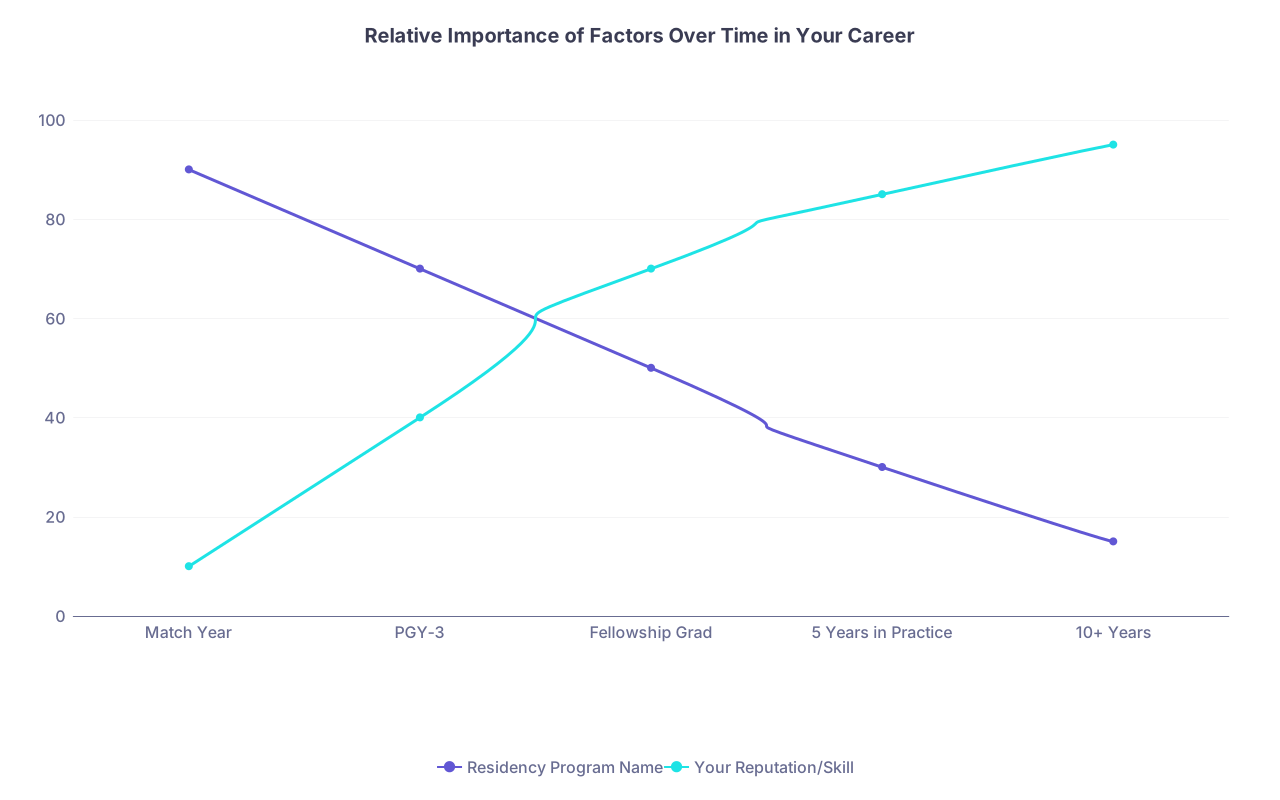
| Category | Residency Program Name | Your Reputation/Skill |
|---|---|---|
| Match Year | 90 | 10 |
| PGY-3 | 70 | 40 |
| Fellowship Grad | 50 | 70 |
| 5 Years in Practice | 30 | 85 |
| 10+ Years | 15 | 95 |
Early:
- Program name and pedigree help for fellowship and first jobs.
- But even then, they’re not everything. LORs, research, interview performance, and your vibe matter a ton.
Later:
- People care way more about: Are you good? Are you reliable? Do other physicians trust you with their patients?
I’ve watched “no‑name” residency grads become the go‑to person at major hospitals. I’ve watched elite‑program grads get quietly sidelined because they’re unsafe, arrogant, or lazy.
Residency is a launch pad, not a prison sentence.
If you already submitted your rank list (or already matched)
This is usually when the anxiety ramps up: when you can’t change anything.
Step 1: Stop catastrophizing the unknown
Your brain is currently comparing:
- The imagined best‑case at the program you ranked lower
vs - The imagined worst‑case at the program you ranked higher
That’s not fair. You don’t actually know that the “stronger” program would’ve:
- Given you good mentors
- Not burned you out
- Fit your personality
You’re grieving an alternate universe that may not have existed.
Step 2: Audit the program you did choose
Be brutally honest but rational:
- Does it graduate competent residents?
- Are board pass rates OK?
- Do graduates get some fellowships/jobs you’d be happy with?
- Are there at least a few faculty doing things you’d like to do?
If the answer to most of those is yes, you did not ruin your life. You just picked one valid path over another.
Step 3: Decide how you’re going to compensate (if needed)
If your program is weaker in some area, that doesn’t mean you’re doomed. It means you’ll need to be a bit more intentional.
Examples:
- Less research? You start early, cold email faculty, maybe collaborate with outside institutions.
- Less volume in certain cases? You hustle for electives, away rotations, simulation, extra case coverage.
- Weaker fellowship history? You network harder, go to conferences, ask early who’s successfully matched in the past and how they did it.
I’ve seen people “overperform” their program every single year because they refused to let the name on their badge cap their trajectory.
If you haven’t submitted your rank list yet
Ok, this is the part your anxious brain is actually begging for: “Tell me how not to screw this up.”
Here’s my blunt ranking rule of thumb:
If you’re deciding between:
- A dysfunctional program in a great city
vs - A healthy, solid program in a boring city
Pick the healthy program. You can survive a boring zip code. You can’t easily survive toxicity, lack of training, or chronic chaos.
If you’re deciding between:
- A slightly stronger program in a blah city
vs - A slightly weaker but still solid program in a great city
Then it’s reasonable to pick the city. Especially if:
- You’ll have real support systems there
- You liked the residents and culture more
- You’re not chasing ultra‑elite fellowships where pedigree is life or death
Use this mental model:

| Step | Description |
|---|---|
| Step 1 | Compare Programs |
| Step 2 | Rank safer/healthier program higher |
| Step 3 | Lean toward stronger training/reputation |
| Step 4 | Include city & support in decision |
| Step 5 | Pick best combo of training + life you can tolerate |
| Step 6 | Any major red flags? |
| Step 7 | Chasing highly competitive fellowship? |
Not perfect. But better than spiraling.
The quiet truth nobody tells you on interview day
Residency is long. Your life does not go on pause just because you are “in training.”
You might:
- Have a kid
- Lose a parent
- Develop anxiety or depression
- Need surgery
- Fall in love, break up, move, all of it
Where you live can either:
- Make those things survivable
or - Make them unbearable
So no, prioritizing location is not automatically shallow or stupid. It’s only dangerous if you ignore glaring training problems because you’re in love with the skyline.
If you chose a great city over a marginally better program and the one you chose is still decent? You didn’t ruin your life. You just picked a different trade‑off.
FAQ (exactly 6 questions)
1. Did I ruin my career by choosing a great city over a better‑known program?
Almost certainly not. Unless you knowingly picked a clearly unsafe or severely underperforming program purely for location, you didn’t “ruin” anything. You may have made some parts of your path slightly harder (especially for super‑competitive fellowships), but that’s very different from permanent damage. Most people vastly overestimate how much their program name alone controls their future.
2. Will fellowship directors judge me for picking a “weaker” program in a big city?
They’re not sitting there reading your rank list decisions; they only see where you actually trained. They’ll look at: your letters, research, performance, personal statement, interviews, and the reputation of your actual program. If your program has a track record of matching people into decent fellowships and you perform well, you’re fine. If your program has a weaker track record, you’ll just need to start early and hustle harder on mentorship and research.
3. What if my program doesn’t have the volume or intensity of the one I ranked lower?
Then your job is to be deliberate about filling those gaps. That can look like: extra elective time in high‑volume services, seeking out procedures, simulation lab work, away rotations (when allowed), and being the resident who always volunteers for more experience. I’ve watched people outgrow their program’s “limitations” by being aggressive in pursuing opportunities. It’s not as easy as having it handed to you, but it’s absolutely doable.
4. How do I know if my “city choice” program is actually too weak?
Look at hard data and real outcomes, not rumors. Board pass rates over several years, ACGME citations, resident retention, where graduates end up (jobs and fellowships), and what off‑record conversations with current residents were like. If residents say they feel unsafe, undertrained, or abandoned—and the outcomes reflect that—you might have a real problem. If instead you see solid outcomes and people who seem adequately trained, it’s probably your anxiety amplifying small differences.
5. I already matched and now I’m obsessing I picked wrong. Is there anything I can do?
Yes. First, stop doom‑scrolling program rankings and anonymous forums; they’re gasoline on anxiety. Second, map out what you want from your career (fellowship vs general practice, academic vs community) and then figure out what specific steps will help you get there from this program: who to meet, what projects to start, what skills to prioritize. Third, give the program a real chance before deciding it’s a disaster. If it truly is unsafe or toxic, transfers sometimes happen—but that’s plan Z, not Plan A.
6. How should I balance training quality vs location if I haven’t submitted my rank list yet?
Use a simple hierarchy: safety and baseline training first, career goals second, lifestyle/location third. If a program can’t make you competent and safe, it shouldn’t be high on your list no matter how great the city is. If multiple programs can train you adequately, then factor in your goals (competitive fellowship vs general practice). Only after that should city and lifestyle break ties. It’s not wrong to choose the great city—just don’t let the skyline blind you to red flags that will matter much more when you’re the one holding the pager at 3 a.m.
If you remember nothing else:
- A single rank decision almost never makes or breaks an entire career.
- A solid but slightly “lesser” program in a city where you can actually survive is not a failure—it’s a trade‑off you can work with.