
Everyone talks about “fit” on interview trail, then quietly ranks the shiniest logos anyway.
If you’re staring at your rank list thinking, “I like this community program more… but what if I ruin my whole career by putting it above the big-name academic place?”—yeah. I’ve been in that exact pit of anxiety.
Let me say this bluntly: ranking community programs above famous academic institutions is not only “safe,” it’s often the smarter, more adult move. But your brain doesn’t care about logic right now. It cares about worst‑case scenarios. So let’s drag those into the light and tear them apart one by one.
What You’re Actually Afraid Of (Let’s Name the Monsters)
You’re not just choosing between Program A and Program B. In your head, you’re choosing between:
- Being “taken seriously” vs being “that person who went to a no‑name place”
- Future fellowship vs being filtered out forever
- Proudly saying your institution vs mumbling it and hoping nobody judges you
- The life you want vs the career you’re “supposed” to have
So your internal monologue sounds like:
- “If I rank the community place first, attendings will think I couldn’t match academic.”
- “Will I ever get a competitive fellowship from a community program?”
- “Am I closing doors I don’t even know exist yet?”
- “Will PDs think I ‘couldn’t hack it’ in academics?”
The poison thought underneath all of that is:
“If I don’t pick prestige now, I’m permanently less.”
That’s the lie you have to be very careful not to build your whole rank list around.
First Reality Check: How the Algorithm Actually Works
The Match algorithm is applicant‑favorable. That sounds like propaganda, but it’s true. Here’s the key piece:
You should rank programs in your true order of preference, not based on where you think you’re “likely” to match or what looks good to other people.
The algorithm doesn’t punish you for putting a “reach” high. It doesn’t reward you for putting a “safety” academic name higher even if you actually liked the community place more.
It literally tries to give you your highest possible choice that also wants you.
To make it less abstract, think:
You rank:
- Community Hospital X (you loved it)
- Big Name U (you were meh but it’s famous)
Both rank you high enough to match.
The algorithm will match you at #1 Community Hospital X. Not because you’re weaker. Not because they think you “belong there.” But because you told the system that’s what you want.
And no one downstream can see your rank list. They don’t know if you ranked them first or eighth. They just know where you matched.
So if the fear is “will people find out I chose community over academic and judge me?”—no. They will just see where you trained.
The Prestige Panic: Are You Throwing Away Your Future?
This is the big one. The 3 a.m. thought spiral.
“Is matching at a community program going to kill my chances at cards/gi/Gyn Onc/whatever?”
Here’s the non‑sugarcoated version:
Prestige helps. But not the way you think.
Programs and fellowships care about:
- How strong your training is
- Your letters (from people they trust)
- Your performance (evaluations, in‑service, Step/COMLEX if they still look)
- Evidence you actually care about/are engaged in the field (research, electives, away rotations, connections)
Now, academic centers have structural advantages. Built‑in research infrastructure. Name‑brand attendings. Internal fellowships. It’s easier, on average, to collect the “standard fellowship applicant checklist” there.
But here’s what applicants underestimate all the time:
A strong, high-volume community program with engaged faculty, decent support for scholarly work, and a track record of getting people into good fellowships can absolutely get you where you want to go.
A big‑name academic program where:
- You’re miserable,
- You’re burnt out,
- You’re lost in the crowd,
- You can’t get mentors because everyone is too busy or you’re too exhausted to care—
will not magically save you.
I’ve seen residents from “no‑name” community IM programs land GI, cards, heme/onc at excellent fellowships because they were rockstars who had attendings willing to go to bat for them. And I’ve seen people at famous institutions get lost, not match their dream fellowship, and feel completely blindsided because they thought the name alone would carry them.
Concrete Comparison: Community vs Academic Isn’t One Dimensional
This isn’t “good vs bad.” It’s trade‑offs.
| Factor | Strong Community Program | Big Academic Center |
|---|---|---|
| Research infrastructure | Limited but possible | Built-in, easier access |
| Clinical volume | Often very high, hands-on | High, but more layered teams |
| Autonomy | Typically more, earlier | Typically less, more supervision |
| Faculty relationships | Closer, more personal | Variable, may need to chase them |
| Name recognition | Local/regional | National/international |
The right question isn’t “Is it safe to choose community over academic?”
The right question is “Given what I actually want and who I actually am, which environment gives me the best odds of becoming excellent?”
Not impressive on paper. Excellent in reality.
The Hidden Risk No One Talks About: Ranking for Ego, Not For Life
Here’s the thing no one likes to admit: a lot of people rank based on how they want to sound in front of other med students.
“I matched at [Insert Famous University].”
It feels good. It hits the ego center. You can see people’s faces when you say it.
So people do things like:
- Ignore that they felt completely out of place on interview day.
- Dismiss the program where residents actually looked happy because “it’s just a community place.”
- Tell themselves: “I can handle anything for 3–7 years. It’s fine.”
Then July hits. And they realize:
- Commute sucks.
- Cost of living is brutal.
- Culture is malignant or at least cold.
- They feel like a cog, not a person.
But hey, the name is great.
Compare that to choosing the “less fancy” program where:
- You would’ve had more support.
- You actually liked the residents.
- You could have afforded rent without six roommates.
- Attendings knew your name and were invested in getting you where you wanted to go.
Nobody brags about “good mentorship and livable call schedule” on Instagram.
But your actual body and brain care about it a lot.
What About Fellowships Specifically? (The Big Career Fear)
Let’s address this directly, with the anxiety dial turned all the way up.
Worst‑case fear: “If I go to a community program, I can’t match competitive fellowship.”
Is that universally true? No. That’s just false.
What is true:
- Some purely community programs have almost no research culture and no track record of sending people to the fellowships you want. That’s a red flag if you’re eyeing something highly competitive.
- Other “community” programs are actually hybrid or community‑university affiliated and do very well for fellowship placement.
Your job is not to obsess over “community vs academic” as a label. Your job is to stalk outcomes.
Ask:
- Where have your grads matched for fellowship in the last 5 years?
- How many went into the fellowship I’m considering?
- Do you have faculty in my field of interest, and are they fellowship‑connected?
- Is there protected time or support for scholarly activity?
If a program director can confidently rattle off:
“Last few years we’ve sent people to cards at [X/Y/Z], GI at [A/B], heme/onc at [C],”
that matters more than the building’s logo.
Data vs Fear: Where People Actually Match From
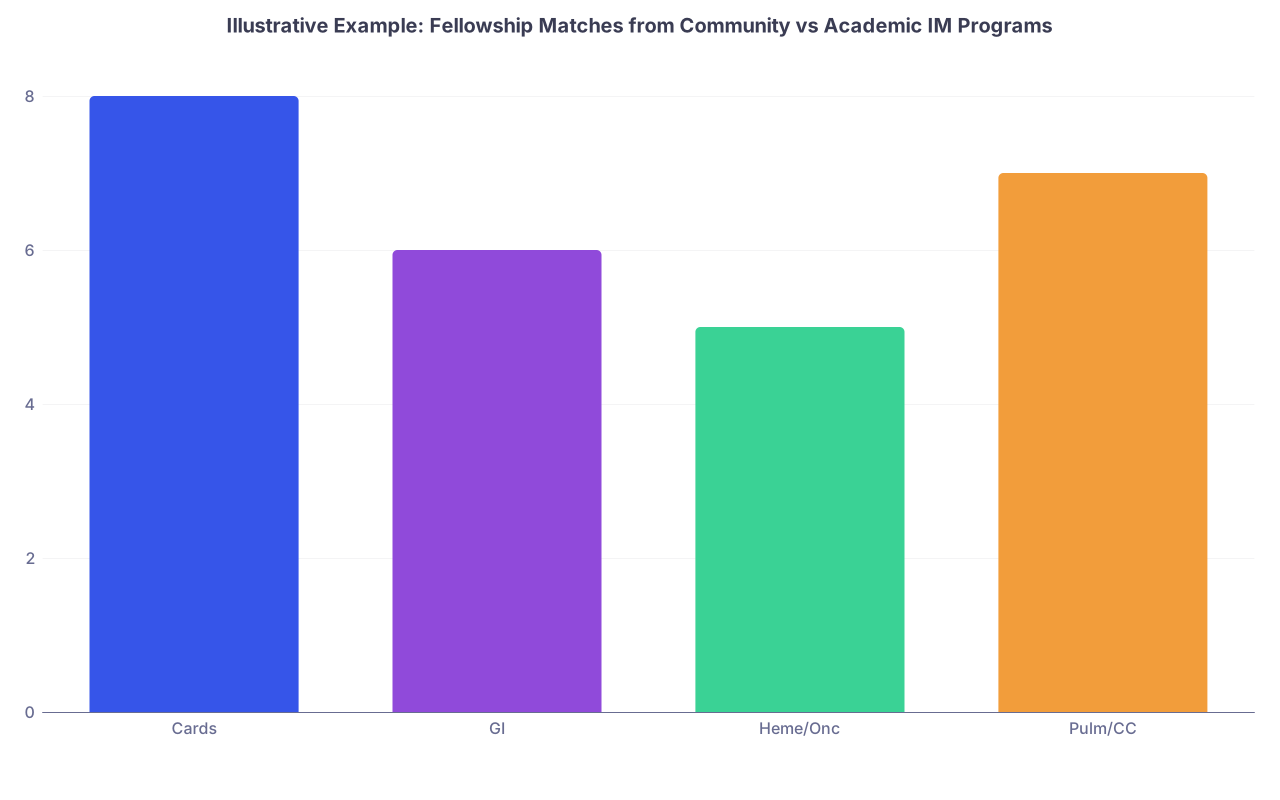
| Category | Value |
|---|---|
| Cards | 8 |
| GI | 6 |
| Heme/Onc | 5 |
| Pulm/CC | 7 |
Imagine this bar chart as total matches from a solid community program over 5 years. There are plenty of places like this. They just don’t brag as loudly as the name brands.
What matters isn’t, “Is it academic?”
It’s, “Are there people like me, with my goals, who’ve made it from there?”
The “PDs Will Judge Me” Fear
Another ugly thought:
“If I pick a community program, PDs and attendings will think I wasn’t good enough for academic.”
Reality: by the time people know where you trained, you’re already in the next application pool (fellowship, job). They are not sitting around reconstructing your Match options from med school.
They see:
- Your current program
- Your performance there
- Your letters
- Your scholarly stuff
Most of them know the truth: tons of highly qualified applicants pick programs for geography, family, partner jobs, kids, cost of living, or culture.
The only people obsessing over whether your program has a U in its name or not are… other anxious med students.
When Ranking a Community Program Higher Does Deserve a Hard Look
Let me be fair. There are times where ranking a community program above an academic one deserves real scrutiny. Not because it’s “unsafe,” but because trade‑offs are real.
You should pause and think harder if:
You are 100% sure you want a super‑competitive fellowship (e.g., derm from IM? very niche stuff) AND
the community program has no track record or local champion in that field.The community program:
- Has poor board pass rates.
- Has a reputation for service‑heavy, education‑light training.
- Couldn’t give you a straight answer about where graduates end up.
The academic program:
- Is well‑known to be supportive.
- Has strong mentorship in exactly your area.
- Didn’t give you any major “my life will be miserable here” vibes.
In that case, yeah, prestige plus infrastructure plus outcomes might outweigh your comfort preference. That’s not selling out, that’s strategy.
But if your situation is more like:
- Community program: happy residents, strong training, decent fellowship outcomes, location you actually want.
- Academic program: mixed vibes, more miserable residents, worse location for you, but big name.
Then ranking the community program higher is not just “safe.” It’s rational.
A Very Unsexy But Crucial Question: Where Will You Actually Thrive?
You’re signing up for 3–7 years of your life.
Not a brand sticker.

| Step | Description |
|---|---|
| Step 1 | Interviewed Programs |
| Step 2 | Move down rank list |
| Step 3 | Be cautious ranking high |
| Step 4 | Rank as backup |
| Step 5 | Rank higher |
| Step 6 | Could I see myself living here 3+ years? |
| Step 7 | Good training & outcomes? |
| Step 8 | Supports my career goals? |
Ask yourself:
- Where did I feel like a human, not a number?
- Whose residents seemed tired but not destroyed?
- Where did I walk away thinking, “I could grow here”?
Because here’s the sneaky truth: the people who end up with “impressive” careers are not just the ones who chased prestige. They’re the ones who:
- Were in an environment where they could safely fail and improve.
- Had mentors who remembered their names.
- Had enough gas in the tank to do a project or two, show up well, and not hate their lives.
That can absolutely happen at a community program. And it absolutely does not automatically happen at academic ones.
How to Sanity‑Check Your Rank List Before You Certify It
Late night, last week before the deadline, you’re spiraling. Here’s a concrete way to gut‑check yourself without a spreadsheet meltdown.
Imagine no one will ever know where you matched. No Instagram posts, no group chats, no CVs. It’s just you and your future self.
In that world, which program do you pick first?Picture your worst‑case day: post‑call, no sleep, 8 admissions overnight.
At which program are you more likely to have a co‑resident or attending you’d actually want to be stuck with?Look at post‑residency outcomes, not just logos.
If a “lesser” program quietly gets people into good fellowships or jobs every year, respect that.Talk to someone already in the field you want (fellow or young attending), not just your classmates.
Ask them bluntly: “Would going to [community program] close doors for me if I want [goal]?”
You’ll be surprised how often they say, “No, just make sure you get X/Y/Z there.”
A Quick Reality Snapshot: Where People End Up
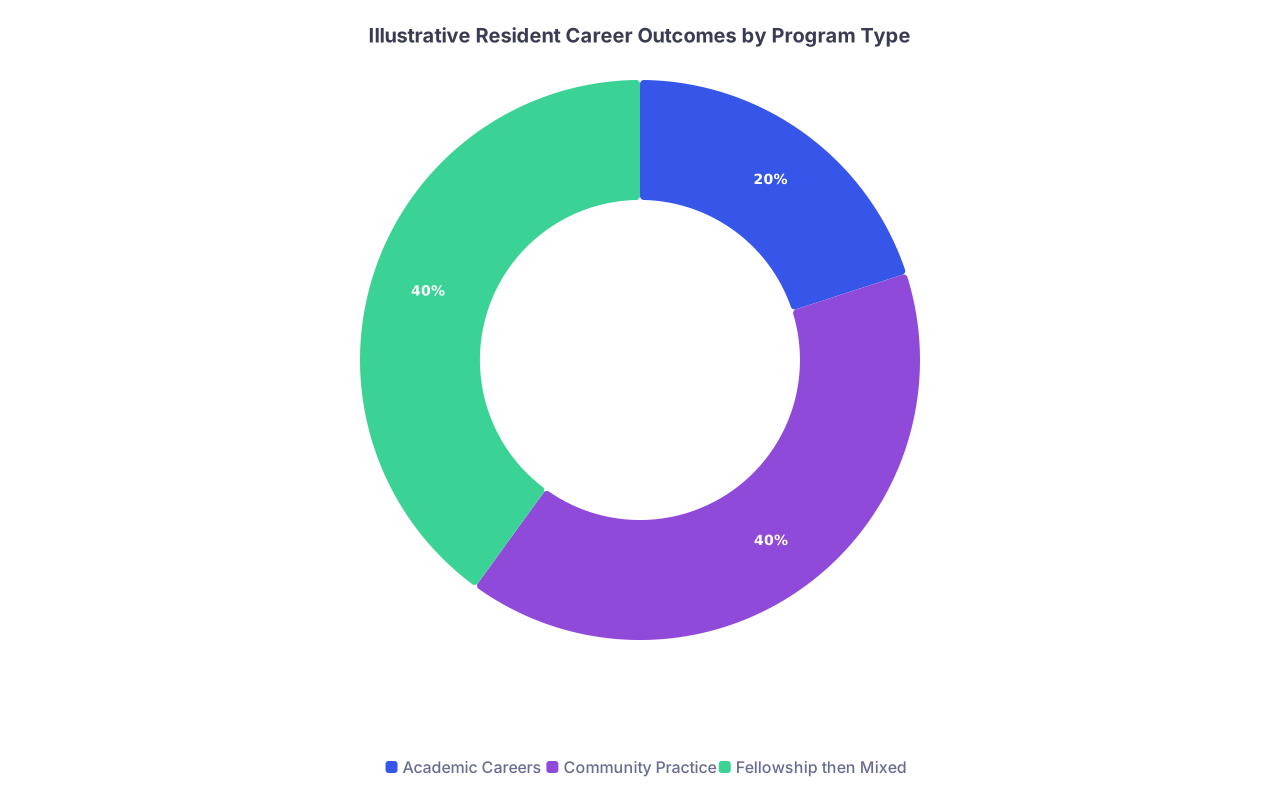
| Category | Value |
|---|---|
| Academic Careers | 20 |
| Community Practice | 40 |
| Fellowship then Mixed | 40 |
Most residents—academic or community—do not become tenure‑track physician‑scientists at world‑famous institutions. Many do fellowship then work in mixed or community settings. Many go straight into practice.
Your residency environment matters. Your name brand matters less than your actual development as a competent, decent, semi‑sane physician.
The Part of You That’s Afraid of Regret
I know the most haunting thought isn’t even “Will I match a fellowship?”
It’s: “Will future me look back and think I settled?”
Let me flip that.
Future you is more likely to resent:
- Choosing prestige and being miserable, unsupported, or burned out,
- Than choosing a slightly less fancy program where you became really damn good, had mentors, and still ended up with solid opportunities.
I’ve yet to meet someone who said, “I loved my program, I grew a ton, the culture was healthy, but I regret not trading all that away for a better bumper‑sticker name.”
But I have very much heard:
“I wish I’d taken the program where I actually felt like they wanted me and I fit in. I overrated the name.”
So… Is It Safe?
If by “safe” you mean:
- “Will I be automatically doomed if I rank a community program over a big academic one?” → No.
- “Can I still have a strong career, even do competitive fellowship, from a community program that supports those goals?” → Yes.
- “Will anyone ever know I ranked the community place higher than Famous U?” → No.
The dangerous move isn’t ranking a community program above an academic one.
The dangerous move is ignoring your own judgment, gut feeling, and the actual evidence (outcomes, culture, support) in favor of chasing a logo you think will quiet your anxiety.
It won’t. Anxiety just moves the goalpost.
At some point, you have to decide whose life you’re living: your classmates’, your imagined CV reader’s, or your own.

One Last Check Before You Click “Certify”
Here’s a thought experiment that cuts through a lot of noise.
Pretend you’re already an attending, ten years from now. You’re tired after clinic, driving home. You pass a billboard with your residency program’s name on it.
Which name on that billboard makes you feel:
“Yeah. That’s where I became who I am. I’m glad I spent those years there.”
If that honest answer is a community program over an academic giant, then yes—it’s not just safe to rank it higher.
It’s the kind of brave, clear‑eyed choice you’ll actually respect yourself for later.
Years from now, you won’t remember the exact order of your rank list. You’ll remember whether you picked the place that looked best on paper—or the place that actually let you become the doctor you wanted to be.