
You’re not “being weak” for needing to stay near family. You’re being realistic about what it takes to survive residency.
If you have a non‑negotiable geographic limit—because of kids, a sick parent, partner’s job, immigration issues, or your own mental health—you cannot afford a vague, feel‑good approach to your rank list. You need a cold, structured strategy.
This is how to do it, step by step, without sabotaging your chances in the Match.
Step 1: Get Brutally Honest About Your True Geographic Box
Do not start with programs. Start with your radius.
You’re not choosing between “local vs not local.” You’re choosing between specific commute realities and support realities. Those are not the same.
Ask yourself, in plain language, not in fantasy mode:
- Who exactly is my “support” and what do they actually do for me?
- How often do I realistically need them to be physically present?
- Is this more “Sunday dinner” or “I need childcare 3–4 days a week at 5 a.m.”?
- What’s the maximum door‑to‑door commute I can tolerate on q4 call, post‑nights, or with daycare pickup deadlines?
Then define your real geography:
- “Within 30 minutes of my parents’ house”
- “Within 45 minutes of our daycare”
- “Within 1 hour of my partner’s job by public transit”
- “Within X miles of major cancer center where my parent is treated”
45 minutes on Google Maps at 2 p.m. on a Tuesday does not equal 45 minutes at 6:45 a.m. every day. You need actual commute reality.
Use this simple approach:

| Step | Description |
|---|---|
| Step 1 | List all programs in my specialty within my state/region |
| Step 2 | Map each programs address to my support location |
| Step 3 | Keep on list |
| Step 4 | Remove or put on stretch list |
| Step 5 | Check call schedule & hours |
| Step 6 | Mark as Geographically Viable |
| Step 7 | Door-to-door commute <= X minutes during rush hour? |
Do not skip this. I’ve seen people ignore geography, match “nearby‑ish,” and then blow through their support because they live 70 minutes away in traffic and never actually see the people they counted on.
Step 2: Split Programs into Three Buckets Before You Rank
You’re going to create three piles before you start thinking about “prestige” or “gut feel”:
- Absolutely viable (geography + support + competitiveness)
- Borderline viable (one or more constraints stretched)
- Not viable (but might tempt you—these are dangerous)
Here’s a simple way to structure it:
| Bucket | Commute/Location | Support Access | Competitiveness Fit |
|---|---|---|---|
| Absolutely viable | Within defined acceptable radius | Reliable, realistic support | At or slightly above stats |
| Borderline | Slightly beyond ideal radius | Partial or occasional support | Reach programs |
| Not viable | Outside realistic radius | Support mostly theoretical | Extreme reach or low fit |
The mistake people make: they pretend borderline and not‑viable programs might work “if things line up.” Residency is four years (or more) of things not lining up.
Absolutely viable = programs where you can:
- Get to your support on a bad day, with bad traffic, after a 28‑hour call.
- Realistically use that support for what you need: childcare, elder care, meals, emotional backup.
- See your support often enough that it actually changes your life, not once a month.
If your list inside that “absolutely viable” zone is tiny (or zero), that’s a different problem—the “do I need to expand region or change specialty or consider SOAP?” problem. Do not lie to yourself to avoid facing that.
Step 3: Decide What “Support” Actually Means for You (Not in Theory)
“Near family” is vague. “My sister can pick up my kid from daycare on days I’m stuck at the hospital” is not.
You need to write down—literally write—what support you’re counting on:
Examples I’ve seen that actually matter during residency:
- Grandparents doing drop‑off/pickup 2–3 times per week when you’re on wards.
- A sibling who lives 20 minutes away and can be at your apartment at 10 p.m. if your partner needs to take you to the ED.
- Parents who can stay overnight with your kids when you’re on nights and your partner is on a weird shift.
- Someone who will actually cook or bring you real food when you’re post‑call and wrecked.
- A family member who will sit with your sick parent during your 14‑hour days so you’re not trying to coordinate everything yourself.
Now, test it:
- Where do they live exactly?
- Do they drive? Have a car? Parking situation at your place / their place?
- What are their jobs and hours? Are they actually flexible or just “kind of flexible”?
- Any health limits they have that cap what they can really do?
A grandma who “would love to help” but doesn’t drive at night and lives 55 minutes away is not midnight‑crisis support. She’s Sunday‑afternoon support. Both are valuable, but they affect your rank list differently.
Step 4: Overlay Program Reality: Hours, Call, Culture
Within your geographic box, you’re going to find programs that are technically “close to family” but will destroy your ability to use that support because of how they run their residents.
This is where most people mess up. They assume “closer to family = better” and ignore:
- Call frequency
- Weekend expectations
- Realistic end times for “clinic days”
- How malignant or reasonable the culture is
The question is not “Is this program good?” It’s “Can I, with my life, survive this program in this location?”
A rough comparison mindset helps:
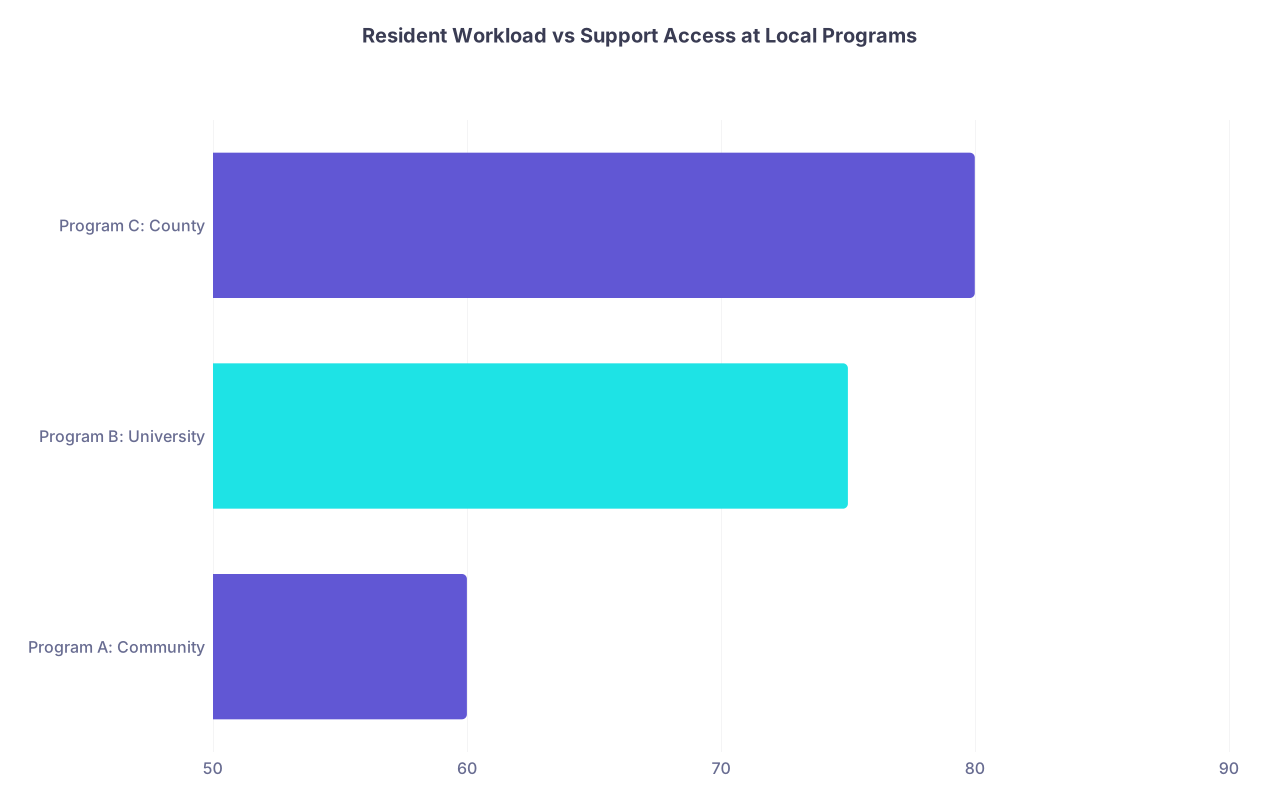
| Category | Value |
|---|---|
| Program A: Community | 60 |
| Program B: University | 75 |
| Program C: County | 80 |
Now imagine:
- Program A: 60–65 hours/week, lighter call, closer to your parents, culture supportive.
- Program B: 75–80 hours, heavy q4 call, same city but 30 minutes farther, culture “sink or swim.”
- Program C: 80+ hours, trauma heavy, 24‑hour calls, 5 minutes from your partner but 50 from your kids’ grandparents.
Which one keeps your life barely stitched together? For most people with heavy dependence on family support, it’s Program A—even if B and C look “better” on paper.
Here’s the harsh truth: prestige will not raise your kids, sit with your chemo‑receiving parent, or get you out of bed after a depressive crash. Your support system will. If you need them, rank accordingly.
Step 5: Run the “Worst Month” Simulation for Each Program
Forget the glossy interview day. For each geographically viable program, simulate your worst reasonable month:
- You’re on ICU or nights.
- You’re working 6 days a week, long shifts, with unpredictable end times.
- Something goes wrong at home: sick kid, hospitalized parent, partner crisis, your own mental health flare.
Now answer for each program:
- How fast can your support physically get to your home or hospital?
- If daycare calls at 4 p.m. and you’re scrubbed in, who actually goes?
- If your parent needs urgent help, are you 25 minutes away or 75?
- If you crash emotionally, who can be in your apartment by 8 p.m. on a Tuesday?
Do that exercise mercilessly. Anywhere the answer is, “Well, in theory if traffic isn’t bad and if my dad isn’t at work and if…”—that program should drop down your rank list.
I’ve watched residents in programs that were “only 45 minutes away” from family support spend entire years feeling like they had zero help. On paper they were “near family.” In reality, it was too far for any real-time rescue.
Step 6: Structure the Actual Rank List: Safety First, Ego Last
Now you have:
- A set of geographically viable programs.
- A sense of their workload/culture.
- A clear picture of how support would function.
Here’s how to translate that into a rank list.
Order of priorities if you truly must stay near family:
- Programs that are both geographically viable and reasonably likely to match you.
- Within that set, order by: support realism → workload/culture → training quality.
- Only after that, add “stretch” local programs higher if they don’t compromise #1 and #2.
- Distant programs go at the bottom only if they’re a last‑ditch “I’d rather move than SOAP” safety net.
What you don’t do:
- You don’t put a top‑tier academic program that’s at your very edge of geography and support above 3 solid, nearby community programs where your life would actually work.
- You don’t rank a program where your support is mostly theoretical just because the name is shiny.
- You don’t “gamble” your sanity because of FOMO.
If you’ve got, say, 7 local-ish programs:
- 3 are clearly workable with strong support.
- 2 are workable but heavier, with partial support.
- 2 are brutal or barely reachable but prestigious.
A sane rank list for someone who must stay near support might look like:
- Best combination of close support + decent hours + good fit.
- Next best combo of those factors.
- Slightly heavier program but very close to core family.
- Less appealing culture but still highly supported and close. 5–6. The heavier/academic ones that might be amazing but realistically strain your support.
- Any “I really don’t want to go here but it beats going unmatched” distant program.
Notice how prestige is not driving the top.
Step 7: Have the Hard Conversation with Your Family (Before You Certify)
You’re not the only one in this equation. If your whole ranking strategy relies on your family, they deserve to understand what that means in practice.
You sit them down and walk through specific scenarios:
- “If I match at Program X, that means I’ll likely be out of the house 70–80 hours/week. I’ll need help with [daycare, meals, parent transport]. Is that something you can really do?”
- “If my call ends at 8 a.m. and I’ve been up all night, and the baby is sick, can you help some mornings?”
- “If I’m at Program Y, I’ll be 50 minutes away. Will you be able to come out on weeknights if we really need you?”
Push for concrete answers, not “we’ll help however we can.” Well‑meaning people overpromise. Then life, jobs, their own health, and logistics get in the way.
Sometimes this conversation will change your radius. You’ll realize:
- Your parents can’t do 5 a.m. drives.
- Your sibling’s job is not actually flexible in the way they thought.
- Your “built‑in childcare” uncle is planning to move in 2 years.
Better to know now and adjust your rank list than to discover in October of PGY‑1 that your entire support plan is fiction.
Step 8: Match Strategy if Your Local Options Are Weak or Very Competitive
Sometimes the situation is ugly:
- Only 1–2 programs within your realistic radius.
- They’re very competitive.
- Your application is average or below for the specialty.
This is where you need strategy, not denial.
You have three levers:
Breadth across nearby regions
Maybe your radius isn’t “my city.” Maybe it’s “these three nearby metro areas that are 60–90 minutes from family but on a direct train” and still allow real support at least weekly plus emergencies.Program tier trade‑offs
You may need to prioritize lower‑tier/community programs if they’re your only realistic local options. Matching into a “less shiny” local program is always better than not matching or matching 3 time zones away when you’re a caregiver.Specialty flexibility
If you’re applying to something competitive (derm, ortho, ENT, etc.) and you must be in one zone, you should have a dual‑application or backup plan. A lot of people pretend they’ll “just reapply” later. That’s much harder once you’re locked into another residency and your life is even more complicated.
If local options are truly that limited, build your list like this:
- Top: all local/near‑support programs in your primary specialty that you’d accept.
- Middle: any reasonable near‑support programs in your backup specialty (if you applied).
- Bottom: only a few far‑away programs you’d reluctantly accept rather than go unmatched, and you’re honest with yourself that these will be painful.
Do not casually toss in 10 distant programs “just in case I match there.” If you get one of them, you’re going. And your support plan is gone.
Step 9: Reality‑Check with Someone Not Emotionally Invested
You need at least one outside brain. Someone who doesn’t care about your city pride, your school’s competitiveness bragging, or your aunt’s opinions.
Good options:
- A mentor in your specialty who understands program tiers and your stats.
- A chief resident or upper‑level who trained in your geographic area.
- An advisor who can say, “You are very unlikely to match at these top three; don’t rank them above your solid options.”
Show them:
- Your geographic constraint (clearly defined).
- Your list of local programs and what you think about each.
- Your draft rank order.
Ask bluntly:
- “Given my application, what are my real odds at each of these?”
- “Am I about to do something stupid like ranking a huge reach above my best realistic local option?”
- “If you were me, needing to stay close to a sick parent / kids, how would you order these?”
If they tell you something that hurts your ego, sit with it. Better an ego bruise in January than a life meltdown in October.
FAQs
1. Should I ever rank a far‑away “better” program above a close but less prestigious one?
If you truly must stay near family support, usually no. The only time I’ve seen it make sense is when:
- Your family support near home is weak or unreliable, and
- The distant program is dramatically better in culture, support for residents with families, and maybe even has its own on‑site childcare or social support systems.
But that’s rare. For most people in your situation, trading reliable support for prestige is a bad bet.
2. What if my partner wants to move for a “better” city but I need family support?
Then you have a priorities problem, not a geography problem. You and your partner need to decide whether:
- Being close to family support for residency is non‑negotiable, or
- You’re both willing to do the “we’re on our own in a new city” experiment.
You can’t build a coherent rank list until you agree on that basic premise. If you don’t, you’ll either tank your support or your relationship.
3. How many local programs do I need on my list to feel “safe”?
There’s no magic number, but as a rule of thumb: you want as many local programs as reasonably exist where you’d be willing to train. If there are 8 programs within your realistic radius and you only ranked 3 “because the others seemed mid,” that’s reckless. Rank every local program you’d be willing to attend before you start padding with distant options.
4. What if my family is nearby but emotionally draining or unsupportive?
Then proximity does not equal support. Being 15 minutes from people who criticize you, undermine your partner, or refuse to help when asked is worse than being 3 hours from genuinely supportive friends. In that case, de‑prioritize “family distance” and focus on where actual support is—friends, partner, community, or a city where you can build that.
5. How do I handle guilt if I rank a “worse” program higher just to stay near family?
You reframe it. You’re not choosing a “worse” program. You’re choosing a system that makes it possible for you to be a functioning physician, partner, parent, or caregiver. Match outcomes are not Instagram posts; they’re lived lives. A “good” match is one you can survive without burning out or blowing up your family. That’s not something to feel guilty about—that’s you doing your job as an adult.
If you must stay near family support, your rank list is not about chasing the best program on paper. It’s about building the only life you’ll actually be able to live. Define your real radius, test your support in specific scenarios, and put your most livable, local, realistic options at the top—even when your ego screams otherwise.