
Second‑Look Visits Change Your Perspective: Adjusting Your Rank List
What do you do when your “#1” program suddenly feels wrong after a second‑look visit… and a place you barely considered just punched way above its weight?
You’re not crazy. This happens every year. People walk into a second look convinced their list is basically set, then leave with their gut screaming something different. And then they panic: “Am I overreacting? Am I being emotional? Am I going to screw up my rank list?”
Let’s handle that.
This is about what you do right now—when the visits are over (or almost over), the NRMP deadline is staring at you, and your brain is a mess of half-remembered tours, fake smiles, and “we’re a family here” speeches.
What Second Looks Actually Tell You (That Interview Days Don’t)
Interview day is a performance. Second looks are closer to reality.
On interview day:
- Everyone is on-script.
- You’re in a suit, adrenaline is high.
- You meet handpicked residents who are “safe” to put in front of applicants.
- No one is going to say, “Our call system kind of sucks and morale is low right now.”
Second looks, if you do them right, show you:
- Who actually hangs out in the resident workroom at 2 p.m. on a Tuesday.
- Who looks tired vs. who looks dead-inside.
- Whether attendings acknowledge residents in the hallway or walk past them like furniture.
- How residents talk when the door closes and no faculty are around.
You should expect your perspective to shift. If it doesn’t, you probably didn’t look closely enough.
So if you’re thinking, “I liked Program A on interview day, but at the second look something felt off,” that’s not noise. That’s new data.
Step 1: Sort What Changed – Feelings vs Facts
Do this before you touch your rank list.
Sit down and write two short lists for each program you second-looked:
- What felt different at the second look compared to interview day
- What concrete facts changed
Concrete facts are things like:
- “Night float is actually 6 months total, not 2–3 like I thought.”
- “They just lost two key faculty and no one knows if they’re being replaced.”
- “Clinic is across town, 30–40 minutes each way, 3x per week.”
- “Surgical case logs: chiefs graduating at bare minimum numbers.”
Feelings are:
- “Residents seemed anxious when leadership was mentioned.”
- “The chief I talked to sounded bitter.”
- “Everyone kept talking about how they ‘just push through’ the rough culture.”
- “I didn’t see a single resident smile all afternoon.”
Both matter. Facts keep you grounded. Feelings reveal culture.
If you don’t separate them, you’ll either:
- Overcorrect based on a single awkward interaction, or
- Ignore your gut because you’re afraid of “being emotional.”
Bad strategy either way.
Step 2: Use Residents as Your Primary Data Source
If you learned one thing on second looks, it was probably this: residents tell you everything—directly or indirectly.
You should be asking yourself:
- Did residents contradict what faculty said on interview day?
- Did more senior residents give a different picture than the juniors?
- Did anyone drop those subtle red-flag lines, like:
- “You’ll be fine as long as you’re tough.”
- “We’re working on wellness stuff.”
- “We had some issues with leadership in the past… anyway…”
Here’s how I’ve heard people sort programs after second looks:
- Program X: “Residents were tired but joking with each other. When I asked about call, they complained but in a very normal way. They still recommended the program without hesitation.”
- Program Y: “When I asked about leadership, the tone changed. One resident said, ‘We probably shouldn’t talk about that,’ and the others got quiet.”
- Program Z: “They were honest: workload is heavy, but they had specific examples of things that improved in the last 2 years. That’s a good sign. It means the program responds.”
If the residents’ vibe and stories didn’t match the glossy sales pitch, you adjust your rank list. You are not overreacting. You’re doing due diligence.
Step 3: Compare On-Camera vs Off-Camera Versions of Each Program
You basically have two versions of every program now:
- The interview-day, curated version
- The second-look, closer-to-real version
Make that explicit. For each program that changed in your mind, write this out:
“On interview day, I thought this place was: ________
On second look, it actually felt more like: ________”
For example:
- “On interview day: super academic, tight-knit, friendly.
Second look: very academic, yes, but residents seemed isolated and burnt out.”
Or:
- “On interview day: medium-tier, nothing flashy.
Second look: residents were genuinely happy, joked a lot, and talked about how supported they feel.”
That delta—the gap between those two pictures—is what should move programs up or down your list.
The programs where the story held up under the second look? They deserve to move up. Consistency is rare and valuable.
Step 4: Do Not Rank Based on FOMO, Clout, or Name Alone
Second looks mess with people’s heads because they collide with prestige.
Scenario I’ve seen a hundred times:
- You interview at a “big-name” program.
- You convince yourself this must be #1 or #2 because “career doors.”
- Second look: culture feels toxic, seniors are miserable, everyone half-jokes about leaving the specialty.
- You go home and think, “But… it’s [Prestige Program]. I can’t drop it too far.”
Yes, you can. And probably should.
Here’s the problem: you don’t train in a name. You train in a hospital, in a call room, with a group of actual humans at 3 a.m. when a patient is crumping and your senior either shows up or doesn’t.
If your second-look gave you strong data that a highly ranked, high-prestige place is a terrible fit for how you function as a human, that’s not noise. That is signal.
The worst decisions I’ve seen:
- Ranking a “fancy” program highly when you already know you’d be miserable there.
- Keeping a program high because your classmates think it’s impressive.
- Ignoring your clear favorite because “it’s not as academic.”
Programs care about your performance and development a lot more than what name is stitched on your fleece. If you’re thriving, you’ll do well almost anywhere. If you’re drowning, the name won’t save you.
Step 5: Build a Simple, Brutally Honest Comparison
Stop arguing in circles with yourself. Put programs side by side.
| Factor | Program A | Program B | Program C |
|---|---|---|---|
| Gut comfort (1–10) | 6 | 9 | 7 |
| Resident morale (1–10) | 5 | 8 | 6 |
| Workload sanity (1–10) | 4 | 7 | 8 |
| Training strength (1–10) | 9 | 8 | 7 |
| Location satisfaction (1–10) | 7 | 8 | 5 |
Do numbers like this capture everything? No. But they force you to stop hand-waving and confront what you actually think.
If you’re giving Program B 9s and 8s across the board but still clinging to Program A for “prestige,” that’s your bias talking.
Pick 5–7 factors that really matter to you:
- Resident morale / culture
- Training quality / case volume / fellowship placement
- Workload + schedule reality
- Location / cost of living / support system
- Program leadership (trust vs chaos)
- How much you can be yourself there
Score them fast. Don’t overthink. Your first-pass numbers are usually more honest than your 3rd revision.
Step 6: Decide What Actually Matters in Your First 3 Years
A second look tends to sharpen what will matter to you daily, not in some hypothetical future ten years away.
Things you think will matter a ton as an MS4:
- Name recognition
- How “impressive” your Match Instagram post looks
- Whether the residents all match into ultra-competitive fellowships
Things that actually matter when you’re an intern:
- Can I ask “stupid” questions without getting humiliated?
- Will someone back me up when I’m in over my head at 2 a.m.?
- Can I sleep on call without getting passive-aggressively shamed?
- Will my program have my back if I’m struggling or need time off?
Your second-look impressions should be weighed heavily through that lens.
For example:
Program A (big-name academic):
- Great research, huge name.
- Residents openly said “you just kind of survive intern year.”
- PGY-3 said, “We lose people every few years. This place isn’t for everyone.”
Program B (solid academic/community mix):
- Less flashy.
- Multiple residents told you: “Our PD is amazing. When someone struggles, they really support them.”
- People joked around during sign-out. No one looked scared of attendings.
Long term, which cultivates better growth? B, almost always. You’ll actually learn more in a place where you’re not constantly in fight-or-flight.
Step 7: Handling Conflicting Data from Multiple Second Looks
You might have had different visits on different days—some days residents are post-call, short-staffed, or dealing with recent drama. That can skew your read.
So ask:
- Was this an off day or a pattern?
- Did I hear similar things from multiple people at different times?
- Did the vibe match what I’ve heard from alumni, mentors, or residents I talked to earlier in the season?
If something felt off but you’re not sure if it was a fluke, email or call a resident you trusted and ask specific questions:
- “You mentioned call can be rough—can you give me a sense of q4 vs q6, and how backed up you feel?”
- “You alluded to some turnover in leadership. Has that actually changed your day-to-day?”
- “How has morale been this year compared to prior years?”
Most will answer honestly. If they dodge or sugarcoat, you just learned something else.
Step 8: Married / Partnered / Kids? You Weigh Different Things
If you dragged a partner or spouse to a second look, listen to them. They’re not biased by prestige and specialty culture the way you are. They’re watching people, lifestyle, and whether this place eats families alive.
Things I’ve heard from partners after second looks:
- “No one mentioned childcare or families. People seemed surprised when I asked.”
- “Everyone talked about living in the hospital. That freaked me out.”
- “The residents with kids actually looked… okay. They all mentioned the same supportive PD.”
If you have kids or plan to in residency, you must factor:
- Call schedule and weekend burden
- Parental leave policy in practice (not just what’s written)
- Whether there are any residents with kids—and whether they seem like ghosts
- How far you’d live from the hospital and from family support
These aren’t soft factors. They determine whether you burn out, your relationship implodes, or you survive.
Step 9: Turn All This into a Final Rank Strategy
Now, turn the chaos into an actual plan.
Here’s a simple ranking logic that usually holds up:
Automatically drop any program where:
- You don’t trust leadership
- Residents privately warned you away
- You felt physically sick thinking about working there
Even if it’s “top tier.”
Move up programs where:
- Interview-day impression and second-look impression were consistent
- Residents were honest, not performative
- You left thinking, “I can see myself here in July and not hating my life.”
Use prestige only as a tiebreaker:
- When two programs feel genuinely similar in culture and support
- When you’re truly ambivalent between them otherwise
Don’t rearrange your entire list over one awkward interaction:
- One weird resident ≠ bad program
- One super-charismatic resident ≠ good program

| Step | Description |
|---|---|
| Step 1 | Second-Look Impressions |
| Step 2 | Drop down list |
| Step 3 | Mid-lower on list |
| Step 4 | Top section of list |
| Step 5 | Resident culture OK? |
| Step 6 | Leadership trust? |
| Step 7 | Training meets goals? |
You’re not building a philosophical argument. You’re building a list that answers one question: Where am I most likely to be well-trained and not miserable?
Step 10: Stop Re‑Ranking Every 24 Hours
Once you’ve integrated second-look data and adjusted your list, stop messing with it every night.
The re-ranking spiral goes like this:
- You build a list that reflects your actual values and second-look impressions.
- You talk to a classmate, panic, and move the “famous” programs up again.
- You talk to your mentor, panic the other direction, and move your “comfort” programs up.
- Now your list reflects everyone’s anxiety, not your judgment.
Do this instead:
- Build your list using the steps above.
- Walk away for 24–48 hours. No poking it.
- Come back and ask: “Does anything here feel wrong in my gut?”
- Make at most one more pass of adjustments. Then certify it and be done.
Your brain will try to optimize this to death. You can’t. The Match is probabilistic. Your job is to submit a list that your future self won’t hate, no matter where you fall on it.
A Quick Reality Check on Second Looks
Second looks are valuable, but they’re not magic. A few truths:
- You will miss things. Every resident finds out new realities after July 1.
- No program is as good as it looks on its best day, or as bad as it looks on its worst.
- You can have a rough visit to a good program. You can have a charming visit to a bad one.
That’s why you focus on patterns:
- Multiple aligned conversations
- Consistent themes across PGY levels
- Alignment (or misalignment) between what leadership claims and what residents live
And then you accept that this is a high-stakes decision with incomplete data, like almost everything in medicine.
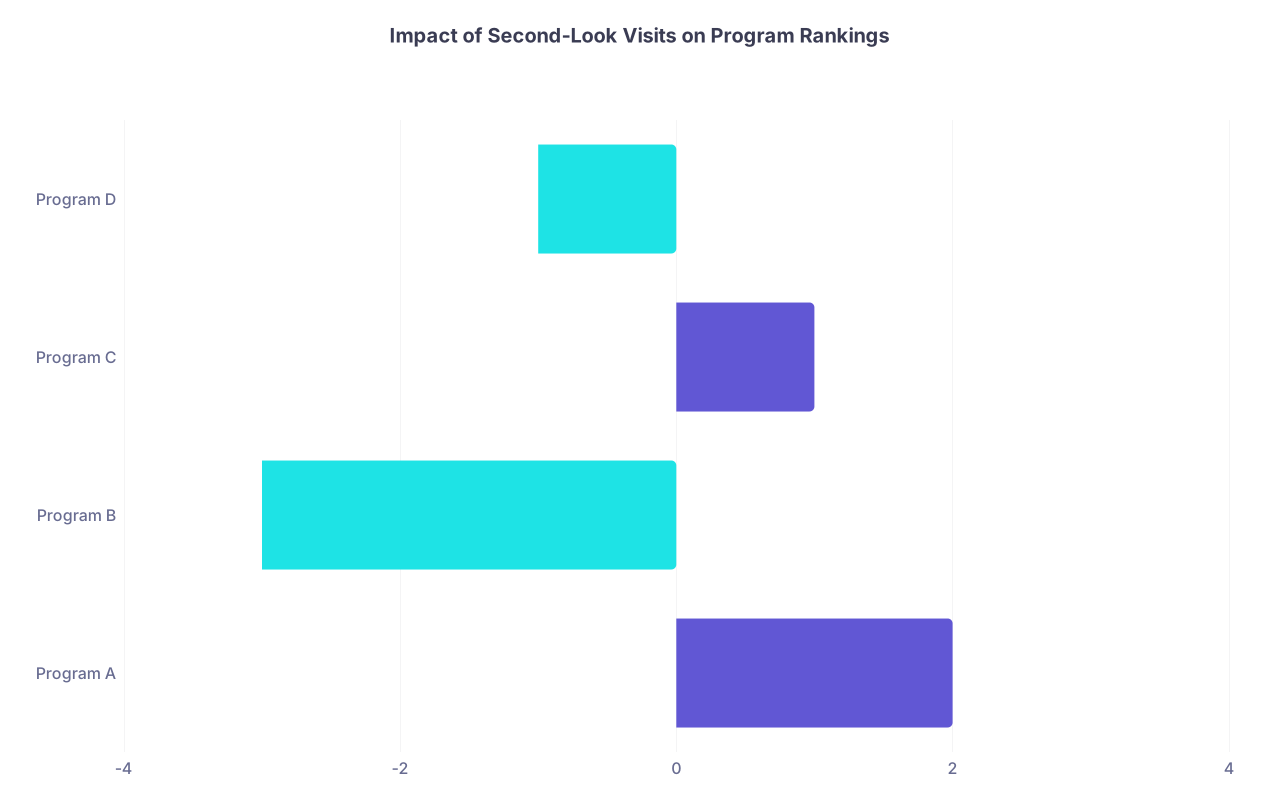
Visualizing How Second Looks Shifted You
Sometimes it helps to literally see how much your view changed.
| Category | Value |
|---|---|
| Program A | 2 |
| Program B | -3 |
| Program C | 1 |
| Program D | -1 |
Here, positive numbers = moved up that many positions after second look, negative = moved down. If one program dropped 3–4 spots for you, that’s not overreacting. That’s using new information.
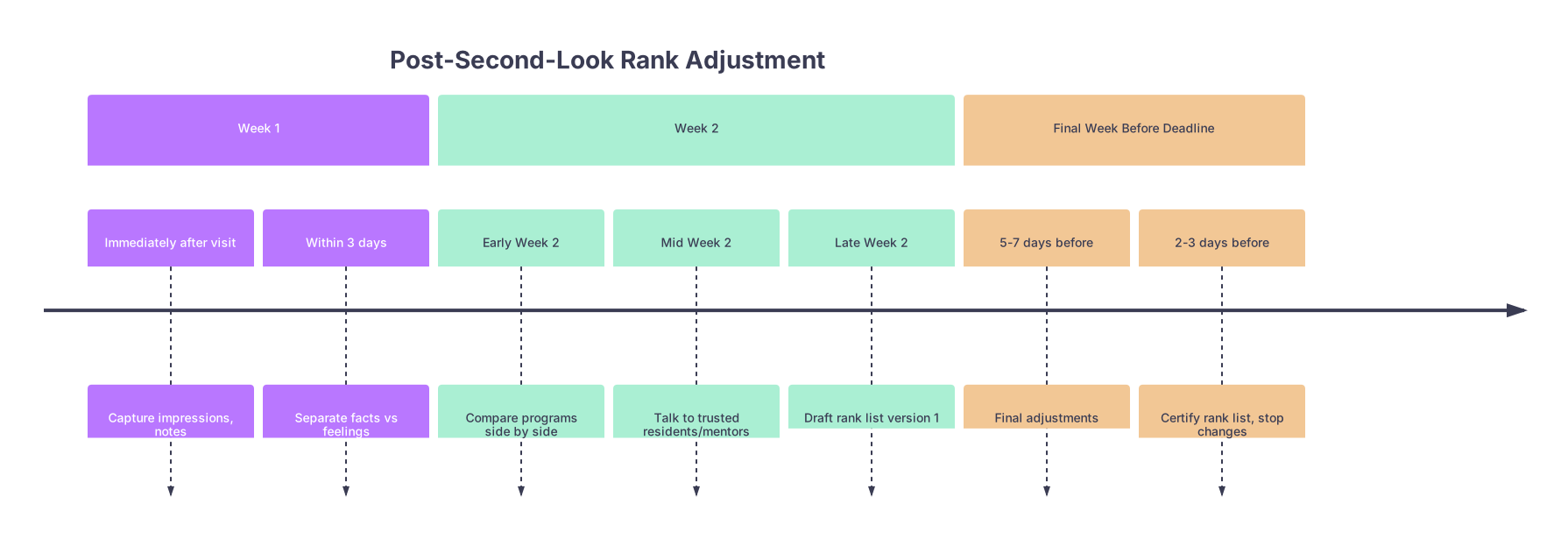
Timeline: When to Do All This Before the Rank Deadline
You don’t want to be rebuilding this the night before NRMP closes.
| Period | Event |
|---|---|
| Week 1 - Immediately after visit | Capture impressions, notes |
| Week 1 - Within 3 days | Separate facts vs feelings |
| Week 2 - Early Week 2 | Compare programs side by side |
| Week 2 - Mid Week 2 | Talk to trusted residents/mentors |
| Week 2 - Late Week 2 | Draft rank list version 1 |
| Final Week Before Deadline - 5-7 days before | Final adjustments |
| Final Week Before Deadline - 2-3 days before | Certify rank list, stop changes |
If you’re reading this close to the deadline, compress it, but keep the structure. Don’t skip the “walk away” step if you can help it.
Two Tooling Extras (If You’re Analytical)
If you’re the spreadsheet type, build one. Include:
- Columns for each program (A, B, C, etc.)
- Rows: culture, workload, training, location, leadership trust, gut feel
- A short free-text note per program: “Biggest pro / biggest con”
Or use a “dealbreaker” list written at the top of the page:
- “I will not train somewhere I fear my attendings.”
- “I will not train somewhere residents tell me not to come.”
- “I will not train somewhere that treats pregnancy/family as a burden.”
Any program that hits one of your dealbreakers drops down, no matter how pretty it looks on paper.
A Word on Last-Minute Cold Feet
You may get this: you liked your top program on second look, but as soon as you move them to #1, you get nauseous. “What if I’m wrong?”
You will feel this no matter what’s #1. It’s not a sign you chose wrong. It’s a sign you understand the stakes.
If you keep wanting to move your list every time anxiety spikes, stop and ask:
- “If Match Day were today and I opened my envelope to [Program X], would I be relieved, okay, or horrified?”
That cuts through a lot of noise. If imagining yourself at Program X gives you relief, that program should be higher. If you feel dread, it should be lower. Simple.
Final Takeaways
- Second looks aren’t “extra credit”—they’re real data. Use them to correct the polished version of programs you saw on interview day, especially around culture, resident morale, and leadership.
- Rank where you’ll be well-trained and not miserable. That means trusting your direct impressions of residents and day-to-day reality over prestige, clout, or other people’s expectations.
- Build your list, adjust once with a clear head, and stop tinkering. Your goal isn’t perfection—it’s a rank list your future self can live with, wherever you match on it.