

The way program directors use your rank list behind closed doors is not how anyone explains it to you on the outside. You’re told “just rank where you’ll be happiest” while attendings in another building are dissecting your list line by line asking, “Are we her backup or her dream?”
Let me pull you into that room.
What PDs Actually See From Your Rank List
First truth: they do not see your exact NRMP order during interview season.
They see pieces. Patterns. And they make assumptions.
In most specialties, here’s what they concretely get before the rank meeting:
- Your preference signals / tokens / tracks (ENT, ortho, IM, EM, etc.).
- Your geographic and regional patterns from ERAS and interviews you accepted/declined.
- Your communications: letters of interest, “you’re my #1” emails, update notes.
- Your interview behavior: what you asked about, what you didn’t, how hard you seemed to be selling them.
Then after everyone clicks “Certify List” and Match results come out, some PDs pull out the real toys: program director reports from NRMP, match analytics from their GME office, and “Applicant Match History” to infer where they sat on your list.
They get enough data to reverse-engineer a scary amount of your strategy.
, Post-interview emails, Geography, [Home/rotation ties](https://residencyadvisor.com/resources/residency-ranking-strategy/how-away-rotations-quietly-influence-your-spot-on-rank-order-lists), Interview behavior](https://cdn.residencyadvisor.com/images/articles_svg/chart-common-factors-pds-use-to-infer-applicant-interest-6367.svg "Common Factors PDs Use to Infer Applicant Interest")
| Category | Value |
|---|---|
| [Preference signals](https://residencyadvisor.com/resources/residency-ranking-strategy/the-hidden-signals-programs-use-to-decide-if-youll-rank-them-high) | 85 |
| Post-interview emails | 70 |
| Geography | 65 |
| [Home/rotation ties](https://residencyadvisor.com/resources/residency-ranking-strategy/how-away-rotations-quietly-influence-your-spot-on-rank-order-lists) | 60 |
| Interview behavior | 55 |
That means your rank list, plus your behavior around it, feeds back into how they rank you. Some programs do this heavily. Others pretend they do not. The smart ones track it systematically.
Let me walk you through how that actually shows up in rank meetings.
Inside the Rank Meeting: Who’s in the Room and What They Care About
I’ve sat in those meetings. They’re not mystical. They’re messy.
You’ve usually got:
- Program Director (PD) – owns the final list, deeply aware of ACGME and board pass numbers.
- Associate PDs (APDs) – know which residents are actually good to work with.
- Key Faculty – specialty “names” whose approval matters for politics and recruitment.
- Chief residents – they remember who was painful on interview day.
- Program coordinator – the quiet one with the spreadsheet who actually runs your life.
Here’s the part students never hear: almost no one is arguing about raw scores at that stage. That work was front-loaded. The rank meeting is about fit, risk, and one big question:
“If we offer this person a spot, how likely are they to actually land here, be happy, and not create disasters for us down the line?”
Your rank list—directly or indirectly—is used to answer that.
The Unspoken Categories PDs Use
Programs sort candidates into buckets behind the scenes. Not in official documents. In the conversation.
You’ll hear things like:
- “Reach for us, but might come if we’re their #1”
- “Solid fit, likely to rank us high”
- “We’re a safety for them”
- “They’re only here for the city name”
- “They’re shopping prestige; we’re a stepping stone”
Your signals, emails, and behavior get triangulated into this. Your rank list comes into play through:
Preference signals / tokens – If your specialty uses them, those are your first proxy for rank intent. Signal = “you are probably in my top tier.” No signal = “I might like you, but you’re not a priority.” Programs take that personally.
Geographic choices – You rank only coastal big-name places? That screams “I’m prestige or location-driven; community or mid-tier academic is backup.” Programs know this and adjust their expectations.
How your application clusters – You apply to 50 programs but only in three metro areas? They know this isn’t random. Someone in the room will say, “They’re trying to land in Chicago, we’re option C.”
They do not see your exact numeric list, but they act as if they can guess it with decent accuracy.
How Programs Use Your (Implied) Rank List to Shape Their List
Now the ugly truth: programs do gamble based on how likely you are to rank them highly.
Everyone says “R3 – the Match is applicant-favoring, programs can’t game it.” The algorithm is applicant-optimal. The people are not. They try anyway.
1. Deciding How High to Rank “Superstar Flight Risks”
Take this scenario. Surgery program at a solid mid-tier academic center. Candidate A:
- 260+ Step 2
- 15+ pubs, mostly in a big-name research group
- Interviews at MGH, Hopkins, UCSF, and also here
In the room, someone will say exactly this:
“They’re not coming here unless something catastrophic happens at their top places. Don’t burn a top-5 spot on them.”
Another faculty: “But if they somehow fell to us, they’d be incredible. Do we roll the dice?”
Here’s where your implied rank list is weaponized:
- If they know you’re from that city, with family there, and you sent them a strong “I’d be thrilled to train here” email, they’re more willing to rank you higher.
- If you joked during the interview about “probably not staying in the Midwest long-term,” you just got downgraded. That one comment gets quoted in the meeting verbatim.
So what happens? They slide you several spots down compared to applicants with slightly weaker stats but a much higher perceived chance of ranking them #1–3.
2. Protecting Their “Yield”
Programs care about “yield” even though they won’t call it that to your face. They look at:
- How many of their top 10 actually matched there last year.
- How many “highly ranked” applicants they never had a shot with.
Some PDs get NRMP outcome reports showing whether applicants ranked them above or below their matched program. Over a few years, they build a mental (and sometimes literal) list:
- “Home med students who interview tend to rank us top 3.”
- “Research-heavy candidates who also interview at Top-10 academic centers almost never come.”
- “Applicants from X med school who interview here rarely rank us high.”
When they’re building this year’s list, someone says:
“Historically, students from that school use us as a backup. Let’s not stuff the top 10 with them.”
That’s your perceived rank list from previous years reshaping the current rank order.
3. How “You’re My #1” Emails Actually Land
You’ve been told you can’t influence anything. That’s not accurate.
I’ve seen this many times: mid-level candidate (not a score monster, but strong) sends a very specific, believable “You are my #1” email. No hedging. No weird conditional language.
During the rank meeting, faculty are torn between several similarly ranked applicants. The PD looks around and says:
“Well, we know Applicant X is ranking us first. That matters.”
And then they bump that person up above a slightly “stronger on paper but likely not coming” applicant.
Is this logical given the Match algorithm? Not perfectly. But humans are not logical. PDs want to feel chosen. They’re also trying to reduce the risk they’ll drop farther down their own list than they’d like.
Your explicit ranking communication—when clear and credible—does influence where some programs place you.
4. Reading Between the Lines of Mixed Messages
Now the flip side. The “I’m very interested and ranking you highly” nonsense.
Programs hate this. They’ve heard it for decades. It means nothing.
Behind closed doors:
- If you tell three different programs they’re “very high on your list,” everyone assumes “we’re probably not #1.”
- If your email sounds like a template you sent 12 places, you’re treated as noncommittal.
- If your message contains specifics from your interview that show you paid attention, they’ll take that more seriously.
They are trying to read your rank list, whether you like it or not.
Where the Actual NRMP Data Shows Up
Let’s talk post-Match, because this is where your real rank position is quietly analyzed.
Certain NRMP reports allow programs to see:
- Where you matched.
- Whether you ranked them at all.
- In some cases, whether you ranked them higher or lower than your eventual match (depending on which report and aggregate vs individual data; details vary by year and agreement).
Then GME offices and PDs start looking for patterns. Over a few cycles, they notice:
- “High-Board-Score applicant types from School Y often don’t rank us at all even when we interview them.”
- “Couples from X/Y med schools who interview together often end up ranking us lower because we don’t have both specialties.”
That feeds back into next year’s invite and rank decisions.
So your rank behavior this year shapes someone else’s odds next year. It’s very much a feedback loop.

How Your Rank List Interacts With Their Strategy in Different Scenarios
Let’s walk through real-style scenarios so you can see how this actually plays out.
Scenario 1: The “Borderline” Applicant With Strong Interest
You’re applying Internal Medicine. You’re fine but not shiny:
- Step 2: 228
- Mid-tier school, average letters, no red flags
- Strong, clear interest in one specific city for family reasons
You:
- Send a specific “You are my #1” email to a solid mid-tier university program.
- Ask detailed program-specific questions on interview day.
- Decline interviews from distant locations after this one (they notice you canceled those dates).
In the rank meeting, your name comes up around the middle-third of applicants. One APD says:
“Not our strongest on paper, but clearly wants to be here. I’d bet they rank us #1.”
You get bumped up several spots, enough to land in their “we realistically expect to match them” zone.
Your “weakness” gets offset by the predictability of your rank behavior.
Scenario 2: The Oversubscribed Rockstar
EM applicant:
- Honors in everything, 260s, glowing SLOEs.
- Interviewed at all the big-name urban programs.
- On interview day at a strong-but-not-elite program, you say things like, “Yeah, I’m really hoping to end up in [insert major coastal city] if I can.”
Rank meeting discussion goes like this:
“They’re phenomenal. But look at this trend—everyone with that profile the last three years ranked us lower than where they actually matched. We can keep them relatively high, but don’t anchor our hopes on them.”
They keep you high enough that they’d happily take you if you miraculously fall. But they load the rest of the top spots with people they expect will actually rank them above other good but not top-5 programs.
In other words, your perceived rank list turns you into a “lottery ticket” instead of a “planned match.”
Scenario 3: The Couples Match Wildcard
Couples Match introduces a new layer of paranoia.
Programs know:
- Couples often contort their lists to be in the same city.
- A partner in a hyper-competitive specialty (e.g., derm, ortho) can dramatically alter what the pair ranks in the other specialty.
So they look for signals like:
- Did both of you interview here?
- Did one of you send a “you’re our #1 city” note?
- Does your geography pattern show strong clustering around a few metros?
If you’re the stronger partner on paper, a program in your specialty may assume you’ll drag your partner’s rank list towards your offers. If you’re the weaker partner, they may think the opposite.
They’ll use these assumptions when debating whether to rank you aggressively or treat you as another “flight risk.”

| Step | Description |
|---|---|
| Step 1 | Interview Season |
| Step 2 | Applicant Signals Interest |
| Step 3 | Ranked More Aggressively |
| Step 4 | Ranked as Flight Risk |
| Step 5 | Match Outcomes Reviewed |
| Step 6 | Adjust Future Strategy |
| Step 7 | Perceived as High-Interest? |
What You Should Actually Do With This Knowledge
No, you can’t completely control how programs interpret your behavior. They gossip, they speculate, they’re human.
But you’re not powerless.
1. Build a Rank List That Makes Internal Sense
Your rank list should reflect a coherent story if someone were to reconstruct it:
- Geography preference that actually matches your stated priorities.
- Program type alignment (academic, community, hybrid) that fits how you talked about your goals.
- Realistic ordering—do not put clear safety programs above true dream programs “just to be safe.” The algorithm does not reward that. Programs that know what they’re doing know this too.
If you interview at MGH, UCSF, and then rank a tiny community program #1 “to be safe,” all you’ve done is sabotage yourself.
2. Be Strategic and Honest With “You’re My #1” Statements
You get one real “You’re my #1” communication per specialty. Use it.
Make it:
- Specific: Refer to details: “Your X rotation, your Y clinic, your Z mentor.”
- Unambiguous: “I will be ranking [Program Name] as my number one choice.”
- Believable: Don’t send it to a place clearly outside the pattern of your applications.
Programs do use these as a soft tiebreaker when they believe you.
3. Do Not Over-Game What You Cannot Control
Trying to “fake” geographic interest, pretending to love a region you obviously don’t, or scattering vague “high on my list” emails everywhere just makes you look insincere.
Most rank list damage happens when people panic and try to “game” the system instead of:
- Ranking programs in their true order of preference.
- Giving one or two programs a clear, believable signal.
- Accepting that you cannot micromanage how every PD interprets you.

How Different Types of Programs Think About Your Rank Behavior
Let me pull back the curtain on one more layer: not all programs treat your implied rank list the same way.
| Program Type | How Much They Care About Your Apparent Rank List |
|---|---|
| Top 10 Academic | Low–Moderate; they assume they’re high for most |
| Solid Mid-Tier Academic | High; they obsess over yield and interest |
| Competitive Community | High; they want people who really want to be there |
| Rural/Community | Very High; fear of attrition and flight risk |
| Home Program | Very High; they track student interest closely |
The elite programs know they’ll fill. They still like being loved, but they’re not panicking if they suspect they’re #3 on your list instead of #1.
The mid-tier academic and desirable community programs are where your behavior and perceived rank order matter most. They’re constantly walking the line between:
- Reaching for a few stars who might rank them low.
- Loading up on strong, clearly committed applicants who will likely put them very high.
That’s the space where your “you’re my #1” email, your interview comments, and your visible geographic logic can move you several dozen spots on their list.
Huge Misconceptions You Should Dump Now
Let me clean up a few myths that float around every year:
“Programs can’t see or use my rank list at all.”
Not during the active ranking process, no. But they absolutely use your behavior as a proxy for your list, and they absolutely analyze match outcomes across years to infer patterns.“Telling a program they’re my #1 doesn’t matter because of the algorithm.”
Program behavior can be irrational. If they bump you up 10 spots because they believe you, that changes your odds—no matter how the algorithm works theoretically.“If I signal interest to more places, my chances go up.”
Spraying generic interest makes you look disingenuous. PDs talk. Faculty move between programs. You’re not as invisible as you think.“I should rank places ‘strategically’ instead of by true preference.”
Wrong. The NRMP algorithm really is applicant-optimal. Programs may try to game perceived interest, but you still maximize your outcome by ranking in your true order of desire.
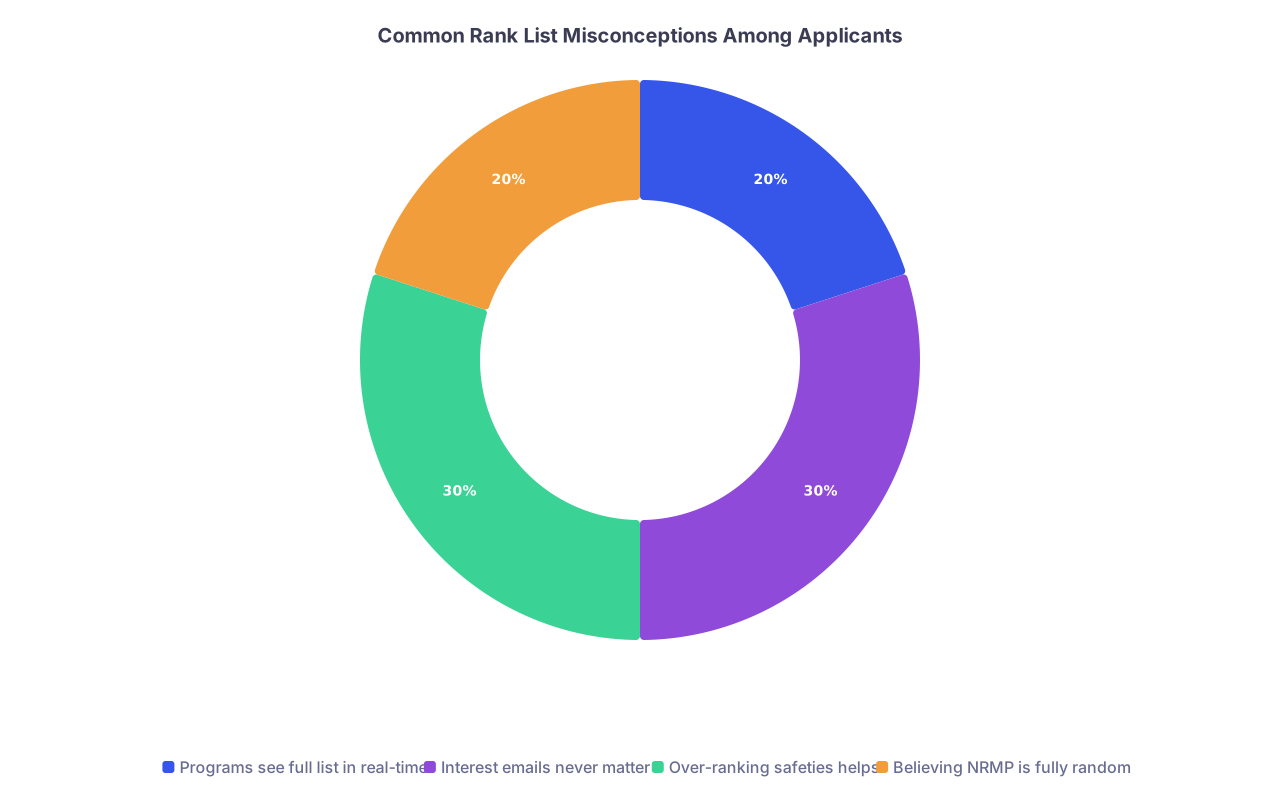
| Category | Value |
|---|---|
| Programs see full list in real-time | 20 |
| Interest emails never matter | 30 |
| Over-ranking safeties helps | 30 |
| Believing NRMP is fully random | 20 |


