
What if you did everything right for four years… and then blow your Match because your rank list is too short?
That’s the nightmare version, right? You submit your list, it feels tiny compared to what everyone else is bragging about in the group chat, and then you spiral:
“I only ranked 7 programs. My friend ranked 18. Did I just screw myself?”
Let’s walk through this slowly. Because the fear is real, but the story you’re telling yourself is probably way worse than reality.
First: Can a Short Rank List Actually Make You Go Unmatched?
Yes. But not automatically. And not in the simplistic way your brain is scaring you with.
The Match algorithm wants to match you. It tries to put you in your highest possible choice that also wants you. It doesn’t punish you for ranking places honestly.
Where a short list becomes dangerous is simple:
If you run out of programs on your list before the algorithm finds one that ranked you high enough, it can’t “keep trying” new places. Your list is finite. Once it’s done, it’s done.
So the real questions are:
- How competitive is your specialty?
- How competitive are YOU in that specialty?
- How realistic are the programs you ranked?
Not “Is 7 enough?” or “Is 12 enough?” in isolation. The number alone is a terrible metric.
What “Too Short” Usually Means in Real Life
Let me be blunt: most people aren’t actually worried their list is too short. They’re worried their ego will be bruised if they have to rank backup programs.
So they say things like:
- “I’d rather go unmatched than go to X program.”
- “I only ranked places I’d truly be happy at.”
- “I don’t see myself living in the Midwest / South / Northeast…”
That’s how you end up with a short list that really is dangerous.
If you’re applying to something like internal medicine, FM, psych, peds, neurology, pathology as a reasonably solid US MD with normal red flags (or none), and you have 8–12 programs that actually interviewed you, you’re probably fine.
If you’re applying to derm, plastics, ENT, neurosurgery, integrated vascular, etc., and you ranked 5 super elite places and nothing else? That’s not a “short list problem.” That’s a “you built a fantasy list” problem.
Your risk isn’t because the list is short.
It’s because it’s narrow and unrealistic.
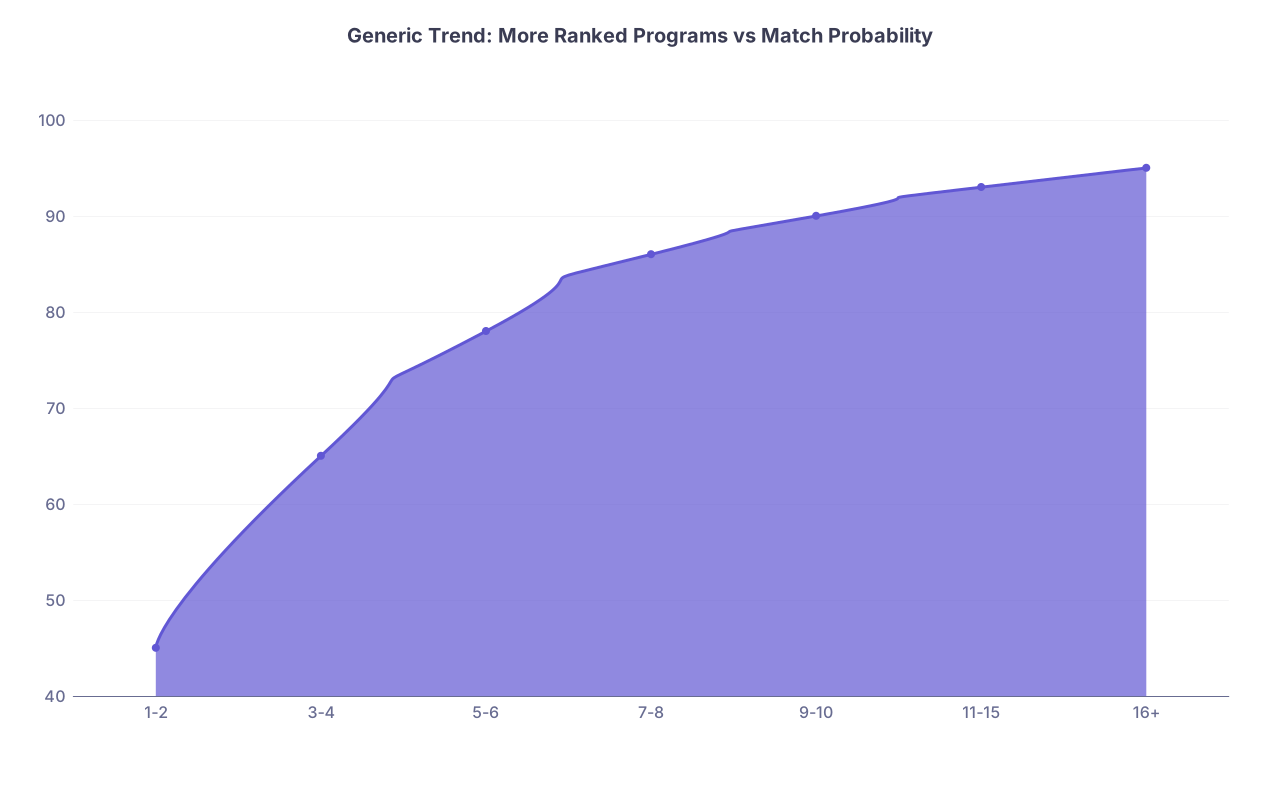
Data Reality Check: Does Longer Automatically Mean Safer?
| Category | Value |
|---|---|
| 1-2 | 45 |
| 3-4 | 65 |
| 5-6 | 78 |
| 7-8 | 86 |
| 9-10 | 90 |
| 11-15 | 93 |
| 16+ | 95 |
Across specialties, NRMP data shows a pattern that makes intuitive sense:
- Match rates go up as the number of ranked programs goes up.
- The jump in safety is big when you go from extremely short (1–3) to moderate.
- After a point (often ~10–15 programs for many core specialties), the curve flattens. You get diminishing returns.
Does that mean 10 is enough? For some people, yes. For others, not even close.
But here’s the piece your anxious brain is skipping:
Those stats assume you’re ranking a realistic mix of programs that actually interviewed you. Not just your dream coastal academic powerhouses.
The Hidden Risk: “I’d Only Be Happy At…”
This is the sneaky trap I see over and over.
You tell yourself:
“I only want to train at a place where I’ll be happy. It’s not about prestige.”
Sounds healthy. Mature. Boundaries.
But “happy” somehow ends up meaning:
- Big name places
- In 2–3 trendy cities
- With certain amenities, call structure, or reputation
- With a “vibe” you liked
Then residency coordinators say the thing nobody wants to hear out loud:
“We’ve seen people go unmatched because they refused to rank perfectly solid programs that weren’t in their top cities.”
This happens every year. In every match cycle. People go to SOAP in tears because they couldn’t see themselves in “less ideal” cities… right up until they don’t match.
Let me be harsh for a second because I wish someone had done this for me:
You can survive 3–5 years in a city you don’t love.
You cannot practice your specialty if you never match into it.
So… Is Your List Too Short?
Let’s diagnose this instead of just catastrophizing.
Ask yourself:
Specialty Type
- Hyper-competitive (derm, plastics, ortho, ENT, neurosurg, IR/DR integrated, some uro and ophtho): a list under ~10 is often risky unless you are a top-tier candidate with strong signals and evidence programs like you.
- Middle-tier competitive (EM, anesthesia, OB/GYN, gen surg, radiology): ranking <10 can be fine if your app is solid and your interviews went well, but it starts to feel tight if you had fewer interviews overall.
- Less competitive (IM, FM, peds, psych, path, PM&R in many regions): many people match with 5–10, but that’s assuming realistic programs.
Your Applicant Profile
- Any fails? Leaves? Major red flags?
- IMG or DO in a competitive specialty without strong US experience?
- Low Step scores or no Step 1/2 until late?
The more these apply, the longer and more realistic your list should be.
Program Mix
- Did you rank a combination of:
- Academic and community?
- More and less desirable locations?
- Places where you actually felt like they needed/wanted residents?
- Did you rank a combination of:
If your honest answers sound like:
- “I’m going into IM, I’m a US MD with decent scores, I ranked 8 programs in mixed regions I could tolerate” → then yeah, your anxiety is probably louder than the reality.
- “I’m going into derm, I’m mid-tier, and I only ranked 5 programs, all top tier academic” → yes, you are at genuinely high risk.
The Ugly Truth About “Short” Lists No One Tells You

A lot of people end up with short lists for reasons that have nothing to do with data:
- They cancelled interviews late because they “weren’t excited” about programs.
- They didn’t apply broadly enough at the start because someone told them, “You’re strong, you only need 20 applications.”
- They didn’t want to pay for extra travel or take more days off rotations.
- They fell in love with a city or one program and kind of mentally stopped caring about the rest.
By the time rank list certification comes, they’re backed into a corner with a small handful of options and no way to fix it. And then they panic about their “short list” instead of admitting the real issue: they cut their safety net too early.
If that’s you, you can’t undo it now. But you can at least be very honest:
“Did I choose a short list… or did circumstances leave me with one?”
If you chose it, you accepted more risk. That doesn’t guarantee disaster. But you lost some control.
How the Algorithm Actually Treats Your Short List
There’s this weird myth that if you don’t rank a lot of places, the algorithm somehow “penalizes” you.
No. It doesn’t care if you have 3 or 30. It just does this:

| Step | Description |
|---|---|
| Step 1 | You submit rank list |
| Step 2 | Algorithm checks your #1 |
| Step 3 | You match at #1 |
| Step 4 | Algorithm checks #2 |
| Step 5 | You match at #2 |
| Step 6 | Algorithm checks #3, etc. |
| Step 7 | You go unmatched |
| Step 8 | Did program rank you high enough? |
| Step 9 | Ranked high enough? |
| Step 10 | Any programs left on list? |
The only “punishment” for a short list is that the loop ends sooner.
If you ranked 7 and none of those ranked you high enough, the system can’t magically try #8, #9, #10. They don’t exist.
That’s why people say “rank every program you’d be willing to attend.” It’s not just a slogan. It’s literally how you give the algorithm more chances to help you.
“But I Don’t Want To Be Miserable for 3–7 Years”
Fair. Completely valid. Nobody’s saying, “Rank every malignant hellhole you stepped into.”
Here’s the line I draw:
If you would rather SOAP/scramble, change specialties, delay training, or risk never doing your desired specialty than go to a certain program or city — do not rank that program.
If you would definitely be disappointed but still relieved to be a doctor in your chosen field, rank that program.
You’re not choosing your forever life partner. You’re choosing 3–7 years of training that will be hard literally everywhere.
Sometimes the mature decision is:
“I’m okay being a little unhappy with the location if it means I still become a psychiatrist/surgeon/whatever.”
Late-Stage Panic: What Can You Do If Your List Already Feels Too Short?
If the rank list deadline hasn’t passed yet, your options are limited but not zero:
Go back through your interview list and ask:
“Is there any program I didn’t initially like that I would still rather attend than SOAP?”
If yes, add it. Swallow your pride.Reconsider your bias about certain cities or community vs academic.
The name on your badge matters a lot less than having a badge at all.Talk to someone who’s actually been through this: advisor, PD, upper-year resident who matched recently. Not your panicked classmates.
If the list is already certified and the deadline is past? Then you’re in the waiting phase. No more moves left on the chessboard.
At that point, the only useful thing is to mentally rehearse both outcomes:
Scenario 1: You match somewhere on your list.
Then all this panicking becomes a weird footnote.Scenario 2: You don’t match.
That’s not a death sentence. It’s painful, it’s humiliating, it’s expensive — but people recover. They SOAP into prelims, do research years, reapply, pivot specialties. It’s not the end of your medical career unless you decide it is.
A Brutally Honest Example
Let’s say:
- You’re a US MD going into anesthesia.
- Step 2: 235. No red flags.
- You got 11 interviews.
- You ranked 8 programs because 3 felt “meh” or were in cities you “couldn’t see yourself in.”
What’s your risk?
You’re not doomed. Anesthesia isn’t derm. But did you just slightly increase your chance of going unmatched compared to ranking all 11? Yes. Definitely.
Did you go from “probably safe” to “disaster guaranteed”? No.
Now tweak it:
- IMG, anesthesia, Step 2: 222.
- 6 interviews. You ranked all 6.
Now your list isn’t “too short” — it’s exactly as long as your reality allowed. Matching is absolutely still possible, but your risk is meaningfully higher because your whole portfolio is tight, not just the length of your list.
See the pattern? The length of your list is almost never the only issue.
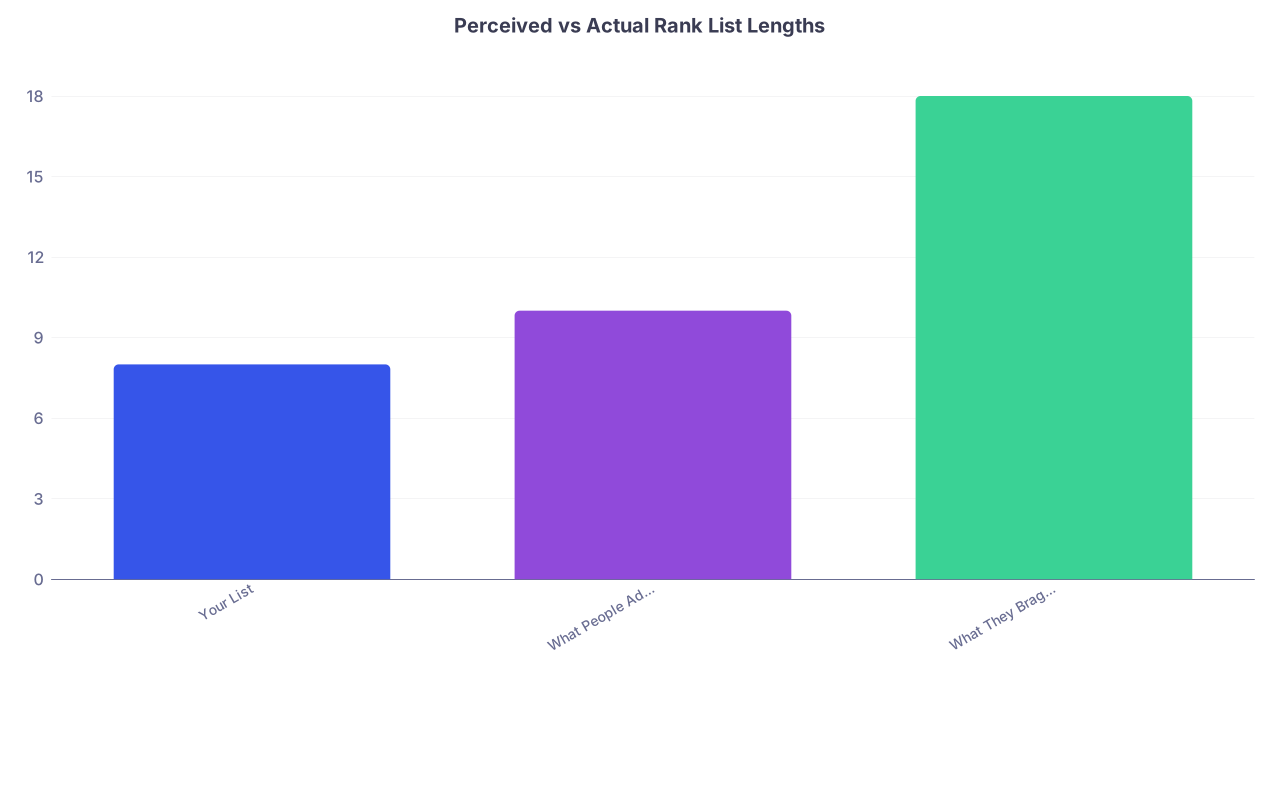
When the Group Chat Makes You Feel Like You Messed Up
| Category | Value |
|---|---|
| Your List | 8 |
| What People Admit | 10 |
| What They Brag About | 18 |
Nobody’s being honest about how many places they ranked.
- The person flexing about their 22-program list might have ranked 10 they actively disliked out of pure panic.
- The person saying, “I only ranked 5, I’m chill,” might secretly be spiraling just like you.
- Some people flat-out lie because they’re insecure.
Stop comparing your insides to their curated outsides. Your risk isn’t determined by how your list compares in the group chat. It’s determined by your specialty, your competitiveness, and the realism of your programs.
You’re Allowed to Be Scared — But Don’t Rewrite History
If you made your list thoughtfully, ranking only places you’d actually go, with a realistic mix… the fear you’re feeling now is mostly just that: fear.
You’re not having a revelation. You’re having anxiety.
Every future PGY-1 I’ve known went through some version of this:
- “My list is too short.”
- “I ranked that program too low.”
- “I should’ve applied to more.”
- “I bet everyone else is safer than me.”
And then Match Day comes. They open the envelope. And suddenly all of this noise dies in one second.
Years from now, you won’t measure your career by how long your rank list was. You’ll measure it by how you responded to uncertainty when it felt like the stakes couldn’t be higher.
FAQ (Exactly 5 Questions)
1. Is there a “magic number” of programs I should rank to be safe?
No. There isn’t. For some average applicants in non-competitive specialties, 8–10 is plenty. For others in hyper-competitive fields, 15 might still be risky. The number alone is meaningless without factoring in specialty competitiveness, your scores, your red flags, and how realistic your interviews were.
2. I have 5 programs on my list. Am I basically guaranteed to go unmatched?
Not guaranteed at all. People match every year with 3–6 programs ranked, especially in less competitive specialties where they had strong interviews and realistic programs. But yes, your risk is higher than someone similar to you who ranked more. At this point, if the deadline has passed, your best move is to mentally prepare for both outcomes and have a SOAP/reapply plan ready, just in case.
3. Should I rank programs I hated just to make my list longer?
If you truly mean “I would be miserable and might rather SOAP or change specialties,” then don’t rank them. But be honest: did you hate them, or were you just underwhelmed or biased about location, call schedule, or name recognition? If you’d still be relieved to train there instead of not matching at all, rank them. Disappointed is not the same as miserable.
4. I cancelled some interviews because I thought I had enough. Did I screw up my chances?
You increased your risk, yes. Whether you “screwed up” depends on how strong you are as an applicant and how competitive your specialty is. You can’t undo it now. Beating yourself up won’t change Match outcomes. What you can do is learn from it for future decisions and, in the worst case, use that information if you have to reapply.
5. Everyone else seems so confident about their list length. Why am I the only one panicking?
You’re not the only one. You’re just one of the few being honest with yourself. Almost everyone has some version of this anxiety; they just mask it with jokes, overconfidence, or silence. Being scared right now doesn’t mean you did it wrong — it just means you understand the stakes. That fear will fade the second you see the word “Matched” on your screen.