

Last January, I watched a medicine program’s rank meeting go sideways for one applicant. On paper he was top 10 material. Interview day went fine. Then, two weeks later, the PD pulled up a new email from a faculty member who’d worked with him on a late rotation. “I’d be very cautious with this one,” the email started. He dropped twenty spots in five minutes.
Same season, different program: a solid‑but‑not‑spectacular applicant quietly slid up a mid-tier IM list. She hadn’t sent some cheesy “thanks for interviewing me” email. She’d done something far more powerful—and most of her competition never even knew the game was still being played.
Let me tell you what really happens to rank lists after the last interview is over.
The Myth: “After Interview Day, It’s Out of Your Hands”
I’ve lost count of how many students tell me, “Once interviews are done, all I can do is wait.” That’s what the schools and the official webinars like to say. It keeps things clean, simple, and litigation-proof.
Reality behind closed doors? Rank lists move. Applicants rise and fall in the weeks after interviews end. Not wildly, not for everyone, and not usually from #60 to #1. But movement happens. And it’s not random.
Programs are not static machines. They are messy collections of overworked humans, half-remembered impressions, late-arriving information, and politics between services. The rank list is built in that chaos.
To understand why some applicants rise, you need to know who is in the room and what actually drives those “small” changes that end up changing someone’s life.
How Rank Meetings Actually Work (Not the Clean Version You Were Told)
Every program does it a little differently, but the skeleton is the same. Data, discussion, revision, repeat.

| Step | Description |
|---|---|
| Step 1 | End of Interviews |
| Step 2 | Preliminary List by PD/Coordinator |
| Step 3 | Faculty & Resident Review |
| Step 4 | Rank Meeting |
| Step 5 | Post-Meeting Adjustments |
| Step 6 | Final Certification in NRMP |
The crucial detail: step E exists. “Post‑meeting adjustments.” That’s where applicants rise or fall after interview day is over.
Let me walk you through what actually drives those adjustments.
Reason #1: Fresh Clinical Intel Drops — For Better or Worse
This is the big one no one talks about enough.
Programs keep getting new information about you after you interview. Especially if you’re doing a rotation at that institution or in that city around rank time.
Here’s what I’ve seen move people up:
- A resident comes back from nights and says, “Hey, that visiting student from State med? She’s been busting her ass on our team. You all ranked her too low.”
- A subspecialty attending emails the PD late January: “FYI – I worked with Applicant X on consults this month. Excellent clinical reasoning, great with patients. I’d put them higher if you can.”
- A chief realizes, reviewing the list, that one or two of the strongest rotators are sitting suspiciously low because they interviewed quietly and didn’t “perform” in the 20‑minute Zoom.
Here’s how that looks in an actual rank review discussion:
“We’ve got her at 24. Why is she that low again?”
“Step is fine, good letters, quiet interview.”
“She just did wards with us. All the interns loved her. Bump her up a tier.”
That bump might mean from 24 to 15. Or from 15 to 8. Those tiny shifts change whether you actually match there once other programs’ lists collide with yours.
On the flip side, people fall too. A poorly handled cross-cover page, an eye-roll in front of a nurse, a snarky comment on sign-out—if the wrong resident sees it and mentions it to the PD, you can drop ten spots overnight.
What raises you post‑interview:
- You’re on a home or away rotation at that program and you’re clearly outperforming expectations.
- A recent evaluator at that institution (even in a different department) sends a strong email or calls the PD.
- Residents casually but consistently vouch for you in the weeks after interviews.
What doesn’t help: generic “I really loved your program” emails with nothing concrete attached. Those are white noise.
Reason #2: Your Letters and Scores Don’t Land Until After the Interview
This part’s ugly but true: not every file is fully reviewed before you step into your interview. Especially at large programs drowning in applications.
Some PDs and selection committees heavily pre-screen, but many rely on filters and quick looks to decide who to invite. Deep dives into your letters, narrative comments, and full transcript happen later—sometimes after all interviews are done.
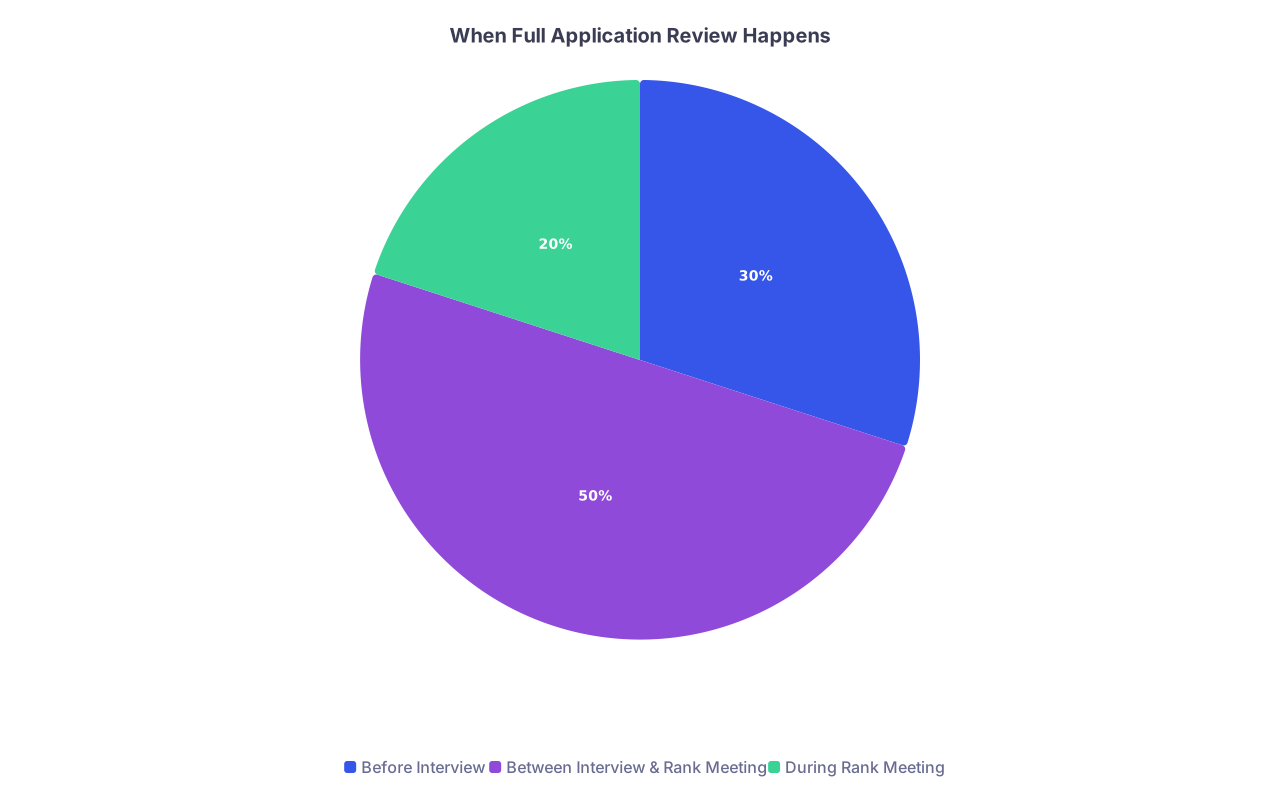
| Category | Value |
|---|---|
| Before Interview | 30 |
| Between Interview & Rank Meeting | 50 |
| During Rank Meeting | 20 |
When someone finally reads your letters closely, two things can happen.
You rise if:
- Your narrative comments are unusually strong: phrases like “top 1% student,” “would recruit to our residency,” “independent beyond level,” “handles high acuity calmly.”
- Your sub-I evals show you did significantly better than your core clerkships might have suggested.
- A late-added letter (often uploaded in December or even January) is stellar and specific.
I’ve watched more than one applicant move up simply because someone took the time, at the 11th hour, to actually read their narrative evaluations out loud in the meeting. The dry spreadsheet said “Honors, High Pass, High Pass.” The written comments said “best student I’ve had in 5 years.”
No one knew that until rank night.
You fall if:
- Narrative comments reveal professionalism issues that were buried under decent grades.
- A “name” letter that everyone expected to help is lukewarm or subtly negative.
- A late-transmitted transcript shows a string of recent marginal performances.
If you suspect there’s something in your file that reads better than it looks numerically, you are exactly the kind of person who can rise late—if someone in that program actually knows to go look.
Reason #3: Residents Quietly Reorder the Middle of the List
Most applicants obsess over impressing attendings and PDs. Fair. They sign the contracts. They send the letters. But in rank meetings, residents often control the middle third of the list. That’s where you win or lose as a “borderline” candidate.

Here’s what really happens. The top 10–15 spots? PD and key faculty territory. Everybody knows who these are; they’ve been informally “pre‑crowned” all season. The bottom chunk? Easy passes. Committee barely argues.
The chaos is in the fat middle. Spots 15–60 or so at a mid‑sized IM program. That’s where residents’ offhand comments can move you five or ten positions.
A common scene:
PD: “What about Applicant 32?”
Senior resident: “Honestly, I didn’t feel much either way.”
Intern who pre‑interviewed you on Zoom: “I actually loved them. Asked really thoughtful questions, seemed very down-to-earth, said they liked our night float system, which is rare.”
Chief: “Ok, let’s bump them above 28 and 29 at least.”
You go from “whatever” to “favored middle.” That often means the difference between matching and not when the algorithm randomizes its way through overlapping lists.
What makes residents push for you after interview day?
- You engaged with them like colleagues, not props. You remember what they told you, followed up, or mentioned them in a genuinely specific way.
- You treated “optional” socials like real auditions and weren’t weird, entitled, or invisible.
- You did not say stupid things about lifestyle, moonlighting, or “not wanting to work that hard” in what you thought were casual conversations.
Residents are hunting for two things: “Will they pull their weight?” and “Can I stand to be on night float with this person at 3 a.m.?” If the answer becomes a firm yes in their minds, your name gets circled on someone’s notepad. They bring that name back to rank night.
Reason #4: Strategic Balancing – You’re a Puzzle Piece, Not a Standalone CV
Most applicants think in isolation: “Am I good enough for this program?” The committee thinks in terms of building a class.
That means if you fill a gap they suddenly realize they have, you may rise late—well after interviews.
Programs juggle balance along a few axes:
- Career goals: fellowship‑bound vs community‑bound
- Home vs away vs completely external schools
- Gender and diversity
- IMG vs AMG vs DO
- People likely to stay local vs people likely to leave
| Dimension | What Programs Look For |
|---|---|
| Career Goals | Mix of fellowship-focused and generalists |
| Geography | Some local, some from outside region |
| Degree Type | Balance of MD/DO/IMG as appropriate |
| Diversity | Broader perspectives and backgrounds |
| Future Chiefs | 1–3 potential leaders per class |
Example I’ve seen over and over: halfway through building the list, someone realizes they’re oversaturating with heavy research, MD‑PhD, subspecialty–obsessed applicants. They look at the grid and notice there’s almost no one who openly wants to do primary care or hospitalist work.
Suddenly that “solid, team‑oriented, wants to practice general IM in the community” applicant gets a second look. Residents say, “Oh, I really liked her actually,” and she gets bumped up. Not because she became more impressive. Because she fit something they needed.
Or the reverse. They realize they’ve inadvertently ranked 10 people from one medical school in their top 30. That triggers political and culture flags.
“We cannot have a class that’s half Midwest U. We’ll get crucified by the dean’s office. Spread them out.”
You might climb simply because you’re the strong applicant from a different school, different region, or underrepresented background that helps them rebalance the class profile.
You don’t control that, but here’s what you do control: making your goals and identity crystal clear, so when they go hunting for “we need at least a couple of people who truly want outpatient,” your name immediately comes to mind.
Reason #5: Your Communication After Interviews — Done Right
Let’s be blunt: most post-interview emails are noise. That doesn’t mean communication is useless; it means most people do it badly.
Here’s how programs actually react to typical “thank you” messages:
- Generic two-line thank you: skimmed, maybe appreciated for 5 seconds, then forgotten. No rank movement.
- Overly effusive love letter to the PD clearly copy‑pasted to 15 programs: transparent, mildly annoying. No rank movement.
- Weirdly intense “I will rank you #1 if you rank me highly” nonsense: occasionally gets you dropped a few spots if it rubs the PD the wrong way.
Where you can rise is with targeted, specific, professional communication that solves a problem for them or clarifies a question.
Examples that have actually helped applicants:
- Sending a clear, honest “you are my #1” email to a single program (for real) when your application was borderline. If the program already liked you, that can tip them into nudging you higher to maximize the chance of a match.
- Updating them with meaningful new information: a major award, first‑author paper accepted, AOA/Honors in a key sub‑I—especially if it matches their strengths (“I’m excited this research got accepted in cardiology, given your program’s strong cardiology training…”).
- Clarifying geographic or family ties that weren’t obvious in the application: “My partner just matched to fellowship here,” “My parents live 20 minutes away,” etc. That can make you more attractive because you’re now a good bet to actually come and stay.
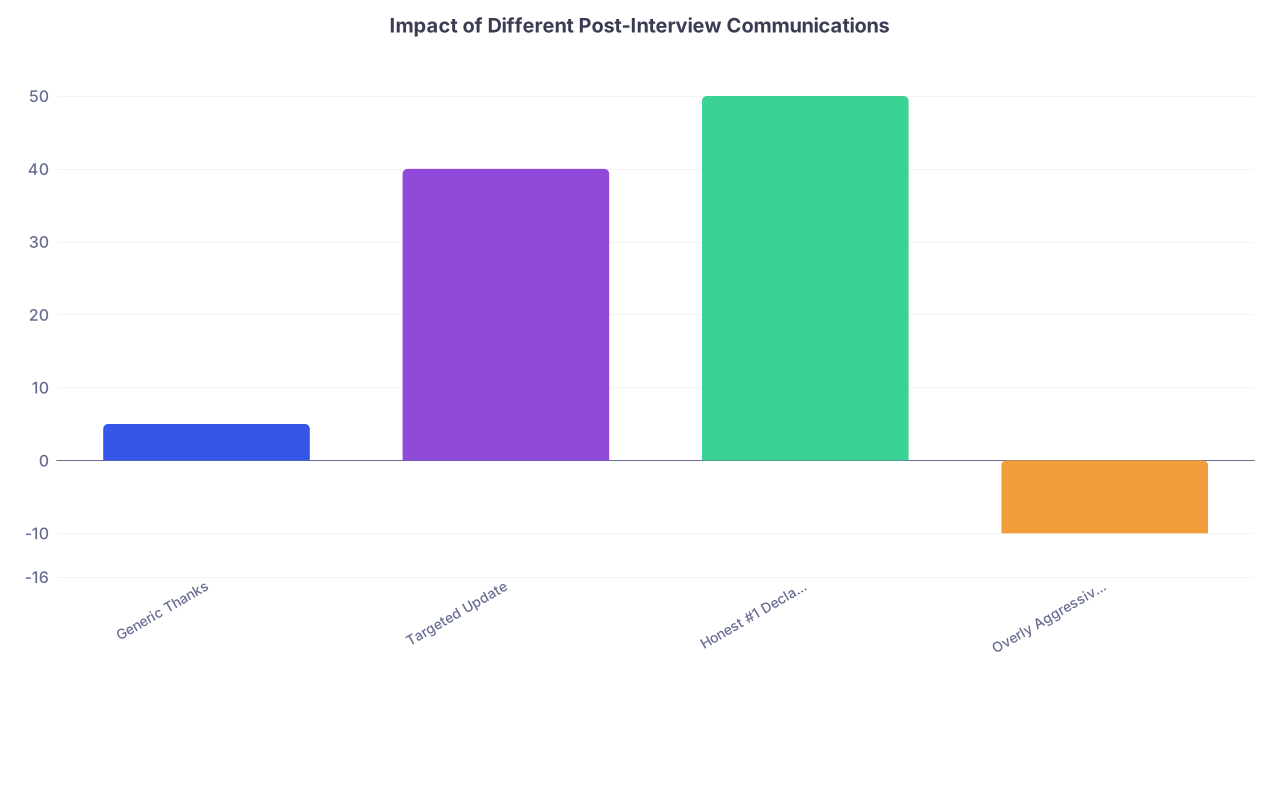
| Category | Value |
|---|---|
| Generic Thanks | 5 |
| Targeted Update | 40 |
| Honest #1 Declaration | 50 |
| Overly Aggressive Email | -10 |
That “honest #1” email is a whole separate ethics and strategy story. But know this: programs do pay attention when it’s credible and not overused. I’ve personally watched borderline applicants move into “we’d be happy if they matched” territory because they signaled clearly and appropriately.
Reason #6: Someone Else Implodes, and You Benefit
Sometimes you rise because someone above you falls. Hard.
This is the part no committee will ever put in a webinar. But it happens every year.
Triggers:
- A late professionalism flag from the dean’s office.
- A social media disaster that gets back to the PD.
- An ill‑advised “I will rank you #1” email sent to multiple programs that accidentally gets forwarded or compared.
- Toxic behavior on a late in‑house rotation that leads to, “Under no circumstances should we take this person.”
When that happens, the conversation is short:
“We need to drop them down the list. Actually, take them off entirely.”
“Ok, who moves up into that tier instead?”
If you’re clustered near that person with reasonably strong support, you benefit from their implosion. You did nothing new. You just didn’t blow yourself up—and that’s wildly underrated.
What You Should Actually Do, Knowing All This
Let’s strip this down to actions, not just voyeurism into committee drama.
If you’re rotating at your target program around interview or rank time, understand you’re still auditioning. Harder than interview day. Every sign‑out, every note, every cross-cover encounter is part of your rank.
Identify 1–2 programs where you are truly competitive and genuinely would go if they ranked you high. Those are worth a clear, honest, single “I will rank you #1” or “you are one of my top choices, and I would be thrilled to match here” communication. Don’t spray that at ten places. That dilutes you and can backfire.
Send substantive updates only: new publications, major honors, or meaningful life changes that tie you closer to that city or program.
Stay off the radar for anything negative. Do not get cute on social media, do not overshare about your rank list, and do not treat late rotations like a victory lap.
Accept that some of this is out of your hands. You can put yourself in position to rise; you cannot script every committee argument.

Ultimately, the people who move up late are those who did the quiet, unglamorous things: performed consistently, built real relationships with residents, had strong narratives in their files, and communicated once or twice strategically—not desperately.
FAQs
1. Can a post-interview thank-you email alone move me up the rank list?
Almost never. A generic “thank you for your time” doesn’t move anyone. What can move you is a targeted, thoughtful message that either a) clearly states the program is your genuine #1 (to a single place), or b) updates them with significant new information that materially changes your file. Even then, you’re moving within a band, not leaping from the bottom to the top.
2. Is it worth doing a late rotation at a program after I’ve already interviewed there?
If it’s genuinely feasible and you’re competitive there, yes, it can matter. I’ve seen late rotations rescue “borderline” applicants who were quiet or nervous in interviews but excellent on the wards. Faculty and residents came back with, “We underrated this person,” and they climbed the list. But if you’re going to be average or burned out, a mediocre rotation can hurt or do nothing. Only do it if you can perform.
3. Do programs really change their list after the official rank meeting?
Yes. They won’t advertise that, but adjustments happen right up until the list is certified in NRMP. Usually it’s small stuff—swapping within tiers, moving someone up a band, dropping someone who raised red flags. The top several spots tend to be stable; the action is in the middle. That’s exactly where many applicants live.
4. How many programs should I tell “you are my #1 rank”?
One. Only one. Anything else is dishonest and, if discovered, can burn you badly. PDs talk. Coordinators talk. If you’re caught promising #1 to multiple places, you’ll lose credibility fast and sometimes drop on lists because no one trusts that you’ll actually come. Pick the program you truly would be happiest at, where you’re reasonably competitive, and be clear with them—then let the rest of your application stand.
In the end, three truths matter. First, interview day isn’t the finish line; your behavior and your file can still move your position up or down afterward. Second, residents and late-arriving clinical intel have more power over your rank than most applicants realize. Third, the applicants who rise are rarely the loudest—they’re the ones who quietly leave no one with doubts about working alongside them at 3 a.m.


