

Programs are not guessing whether you’ll rank them. They’re scoring it. Quietly. And they use that score when they decide how high to put you on their list.
I’ve been in those rank meetings. I’ve watched applicants with better scores and stronger CVs get pushed down because “I don’t think we’re in their top five.” You will not see that on any website or in any official handbook, but it’s happening in almost every competitive program.
Let me walk you through how this really works.
The Dirty Secret: “Likelihood to Rank Us” Is a Real Variable
Every program director denies it publicly. “We rank purely on merit.” That’s the official line.
Behind closed doors, most mid-to-large programs have some version of a “probability they’ll rank us” column—sometimes explicit, sometimes just in everyone’s head. I’ve literally seen columns labeled:
- “Commitment”
- “Fit/Interest”
- “Likelihood”
- “Enthusiasm”
Same thing. Different label.
Here’s the quiet logic: programs are terrified of “wasting” high spots on applicants who will never come. They have trauma from past years—when they put a rockstar at #2, that person matched at MGH or UCSF, and they dropped 20 spots before filling. So they adapt.
When it’s close between two otherwise similar applicants, the deciding question often becomes:
“Between these two, who is more likely to actually rank us high?”
If you don’t understand the signals they use to answer that, you’ll lose to someone with weaker numbers but stronger “likelihood” signals.
The Signal Categories: What Programs Quietly Track
Different programs formalize this differently, but the core buckets are consistent. Think of it as three main domains:
- Pre-interview interest signals
- Interview-day and post-interview behavior
- Context clues from your application
Let’s pull the curtain back on each.
1. Pre‑Interview Signals: You’re Being Watched Earlier Than You Think
Program coordinators and PDs start building their “interest” impression long before you show up for interview day.
Away Rotations: The Strongest Signal You Can Send
Away rotations are the loudest “I will likely rank you” signal. PDs know you gave up time, money, and better weather to be there.
What they actually say in meetings sounds like this:
- “They did an away and worked hard. They’re probably ranking us high.”
- “They rotated here and emailed about coming back. We’re in their top three.”
If you did an away and performed decently, you start with a huge “likelihood to rank us” credit. If you crushed it and were visibly enthusiastic about the program, that credit skyrockets.
If you did an away but acted like you were too good for the place? You get marked as “auditioning for something better”—and your signals hurt you.
Pre‑Interview Emails: The Ones That Actually Matter
Most “interest” emails are useless fluff. PDs and coordinators see right through:
- “I’m very interested in your program because of your excellent training and diverse pathology…” – deleted mentally the instant it’s read.
What gets remembered isn’t the generic interest. It’s the specific, costly signals.
Things that move the needle a bit:
- You’re from out of region and you email early saying you have strong ties to that city and really want to stay there.
- You politely mention that this is one of your top choices and you’d be grateful for consideration because of XYZ clear reasons (family, specific track, niche interest that fits them).
Programs don’t usually interview you because of that. But if your application is borderline and you’ve already shown genuine, targeted interest, the coordinator will sometimes say:
“They reached out early and seem really committed to this city. Might be worth offering an interview.”
That matters. And later, in rank meetings, that “early interest” is still in people’s heads.
2. Interview‑Day & Post‑Interview Signals: Where Most People Blow It
Everyone focuses on answering questions well. Fewer people realize the day is also a long, structured test of: “Are you going to rank us high?”
The Questions You Ask: They Read Much More Into It Than You Think
Faculty absolutely infer your rank intentions from your questions and comments. They shouldn’t, but they do.
Signals that you are not ranking them high:
- Asking multiple detailed questions about fellowships or research opportunities that they do not have, but that a more famous program does.
- Name‑dropping “peer” programs that are clearly more prestigious: “At Brigham they mentioned X—do you have that here?”
- Asking repeatedly about transferring, away electives at ‘top’ institutions, or “how often do people here match into MGH/Stanford/Hopkins fellowships?”
I’ve seen comments like: “Great candidate, but he’s obviously aiming higher.”
On the flip side, signals you will rank them high:
- Specific questions about staying in that city/region long‑term.
- Asking advanced questions that show you’ve really read their website, recent changes, or recent research.
- Comments like, “I could really see myself here. The training and culture fit exactly what I’m looking for.”
No one writes “they said we’re #1” in the file. But they do write “very enthusiastic about this program; likely to rank us high.”
Social Events: Residents Are Measuring Your Intentions
Residents aren’t just judging whether you’re fun at dinner. They’re trying to figure out: “Would this person actually come here, or are we their safety?”
The phrases that get back to PDs:
- “They were basically here to compare us to [bigger name program].”
- “They said they’re mostly trying to get back to California and we’re their only Midwest interview.”
- “She told us she really wants to be near family in Texas. We’re in New York. So…”
If you casually say things like “I’d really love to end up in [opposite region] long term,” residents hear: “I will not rank you high” and report accordingly.
The smart move: be honest about your priorities, but do not casually broadcast that the program doesn’t match them. Unless you want them to rank you low.
Post‑Interview Communications: Quiet But Powerful
This is where people are the most confused. Let me be blunt.
Most programs claim they do not consider post‑interview emails for ranking. Many say, “We will not respond to post‑interview communication per NRMP rules.”
What actually happens:
- Coordinators track who sends thank‑you emails.
- Some PDs have a mental (or literal) list of who followed up with genuine interest.
- In tie‑breaker conversations, someone will absolutely say, “He wrote a really thoughtful note and said we’re one of his top programs” versus “I haven’t heard a thing from her.”
Are thank‑you emails required? No. Do they matter when other factors are equal? More often than you think.
And yes, there is a spectrum:
- Generic, copy‑pasted “thank you for your time” – quickly forgotten.
- Specific, anchored messages – remembered.
Something like: “Talking to Dr. X about your global health track really confirmed this is the type of training I’m looking for” plants a “high interest” flag without breaking NRMP rules.
3. Application Context Clues: The Subtle Stuff They Read Into
Programs are surprisingly good at reading between the lines of your history. They know patterns. They’ve seen thousands of applications.
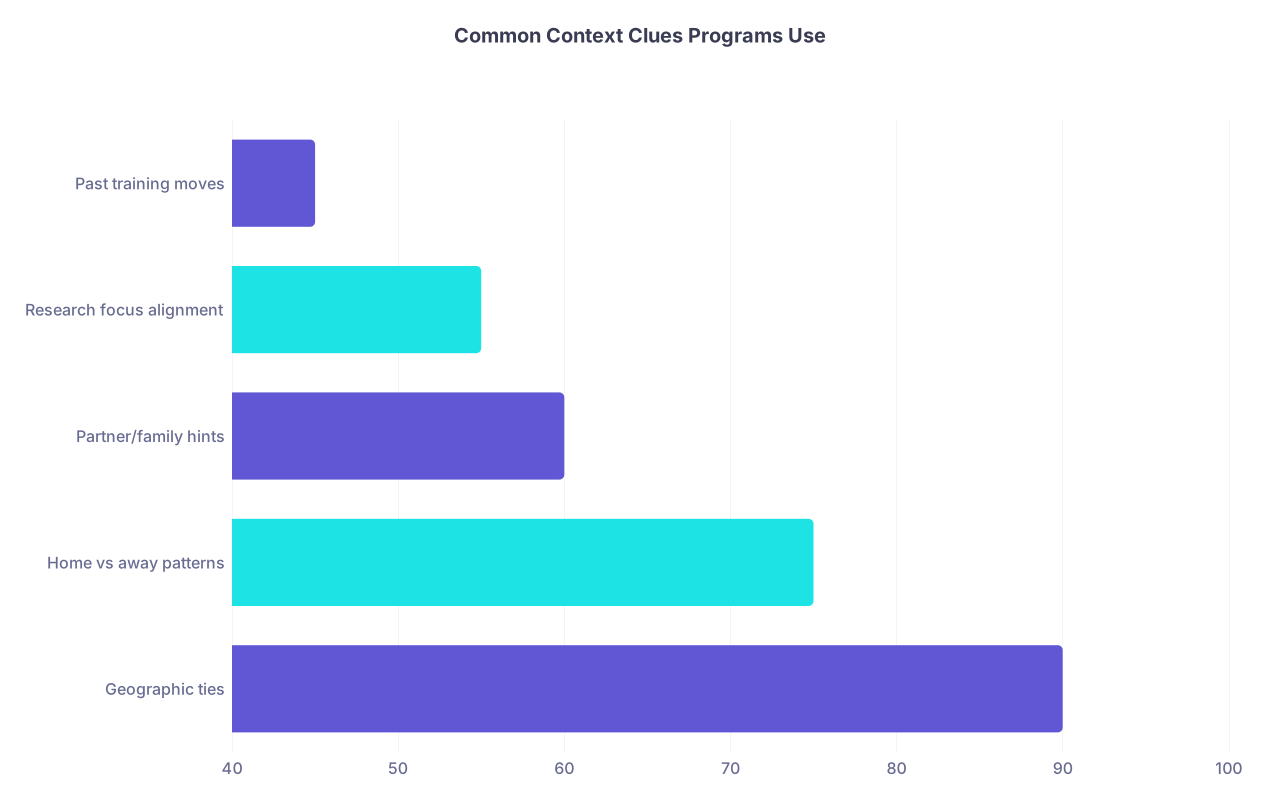
| Category | Value |
|---|---|
| Geographic ties | 90 |
| Home vs away patterns | 75 |
| Partner/family hints | 60 |
| Research focus alignment | 55 |
| Past training moves | 45 |
Geography: The Most Predictable Signal
You think you’re just applying broadly. Programs think geography is destiny.
If you’ve lived your entire life in California, went to a California med school, have all your family in California, and you’re interviewing in Minnesota with no stated ties?
The faculty conversation sounds like:
“Great applicant, but I’ll be shocked if we’re not below their top ten. They’ll go back west.”
They will still rank you—if you’re strong enough—but often lower, because the “likelihood they’ll rank us high” is judged as low.
If you genuinely want to move regions, you have to explicitly say it. Application, interview, emails. Otherwise, you’ll be silently penalized.
Couple’s Match & Relationships: They’re Reading Those Too
Programs “read” couple’s match and significant-other situations as strong indicators of what you’ll actually do.
Red flags for “probably not ranking us high”:
- You’re couple’s matching, your partner’s specialty is ultra‑competitive, and there are only 2‑3 must‑have “tier‑1” cities where they realistically land. You’re interviewing in a small midwestern city nowhere near those.
- Your personal statement is a love letter to “eventually returning to my hometown to serve my community” and your hometown is 1,000 miles away.
If you don’t align your narrative to explain why you’d realistically come to that city, you get internally tagged as “probably just covering bases.”
Training and Career Goals: When Your Story Doesn’t Fit
Programs are ruthless about this in competitive fields.
If you say you want:
- A T32 research career with heavy basic science
- Niche highly academic fellowship at a top‑5 institution
- Or a policy/academic leadership track
…yet you’re interviewing at a small community‑heavy program with minimal research?
They assume you want to go somewhere else for that trajectory and are using them as backup.
The flip side: if your stated goals match exactly what their graduates typically do, that boosts your “likelihood” score.
Example: You say, “I want to be a solid, clinically excellent community cardiologist in this region.” Their graduates mostly do community jobs in that region. They feel like your future and their output align. That alignment is a quiet but powerful signal you’ll rank them high.
4. The Soft Score: How Programs Actually Use These Signals on Rank Day
Let me show you how this looks in real life, because it’s not as simple as “we move you up 20 spots if you like us.”
On rank day, most programs have some version of a spreadsheet with:
| Column | What It Really Means |
|---|---|
| Academic Score | Boards, grades, class rank, letters |
| Interview Score | How much faculty liked you |
| File Score | Research, leadership, narrative |
| Red/Yellow Flags | Any behavioral or professionalism concerns |
| Fit/Interest/Likelihood | How likely you are to rank and stay |
Now, a few realities:
- Academic and interview scores get you into the conversation.
- Fit/Interest is the tiebreaker and tie‑destroyer.
I’ve seen this exact type of exchange more times than I can count:
“Applicant A has slightly better metrics, but we’re pretty sure we’re their backup. Applicant B may be numerically weaker but seems to really want to be here and fits our culture. Let’s flip them.”
And they do.
Does this violate NRMP rules? Not directly. Programs are allowed to consider the likelihood you’ll actually come, as long as they’re not coercing you or asking for your list. But it’s absolutely a game being played.
5. How You Can Intentionally Send the Right Signals (Without Being Sleazy)
You can’t control everything they infer, but you can stop sabotaging yourself. And you can push a few quiet levers.
Calibrate Your Story to the Program
You don’t rewrite your life. But you do decide which parts you emphasize.
If you’re interviewing at:
- A strong community‑academic hybrid → highlight your desire for broad clinical training, continuity clinic, and long‑term community ties.
- A research‑heavy powerhouse → highlight specific research goals that fit their actual strengths, not vague “I want to do research sometime.”
The more your future looks like their typical graduate, the more they believe you’ll rank them high.
Be Explicit About Geography When It Helps You
If you have a real reason to be in a city or region, say it. In the interview. In the thank‑you email. On your ERAS geographic section.
PDs are jaded. You have to overcome that.
Concrete beats vague:
- Weak: “I really like this city.”
- Strong: “My partner’s entire family is here and we’re planning to stay long‑term.”
- Strong: “I grew up two hours from here and my parents are aging; being close matters to me.”
They may not write that down. They absolutely remember it when arguing you up or down the list.
Avoid Sending “You’re My Safety” Vibes
Even if the program is not your dream, broadcasting that fact is just… bad strategy.
Watch for these habits:
- Constantly comparing them unfavorably to bigger‑name places.
- Over‑indexing on “escape routes” (away electives, transfers, second fellowships).
- Acting disinterested during resident socials because “this isn’t my top choice anyway.”
Programs don’t need you to lie. They just don’t want to feel obviously disrespected or used.
6. The Big Misconceptions You Need to Drop Now
Let me kill a few myths I hear every cycle.
“The Match Algorithm Protects Me, So Programs Don’t Care How I Rank Them”
The algorithm protects you from needing to tell programs your list. It does not stop programs from gaming their list based on how likely they think you are to come.
They’re trying to hit a sweet spot: fill high on their list, with people who won’t all vanish to higher‑tier places. So they factor in interest.
“If I’m Strong Enough, They’ll Rank Me High No Matter What”
Strong applicants get more slack, yes. But even “superstars” get hit by this.
I’ve watched top‑tier applicants get moved down purely because a PD said, “We all know they’re going to [top-3 program]. Let’s not waste a top‑5 spot.”
Does the superstar still match great? Sure. But the point is: if you’re strong and you send smart signals, you can end up at the program that actually fits you best, not just the one with the biggest name.
“Post‑Interview Communication Doesn’t Matter”
It doesn’t matter… until it does.
If a program has 3–4 applicants clustered together, someone will bring up post‑interview cues:
- Who followed up
- Who expressed clear, genuine interest
- Who disappeared completely
No one is ranking you #1 purely because you emailed. But that “interest” column does nudge you up or down those critical few spots.
7. Putting It All Together Without Losing Your Integrity
The point is not to become a manipulative robot. The point is to understand the hidden game so you stop accidentally losing.
Here’s the clean, ethical way to play:
- Be honest about where you’re truly interested, and let those places see it clearly.
- Don’t telegraph that a program is your backup, even if it is. Respect their time and their process.
- Align your narrative—goals, geography, life logistics—with the programs where it genuinely fits.
- Use away rotations and targeted communications sparingly but strategically.
You’re allowed to have preferences. Programs know you do. Just don’t hand them a reason to bury you on a list when they’re deciding between you and someone only slightly “weaker” but clearly more likely to come.
You’re in the ranking phase now. The application chapter is closing. The next big moment is interviews, then the rank list you send to NRMP. And after that? The very different game of actually starting residency and proving you’re more than what your file ever showed—but that is a story for another day.
FAQ: Hidden Signals & Residency Ranking
1. Should I ever tell a program they’re my “number one”?
Only if it’s absolutely true, and only to one program. And phrase it carefully to avoid NRMP issues: “If given the opportunity, I would be thrilled to train at your program and intend to rank you very highly.” Programs know what that means. Just don’t spray that line to multiple places—residents and PDs talk across programs more than you think.
2. Do thank‑you emails actually change my rank position?
They rarely move you from #40 to #5. But in the range where decisions are fluid—say #8–15, or #20–30 for larger programs—genuine, specific follow‑up can break ties. Generic, copy‑paste notes? Basically noise. One strong, program‑specific email to the PD and maybe one key interviewer beats a dozen bland ones.
3. If I had a bad interview day but really love the program, can I recover with post‑interview communication?
Sometimes. If the “bad” was just nerves or awkwardness, a thoughtful note clarifying your enthusiasm and interest can soften the impression. If you came off as arrogant, disinterested, or misaligned with their values, an email won’t fix it. Once a PD marks you as “not a fit,” interest alone doesn’t save you.
4. How obvious is it when I treat a program as a backup or safety?
Painfully obvious. Residents hear it over drinks. Faculty catch it in your questions. Coordinators pick it up in your scheduling attitude. You don’t have to fake undying devotion to every program, but you do need to avoid signaling, “I’m only here because I need enough interviews.”
5. Does applying to a ton of programs in one city make each of them think I’m less likely to come?
Not necessarily. In fact, in many metro areas (NYC, Chicago, Boston), programs assume serious candidates apply widely. What matters more is the coherence of your story: if your geography, personal ties, and goals all align with that city, multiple applications just look like commitment to the region. If nothing aligns, you look like you’re just spraying and praying—and they’ll rank you accordingly.


