

Most of what you’ve been told about how programs rank you is incomplete or flat-out wrong.
You’ve heard the sanitized version: “We use a holistic review,” “We consider all aspects of your application,” “We don’t overemphasize scores.” That’s the official line for public consumption. Behind closed doors in the rank meeting, the conversation is much more human, much more biased, and much more brutally simple than the brochures suggest.
I’ve sat in those rooms. I’ve heard the side comments that never make it into any handbook. Let me walk you through what really happens when your name shows up on that projector screen and faculty start debating where you land on the list.
How Rank Meetings Actually Run (Not the Fantasy Version)
Let’s start with the process, because if you understand the structure, the comments and debates make a lot more sense.
In most mid-to-large programs, by the time the rank meeting happens in late January or February, you’re not a mysterious unknown. You’ve already been scored, sorted, and partially slotted by some combination of:
- Interview scores
- File review scores
- Internal “tiers” (A, B, C) or numeric bands
But that’s just the scaffolding. The rank meeting is where everything gets distorted by human memory and emotion.
Here’s the real flow, stripped of the PR fluff:

| Step | Description |
|---|---|
| Step 1 | Pre-interview screen |
| Step 2 | Interview & scoring |
| Step 3 | Preliminary rank list by PD |
| Step 4 | Faculty rank meeting |
| Step 5 | Adjust positions up/down |
| Step 6 | Finalize rank list |
| Step 7 | Debate specific candidates |
If you imagine a purely data-driven process, you’re already lost. The “data” (scores, tiers) are the starting point. The discussion then looks like this, in 3 rough phases:
- Rapid confirmation of obvious top-tier and obvious no-way candidates
- Focused debate on the huge middle chunk where you live
- Micro-adjustments based on strategy (will this person actually come here? do they fit our needs next year?)
That “middle chunk” is where your fate is decided. And it’s 70–80% of the list.
The First Thing They Ask: “Do I Remember This Person?”
This part no one likes to admit: recognition bias drives a terrifying amount of your rank position.
When your name appears on the screen, the program director will often start with a version of: “Do people remember this one?”
If three people immediately jump in with “Oh yeah, that’s the one who…” you’re in play. If the room is silent and they have to look up your file to recall who you are, you’re already at a disadvantage.
And what makes you memorable is not what you think.
Faculty don’t say, “I remember this person because they did a sub-I at a prestigious place with three first-author papers in JAMA.”
They say things like:
- “Isn’t that the one who brought up the QI project idea about handoff templates?”
- “That’s the IMG who crushed the complex patient we gave them and stayed late talking to the intern.”
- “This is the one who gave a weirdly rehearsed answer to every question. I couldn’t get a real read on them.”
- “That’s the applicant who emailed us with that thoughtful follow-up about our clinic.”
Recognition is tied to an emotional footprint, not your bullet points.
If you were “nice, normal, polite, no red flags” with a generic interview, you become background noise. Competent but forgettable. On a 3–4 person interview panel seeing 10–15 applicants per day, then doing that for 10–20 days, that’s a blur.
So when people debate your rank, the first question is brutally simple: Did you imprint on anyone’s brain at all?
What They Actually Say Out Loud When Your Name Comes Up
Let me give you the categories of comments that come up over and over. If you were in the room, you’d hear versions of these on loop.
1. “Would I actually want to work with this person at 2 a.m.?”
This is the core, unspoken question. It gets translated into language like:
- “Seems easy to work with.”
- “Bit intense. I’m worried how they’ll be when they’re stressed.”
- “Very polished, but I couldn’t tell if it was real.”
- “They felt like they’d be a good teammate.”
Faculty are not picturing you in a conference room; they’re picturing you on a bad call night when the ED is paging nonstop and the attending is nowhere to be found. That image drives a lot of the conversation.
If someone says, “I’d absolutely want them on my team,” your stock goes up immediately.
If someone says, “I’m not sure I trust their judgment yet,” that’s a quiet death sentence no matter how strong your CV is.
2. “Can this person handle the workload here?”
This is especially brutal at high-volume or malignant-leaning programs, but it exists everywhere.
Comments sound like:
- “I’m a little worried about their resilience.”
- “They seemed a bit fragile when I pushed them.”
- “They’ve never really been away from home—how’re they going to do here?”
- “They’ve already done a sub-I here and did fine; that’s reassuring.”
They’re scanning your background for evidence you can survive their environment:
- Heavy service? They want grinders who don’t crumble.
- Academic heavy? They want people who won’t melt when asked to prep a talk last-minute.
- Underserved population? They want someone who won’t complain every time social work is unavailable and the system fails the patient.
If you come across as high-maintenance, easily offended, or “needs a lot of support,” you fall.
3. “Are there any red flags we’re ignoring?”
No one wants to be the faculty member who said nothing when there was a hint of a problem. So when your name comes up, everyone mentally scans for “red flag moments.”
These are rarely the dramatic horror stories. It’s more like:
- “They had that one professionalism incident in med school… I know the letter says it was resolved, but still.”
- “Their answer about conflict with a nurse was… not great.”
- “They talked a lot about work–life balance in a way that made me think they don’t understand residency yet.”
- “Something about how they talked about their previous program made me uncomfortable.”
One off-hand comment in your interview that a faculty member didn’t like can haunt you here. Not because they hate you, but because risk-aversion runs everything.
If a faculty member says, “I just don’t feel great about them,” and can’t fully articulate why, that still pushes you down. Programs would rather miss out on a great resident than take a chance on someone they think might blow up into a problem.
The Hidden Criteria: Strategic Questions That Change Your Rank
Now to the part most applicants never even hear rumors about: strategy talk.
After the “Do we like this person?” phase comes the “Does it make sense to rank them here?” phase. This is where your perceived likelihood to match, your career goals, and your background subtly shift your number.
1. “Will this person actually come here if we rank them high?”
Programs deny this publicly. Behind closed doors, they absolutely discuss it.
The comments sound like:
- “They’re from out of region with all their interviews in the Northeast. We’re the only Midwest program they applied to. I doubt we’re high on their list.”
- “They have an offer at [prestigious program]. If we rank them too high, we’ll just waste a top spot on someone who won’t match here.”
- “They sent a very strong signal that we’re their top choice. I buy it.”
No, they can’t know your rank list. But they infer it ruthlessly from:
- Where you’re from
- Your med school
- Your couples match partner’s field and geography
- Your emails/communications
- What you said during interviews (“I’m really set on staying on the West Coast,” etc.)
This doesn’t mean they won’t rank you if they think you’re a reach. It means that in tie-breaker situations, someone they think is likely to actually come will often slide above you.
Programs want to “optimize their yield.” They will move down a stellar but unlikely-to-come applicant a few spots in favor of a very solid, clearly interested one.
2. “Do they fit our current needs?”
This one gets very real once you understand the internal politics.
Faculty talk like this:
- “We’re light on research-minded residents next year; this one has a legit track record and seems serious.”
- “We’ve had three very weak procedural residents in a row. This applicant seems hands-on and confident.”
- “We need someone aiming for cards/ICU; this person has been consistent about that.”
- “We already have two residents from this med school in that class; do we want a third?”
Yes, things like balance of interests, diversity of background, and coverage of subspecialty interest areas matter here. People rarely admit this publicly, but quotas and informal goals absolutely exist:
- Don’t overload with residents all wanting the same fellowship
- Maintain some geographic/school diversity
- Make sure there are enough residents likely to help with research projects
If you happen to match a need—say, you’re a strong research candidate in a class that’s currently weak on academic interest—you get bumped up in the debate.
The Role of Scores, Letters, and CVs in the Actual Debate
Here’s the part applicants consistently misunderstand: your Step scores, grades, and letters matter most before the interview. Once you’re in the room, the weight shifts.
In the rank meeting, these things show up differently:
Step Scores and Exams
No one is reading your exact score line-by-line at the rank meeting. But they do say:
- “Any exam concerns?”
- “They’re fine. Step 2 is strong; Step 1 was pass/fail.”
- “They barely squeaked by Step 2. With our in-training exam history, that might be rough.”
Scores become a binary: reassuring vs concerning. That’s it.
If you’re in the reassuring group, your exact number (245 vs 260, for example) matters much less than applicants think. Faculty are not agonizing over a 10-point difference between two people they both liked. They’re deciding, “Can they pass boards on the first try, or are we going to be fighting this for three years?”
Letters of Recommendation
Letters matter, but not how you think.
No one in February is reading full letters on every candidate again. What happens instead:
- Someone who reviewed your file early on might remember: “They had a truly outstanding letter from Dr. X, and I trust Dr. X’s judgment.”
- Or: “Their letters were fine but generic.”
The actual source of the letter matters more than the flowery adjectives. A short, specific line from a known, trusted faculty member can outweigh a page of superlatives from someone nobody has heard of.
When debating between two similar candidates, a single faculty member saying, “I know their letter writer; if they say this person is special, I believe it,” can nudge you up.
Research, Volunteer Work, Extracurriculars
At this stage, these things function mostly as tie-breakers or narrative support:
- “They’ve shown sustained interest in underserved care; that aligns with us.”
- “They say they’re into academics but their CV is pretty bare.”
- “This person has clearly worked their whole way through school; I respect that hustle.”
Nobody is counting your hours of volunteering. They’re using your CV to answer one question: “Does who they say they are match what they’ve actually done for more than four weeks?”
The Politics: Who Speaks for You in the Room
Here’s a piece almost no one outside the room understands: your rank is heavily influenced by which faculty remember you and advocate for you.
In practice:
- If a powerful, senior faculty member or the PD is excited about you, your spot is safer.
- If only a junior faculty member liked you and no one else remembers you, their influence is weaker.
You’ll hear exchanges like:
- “I interviewed them; I thought they were excellent. I’d bump them up.”
- “I wasn’t as impressed. They were a bit flat with me.”
- “They did a visiting rotation with us. Our chief said they were fantastic on the wards.”
Notice something? Chiefs and residents’ opinions sometimes slip in informally through faculty: “The team loved them” is worth a lot. So if you think your away rotation behavior doesn’t follow you into the rank room, you’re wrong.
Your best case scenario is this: when your name comes up, at least one person in the room says, with conviction, “I want this one.” That is far more powerful than another marginal poster or extra award.
What Actually Moves You Up or Down During Debate
Let’s be specific. You go into the meeting at, say, #42 based on composite scores. How do you end up #28 or #63? Here’s how it plays out.
You Move Up When:
- Multiple interviewers independently say you were one of their top few of the season
- Someone vouches for your work on an away rotation and everyone trusts that person
- You fit a specific need the program has identified for that class
- You clearly demonstrated strong interest in that program (and they believed you)
- You were a “borderline top tier” candidate on pure metrics and also likable in person
The conversation sounds like:
“On paper they’re as strong as the ones we already moved higher. And I actually liked them more. I’d move them up 10–15 spots.”
No one cares that this isn’t “objectively fair.” It’s human. They do it.
You Move Down When:
- Someone raises a concern about your attitude, maturity, or professionalism
- There’s a vague but persistent sense of “off” from a respected faculty member
- You’re perceived as unlikely to come and they want to protect high-yield spots
- Your answers suggested misalignment with the program’s reality (“They seemed like they’d be happier at a cushier place”)
- A red flag from earlier in your training never fully exonerated itself in people’s minds
The death knell comment is, “I just don’t feel good about them.” If that comes from someone the PD listens to, you slide.
It doesn’t always drop you off the list entirely. But going from #30 to #70 can be the difference between matching and not, depending on program size and class.
How You Can Actually Influence These Conversations
You can’t be in the room. But you can control the inputs faculty are working with when they talk about you.
Keep these realities in view as you think about your application and your interview behavior:
- You’re auditioning to be someone’s 2 a.m. colleague, not just a test-taker.
- Memorability matters more than perfection. A few specific, genuine stories beat generic polished answers.
- Consistency between your file, your stories, and your future goals is gold.
- Residents and staff comments about you leak into the room through faculty. People ask them informally, “How was that rotator?”

If you understand that the rank discussion is built on human recollection and risk-avoidance, you’ll stop obsessing over microscopic points on your application and start focusing on the core:
Do you come across as someone they trust, like, and can imagine surviving and contributing in their specific environment?
That’s what they’re actually debating.
| Applicant Focus | What Faculty Actually Debate |
|---|---|
| Exact Step score | Safe vs risky for exams/boards |
| Number of publications | Real academic interest vs padded CV |
| Perfect answer scripts | Genuine, likable, trustworthy |
| School prestige | Fit for *this* program’s reality |
| Generic interest emails | Credible likelihood you’ll rank them highly |
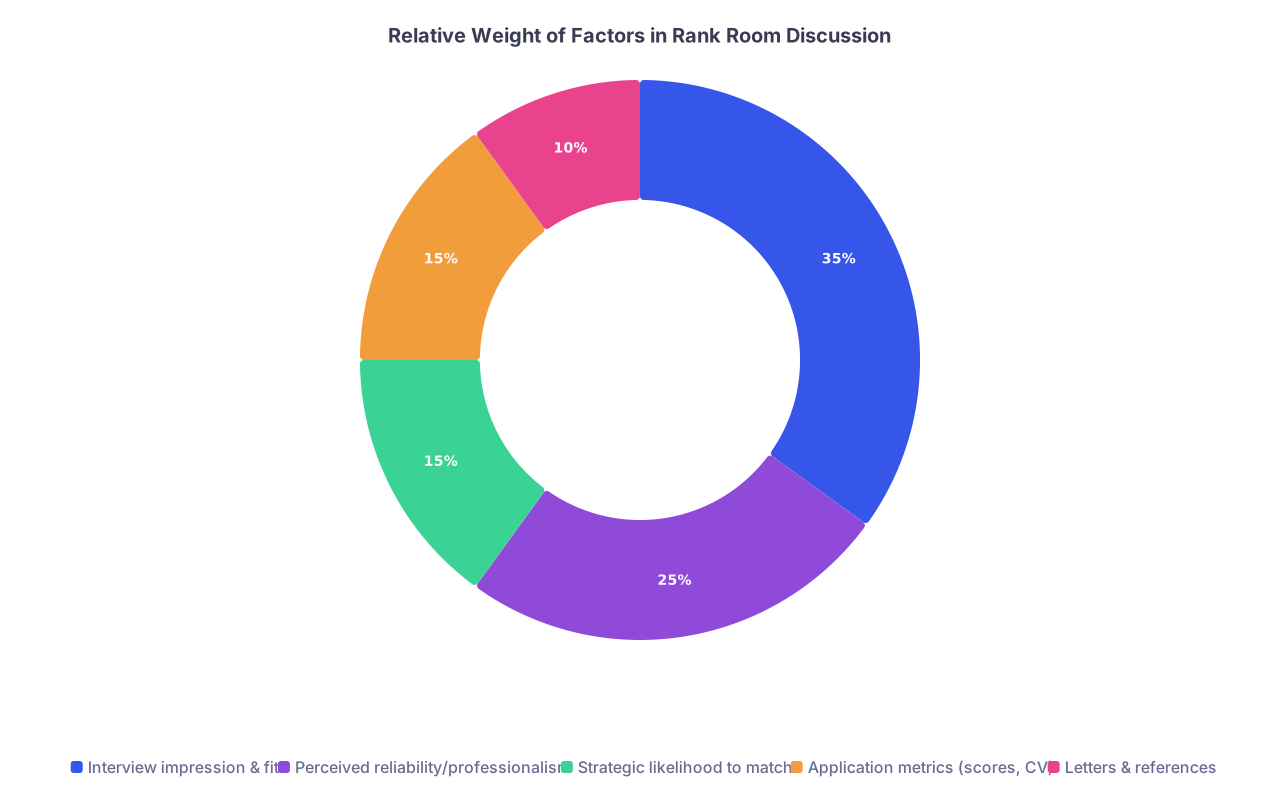
| Category | Value |
|---|---|
| Interview impression & fit | 35 |
| Perceived reliability/professionalism | 25 |
| Strategic likelihood to match | 15 |
| Application metrics (scores, CV) | 15 |
| Letters & references | 10 |

The Hard Truths You Need to Accept
Let me strip this down.
Your rank is not a verdict on your worth as a human being or even as a future physician. It’s a messy compromise between:
- Who impressed whom
- Which concerns stuck in people’s minds
- What the program thinks it needs
- How risk-averse your PD is
- The half-remembered details of dozens of interviews
You might be better clinically than someone ranked above you. You might have higher scores and more research than someone below you. The system isn’t designed to find “the best.” It’s designed to minimize headaches and produce a stable, functional class.
So your job isn’t to become the objectively best candidate on paper. Your job is to be the kind of person who, when your name comes up in that room, someone speaks up and says:
“I remember this one. I want them on our team.”
Everything you do—personal statement, letters, interviews, away rotations—should be building toward that moment.

Once you truly understand what faculty are actually saying about you behind closed doors, you can stop playing the wrong game.
You’re not trying to impress a spreadsheet. You’re trying to win over a room of tired, overworked physicians who are asking themselves one question:
“Will this person make our lives easier or harder for the next three years?”
Answer that with your presence, not your buzzwords.
With that mindset locked in, you’re not just another nervous applicant guessing in the dark. You’re setting yourself up to shape the conversation in the only way that matters—through the impression you leave on the people who will be fighting over your name in that room. The next step is making sure your interview day performance actually matches that strategy. But that’s a story for another day.


