
What do you do when your “dream program” is in a city where the rent is basically a second student loan payment?
If you’re staring at your rank list with Zillow on one side and your loan balance on the other, this is for you.
You’re not choosing in a vacuum. You’re choosing with $200k–$400k of debt, maybe a partner with their own job constraints, maybe kids, maybe parents you help support, maybe no family safety net at all. And the advice you’re hearing is often useless:
- “Just go where you’ll be happiest.”
- “Prestige always pays for itself.”
- “You’ll be a doctor, you’ll be fine.”
Sometimes that advice is dead wrong.
Let’s walk through how to rank residency programs when cost-of-living (COL) and financial stress are central, not afterthoughts.
Step 1: Admit Money Is a Legitimate Primary Factor
You’re not shallow or “less committed” if COL is driving your decisions. You’re being realistic.
I’ve watched residents:
- Moonlight nonstop just to cover Bay Area rent
- Move three times in three years because they could never stabilize housing
- Stay in abusive relationships because they couldn’t afford rent solo in NYC
- Put off necessary dental or medical care during residency “because I just can’t afford it right now”
On the flip side, I’ve seen residents in lower-cost cities:
- Buy a reliable used car cash by PGY-2
- Aggressively pay down high-interest loans
- Build a real emergency fund
- Actually sleep on their days off instead of working urgent care for rent money
So yes, COL matters. Sometimes it matters more than research prestige. More than “big name” faculty. More than the city you think you’re supposed to want.
If your stomach drops every time you open your bank app, let’s build a ranking strategy around that reality.
Step 2: Quantify the Cities You’re Considering (Not Vibes—Numbers)
Stop guessing which city is “cheaper.” You need hard estimates.
Here’s what you should calculate for every program on your list:
- Take-home pay (after tax)
- Expected rent/housing
- Commute costs
- Core monthly expenses
- Realistic loan payments
Then compare. Directly.
Use rough but honest numbers. Per year is fine.
| City / Program Type | Annual Salary | Est. Net After Tax | Est. Annual Rent | Est. Annual Core Expenses* | Est. Net Leftover |
|---|---|---|---|---|---|
| NYC Academic IM | $74,000 | $55,000 | $30,000 | $16,000 | ~$9,000 |
| Boston Academic IM | $72,000 | $54,000 | $27,000 | $15,000 | ~$12,000 |
| Midwestern City Academic IM | $63,000 | $49,000 | $15,000 | $14,000 | ~$20,000 |
| Southern City Community IM | $61,000 | $48,000 | $13,000 | $14,000 | ~$21,000 |
| No-Income-Tax State Program | $62,000 | $50,000 | $14,000 | $14,000 | ~$22,000 |
*Core expenses = food, insurance, phone, utilities, gas/transport, basic stuff. Not loan payments.
Is this exact? No. Is it better than your current vague anxiety? Absolutely.
How to do this quickly:
- Look up each program’s salary on their GME or resident benefits page.
- Use a basic paycheck calculator for the state (there are plenty online).
- Check typical rents on Zillow/HotPads/FB groups near the hospital for:
- Studio
- 1BR
- Room in shared housing
That gives your realistic range.
- Add:
- $300–$500 / month food (higher for HCOL)
- $150–$300 / month utilities/internet
- $100–$200 / month phone
- $150–$300 / month transportation (car or public)
- Health/dental premiums if you pay any
Then see: which cities leave you with something meaningful left at the end of the month?
Step 3: Understand Where Prestige Actually Matters (And Where It Doesn’t)
Here’s the thing people don’t say out loud: sometimes paying for a higher COL city is strategically smart. But not always. Not for everyone. Not for every specialty.
Rough reality:
If you’re going into something ultra competitive (DERM, plastics, ENT, ortho, neurosurg):
A top-tier program, often in a big coastal or HCOL city, can absolutely improve future options (fellowships, academics, elite private groups).
Financial pain now might be a calculated move.If you’re going into moderately competitive but broad (cards, GI via IM; heme/onc; some surgical specialties):
You do not necessarily need Boston/NYC/SF. Strong regional programs, often in mid-COL cities, can get you to the same fellowships if you perform well.If you’re going into broad, high-demand specialties (IM with hospitalist goal, FM, peds, psych, EM in many markets):
The name on your badge matters much less than:- Your competence
- Board scores
- How your attendings talk about you to future employers
For a lot of people, the math is ugly:
- Extra $30k/year in rent x 3 years = $90k
- Plus interest lost, plus extra stress, plus moonlighting later just to dig out
All for a “brand name” that may not materially move your long-term income or happiness.
You need to be honest:
Is the prestige differential real and relevant, or just ego/fear/FOMO?
Step 4: Factor In Your Actual Life (Not Theoretical You)
Do not rank as if:
- You have zero family obligations
- You have infinite energy for moonlighting
- Your mental health will be perfect
- You’ll never get sick, have a car break down, or need emergency money
Let’s walk through a few real scenarios and what I’d do.
Scenario A: Massive Debt, No Financial Safety Net
You’re first-gen, $350k in loans, no parental backup. Any mistake is on you.
In this situation I strongly favor:
- Mid- to low-COL cities
- State or regional academic programs if you want fellowship
- Community programs with strong placement if you’re okay with general practice
I would usually not put a NYC/Boston/SF program #1 unless:
- The field is highly competitive and this program clearly opens future doors
- You’ve run the numbers and can survive without dangerous credit-card debt
- You have a concrete moonlighting plan PGY-2+ that’s sustainable
If all programs on your list are “solid,” pick the one where you can breathe financially.
Scenario B: Partner/Family, Single-Income During Residency
Partner will not work initially (immigration, childcare, their own schooling). You are financially responsible for 2+ people.
COL goes from “important” to “critical.”
Here, I’d:
- Ruthlessly avoid extreme HCOL cities unless you have:
- Subsidized housing through the hospital
- Family support nearby (real support, not “maybe sometimes”)
- A clear, safe budget that works on your salary alone
- Prioritize:
- Cities with reasonable rent for a 2BR or larger
- Short commutes (childcare handoffs matter; gas and time cost money)
- Programs with solid, reliable benefits (childcare discounts, parental leave)
The dream program is one thing. A 2-hour commute each way because that’s the only area with rent you can afford, plus daycare costs, is another.
Scenario C: Severe Burnout Risk + Financial Stress History
If you’ve already had major mental health crashes in med school around money, you are playing with fire if you rank a city where you’ll be barely surviving financially.
Here, I would consciously:
- Drop some prestige-heavy, painful-COL programs lower on your list
- Pick a program where:
- You’re not terrified of overdrafting every month
- You can afford therapy if needed
- You can occasionally take an unpaid day (or not moonlight) without panic
A solid regional academic program in a lower COL city can be better for your career than the big name where you half-collapse by PGY-2.
Step 5: Compare Programs Head-to-Head Using Money, Not Just Vibes
Let’s take two hypothetical Internal Medicine options:
- Program A: “Top 10” academic center in Boston
- Program B: Strong academic center in mid-size Midwestern city
Assume you want cards or GI fellowship.
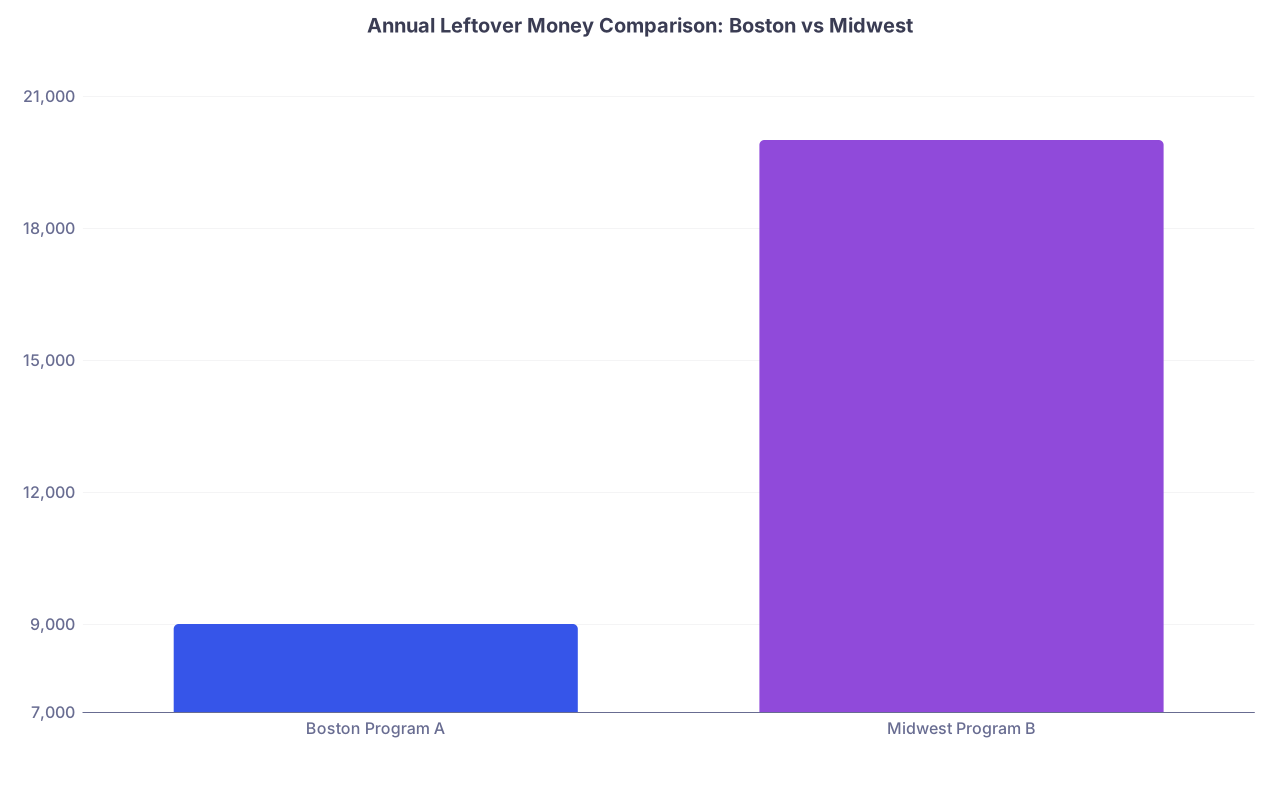
| Category | Value |
|---|---|
| Boston Program A | 9000 |
| Midwest Program B | 20000 |
Now add context:
Program A (Boston):
- Big-name institution
- More research; famous attendings
- Rent for a modest 1BR: $2,200–$2,800/month
- Likely public transport, but parking is expensive
- Higher food/parking/“everything” costs
Program B (Midwest):
- Regionally respected, sends people to good fellowships
- Fewer “superstar” PI’s, but real research still available
- Rent for similar 1BR: $1,200–$1,500/month
- Lower overall living costs
- Easier to own a decent car, cheaper gas/parking
If both can realistically get you into a solid cards fellowship with effort, then an extra ~$10–12k/year left over is not a small difference. That’s:
- Actual emergency fund
- Early aggressive payments on credit cards or high-interest loans
- Avoiding taking out new personal loans during residency (yes, this happens more than people admit)
This is what I mean by ranking based on cost-of-living when you’re under financial stress.
Step 6: Don’t Ignore Program-Provided Financial Buffers
Some programs blunt the COL hit; others don’t bother.
You want to look for:
- Housing support
- On-campus or affiliated housing with below-market rent
- Housing stipends (e.g., $5–10k/year)
- Meal support
- Free or subsidized meals on call
- Insurance
- Health premiums covered versus partly paid
- Disability and life insurance included
- Transportation
- Free/discounted transit passes
- Free or cheap resident parking
- Moonlighting
- When you can start (PGY-1 vs PGY-2/3)
- Typical pay rates
- Whether the program culture realistically allows moonlighting (not just on paper)
A $6,000 housing stipend per year in a high-COL city is not nothing. But it’s also not magic. Run the math again with those numbers.
Step 7: Specialties Where COL-Based Choices Hit Harder
Some specialties make COL decisions more painful or more forgiving.
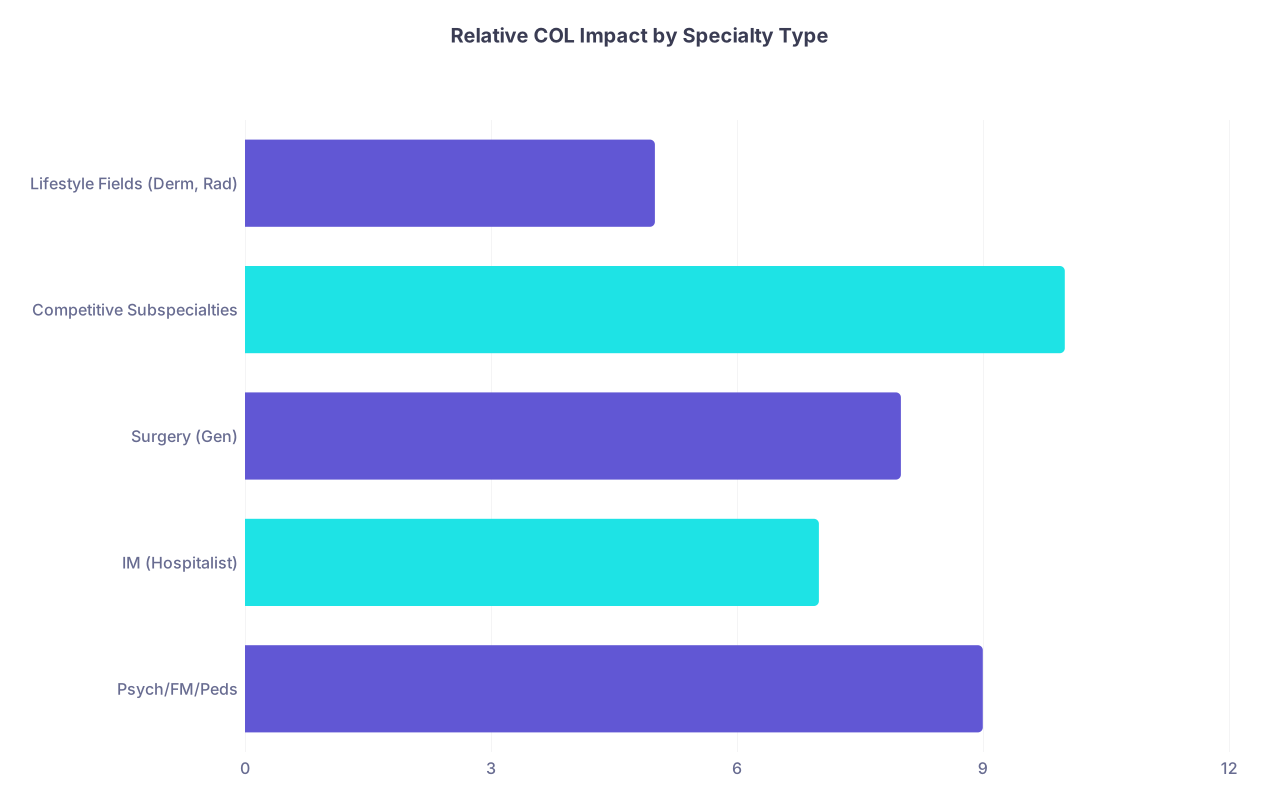
| Category | Value |
|---|---|
| Psych/FM/Peds | 9 |
| IM (Hospitalist) | 7 |
| Surgery (Gen) | 8 |
| Competitive Subspecialties | 10 |
| Lifestyle Fields (Derm, Rad) | 5 |
(Scale 1–10: higher = COL decision has bigger long-term ripple effects.)
Lower-paying fields (peds, FM, psych)
Huge impact. Extra residency debt takes longer to shake. I lean strongly to lower COL unless there’s an overwhelmingly compelling reason.IM with plan to be hospitalist
Moderate to high impact. Hospitalists earn well, but not infinite. You can dig out, but why start deeper?Surgery / competitive subspecialties
Sometimes the payoff and prestige matter more. You might accept a painful residency COL for serious long-term earning potential or academic trajectory.Lifestyle, high-compensation specialties (derm, rads, some anesthesiology jobs)
These can justify a bit more pain now, but again: don’t assume every attending job will be $600k in Manhattan. Markets vary.
Step 8: How to Actually Shift Your Rank List Because of Money
Let’s put this into practice. Here’s a simple process.

| Step | Description |
|---|---|
| Step 1 | List all interviewed programs |
| Step 2 | Estimate net leftover per year |
| Step 3 | Drop those programs lower |
| Step 4 | Mark top 3-5 financial fits |
| Step 5 | Compare training & career goals |
| Step 6 | Keep 1-2 high-prestige even if higher COL |
| Step 7 | Prioritize best training in affordable cities |
| Step 8 | Finalize rank list |
| Step 9 | Are any net negative or near zero? |
| Step 10 | Do you need prestige for your specialty? |
In plain language:
- Rank by training quality and fit first.
- Then overlay money:
- Identify programs where you’d be underwater or scraping by.
- Move those down unless they are absolutely mission-critical for your career.
- From the remaining set, preferentially move up:
- Programs with acceptable COL and strong training for your goals.
- Keep maybe 1–2 “reach” prestige programs higher if:
- The career upside is real (not imagined), and
- You can manage the financial hit without crisis.
Step 9: Specific Red Flags That Should Drop a Program on a Tight Budget
If money is tight, these are not minor issues. They’re landmines.
Drop a program lower if:
- Residents openly joke about “having to moonlight to pay rent”
- Everyone has a roommate and still complains they’re broke constantly
- The commute required for affordable housing is brutal (1+ hour each way)
- Parking is expensive and not covered, and public transit isn’t reliable for your hours
- No meal support and food nearby is pricey (hospitals with only $16 salads and chain coffee add up)
- The GME office handwaves COL concerns: “Residents make it work” with no specifics
When you ask residents privately:
- “Do people struggle financially here?”
and they pause, then say, “Uh…yeah, definitely,”
believe them.
Step 10: What If Your Heart and Wallet Disagree?
Common internal fight:
- Heart: “I loved this big-name, big-city program. The residents were so cool.”
- Wallet: “You will be broke and stressed for three years.”
Here’s how I break that tie:
Will this program realistically change your long-term trajectory (jobs, fellowships, earning potential) compared to your #2 or #3?
- If yes: maybe take the hit—consciously, with a plan.
- If no: your heart is being seduced by vibes.
Can you create a survival budget that:
- Does not rely on credit cards to cover basic monthly expenses
- Leaves some margin for emergencies each month
- Doesn’t require unsafe levels of moonlighting
If not, I’d move it down.
How did your body feel when you imagined actually living there on your salary?
- If you felt excited and challenged: maybe worth it.
- If you felt dread and tightness in your chest: listen to that.
There’s no perfect answer. But ignoring the money side is how people end up three years later saying, “I wish I’d ranked that midwestern program higher.”
Quick Reality Check: What To Do This Week
Do this today:
- Make a simple spreadsheet or even a handwritten table:
- Program
- City
- Salary
- Est. take-home
- Est. rent
- Est. leftover
- For each program, label:
- Green: I can live decently and save/pay a bit.
- Yellow: Tight but doable with minor sacrifices.
- Red: I will be constantly stressed and probably taking on more debt.
- Now look at your current rank list.
- What’s your top-ranked “Green” program?
- Are you about to put three “Red” programs above it just because of the name or location?
Adjust accordingly.
FAQs
1. Is it ever smart to rank a high‑COL “big name” over a lower‑COL “solid” program?
Yes—sometimes. If your specialty is highly competitive and the big-name program clearly opens doors (top-tier fellowships, national-level mentors, research resources that truly matter), it can be a rational choice. But you should go into it with eyes open and a survival plan: concrete budget, awareness of moonlighting options, and an honest look at your mental health resilience. If the “solid” program can get you very similar outcomes, I’d usually choose the lower COL option.
2. How much “leftover” money per month should I aim for during residency?
You do not need a huge surplus, but you do need some margin. If, after rent and basic expenses, you have less than ~$300–$400/month, that’s extremely tight and leaves no room for emergencies, car repairs, or travel for family events. If you can get to $600–$1,000/month free before loan payments, that’s a healthier range—it lets you pay at least interest on loans, build a tiny cushion, and avoid relying on credit. The point isn’t perfection. It’s avoiding a monthly panic cycle.
3. Should I defer my loans in residency to relieve the monthly pressure?
Maybe, but understand the cost. Deferring or using certain forbearance options can stop payments but interest often continues to accrue, and capitalization later can make the total balloon. If your budget is suffocating and the alternative is high-interest credit card debt, some deferral/IDR strategies make sense. I’d usually:
- Enroll in an income-driven repayment (IDR) plan if your loans qualify
- Pay at least something toward interest if you can
- Reevaluate yearly as your salary and situation change
Talk to a real student loan expert, not just random Reddit threads.
4. How much should COL matter if I know I want to be an academic specialist?
Academic careers often pay less than private practice, especially in primary care and some subspecialties. That actually makes COL more important, not less. If you’re planning on a life in academics in a high-cost city, piling additional residency debt on top can trap you financially later. In this path, a strong academic program in a medium-COL city can be ideal: good training, fellowship access, and a more manageable long-term lifestyle. Prestige helps in academics, but you don’t always need the most extreme coastal brand to succeed.
5. What if my family really wants me close by, but my hometown is high‑COL?
You have competing priorities: emotional support vs financial stability. Being near family can reduce costs if they offer concrete help—free childcare, free or cheap housing, shared cars, actual financial backup. It can also raise costs if they expect you to eat out frequently, help them financially, or live in an expensive neighborhood. You need to look at the real math and the real emotional impact. If being near family keeps you sane and they’re truly supportive, a high-COL city might be survivable. If they’re nearby but unable to help and you’ll still be drowning, you may be better off in a more affordable city and visiting when you can.
Open your draft rank list and, next to each program, quickly write one word: Green, Yellow, or Red for finances. Then move at least one “Green” program up if it’s currently buried under a stack of “Red” prestige names.