
The fantasy that you’ll love your Match city is optional. Matching at all is not.
If you’re staring at a map thinking, “I hate every realistic option I have,” you are not alone and you are not doomed. But you are in a situation where feelings can wreck your rank list if you let them drive.
Let’s get ruthless and practical about it.
Step 1: Accept the ugly truth of constrained geography
You might be in one of these buckets:
- Partner locked into a job in a region you don’t like
- Visa constraints pinning you to a handful of states
- Kids / caregiving responsibilities that limit distance
- Only got interviews in cities you’d never choose on purpose
- Need to be near a specific medical system for your own health
Or the classic: “I only like Big Coastal City X, but my interviews are all Midwest community programs.”
This feels unfair because it is unfair. But the Match algorithm does not care that you hate cornfields, desert heat, or snow. It only cares that you submit a logical list.
Here’s the mental reset you need:
You’re not choosing where you’ll live forever. You’re choosing where you’ll train for 3–7 years so you can control the rest of your career.
If you keep trying to solve “Where will I be happy long-term?” you’ll spiral. Instead, solve this narrower problem:
“Given the crappy geography, what rank list gives me the best combination of training, survival, and minimal regret?”
That’s a question you can answer.
Step 2: Translate “I hate this place” into specific, solvable criteria
“I hate the Midwest” is useless. “I get seasonal depression and I’m scared of being socially isolated in a small cold city” is specific. Specific can be planned around.
You need to break “hate” into components.
Common real meanings behind “I hate this geographic option”:
- Weather issues (extreme cold, extreme heat, allergies, seasonal depression)
- Culture mismatch (politics, social scene, diversity, LGBTQ+ safety)
- Distance from support system (family, partner, childcare help)
- Lifestyle mismatch (need big city, public transit, certain religious community)
- Safety concerns (crime, gun laws, reproductive healthcare access)
- Immigration/visa risk (states/programs with history of weak support)
Write this out. Seriously. On paper or in a doc. For each city/program you dislike, ask:
- What exactly am I afraid of here?
- Is it non-negotiable or just uncomfortable?
- Can it be mitigated by money, travel, therapy, or community?
- Will this problem end when residency ends or affect my career long-term?
If a fear is:
- Non-negotiable
- Can’t be mitigated
- And will wreck your function as a resident
…that’s a legitimate reason to rank a place lower or not at all.
If it’s unpleasant but transient and manageable with a plan, it belongs lower on your emotional list, not necessarily lower on your NRMP rank list.
Step 3: Establish your personal “do not rank” threshold
People screw this up in both directions.
Some rank everything because they’re terrified of not matching. Then they end up in a place that destroys them.
Others under-rank out of emotion, don’t match, and end up scrambling into something worse or taking a forced gap year they didn’t plan for.
You have to define your own floor.
Ask yourself, program by program:
“If this were my only Match result, would I still rather train here than go unmatched?”
If the honest answer is “Yes, I would grit my teeth and do it,” then it belongs on the list somewhere.
If the answer is “No, I would actually prefer to go unmatched and reapply or SOAP,” then it should not be ranked. Period.
This is not theoretical. I’ve seen:
- An IMG who refused to rank the only community FM program in a region they disliked, went unmatched two years in a row, burned through savings, and then took that same kind of program anyway through SOAP, in a worse city, with less control.
- A US MD who drew a hard line on being near a medically fragile parent. They ranked only three local programs. Matched their bottom choice but had no regrets because their line was real, not ego.
You need to be brutally honest about:
- Financial runway if you don’t match
- Visa deadlines and limits
- Emotional stability for another whole cycle
- Specialty competitiveness (Reapplying to derm ≠ reapplying to FM)
| Specialty Tier | Example Specialties | Unmatched Risk If You Shrink Rank List Aggressively |
|---|---|---|
| Ultra-competitive | Derm, Plastics, Ortho, ENT | Extremely high |
| Competitive | EM (varies), Anes, Rad, Gas | High |
| Mid-range | IM categorial, OB-GYN, Gen Surg | Moderate |
| Less competitive | FM, Psych, Peds, Path | Lower but very real |
If you’re in an ultra-competitive or even mid-competitive field and your geographic options are limited, shrinking your rank list has real teeth. That doesn’t mean never do it. It means don’t pretend you’re taking a “small risk.” You’re not.
Step 4: Make a cold-eyed program vs. city ranking matrix
Your brain is trying to rank cities. The Match is ranking programs in cities. If you keep thinking “I hate City A, City B is slightly less bad,” you’ll mis-rank.
You need a matrix that separates:
- Program quality and fit
- City tolerability
Do this:
Across the top of a sheet, list criteria. For example:
- Program training quality
- Malignancy / culture
- Fellowship or job prospects after
- Support for your situation (visa help, childcare, partner jobs)
- Call schedule / lifestyle
- City tolerability (your subjective “hate factor”)
- Safety / healthcare access / legal issues that matter to you
Down the side: each program.
Score each item 1–5. Use a high number to mean “good for me,” low number to mean “bad for me.” Do this quickly first, then adjust once.
Then create two different mental rankings:
- Rank by program + long-term career value primarily
- Rank by city tolerability primarily
You’re going to feel cognitive dissonance. That’s the point.
Now you decide: are you optimizing for the 3–7 years of training, or the feeling of the city day-to-day?
Here’s the rule I push almost everyone toward:
Put program quality, culture, and support ahead of city preference, unless the city creates a genuine safety or survival problem for you.
Crucial nuance: “I might be lonely and hate the food scene” is not a survival problem.
“Abortion is illegal here and I have a condition where pregnancy would be dangerous, and I’m in a relationship where failure is possible” might be.
Step 5: Use a structured tie-breaker when everything feels equally bad
Sometimes your entire list looks like: “Bad weather mid-size city vs. isolated conservative town vs. traffic hell to be near family I don’t love living with.”
When everything feels equally awful, you need a tie-breaker that isn’t just mood.
Here’s a practical ordering override that works in most cases:
- Non-negotiable safety and legal concerns
- Program culture (do residents seem supported vs. broken?)
- Training quality and exit opportunities
- Your support system proximity
- City preference (vibes, amenities, etc.)
So if you’re stuck between:
- Program A: Great culture, solid training, city you dislike, no family nearby
- Program B: Mediocre culture, slightly worse training, city you tolerate, some friends nearby
Most of the time, you rank A above B. The years you spend with abusive or disorganized leadership do more damage than the years you spend in a slightly more boring or colder place.
And if two programs feel very similar on those top 4 items? Then yes, let location be the tiebreaker. It’s not irrelevant. It’s just not the primary lever when you already hate all options.
Step 6: Reality-check your fear with actual residents
A lot of the “I hate this place” anxiety is based on imagined worst-case scenarios from Reddit threads and stereotypes.
Before you tank a program for geography, do this:
Email or message 1–3 current residents and literally say:
“I’m seriously considering ranking Program X but I’m nervous about living in [City] because of [specific concern]. How do residents actually manage this in real life?”
You’ll hear things like:
- “Yeah, winters suck, so everyone plans a winter trip, has SAD lamps, and we all basically hibernate and hang out more.”
- “The town is conservative, but the residency bubble is very liberal and tight-knit. Most queer residents feel safe in the hospital but don’t love the rest of the city.”
- “Traffic is horrible, so most of us live walking distance and do everything in a three-block radius.”
Is it perfect? No. Does it beat your abstract dread? Yes.
Your goal isn’t to agree or disagree with them. Your goal is to understand: Is my fear about this location realistic, manageable, or dealbreaking?
Step 7: Handle the “partner / family hates it” variable like an adult
This is where it gets messy.
If your partner or family is loudly voting no on your only realistic region, you’ll be tempted to subconsciously sabotage your list. Do not.
Sit down with your partner (or key family member if they’re materially supporting you) and lay out three maps:
- Where you wish you could be
- Where your interviews actually are
- Where you will realistically work or train after residency if things go normally
Then say plainly:
“For the next 3–5 years, these are my real options. If I shoot for geography over program stability, my risk of not matching or having a toxic residency goes way up. That risk lands on both of us. So we have to pick: do we want a better city right now, or a better chance at long-term stability after this phase?”
If they still push hard for geography over everything, you need to decide personally:
- Am I willing to risk not matching to satisfy their short-term preference?
- Will I resent them (and myself) if that happens?
I’ve seen relationships die when someone sacrifices program quality for joint geography and ends up miserable at work for 3–7 years. I’ve also seen couples pull through fine when they chose a less-than-ideal city but decent training, because they framed it as a time-limited sacrifice.
Don’t make this a silent, simmering resentment. Make it an explicit, joint decision.
Step 8: Think in “tour of duty,” not “forever home”
Residency is a tour, not a sentence. 3 years in FM, Peds, IM prelim. 4 in psych, path. 5+ in surgery.
When you tell yourself “I will be stuck here forever,” you inflate the weight of location. It feels like marrying the city. You’re not.
Instead, think like this:
“This is my professional boot camp station. After this, I can buy my freedom with the skills and board certification I get there.”
Your future choices open because you survived this phase. That mindset shift changes the math.
You don’t need to love the city. You need to be able to:
- Sleep safely
- Commute without wanting to die
- Afford your life without constant panic
- Have some way to decompress (gym, nature, coffee shop, church, whatever your thing is)
Everything beyond that is bonus.
Step 9: Use the algorithm correctly when you hate your options
Quick but crucial reminder: the NRMP algorithm favors your preferences. You do not need to “strategize” based on where you think you’re competitive. You rank in pure order of where you’d actually want to go, given everything we’ve just walked through.
So if you have:
- Program in City You Hate, but clearly the best training and culture
- Program in City You Mildly Hate Less, but weaker training and concerning vibe
And you know, intellectually, that the first is better for your career and sanity despite the city?
You rank the better program higher. Even if you think they’re “a reach.”
If they don’t want you, they won’t rank you, and you won’t match there. No harm done.
What you can’t do is reverse-engineer your list based on imaginary program behavior. That’s how people end up matched to worse options they could’ve outranked.
Step 10: Build a “survive this city” plan now, not after Match
Assume you will end up in the place you’re least excited about. That’s emotionally unpleasant. It’s also smart contingency planning.
For each of your realistic geographic regions, sketch:
- Where you’d realistically live (neighborhood, commute time, rough rent)
- How you’d get your basic needs: grocery, gym, coffee, favorite hobby
- How you’d maintain relationships: planned FaceTime, visits, time zones considered
- How to handle your main worry: winter, heat, politics, safety, etc.
That way, when you rank a place highly, you’re not just choosing vibes. You already know, “Okay, if I match here, I’ll live in X neighborhood, budget Y, join Z gym, find community at A/B/C.”
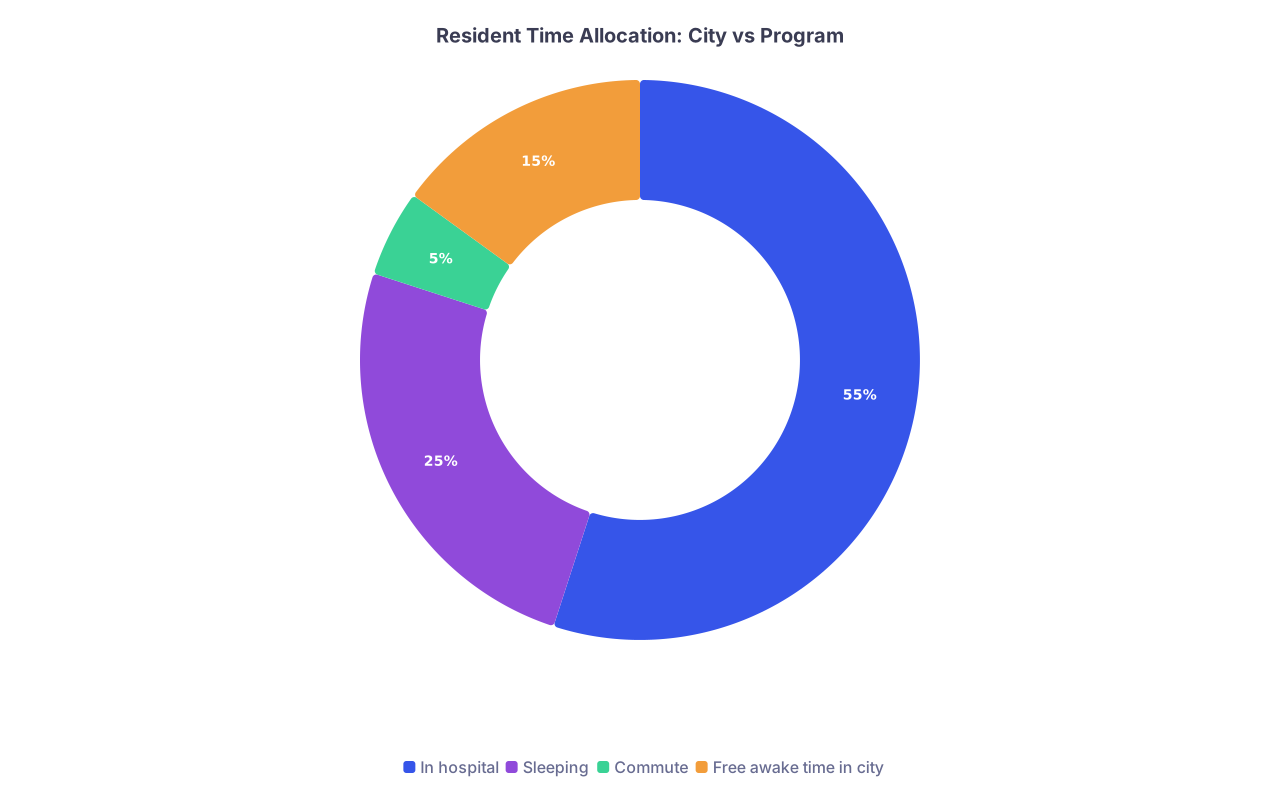
| Category | Value |
|---|---|
| In hospital | 55 |
| Sleeping | 25 |
| Commute | 5 |
| Free awake time in city | 15 |
Look at that distribution. Your free “enjoy the city” hours are tiny compared to your hospital time and sleep. That doesn’t mean city is irrelevant. It does mean that program culture and workload shape your actual life more than the restaurant scene.
Step 11: Emotional cleanup before you certify your list
Right before certification, a lot of people panic and do something dumb: they reorder their list at midnight based on fear.
Don’t.
Do this instead, 3–5 days before the deadline:
- Print (or open) your matrix and your draft rank list.
- For each rank position, write one sentence:
- “I’m putting this program here because _______.”
- Check that those “because” statements line up with your stated priorities: safety, training, culture, long-term goals.
If you spot any of these phrases, be suspicious:
- “Because I just hate that city less.”
- “Because it feels scary to put a stronger program first.”
- “Because my parent/partner said it would be a mistake not to.”
Those are feelings talking, not strategy. Re-evaluate those moves.
Once you’ve cleaned it up logically, walk away for 24 hours. Then re-open, confirm it still feels right, and certify. And then stop touching it.
The bottom line
You are allowed to hate your geographic options. You’re not weak or spoiled for having preferences. But the Match doesn’t care how you feel about the highway system or the restaurant scene.
It cares if you produce a rank list that reflects:
- Your non-negotiable constraints
- Your realistic risk tolerance
- Your professional goals
- Your ability to survive 3–7 very hard years
Do that, and you can hate the geography and still end up okay.

| Step | Description |
|---|---|
| Step 1 | List all programs |
| Step 2 | Identify non-negotiable dealbreakers |
| Step 3 | Remove from list |
| Step 4 | Score programs on training & culture |
| Step 5 | Score cities on tolerability |
| Step 6 | Apply your priority order |
| Step 7 | Draft rank list |
| Step 8 | Explain each rank to yourself |
| Step 9 | Adjust if reasons are emotion-only |
| Step 10 | Certify final list |
| Step 11 | Any true dealbreakers? |
Next step: Open a blank document and, program by program, answer this exact question in one line: “If this were my only Match, would I still rather train here than go unmatched?” Use those yes/no answers to draw your hard line for what you will and will not rank—before you let emotions reorder anything.