
It’s late January. Your ERAS season is almost done. You’ve got a half‑finished rank list open on your laptop and a FaceTime window with your partner in the corner of the screen.
They just said, “I’ll follow you wherever you go,” but you both know that’s not actually how jobs, visas, leases, or other residency matches work. You’re scrolling between a dream program three time zones away and a solid mid‑tier place that’s drivable from where they live. Your chest feels tight. This doesn’t feel like choosing between programs. It feels like choosing between lives.
Here’s how to handle this like an adult who actually wants a career and a relationship that both survive the match.
Step 1: Get Absolutely Clear on Your Real Constraints
Before you touch the rank list, you and your partner need a brutally honest inventory of what’s actually possible, not what sounds romantic.
Sit down (together, live, no texting this) and go through these categories one by one:
Geography
- Where are you each now?
- Where could each of you move, realistically, in July?
- Where are true “no” locations? (visa limits, financial reality, shared care of kids, aging parents)
Work / Training
- Are they also in a match? Med school, SOAP, couples match, fellowship?
- Are they in a job that is location‑bound (teaching contract, union job, small business, military posting)?
- How portable is their field? Example: tech/remote‑possible vs public school teacher vs law vs grad school.
Money
- Could you afford long‑distance flights every 1–2 months?
- Do either of you rely on the other’s income for rent, loans, childcare?
- Is there any family financial support, or is it just you two?
Immigration / Legal
- Any visas involved? (J‑1, H‑1B, F‑1, spouse‑dependent visas)
- Are there restrictions on moving states, working, or being apart?
Timeline
- How long would you be long‑distance if it comes to that?
- Are you talking one year prelim → re‑apply near them, or 3–7 years straight apart?
Write this down. On paper or a shared doc. If it stays vague, your rank list will be vibes‑based and you’ll regret it.
Step 2: Decide What “Success” Actually Looks Like for You Two
“Match somewhere good and stay together” is not specific enough. You need a target.
You’re choosing between broad relationship strategies, not just ZIP codes. Here are the real modes people end up in:
| Model | Distance | Duration | Main Risk |
|---|---|---|---|
| Same city, cohabiting | None | Full training | Less program flexibility |
| Same city, separate apts | None | Full training | Financial strain |
| Long‑distance, driveable | 1–4 hours drive | 1–3 years | Time/exhaustion |
| Long‑distance, flights | 5+ hours travel | 3–7 years | Emotional drift, cost |
| Staggered: join later | LD → same city | 1–2 years LD | Plans fall through |
Pick what you’re ACTUALLY willing to do. For example:
- “We’re OK with long‑distance for up to 2 years, but then we need to be in the same city.”
- “We will not do cross‑country long‑distance for 5–7 years. That’s a breakup in slow motion.”
- “If you match at X or Y, I’m ready to move and find work there, but if it’s Z state, I can’t leave my current contract.”
Say the quiet parts out loud. If you both pretend you’re fine with “whatever happens,” your rank list will not match your actual tolerance, and resentment will show up by October.
Step 3: Sort Programs into Realistic “Relationship Buckets”
Now you look at your programs, but through the lens of your relationship, not USNWR.
Go down your interview list and put each program into one of these buckets:
Same‑City / Same‑Area
- You’d be living together or within easy driving distance (under 45–60 minutes).
- Your partner can realistically live and work there, or is already there.
Drivable Long‑Distance
- 1–4 hours one way by car/train.
- Weekend visits are doable. Multiple times per month in the best case.
- Could be sustainable for a few years if both of you are motivated.
Flight‑Only Distance
- You need a plane, usually time‑off approval, and serious money to visit.
- You’re probably seeing each other every 2–3 months at best.
Relationship‑Impossible (for you)
- Might be great professionally, but your partner cannot be there or near there for legal/work/family reasons.
- Or the distance is so insane (e.g., international with visa complications) that you both know you’d be effectively single.
This isn’t sentimental; it’s just classification. Once you see how many programs land in each bucket, reality stops being foggy.
Step 4: Weigh Career vs Relationship Like an Adult, Not a Martyr
You’re going to hit this thought: “If I don’t rank my ‘best’ program #1, I’m throwing away my career for a relationship.”
That’s not how this works. You’re actually trading between:
- A specific program’s pros/cons
- A specific relationship future
You need to rank options, not ideals. So ask yourself:
On a 1–10 scale, how much better is that “dream” program vs the next few options?
- Reputation, fellowship placement, case volume, vibe from interview.
- Not the name your aunt recognizes.
On a 1–10 scale, how much does your relationship location matter for your happiness and functioning?
- Be honest: Are you someone who falls apart without your partner? Or very independent but still care about long‑term commitment?
Are there strong professional options in your partner‑friendly cities?
- Maybe you have a powerhouse community program near them and a big‑name academic in another city. Ranking the community program higher is not career suicide. I’ve seen people match “lower‑ranked” residencies and still land top fellowships because they crushed it.
Where people mess this up: they pretend they’re choosing between 100 vs 0, when it’s really 92 vs 88 professionally, and 90 vs 30 relationally. If your relationship matters, you factor it like that.
Step 5: Build a Rank Strategy That Matches Your Reality
Now you’re ready to shape the actual list. A few concrete patterns I’ve seen work.
Scenario A: Partner is Fixed in One City (Job/School/Family)
Example: They’re locked into Boston for a PhD, school contract, or family reason, and you’re IM applying across the Northeast.
How to rank:
- Put any strong Boston programs you’d be happy at right at the top, in your true preference order.
- Next, add programs within reasonable commute or short drive (e.g., Providence, Worcester), again by your actual preference.
- After that, you decide: how far away are you truly willing to be if Boston‑area doesn’t hit?
Your list might look like:
- Mass General
- BIDMC
- BMC
- Tufts
- Brown
- UMass
7+. Selected “far” programs (like Hopkins, Penn) in your true order
Notice: you are not putting “best name” #1 if you’d be miserable being far. You’re putting best full‑life option #1.
Scenario B: Both of You Are Mobile but Resources Are Tight
Example: Your partner can move, but you’re both broke and flying monthly is fantasy.
Strategy:
Prioritize cities where:
- Cost of living isn’t brutal.
- They can plausibly get a job.
- You have at least one program you liked.
Rank those cities/programs together in a “cluster” near the top.
Something like:
- Solid academic program in a mid‑size city they can work in
- Community program same city
- Another academic program nearby city (90 mins away)
4–6. A few higher‑prestige but expensive or far options you’d still consider worth it
You’re not sacrificing your future. You’re avoiding being broke, burned out, and alone.
Scenario C: You Already Know You’ll Be Long‑Distance
Example: They’re locked in Chicago for at least 4 years, you applied mostly in the South and West for family support, and realistically you will be apart.
You have two levers:
- Minimize distance within that constraint (midwest vs coasts)
- Maximize your chance of being happy and successful where you are
Rank primarily by program fit and career because the distance is baked in. But still build a pattern:
- First: Programs closer to them (Midwest, similar time zones, hubs with direct flights)
- Then: Other programs you liked, ranked honestly
- Drop any “relationship‑impossible” programs unless they’re truly life‑changing and you both have explicitly agreed that you’d risk the relationship for that.
This is where people sometimes flip into, “Well, if we’re long‑distance anyway, I’ll just pick the top‑name program.” Fine. But you both need to say out loud: “We’re prioritizing your career for this phase and accepting the relationship risk.” Then actually act like that was a joint decision, not a betrayal.
Step 6: Talk Through Specific “What If We Match X vs Y?” Scenarios
Do not keep this conversation theoretical. Go program by program.
Open your rank list, share screen if remote, and say:
- “If I match at [Program A in your city], what’s the plan? Where would we live? What would you do for work or school?”
- “If I match at [Program B, 2 hours away], how often do we realistically see each other? Who’s driving? On what schedule?”
- “If I match at [Program C, flight‑only], what’s the visit schedule? Who pays for flights? What’s the endgame timeline?”
If you can’t come up with plausible plans for a program, that program needs to drop on the list. Maybe off the list.
This is where the fantasy programs die. I’ve watched couples realize, mid‑conversation, that a program that looked fine on paper is actually impossible once they try to map real weekends, call schedules, and bills onto it.
Step 7: Factor Call, Schedule, and Program Culture into Your Relationship Math
People underestimate how much your call schedule matters more than distance sometimes.
Program A: 10 minutes from your partner, but malignant, q3 home call, you’re constantly at the hospital, texts unanswered, brain fried.
Program B: 2 hours drive away, but protected golden weekends, real elective time, leadership that doesn’t treat you like disposable labor.
Which one is better for your relationship? Usually B.
Ask current residents at each place:
- “How many weekends off per month, really?”
- “How easy is it to swap shifts to make it to important events?”
- “What time do people actually get out?”
- “Does anyone here do long‑distance? How often do they see their partner? Surviving or miserable?”
If multiple residents at a program say, “My relationship did not survive intern year here,” believe them.
Step 8: Don’t Lie to Your Partner (or Yourself) About Future Flexibility
There’s a classic trap: “I’ll just transfer later” or “You can move to me after your year ends.”
These are sometimes true. Often they’re not. Transfers are rare. Matching again near them is not guaranteed.
You need realistic language:
Instead of: “I’ll probably switch to a program near you in PGY‑2.”
Say: “Transfers happen but they’re rare. We should plan like I’m staying 3 years and treat any transfer as a bonus.”Instead of: “You’ll definitely find a job there.”
Say: “There are jobs, but we won’t know until you apply. Are you okay moving without a guarantee?”
If the relationship depends on a low‑probability future event, that program is a high‑risk choice. Rank accordingly.
Step 9: Protect Yourself from Other People’s Opinions
You will get stupid outside noise:
- Attendings: “You have to go to the biggest‑name place you matched at, or you’re wasting your potential.”
- Family: “Why would you move for a boyfriend/girlfriend? Just focus on your career.”
- Friends: “I’d never give up [Top 10 Program] for a relationship.”
Here’s the truth: none of them live your life at 11 p.m. on a Sunday of a 28‑hour call block. You do. With or without your partner.
You’re allowed to:
- Rank “lower‑tier” but still strong programs in the city where you’ll actually have a support system.
- Choose proximity to your spouse or serious partner over marginal prestige differences.
- Also choose the stronger program even if it means long‑distance—if both of you are truly, explicitly on board with that trade.
What’s dumb is letting someone else’s ego choose for you.
Step 10: Once You Certify, Stop Punishing Yourself
You’ll second‑guess your list. Everyone does. It’s worse when there’s a relationship tied to it.
Once you and your partner have:
- Listed your constraints
- Defined your tolerance for distance
- Bucketed your programs
- Talked through real scenarios
- Built a list that reflects all that
You’re done. Certify it. Walk away.
Don’t keep texting, “Do you think we made the right choice?” every night until the deadline. Make the decision together, own it together, and then mentally shift to: “Whatever comes out on Match Day, we’re going to problem‑solve that reality.”
To help your brain calm down, it sometimes helps to see the “trade‑offs” visually.
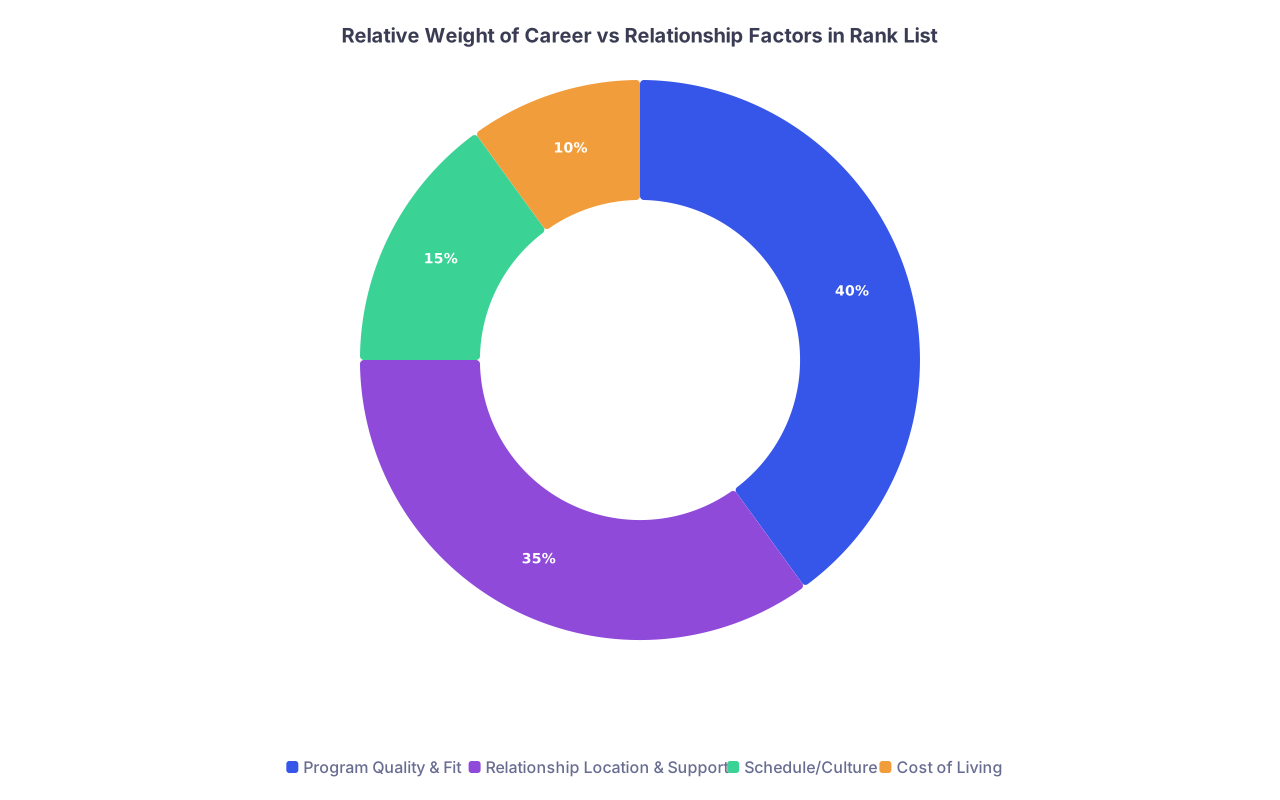
| Category | Value |
|---|---|
| Program Quality & Fit | 40 |
| Relationship Location & Support | 35 |
| Schedule/Culture | 15 |
| Cost of Living | 10 |
Maybe your pie looks different. The point is: you chose the weights. Not your dean. Not your parents.
A Concrete Example Walkthrough
Let’s do a quick reality pass through a sample IM applicant, long‑term partner in another city:
- You: Applying Internal Medicine. Solid app, 240s Step 2, some research.
- Partner: Teacher in Philadelphia, committed to at least 2 more years there. No easy transfer.
- Your interviews:
- University of Pennsylvania (Philly)
- Jefferson (Philly)
- Cooper (Camden)
- Maryland (Baltimore)
- UVA (Charlottesville)
- Big‑name program in Chicago
- Well‑known academic IM in California
You both agree:
- Max acceptable long‑distance: driveable, for 3 years if needed; flights across the country = no.
- You care about fellowship, but aren’t tied to only “top 10.”
Buckets:
- Same‑city: Penn, Jefferson
- Drivable: Cooper, Maryland, UVA
- Flight‑only: Chicago big‑name, California big‑name
Actual life reality:
- If you rank Chicago/California high and match there, your partner can’t move and you see each other maybe 2–3 times per year. For 3 years.
- You have several strong East Coast programs that place into good fellowships.
A relationship‑aligned rank list might be:
- Penn
- Jefferson
- Maryland
- Cooper
- UVA
- Chicago
- California
Compare that to a prestige‑max list:
- California
- Chicago
- Penn
- Jefferson
5–7 others
Those are completely different futures. Only one of them matches what you said you could tolerate as a couple. That’s the one you should submit.
Visual: What Your Ranking Workflow Should Actually Look Like

| Step | Description |
|---|---|
| Step 1 | List all programs |
| Step 2 | Define constraints with partner |
| Step 3 | Bucket programs by distance |
| Step 4 | Score career vs relationship fit |
| Step 5 | Simulate What if I match here? |
| Step 6 | Build draft rank list |
| Step 7 | Review together & adjust |
| Step 8 | Certify final rank list |
Use this as a mental checklist. If you skip B, C, or E, you’re basically gambling with both your career and your relationship.
FAQ (Exactly 5 Questions)
1. Should I ever rank a “worse” program higher just because it’s in my partner’s city?
Yes, if “worse” means slightly less prestigious but still solid training, and being with your partner matters a lot to you. No, if the program is truly malignant, has terrible outcomes, or you’d be miserable there. There’s a difference between reasonable compromise and self‑sabotage. If both of you agree that being in the same city is a top priority and the program will still train you well, ranking it higher is rational, not weak.
2. What if my partner says, “Do whatever is best for your career,” but I’m not sure they mean it?
Push back gently. Say: “I appreciate that, but I don’t want hidden resentment later. Let’s talk through what each place would actually look like.” Then walk them through the scenarios program by program. If they keep insisting they’re fine with long‑distance or a big move after seeing the details, take them at their word—but check in again before you certify the list. Avoid “I did this for you, and you weren’t even honest” narratives.
3. Is it dumb to do long‑distance all of residency?
Not automatically. I’ve seen couples do 3–7 years long‑distance and end up stronger. But it demands clear expectations, money for travel, emotional maturity, and programs that don’t grind you to dust. If you’re already shaky, or if the distance is across time zones with limited flights, the risk is high. Don’t romanticize it. Call it what it is: a hard mode that you choose only when the professional upside or constraints truly justify it.
4. How should couples match factor in if we missed the official couples match?
If you didn’t couple in NRMP but still want to be together, you’re essentially doing a manual couples match. Coordinate your rank lists informally: share programs, locations, and likely match odds. Maximize overlap in cities or nearby areas. But remember: without official coupling, there’s no algorithmic protection—one of you can match high while the other falls to a distant backup. That’s all the more reason to have frank discussions about worst‑case outcomes before you rank.
5. What if we break up after I’ve already ranked for them?
It happens. More than people admit. If the breakup is before the deadline, you can absolutely edit your list to reflect your new reality—don’t martyr yourself to a dead relationship. If the breakup happens after the deadline (or after the match), you adapt. Maybe you’re now in a city you wouldn’t have picked purely for career reasons. That doesn’t mean it’s a mistake. You can still make the most of that program and either re‑shape your life there or consider switching later. The key is what you do from now forward, not beating yourself up about a decision you made with the information you had at the time.
Bottom line:
You’re not just matching to a program; you’re matching to a life structure.
- Get brutally clear with your partner about constraints and distance tolerance.
- Bucket programs by relationship reality and build your rank list to reflect both career and life, not prestige alone.
- Once you jointly decide and certify, own that decision together and stop re‑litigating it every night.
That’s how you give both your residency and your relationship a real shot.