
The residency Match does not care that you just had your heart broken.
The brutal reality of a late breakup or engagement change
You submitted ERAS, did the interviews, maybe even did couples Match. Your rank list strategy was built around one assumption: “We’re doing this together.” Then, right as rank lists are due—or worse, after you certified—everything blows up.
Someone says:
- “I can’t move there.”
- “I don’t think we should do long distance.”
- “I need to stay near family.”
- Or the nuclear option: “I think we should end this.”
The standard advice—“follow your heart” or “you can always reapply”—is useless in this moment. You have days or hours, not months. You’re staring at a certified rank list built for a life that no longer exists.
So here’s the position you’re in:
- The NRMP deadlines are hard. After the rank list deadline, you cannot change your list.
- Programs do not reshuffle their rank lists for your personal life.
- You may have already tied yourself to a geography, to couples Match, or to a set of programs you only ranked for the relationship.
But you still have agency. You can absolutely rework a rank strategy—if you move fast and think clearly.
Let’s walk through what to do depending on exactly when this breakup or engagement change lands in your lap.
Step 1: Identify your exact timing and constraints
First, you need to know what clock you’re on. This determines what’s possible and what’s fantasy.
| When the breakup happens | What you can realistically change |
|---|---|
| Before rank list certification deadline | Almost everything about your rank order |
| After certification but before rank deadline | You can still edit and re-certify; previous is overwritten |
| After NRMP rank deadline but before Match Week | Nothing in the algorithm; only life prep / backup planning |
| During Match Week (pre- or post-unmatched result) | Only SOAP / reapply strategy; not this cycle’s list |
| Before ERAS next cycle | Total reset; geographic and program strategy rewrite |
Log in to NRMP right now and confirm:
- Has the rank order list deadline passed?
- Is your list certified?
- Are you in Couples Match?
Do not guess. People screw themselves by assuming they “can probably still change something.” You either can or you cannot.
Step 2: Strip your life back down to your priorities
You built the original rank strategy on a shared life plan: same city, same coast, maybe same institution. That mental model is now expired.
You need a 30–45 minute ruthless reset. No phones, no texting the ex, no polling 12 group chats. Just you, maybe one trusted non-chaotic person, and a scratch pad.
Answer these, fast and clearly:
- What matters most for your training quality?
- Program reputation?
- Case volume?
- Fellowship opportunities?
- Supportive culture vs malignant?
- How much do you actually care about geography now, without them?
- Do you still want that city?
- Are you only there because of their job/school/family?
- What about your personal support system?
- Where are your people? (Family, real friends, not acquaintances.)
- Can you survive emotionally doing intern year isolated and newly single?
- Any non-negotiables?
- Need to be near a co-parent?
- Immigration/visa issues?
- Health conditions needing specific care center?
This isn’t therapy. You don’t have time for deep processing right now. You’re triaging.
Write down 3–5 concrete priorities. Not 14. For example:
- Solid training with decent fellowship access in IM.
- Non-malignant culture—willing to trade some prestige for sanity.
- Within 2–3 hours of my parents.
- Avoid brutal cost-of-living cities this time.
Those become your new filters. Now we apply them.
Step 3: If this happens before the rank list deadline
You’re in the best of the bad scenarios. You can still salvage your strategy.
3A. You’re not in Couples Match
Good. Fewer moving parts.
Here’s what to do, stepwise:
- Pull up your existing rank list.
- Mark every program that was:
- Chosen primarily for the relationship (their job/school/family).
- In a city you actually do not want to live in alone.
- Now, against each program, write:
- Training quality: Strong / Mid / Weak (for you and your goals).
- Personal viability solo: Good / Tolerable / Miserable.
This is where you get honest. I’ve seen people leave “dream program” at #1 even though they confessed, “I’d hate living in that city alone and I have zero friends there.” That’s how people end up starting intern year already planning to transfer.
You’re balancing two types of risk:
- Professional: slightly weaker program, fewer fellowships.
- Personal: depression, burnout, isolation, failing to function.
You’re not choosing “perfect”. You’re choosing “most survivable and reasonably good for your career.”
Tactically:
- Move programs with strong training + good solo viability up.
- Move programs that were relationship-dependent and now look miserable down or even off the list.
- Don’t suddenly add a brand-new city you hated on interview day just because your relationship ended and you’re panicking. Anchor to what you actually saw and heard on interview day.
You’ve got to do this once, decisively. Don’t keep re-tweaking every 2 hours; that’s anxiety, not strategy.
3B. You are in Couples Match and just broke up
This is messier. But it’s not hopeless.
Key fact: You cannot un-couple after the NRMP couples registration deadline. The match will still treat you as a couple, even if you are now emotionally single.
So what do you do?
Talk once. Calmly. Yes, it’s uncomfortable.
- “We’re still technically in couples Match. We need to align enough so we don’t both completely screw ourselves.”
- You’re not rekindling. You’re disaster-managing.
Decide on a default philosophy:
- Option A: “We’d rather land in the same city, even if we’re not together, than blow the whole match.” (Common if you’re fine being in same city but separate lives.)
- Option B: “We should prioritize our individual best outcomes, even if that means diverging fully.” (Common in bad breakups or if same-city would be toxic.)
Rebuild your couples rank list accordingly:
- If Option A: Keep same-city pairs at the top, but make sure each of you is okay independently with your side of each pair. If you’d hate your program but they love theirs, that’s not a fair compromise.
- If Option B: You may intentionally introduce more “mismatched” combinations that favor each individual’s better program over shared geography.
Here’s what people forget: in Couples Match, you can include combinations where one partner doesn’t match (designated as “No rank” on one side). That can be used strategically.
You might do:
- (Your Dream Program, Their Solid Program in same city)
- (Your Dream Program, No Rank)
- (Your Second Choice Program, Their Dream Program elsewhere), etc.
If the relationship is truly done and you’re not able to coordinate sanely, prioritize your own side of the list. Unfortunate but necessary.
Step 4: If this happens after the rank list deadline but before Match Week
Now your hands are mostly tied. You cannot change your rank list. No secret back door, no email that will “fix it.”
So your job shifts from rank strategy to damage control and prep.
Here’s what you actually do now:
Get a clear mental picture of the top 5–7 programs you might match at.
- Where will you live if you end up there alone?
- Who do you know in those cities?
- What’s your plan for finding community quickly (religious groups, gym, hobby, co-residents)?
Decide whether you’d consider:
- Long distance with the ex if things are “on a break” and not fully dead.
- Fully cutting geographic ties.
- Being in the same city but very separate lives (if your list was constrained to where they are).
You also need to be frank: there’s a non-zero chance you match into a place you would have never chosen if you’d known you’d be single. You can’t fix that now. But you can plan for an eventual transfer application or strong fellowship application if needed.
Make a simple two-column plan:
- “If I match in City X”: housing ideas, nearby support, first 3 people I’ll lean on.
- “If I match somewhere not ideal for personal life”: mental health plan, therapist search, hobbies / routines you’ll commit to.
No, this doesn’t feel like strategy. It feels like survival prep. That’s exactly what it is.
Step 5: Breakup after Match results (including during SOAP)
This is the special hell where you already know what program you’re tied to, and your relationship explodes right as you’re figuring out housing and signing a contract.
Here’s how I’d handle it:
- Accept one thing quickly:
Your contract with the program is now your primary commitment.
The relationship is not.
I’ve watched people tank intern year performance trying to save a long-distance relationship that was already dying. They start asking for weird schedule favors, extra vacation swaps, random weekend flights every 2 weeks. It backfires. Program sees them as unreliable before they’ve even proven themselves.
Instead:
- Tell yourself: “I will stabilize my training first, then revisit relationship decisions.”
- If you’re considering staying with the person, don’t commit to any geographic-based sacrifices (deferring residency, transferring prematurely) in the first 3–6 months post-Match. You’re too raw; you’ll make bad bets.
If you go unmatched and you’re in SOAP when breakup chaos hits, refocus quickly:
- Rank SOAP programs based on training/function, not where your ex lives.
- Don’t chase or avoid a city just because of them, unless there’s a safety issue.
You get one career. You will have other relationships. Reverse that order and you’ll regret it.
Step 6: Avoid the classic emotional trap decisions
Late breakups make people do some impressively self-destructive things. Let me call out a few that I’ve seen up close.
6A. Don’t blow up your rank list to spite them
This is the “fine, I’ll rank the farthest possible city so there’s no chance we reconcile” move. Or the reverse: “I’ll keep all my ranks near them because I’ll show them we can make it work.”
Both are emotional decisions dressed up as “strategy.” They age badly.
Decide where you’d want to train if this person was not in your life at all—good or bad. That’s your reference point.
6B. Don’t cold-email programs begging them to move you up
Occasional exception: serious safety or legal issues (stalking, domestic violence) where you need to not be in same institution/city as the ex. That’s different. That’s a GME and maybe legal conversation, not a “please like me more” email.
But for ordinary breakups or engagement changes, programs are not going to reorder their rank list because you’re sad or because you’re slightly more available.
6C. Don’t re-plan your entire future around your ex’s hypothetical moves
“If I match in City A, they might move there in a year if their fellowship allows…”
No. Make decisions based on what’s real now, not on someone’s maybe-plan.
Step 7: If you’re the one calling off an engagement or relationship
Different flavor, same chaos.
You may feel guilty that your decision is going to force long distance, or split cities, or cause them to be alone where they matched. You might be tempted to “compensate” by sacrificing your own training to soften their landing.
Be blunt with yourself:
- You are allowed to not marry or not stay with someone, even if the original rank strategy assumed you would.
- You are not required to derail your own professional life out of guilt.
What is your responsibility?
- Communicate clearly and early, not two days before the deadline if you already know you’re done.
- Don’t lie. Don’t say, “I might still move there” if you know you won’t.
- Don’t artificially keep couples Match strategies in place if you know the relationship is non-viable.
If breakup is certain before the list is due, you should say something like:
“I don’t think it’s fair to keep our rank strategy built around a relationship I no longer see continuing. I think we both need to rank for ourselves now.”
Cruel in the short term. Much kinder in the long run.
Step 8: When your relationship status changes for the better late
Not all late changes are breakups. Some of you get engaged mid-interview season or right before rank lists. Or a long-term partner suddenly has a job offer in a very specific city.
You can’t fully re-architect fate at this point, but you can make some rational tweaks if the deadline hasn’t passed.
Things you can do, if still before rank deadline:
- Nudge programs in the city/region where your partner’s opportunity is higher on your list—but only up to the point where you’d still be happy alone if needed. Engagements break. Jobs fall through.
- Backup-range planning: make sure you have a spread of ranks in different tiers in that region, not just two ultra-competitive places that could both reject you.
What you shouldn’t do:
- Drop significantly better training programs for a brand-new relationship that isn’t tested by distance, stress, or real life yet.
- Overweight a partner’s “dream city” if you actively disliked it on interview day.
You’re planning for both possibilities simultaneously: relationship thrives, or it doesn’t. You need a rank list that doesn’t screw you in either world.
Step 9: Looking one cycle ahead if this year goes badly
Sometimes the relationship drama plus a constrained rank strategy ends with a rough outcome: you matched somewhere you hate, you didn’t match, or you’re in a couples Match situation that feels suffocating.
If you’re thinking, “I might want out,” plan methodically:
Complete intern year respectably. Programs and PDs help residents who:
- Show up.
- Do the work.
- Aren’t a constant personal drama vortex.
Talk to your PD honestly once you’ve proven yourself a bit, if you’re considering:
- Transferring to another program.
- Reapplying in another specialty.
- Moving institutions for serious personal reasons.
Make your “next cycle” rank plan completely independent of any relationship. If you’re still with the same person after all that, great—you can see if there’s overlap. But start from you this time.
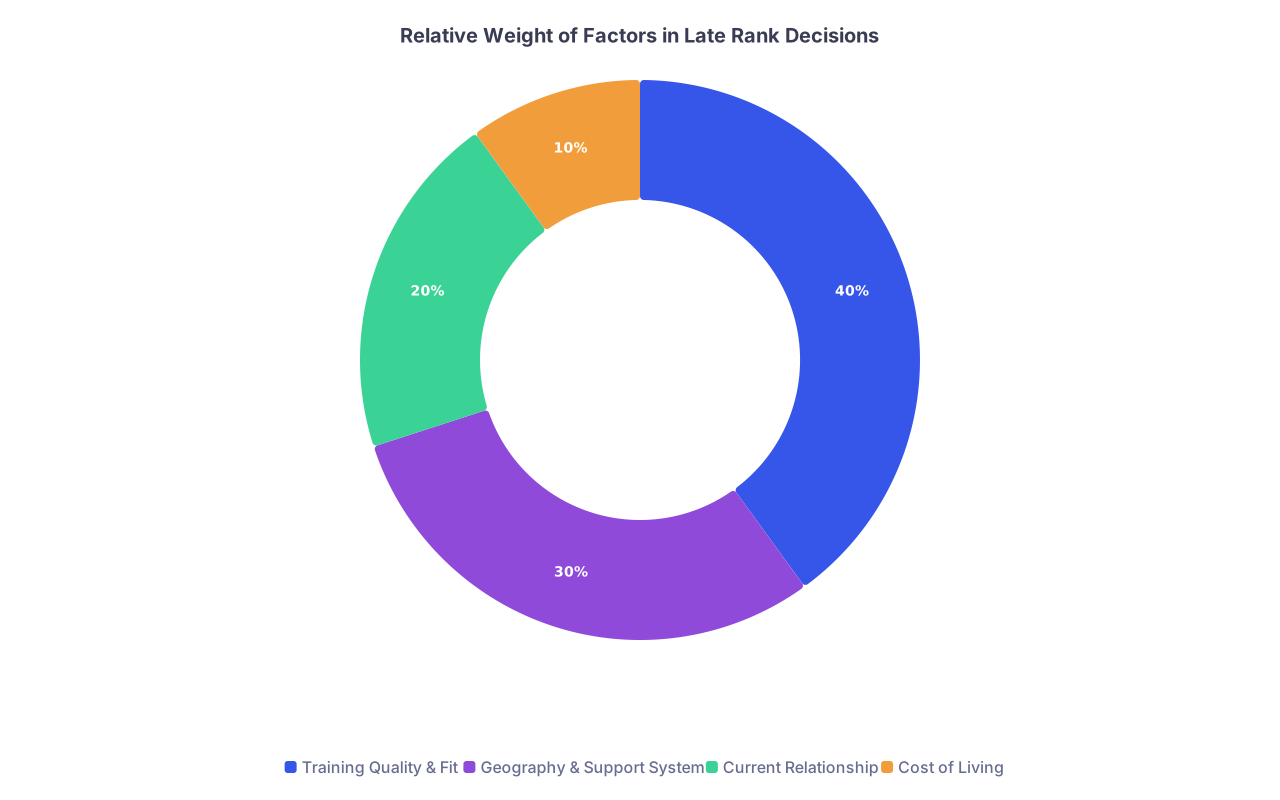
A quick visual: how much weight to give relationships vs training
| Category | Value |
|---|---|
| Training Quality & Fit | 40 |
| Geography & Support System | 30 |
| Current Relationship | 20 |
| Cost of Living | 10 |
That’s a rough proportion I’d recommend in late-stage decision-making. Notice something: the current relationship isn’t 0%. But it’s not 70% either.
A simple process you can follow today
When emotions are high, process helps. Think of it like this:

| Step | Description |
|---|---|
| Step 1 | Relationship Change |
| Step 2 | Clarify 3-5 Personal Priorities |
| Step 3 | Accept List is Locked |
| Step 4 | Reorder Based on Solo Life & Training |
| Step 5 | Single Honest Conversation |
| Step 6 | Adjust Couples List for Individual Best Outcomes |
| Step 7 | Certify Once, Stop Tweaking |
| Step 8 | Plan City-by-City Life Scenarios |
| Step 9 | Prepare Emotional & Practical Support |
| Step 10 | Before Rank Deadline? |
| Step 11 | Couples Match? |
Stick to that and you’ll avoid 80% of the impulsive mistakes I’ve seen.
One thing you should do today
Open your current (or hypothetical) rank list and do this:
For each of your top 10 programs, ask:
“If this relationship vanished tomorrow, would I still be okay matching here?”
- If the answer is “no” for anything in your top 5 and you’re before the deadline, you need to reorder.
- If the answer is “no” and you’re after the deadline, you need to start planning concretely how you’ll build a life there anyway—housing, support, mental health, contingency for transfer or fellowship.
Do that exercise right now, not the night before the deadline.