
Last January, a fourth‑year med student showed me her spreadsheet. On one side: residency programs. On the other: her partner’s non‑negotiable job in a mid‑sized city. “If I match far away,” she said, “either our relationship breaks or his career does.” She wasn’t being dramatic. She was just finally saying out loud what a lot of people in your position are quietly panicking about.
If you’re ranking residency programs while your partner’s job is fixed to one spot, you are not just “optimizing” a list. You’re making a decision that hits money, mental health, relationship stability, and your long‑term career. You do not get to pretend your partner’s job is a side variable. It is the variable.
Let’s walk through this like adults, not fantasy planners.
Step 1: Get Brutally Clear on Your Realistic Geography
Before you obsess over programs, you and your partner need to define the map. Not vibes. Actual drive times.
You’re essentially choosing between three buckets:
- Same-city
- Commutable distance
- Long-distance (LDR)
You can’t rank intelligently until you decide which of these is acceptable and which are dealbreakers.
Same-city: The cleanest, not always the best
If your partner’s job is truly fixed to one metro area, start by listing every residency program within that metro or immediate suburbs.
For example, if they’re in:
- Boston: MGH, Brigham, BIDMC, Tufts, Boston University, and some community programs
- Dallas: UT Southwestern, Baylor, Methodist, various community hospitals
- Twin Cities: University of Minnesota, Hennepin, Regions, etc.
Same-city sounds ideal, but do not blindly prioritize it if:
- The only local programs are toxic or under-resourced
- They’re wildly misaligned with your specialty goals
- They’re extreme outliers in hours/call that will make you a zombie at home
You’re not “being selfish” for caring about program quality. But you do need to be honest about how much risk you’re willing to take with training just to be co-located.
Commutable: Define the real ceiling, not the fantasy one
Everyone thinks they can tolerate more driving than they actually can. Residency crushes fake optimism.
You and your partner need a specific, shared definition:
- What is the maximum daily one-way commute either of you will accept?
30 minutes? 45? 60? Be specific. - Are you counting rush hour traffic or Google Maps at 10 p.m.?
- Does weather matter? (Commuting 60 minutes in Minnesota winter is not commuting 60 minutes in Phoenix.)
Here’s where you stop guessing and use a map.

| Step | Description |
|---|---|
| Step 1 | Partners Work Address |
| Step 2 | Draw 45-60 min drive radius |
| Step 3 | List all hospitals inside radius |
| Step 4 | Cross-check with residency programs in your specialty |
| Step 5 | Prioritize these on rank list |
| Step 6 | Decide if LDR is acceptable or radius can expand |
| Step 7 | Enough viable programs? |
Do this with them, ideally sitting together. Not in your head at 1 a.m. on your phone.
Long-distance: Decide now if it’s on the table
Long-distance for all of residency is a completely different lifestyle. Some couples make it work. Some crash hard.
You both need to answer, honestly:
- Are you willing to live apart 3–7 years?
- What’s the minimum visit frequency you both need emotionally? Weekly? Twice a month? Monthly?
- Can either of you afford the travel costs and time?
If the answer is “we’d rather break up than do that,” then fine—that’s your answer. But then you must rank like LDR is off the table, not as a backup fantasy.
Step 2: Build a Two-Layer Program List (Not Just a Rank List)
A standard rank list is flat: 1, 2, 3… You don’t have that luxury. You need two layers of classification:
- Relationship category (geography)
- Program desirability (for your training)
Start by building this table for your target specialty:
| Category | Example Distance | Relationship Impact |
|---|---|---|
| Same-city | 0–30 min both ways | Max time together, least friction |
| Commutable | 30–75 min for one person | Trade time/energy for co-location |
| Long-distance light | 1–3 hr drive/train | Weekends possible, higher cost |
| Long-distance heavy | Flight or >3 hr drive | Infrequent visits, high burnout |
Now categorize each program you’re considering into one of those four. Do that first, before you emotionally attach to any single name.
Then, inside each category, you can rank by:
- Training quality
- Fit
- Reputation (to a point—don’t worship it)
- Lifestyle (call schedule, support, culture)
You want to end up with something like:
- Tier A: Same-city & good fit
- Tier B: Commutable & good/solid fit
- Tier C: Long-distance & excellent fit
- Tier D: “Only if absolutely forced” options
You’re not ranking yet. You’re sorting your battlefield.
Step 3: Have the “What Are We Optimizing For?” Talk
This is the part almost everyone skips and then regrets.
Sit down with your partner and answer this explicitly:
“If we have to choose between your training and staying co-located, which wins—and by how much?”
There are a few common profiles I see:
Training-first, but not at any cost
You’re willing to do long-distance if the program is truly a game-changer (e.g., you want academic cardiology, and your partner’s city only has small community IM programs).Relationship-first, within reason
You will not do 5-year long-distance, but you’ll take a solid (not elite) program to stay together, as long as it’s not clearly malignant.Balanced tradeoff
You’d sacrifice a bit of program prestige for co-location, but you won’t accept a program that obviously harms your career goals.
You both need to be able to say something like:
“If Program X (same city, mid-tier) and Program Y (top-tier, LDR) rank the same in my head academically, we’re choosing X.”
or
“If I can get into a top-10 in my field, I’m going to rank that above local options, and we’ll do LDR for 3 years.”
Do not assume your partner “knows” this. Say it.
Step 4: Translate Priorities into a Real Rank List
Now the tactical piece: taking all that mess and putting numbers in ERAS.
Principle 1: Don’t rank anything you would rather go unmatched than attend
I’ve seen people rank a terrible distant program “just to be safe” and then match there instead of scrambling into something closer. If you and your partner would choose SOAP + maybe a different city next year over a given program, do not rank that program. Period.
Principle 2: Group by geography, then sort by program quality
A common pattern that works well:
- #1–3: Same-city programs you’d genuinely be happy with
- #4–8: Commutable programs that are solid or better
- #9+ : Long-distance programs that are significantly better for training
Not every situation will follow that, but the pattern is: closest + acceptable first, then farther if they’re clearly superior.
Here’s what that might look like for someone whose partner works in Indianapolis, wanting IM:
- Univ of Indiana – IM (Indy – same city)
- St. Vincent – IM (Indy – same city)
- Community Health – IM (Indy – same city, decent)
- Univ of Cincinnati – IM (2 hr drive, academic upgrade)
- OSU – IM (Columbus, 3 hr, big upgrade academically)
- Northwestern – IM (Chicago, 3+ hr, major upgrade, LDR)
- Univ of Michigan – IM (Ann Arbor, LDR but top-tier)
In that example: they’ve said, “We prioritize staying same-city if the programs are at least decent. If not, we’re willing to go regional, then LDR only if it’s truly elite.”
Principle 3: Use “tie-breakers” you’ll actually feel at 2 a.m.
If two programs feel equal on paper, do not get stuck.
Ask:
- Where will I have more human support when I’m exhausted?
- Which place makes travel between us easier/cheaper?
- Which program is less likely to destroy my mental health?
Things like “direct flights between cities,” “nearby parents/friends,” or “lower call intensity” are valid tie-breakers. You’ll feel those more than the difference between #40 vs #55 on some random ranking list.
Step 5: Communicate (Selectively) with Programs About Your Partner
You don’t need to broadcast your relationship situation to everyone. But sometimes it can help, especially if:
- Your partner’s job is in the same city or hospital system
- You’re choosing between two similar programs in the same area
- There are dual-career support structures (more common when both are physicians, but still)
Some programs are quietly very supportive of anchored partners. Some do not care. You only find out by asking strategically.
How to do it without sounding needy:
If same city:
“My partner works in [industry] in [city], so we’re committed to building our lives here long-term. Your program would allow us to stay together while I train, which is a major positive for me.”If regional:
“My partner is based in [city], which is [X] hours away, so being within reasonable driving distance is a real plus. It makes your program particularly attractive to me.”
Don’t expect them to “fix” anything. This is about framing your genuine interest, not begging for special treatment.
Step 6: Plan the Logistics Like It’s a Second Job
If you end up with commute or LDR, you will need systems.
For commutes
You’re not just losing hours in the car. You’re losing:
- Recovery time post-call
- Flexibility for last-minute schedule changes
- Emotional energy that might have gone to your partner
So:
Decide in advance: Who commutes?
Usually it should be the one with more predictable hours. Often that’s the non-resident.Lock in routines:
“On call weeks, I stay near the hospital. On golden weekends, I do the driving.”Set non-negotiable rest rules:
If you’re post-night float, you do not drive 60 minutes on a highway. I’ve seen residents fall asleep at the wheel. It’s not theoretical.
For long-distance
Long-distance for residents is different from long-distance for 9‑to‑5ers.
You need:
A shared calendar with:
- Call schedules
- Conferences
- Vacations
- Protected weekends for visits
A specific visit plan:
“We see each other:- At least once a month
- Alternating who travels
- Booking flights 6–8 weeks out”
A budget line for travel. Flights, gas, hotels—it all adds up. Pretending it won’t just makes the fights worse later.
Step 7: Be Honest About Dealbreakers and Exit Plans
Hard truth: sometimes the “right” ranking decision still doesn’t work out. The program is worse than advertised. The commute is killing you. The LDR is breaking you both.
You should talk about exit options now, before the match:
- If after PGY-1 the program is destroying my mental health, will we consider:
- Trying to transfer programs closer?
- You exploring job changes after my intern year?
- Me switching to a different, less location-constrained specialty (if very early and truly misaligned)?
No one likes to think about this when they’re still hopeful. But having a pre-agreed “if it’s really awful, here’s what we do” plan reduces panic if you end up needing it.
Example Scenarios and How I’d Rank
Scenario 1: Partner with tenure-track job in a single city
- Partner is a professor at a university in Atlanta. No remote option. Your specialty: Internal Medicine.
- Programs:
- Emory IM (Atlanta, academic, strong)
- 2 community IM programs in Atlanta suburbs
- Solid IM programs in Birmingham, Augusta, Nashville
- Top-tier IM in Boston, UCSF, Hopkins
How I’d probably approach the list (if you’ve agreed “relationship-first, but I still want decent training”):
- Emory IM (best combo of training + same city) 2–3. Atlanta community IM programs (if non-toxic)
- UAB – Birmingham IM (2.5 hr drive, regional, good) 5–6. Nashville IM programs (longer drive, but drivable) 7+. Big-name LDR programs only if you both truly accept multiple years apart
I would not put UCSF/Harvard above all the Atlanta options unless you both are genuinely okay with high-intensity LDR for at least 3 years.
Scenario 2: Partner in niche corporate job, some relocation possible after 1–2 years
- Partner is in a specialized role with hubs in Chicago, Denver, and Dallas, currently based in Chicago.
- Your specialty: EM.
This is different, because their job is “fixed” for now, but not forever.
Here, I might think:
- Rank Chicago EM programs high (same city, near-term stability)
- Also seriously consider programs in Denver and Dallas (where they could transfer in 1–2 years)
- If there’s a truly outstanding program in one of those hub cities, it may jump ahead of a mid-tier Chicago option
Your list might look like:
- Top Chicago EM
- Second Chicago EM
- Top Denver EM
- Top Dallas EM
- Third Chicago EM (if weaker) 6+. Others
You’re optimizing around where the partnership can converge in 1–2 years, not just next July.
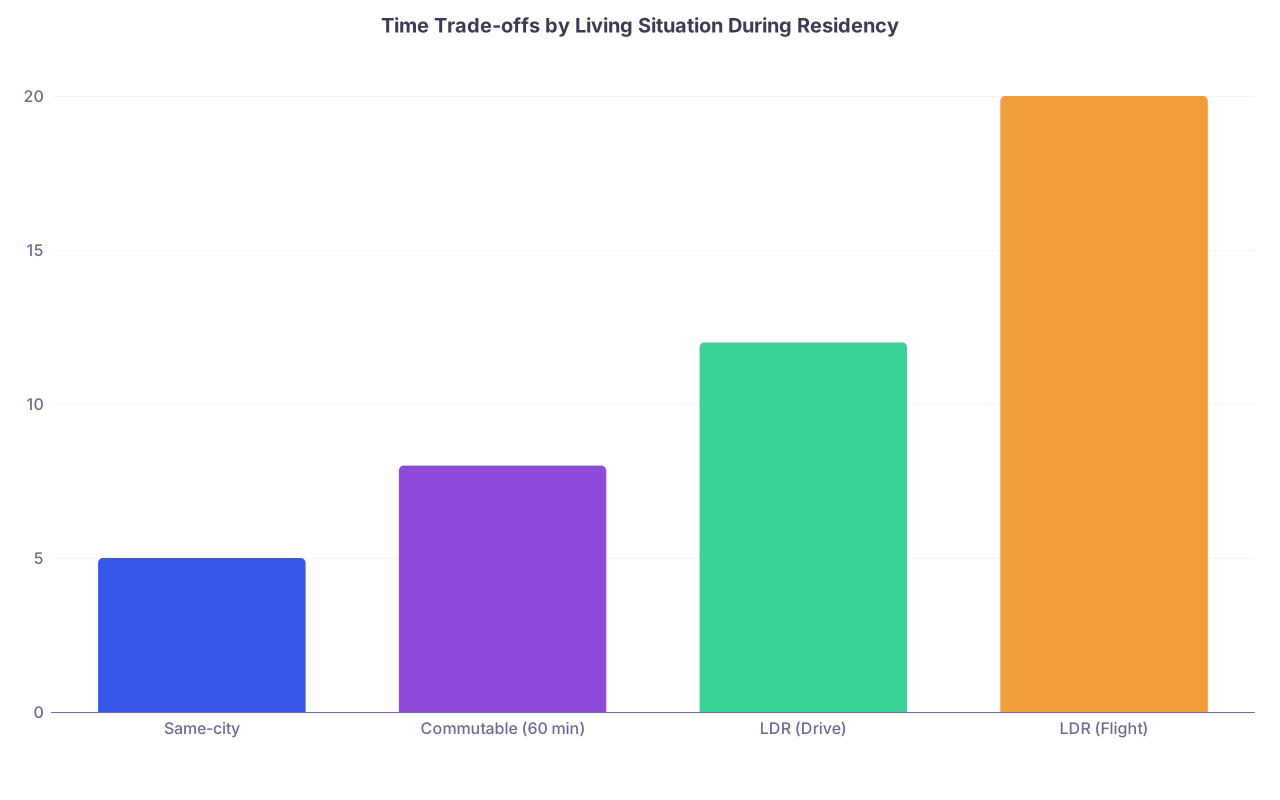
| Category | Value |
|---|---|
| Same-city | 5 |
| Commutable (60 min) | 8 |
| LDR (Drive) | 12 |
| LDR (Flight) | 20 |
(Values represent approximate extra hours per week lost to commuting/travel/coordination compared to a same-city setup.)
FAQs
1. Should I ever rank a “worse” local program above a “better” far-away one?
Yes, and people do it all the time. If the local program is:
- Not malignant
- Solid enough to get you where you want to go (maybe with more hustling)
- And co-location is a high priority for you both
Then ranking a mid-tier local program over a elite far-away one is completely rational. The prestige hit is often smaller than the relationship and mental health hit from LDR.
2. Do programs care that my partner has a fixed job in their city?
Some do, quietly. They like residents who are likely to stick around, buy homes, and become faculty or local physicians. It signals stability. But it’s not something to bank on. Use it to:
- Express genuine interest
- Explain why you’re regionally focused
Don’t expect them to break rules or give special favors just because your partner is local.
3. Should I mention my partner/job situation in my personal statement or interviews?
Not in your personal statement. That’s not the place. In interviews, it’s fine to mention when they ask, “Why this city?” or “What draws you here?” Something like:
“My partner works in [field] here, and we’re planning to build our lives in this area long-term, so training here would be ideal.”
That’s enough. Don’t overshare drama or constraints.
4. How many long-distance programs should I rank if we really prefer to stay together?
Only rank LDR programs you’d genuinely choose over going unmatched and reapplying with a different plan. If you and your partner are very anti-LDR, it’s reasonable to have a short rank list focused on same-city/commutable programs and accept the higher risk. Just do it intentionally, not by accident.
5. What if my partner wants me to prioritize us, but I feel pressured and resentful?
Then you two need a real conversation before you submit your list. Resentment is poison. Tell them honestly:
“I love you and want to be together, but if I completely abandon my training priorities, I’m going to feel trapped.”
From there, look for a compromise: maybe you still prioritize same-city, but you agree to rank at least a few regional programs that significantly upgrade your training. The worst move is silently agreeing, then blaming them for your career later. Be explicit now, not bitter later.
Bottom line:
- Define your real geographic and emotional limits together before you rank anything.
- Build a two-layer system—relationship category first, then program quality—so your rank list matches your actual life priorities.
- Only rank programs you’d truly be willing to live with, as a doctor and as a partner.