

The most dangerous myth in the Match is that you “only need to rank the programs you love.” The data shows this is wrong. Flat‑out.
If you care about matching, rank list length is one of the few levers you control that moves your probability curve in a predictable, quantifiable way. The NRMP has made this brutally clear for over a decade. Many applicants just choose to ignore it.
Let me walk you through what the numbers actually say, not what anxious co‑residents or a random Reddit thread claims.
The Core Evidence: What NRMP Data Actually Shows
The NRMP publishes a recurring report: Charting Outcomes in the Match and the Results and Data: Main Residency Match. Buried in the tables is one of the most actionable relationships in the entire process: rank order list (ROL) length vs probability of matching.
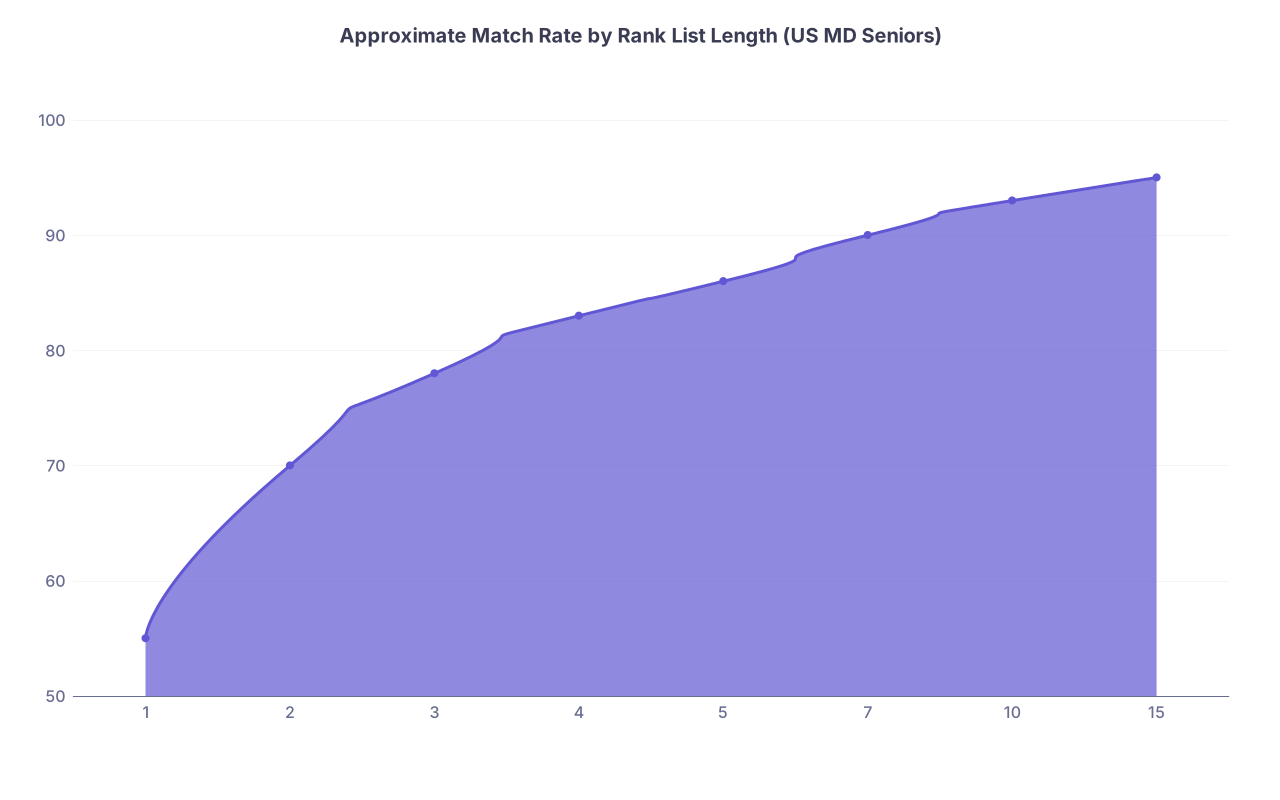
Here is the basic pattern for U.S. MD seniors, categorical positions, all specialties combined. Numbers below are rounded averages drawn from several years of NRMP aggregate data (patterns are consistent year to year):
| Category | Value |
|---|---|
| 1 | 55 |
| 2 | 70 |
| 3 | 78 |
| 4 | 83 |
| 5 | 86 |
| 7 | 90 |
| 10 | 93 |
| 15 | 95 |
The curve is unmistakable:
- Very short lists are dangerous.
- The first 5–7 ranks give large jumps in match probability.
- Returns diminish after ~10–15 programs but are still positive.
To make this more concrete, here is a simplified comparison table. It is not specialty‑specific; individual specialties shift up or down, but the shape holds.
| # of Ranked Programs | Approx Match Probability |
|---|---|
| 1 | ~50–60% |
| 3 | ~75–80% |
| 5 | ~85–88% |
| 8 | ~90–92% |
| 12 | ~94–96% |
The headline: Going from 3 to 8 programs often increases your match probability by roughly 10–15 percentage points. That is not subtle.
The curve for DO seniors and IMGs is steeper
For US DO seniors and IMGs, the same pattern exists, but the penalty for short lists is harsher.
NRMP’s combined data typically shows:
- DO seniors with 1–3 ranked programs: match rates often under 60–65%.
- DO seniors with 8+ programs: match rates rise into the 80–90% range in many fields.
- IMGs (especially non‑US IMGs) need substantially longer lists to approach similar probabilities.
The message from the numbers: if you are not a highly competitive US MD senior in a less competitive specialty, short lists are essentially self‑sabotage.
Why List Length Matters: Mechanics of the Algorithm
This is not superstition. It is baked into how the NRMP algorithm works.
The algorithm is applicant‑proposing:
- The algorithm starts with your first choice.
- If that program has an open slot and wants you (based on its rank list), you are tentatively placed there.
- If the program fills up later with applicants it ranked higher, you get “bumped” and the algorithm tries your next choice.
- This continues down your list until you are either permanently placed or you run out of ranked programs.
Every extra program on your list is:
- One more place the algorithm is allowed to try to place you.
- Another chance to “catch” you if earlier programs fill with people ranked ahead of you.
If your list is short, you simply run out of attempts. That is why the relationship between list length and match probability is so clean in the NRMP data.
Specialty‑Specific Patterns: Competitive vs Non‑Competitive
The aggregate graph hides a critical nuance: specialty competitiveness shifts the entire curve up or down and changes how aggressive you must be.
1. Less competitive specialties
Think Family Medicine, Psychiatry (still relatively accessible in most places), Pediatrics, Pathology, some Internal Medicine community programs.
In these fields, US MD seniors often see:
- 5–7 ranks → match rates in the high 80s to low 90s.
- 10–12 ranks → match rates typically 95%+.
The marginal gain after ~10–12 programs is smaller, but still real. For these specialties, the main danger is complacency—students who interview at 6 places, feel “great vibes,” and then rank only 5 because one “did not feel right.” That is an unnecessary hit to match probability.
2. Moderately competitive specialties
Internal Medicine as a whole, Emergency Medicine (variable by year), Anesthesiology, OB/GYN.
Here, you often see:
- 5 ranks → match probability in the 80–85% range.
- 10 ranks → somewhere around 90–93%.
- 15+ ranks → mid‑90s, sometimes a bit higher.
For these, the data supports ranking essentially every place where you interviewed unless it is truly non‑viable for you (geographically or personally).
3. Highly competitive specialties
Dermatology, Plastic Surgery, Neurosurgery, Orthopedics, ENT, some Radiology niches.
In the NRMP tables, you can see:
- Even with 10 ranks, match probabilities can be far below 90%.
- Longer lists help, but cannot fully compensate for a heavily skewed supply‑demand imbalance.
In other words, for highly competitive specialties:
- You need both a reasonable number of interviews and a long rank list.
- Failing to rank everything you interviewed at is almost always a mistake unless you are dual‑applying and have a clear backup.
How Many Programs Should You Rank? Data‑Driven Heuristics
Let us get practical. You are not a national average; you are one applicant with a certain profile in a particular specialty.
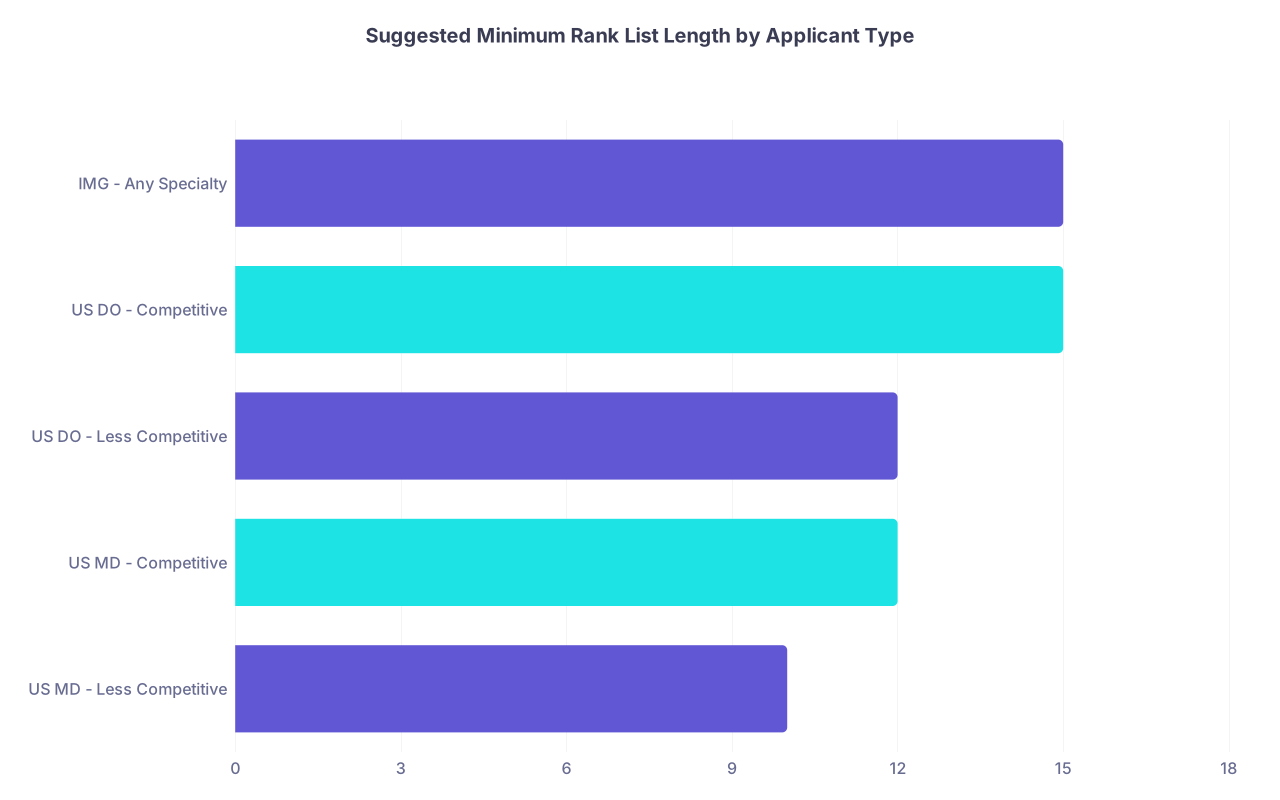
Here is a rough, data‑anchored framework using NRMP patterns.
| Category | Value |
|---|---|
| US MD - Less Competitive | 10 |
| US MD - Competitive | 12 |
| US DO - Less Competitive | 12 |
| US DO - Competitive | 15 |
| IMG - Any Specialty | 15 |
These are minimum targets, not ceilings:
- US MD, less competitive specialty: Aim for ≥10.
- US MD, competitive specialty: Aim for ≥12 (more if possible).
- US DO, less competitive specialty: Aim for ≥12.
- US DO, competitive specialty: Aim for ≥15.
- IMGs (US or non‑US), any specialty: Aim for ≥15, often 18–20+ if you interviewed that broadly.
I am not claiming the curve magically stops at these numbers. The NRMP data shows that:
- The first 5–7 programs deliver the biggest jumps.
- 7–12 keeps adding smaller but meaningful gains.
- >15 often yields continued, smaller upticks, especially for DOs and IMGs.
The main takeaway: almost nobody loses by having a longer list, but many applicants lose by stopping too soon.
Common Bad Arguments Against Longer Rank Lists
I hear the same flawed reasoning every year from unmatched applicants.
“I only want to be somewhere I will be happy.”
That sounds wise. It is often fear dressed up as principle.
The data truth: There is no NRMP category for “programs I will be happy at.” There is only “matched” and “unmatched.”
Does that mean rank every toxic place? No. If you have concrete red flags—patient safety issues, disregard for duty‑hour rules, illegal questions, abusive culture—you should drop that program.
But “I did not click with the resident on my tour” is not a statistically valid reason to sacrifice 5–10 percentage points of match probability. Your satisfaction is more correlated with:
- Location support system.
- Program stability.
- Breadth of training.
The data on career satisfaction shows surprisingly weak correlations with that fuzzy “vibe” on interview day.
“If I don’t match at my top 3, I would rather go unmatched and try again.”
This is almost always bravado. And the NRMP data is merciless to this mindset.
Non‑trivial reapplicant penalties exist, especially in competitive fields. Programs know:
- You were already filtered once by the market.
- Your application now competes against a new cohort plus the shadow of a prior unsuccessful attempt.
If you consciously choose a 20–40% chance of going unmatched because you are “holding out” for a top 3, you are not making a romantic stand. You are making a statistically poor bet with your entire career timeline.
“Ranking more programs will somehow push me to a worse outcome.”
The algorithm does not punish you for longer lists. It always attempts to place you at your highest choice where there is mutual ranking.
Adding program #11 cannot prevent you from matching at program #3. The only thing it can do is give you a backup if #1–10 are not attainable.
The NRMP has hammered this myth repeatedly. The data backs them entirely.
Strategic Scenarios: How to Use the Data in Real Life
Let me walk through a few realistic scenarios and what the NRMP curves imply.
Scenario 1: US MD, Internal Medicine, 9 interviews
You liked 6 programs. The other 3 felt “mid.”
If you rank only the 6 you like:
- Your match probability might sit somewhere around the high 80s, depending on your competitiveness and their tiers.
If you rank all 9:
- NRMP‑style curves suggest your probability can easily move into the 90–93% range.
The 3 “mid” programs may be the difference between SOAP chaos or a stable PGY‑1 year while you regroup or switch paths. Data‑wise, the choice is obvious: rank all 9.
Scenario 2: US DO, EM applicant in a tightening market, 11 interviews
You feel like 11 interviews is “a lot.”
For DOs in EM, the last few cycles have been volatile. NRMP outcomes show DO seniors’ match rates drop sharply with shorter lists. For someone with 11 interviews:
- A rank list of 11 is average, not generous.
- Dropping to 8 because of “vibe” likely cuts your match probability by 5–10 percentage points, sometimes more if your scores are borderline.
Here, the safest, data‑aligned move is to rank all 11, then aggressively self‑audit for SOAP backup if things go sideways.
Scenario 3: IMG, Internal Medicine, 18 interviews
IMGs are the clearest example where long lists pay off.
NRMP data on IMGs shows:
- Very high non‑match rates for short lists, even with reasonable credentials.
- Significant improvement as list length climbs above 12–15.
If you have 18 IM interviews as an IMG and you genuinely could live and train at all of them, ranking all 18 is the rational choice. Cutting to 10 because “the others are in less desirable cities” is a recipe for preventable non‑match.
How to Build Your Rank List Step by Step
Here is a simple, data‑respecting way to construct your list.

| Step | Description |
|---|---|
| Step 1 | Gather All Programs |
| Step 2 | Eliminate Truly Unsafe/Nonviable |
| Step 3 | Group by Preference Tier |
| Step 4 | Order Within Each Tier |
| Step 5 | Check Total Length vs Target Minimum |
| Step 6 | Reconsider Borderline Programs |
| Step 7 | Finalize List in True Preference Order |
| Step 8 | Below Data-Driven Target? |
- Start with every program where you interviewed.
- Eliminate only:
- Places with clear safety or ethical red flags.
- Locations you absolutely cannot move to (visa, family, financial realities).
- Group the rest into tiers:
- Tier 1: Dream programs.
- Tier 2: Solid and acceptable.
- Tier 3: I can live with this.
- Strictly order within each tier based on your actual preference, not guessing “where I’m more likely to match.”
- Look at your total count. Compare it to your data‑driven minimum (10, 12, 15+ depending on your category).
- If you are below the target, revisit borderline programs you were tempted to cut for soft reasons.
- Submit the full, honest list.
The key: never reorder based on where you “think” you are competitive. The NRMP data and algorithm description are explicit: you maximize your outcome by ordering by true preference, then extending length for safety.
Quantifying the Risk of Short Lists
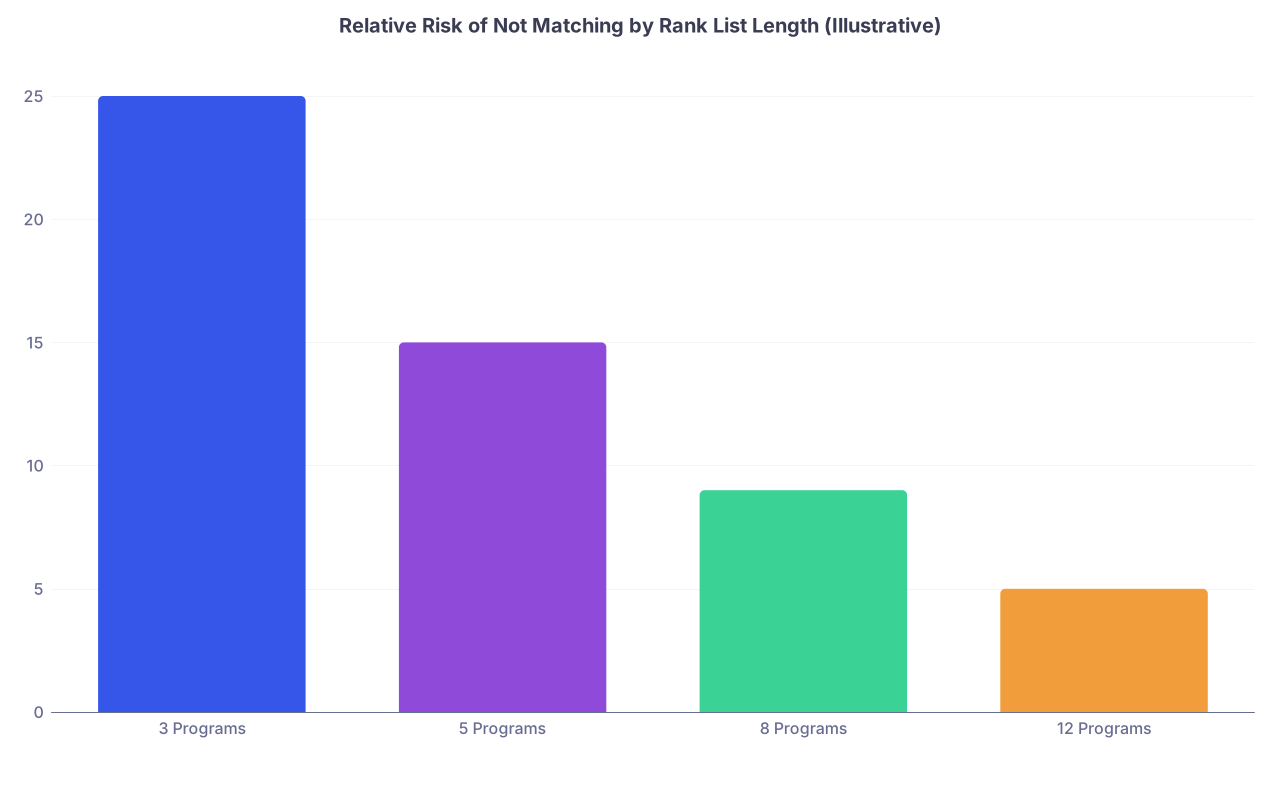
To make this painfully clear, let us look at relative risk. Using NRMP‑style curves for US MD seniors:
| Category | Value |
|---|---|
| 3 Programs | 25 |
| 5 Programs | 15 |
| 8 Programs | 9 |
| 12 Programs | 5 |
Approximate non‑match risk:
- 3 programs: ~20–25%.
- 5 programs: ~10–15%.
- 8 programs: ~7–10%.
- 12 programs: ~4–6%.
Ranking 3 instead of 8 programs can triple your risk of going unmatched. That is not a lifestyle choice. That is a quantifiable, avoidable risk.
For DOs and IMGs, the absolute numbers are worse, but the ratios look similar or more dramatic. Short lists are hazardous.
When Is It Reasonable to Stop Adding Programs?
There is a point where the marginal gain in match probability is so small that the emotional cost of including a particular program may outweigh it. That point is not at 4 programs. It is closer to 15–20 in many cases.
A few rational stopping points:
- You have:
- US MD senior in a less competitive field: ≥12–15 programs on your list.
- US MD in a competitive field: ≥15+ programs.
- DO or IMG: ≥15–20 programs.
- You have genuinely reached the bottom of “I can realistically live and train here without serious harm to my life or family.”
- Additional programs have tangible red flags, not just “I was bored on interview day.”
The NRMP data shows diminishing returns, not zero returns, after these points. So you may decide that going from 18 to 22 is not worth the stress if the last four are truly poor fits. That is a values judgment, not a statistical optimization problem.
Key Takeaways from the Numbers
Three blunt conclusions from the NRMP data:
- Rank list length strongly predicts match probability, especially from 1–10 programs. Short lists are empirically risky.
- You do not get penalized for ranking more programs. The algorithm always seeks your highest possible choice.
- Most applicants should rank nearly every place they interview, cutting only for serious, concrete reasons.
If your strategy is “I will just rank my top 4–5 because I am sure I will match there,” you are not following data. You are gambling.


