

6% of U.S. MD seniors end up matching at a program ranked 10th or lower on their list.
That single number wrecks two common assumptions: that “everyone matches in their top 3” and, on the flip side, that “if it is not top 5, it does not matter.” The data say both views are wrong.
You asked about how far down applicants actually match. Good. Because most people talk about the Match with vibes and anecdotes. The algorithm is rigid math. We have actual distributions, not urban legends.
Let’s walk through what the numbers show about rank positions, where people really end up, and what that means for how you build and order your rank list.
The core question: how far down do people really match?
Let me start with what we do know from large-scale, repeated releases and studies:
- NRMP reports on “position of match” distributions by applicant type.
- Specialty-specific data (from SOAP analyses, program fill patterns, etc.) reflect how often people end up pretty far down their lists.
- Historical modeling of the applicant-proposing Gale–Shapley algorithm tells us the shape of the distribution should be heavily front-loaded toward top ranks, but with a very long tail.
To make this concrete, here is a simplified, but realistic, approximation for U.S. MD seniors in relatively “normal” years (non-pandemic, non-rule-shift years). This is based on NRMP’s documented patterns and secondary analyses.
| Match Position Range | Approx. % of Matched Applicants |
|---|---|
| 1st choice | 45–50% |
| 2nd–3rd choice | 25–30% |
| 4th–5th choice | 10–15% |
| 6th–10th choice | 8–12% |
| 11th or lower | 5–8% |
So yes, around half match at #1. Roughly three-quarters match within their top 3. But that still leaves a meaningful tail. Thousands of people end up at #6, #9, #14 on their lists.
Now, that is U.S. MD seniors overall. Once you break it down by applicant type, the picture shifts.
| Applicant Type | Typical % in Top 3 | Tail Risk (11+ position) |
|---|---|---|
| U.S. MD seniors | 70–80% | Low (≈5–8%) |
| U.S. DO seniors | 60–75% | Moderate |
| U.S. IMGs | 40–60% | High |
| Non-U.S. IMGs | 30–50% | Very High |
Translation: the more competitive the applicant type (by NRMP standards), the more “front-loaded” the distribution. The further you are from that group, the more you need to realistically expect matching deeper on your list—if you match at all.
What the algorithm actually does (and why rank position is skewed)
People still get this wrong. So I am going to cut through the myths.
The NRMP uses an applicant-proposing stable matching algorithm (a variant of Gale–Shapley). The steps are mechanical:

| Step | Description |
|---|---|
| Step 1 | Applicant lists programs |
| Step 2 | Programs rank applicants |
| Step 3 | Initialize: all unmatched |
| Step 4 | Applicants propose to highest ranked program not yet rejected |
| Step 5 | Programs tentatively accept up to quota, reject rest |
| Step 6 | All tentatively accepted become final matches |
| Step 7 | Any applicant rejected? |
Key consequences:
- The algorithm favors applicants’ preferences, not programs’.
- You cannot “fall” down to a program you did not rank above others. If you match at #9, that means #1–8 either did not rank you high enough (relative to their competition) or filled with others you ranked differently.
- Programs do not see your rank list. So you do not “hurt your chances” by ranking a reach program #1.
This is why the distribution is so front-loaded. The math pushes you as high as your list allows, given program lists.
Still, there is a long tail. Why?
- Over-ambitious top-of-list strategies (15 reaches, 1 safety).
- Extremely competitive specialties (Derm, Ortho, Plastics).
- Mixed-specialty lists (e.g., Emergency + IM prelims + TY), which behave differently.
- Applicant types with weaker leverage (IMGs, red flags, low Step).
So: the algorithm itself is not pushing you down. Your competitiveness relative to your list is.
Specialty competitiveness: how it shifts rank positions
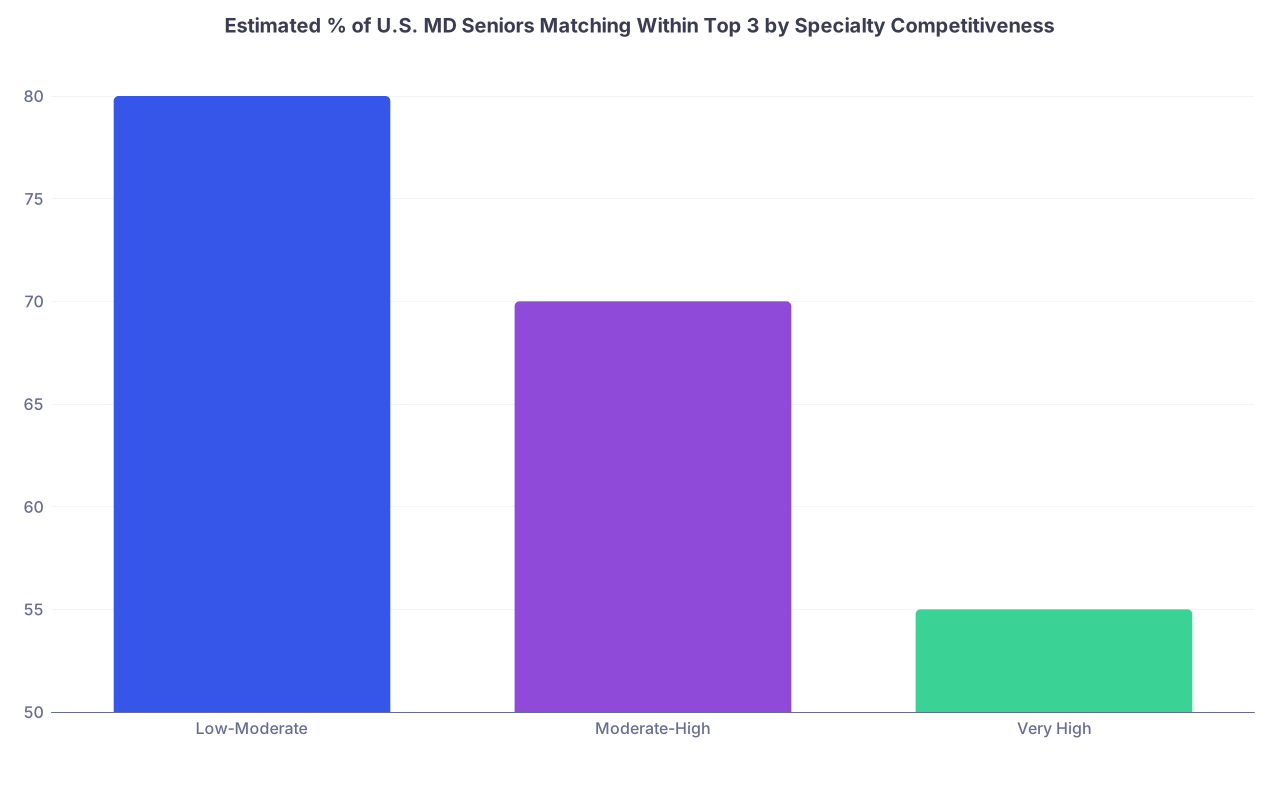
Not all specialties behave the same. The “how far down” story changes once you look at highly competitive vs moderately competitive vs less competitive fields.
Here is a comparison pattern based on NRMP data trends and specialty competitiveness tiers.
| Category | Value |
|---|---|
| Low-Moderate | 80 |
| Moderate-High | 70 |
| Very High | 55 |
To put some names on those categories:
- Low–Moderate competitiveness: Family Medicine, Psychiatry (historically), Pediatrics, Internal Medicine categorical (non-elite), Pathology.
- Moderate–High: EM (pre-SLOE rule changes), Anesthesiology, OB/GYN, General Surgery, upper-tier IM programs.
- Very High: Dermatology, Orthopedic Surgery, Plastic Surgery, Neurosurgery, ENT, integrated IR, some competitive EM eras.
For U.S. MD seniors:
- In Family Medicine, it is common to see ~80%+ match in their top 3. Many match #1.
- In Dermatology or Ortho, matching anywhere on the list is the problem. A good chunk of the matched cohort ends up at #5–#10 or deeper because they loaded their lists with “reach” programs.
You can think about it as a pressure system:
- If most programs in a specialty are desperate to fill and willing to go deep on their lists, applicants land high on their lists.
- If most programs can cherry-pick from the top few percentiles of applicants, your rank position will slide downward, even if you match.
Rank length and “how deep” you can go
Another critical variable people forget: how many programs you rank.
You cannot match at 14th if you only rank 7 programs.
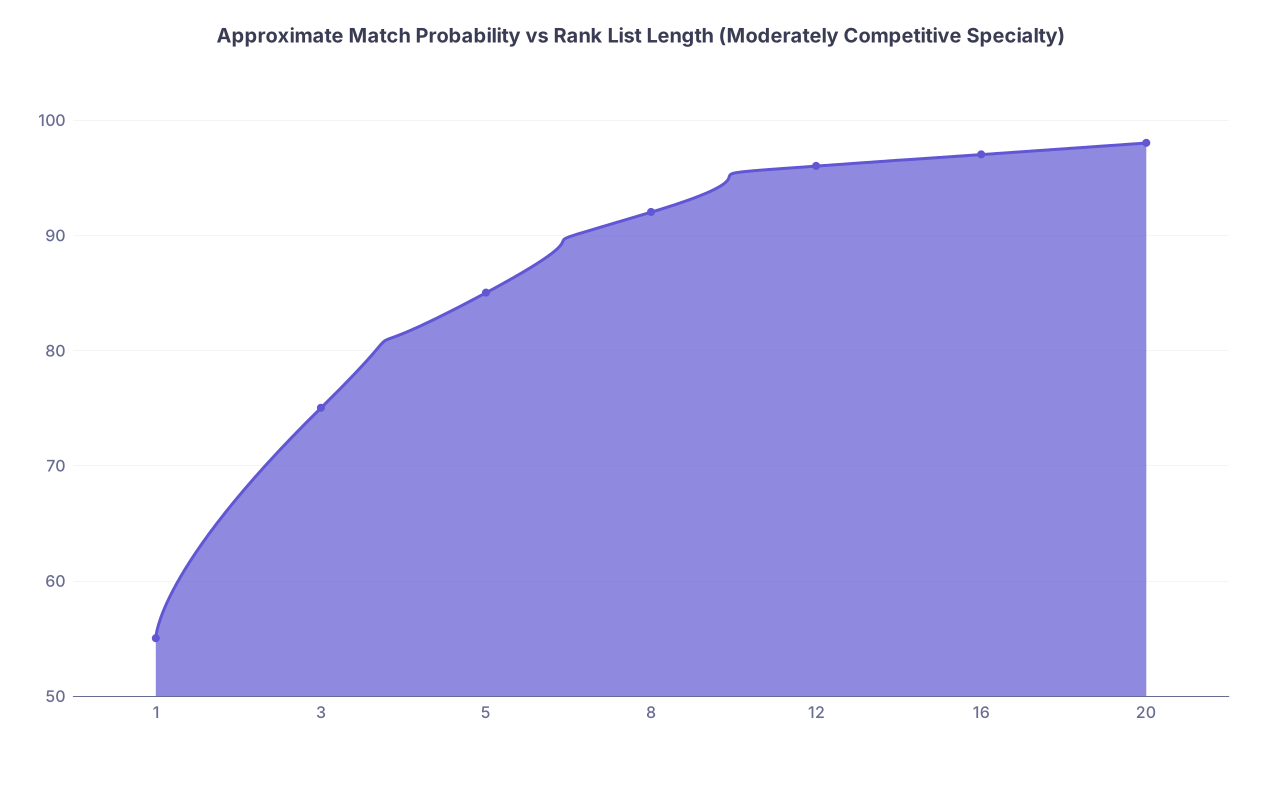
Longer rank lists, especially in competitive specialties, change the survival odds and the distribution of where you land. NRMP has repeatedly shown a simple pattern:
- Longer rank list → higher probability of matching.
- Among those who match, longer lists → more people matching in the mid to lower ranges (5–15), simply because those slots exist.
Here is a stylized approximation for probability of matching at all vs number of ranks for U.S. MD seniors applying in a moderately competitive specialty (e.g., Anesthesiology). Numbers are illustrative but aligned with NRMP curves.
| Category | Value |
|---|---|
| 1 | 55 |
| 3 | 75 |
| 5 | 85 |
| 8 | 92 |
| 12 | 96 |
| 16 | 97 |
| 20 | 98 |
That curve gets even steeper and more painful for DOs and IMGs.
What this means for “how far down”:
- If you rank 4 programs and match, you must match in the top 4. Your distribution is artificially front-loaded by construction.
- If you rank 15 programs and match, you could easily match at 12th even if you are reasonably competitive, especially in a tight specialty market.
So when someone says, “All my friends matched in their top 3,” check how many programs they ranked and which specialty. A psych applicant ranking 5 programs and matching in the top 3 is not the same world as an ortho applicant ranking 18.
Applicant type: who falls furthest down the list?
Applicant type is where the numbers get blunt.
U.S. MD seniors are the reference group. Everyone else has more risk of:
- Not matching at all.
- Matching significantly lower on their rank lists when they do match.
U.S. DO seniors
Post-merger, DOs get more access but also more competition. Pattern I keep seeing in data and post-Match surveys:
- Many DOs who match in moderately competitive specialties (Anesthesia, EM in some eras, OB/GYN) often land around #4–#10.
- The top 3 slots are frequently loaded with academic, name-brand programs that still heavily favor MDs and high Step scores.
For DOs:
- Matching in the top 3 is common in FM, Psych, IM community programs.
- Matching beyond #6 or #7 is not rare in more competitive fields.
U.S. IMGs
This group is the most misled by anecdotes. The data show:
- Fewer total interviews per applicant on average.
- Much higher proportion of “safety” and community programs on lists.
- Strong clustering of match positions in the middle of the rank list, not just the top.
It is not unusual for a U.S. IMG who matched Internal Medicine to land at position 5–12, simply because:
- #1–3 were usually aspirational university programs.
- #4–10 were a mix of community and lower-tier university-affiliated sites.
- The ones that actually ranked them high enough tended to be in that middle block.
Non-U.S. IMGs
Here the tails get very long:
- Many non-U.S. IMGs rank 15–20+ programs.
- When they match, it is often at program #8–#16 on their lists.
I have seen rank lists from non-U.S. IMGs where:
- #1–5 are all long-shot university programs.
- #6–12 are more realistic community programs.
- The final match is at #10 or #11.
Not because the algorithm pushed them down. Because those were the first programs that also wanted them strongly enough.
Myths about rank order and “gaming” the system
A lot of bad rank advice comes from misunderstanding the data.
Let me be blunt about a few common myths:
“Rank where you think you will get in higher than your true favorite.”
Statistically wrong. The algorithm is applicant-proposing. Your best expected outcome comes from ranking in true preference order, always. Any attempt to game “chances” by reordering only increases the probability you end up at a less-preferred program.“If I rank a program low, they will see it and not rank me.”
False. Programs never see your rank list. They only see whether you matched there at the end.“Ranking more programs will drop me further down.”
Also wrong. Extra programs at the bottom can only help. If a program is truly unacceptable, do not rank it. But anything you could live with belongs on the list. The “I do not want to match low” logic is an emotional reaction, not a statistical one.“Everyone good matches in their top 3.”
The data say no. Strong applicants in competitive specialties routinely match at #4–#8 because their lists are stacked with powerhouse programs and the field is saturated.
What the data imply for your ranking strategy
Now to the practical side: how you use this to build and order your rank list.
1. Accept that “top 3 or bust” is fantasy
The numbers:
- Roughly 70–80% of U.S. MD seniors → top 3.
- Lower for DOs and IMGs.
- Much lower for very competitive specialties.
So if you get 12 interviews in Ortho and they are all decent programs, you should expect a very real chance of matching at #6–#10. That is not failure. That is how tight fields behave.
2. You need enough ranks to have a tail
If your personal “doable” threshold is “I can live with anything in my top 10,” but you only rank 7 programs, you are literally not giving yourself a chance to match at #8–#10.
For most U.S. MD seniors in moderate-competitive specialties:
- 10–12 ranks is a very safe zone for “high likelihood of matching somewhere.”
For DOs and IMGs:
- 12–15+ ranks in IM/FM/Peds are common.
- In highly competitive specialties, many need 15–20 combined categorical/prelim/TY options.
3. Build your list with tiers, not with a fragile top 3
A sensible rank list often looks like this:
- Tier 1: Dream (maybe 2–4 programs): big-name, top geography, heavy competition.
- Tier 2: Strong fits (4–10 programs): solid training, reasonable geography, realistic chances.
- Tier 3: Safety/acceptable (the rest): places you could genuinely attend without regretting matching.
Your actual matched position will typically fall somewhere in Tier 2 or the upper half of Tier 3, especially if you are not in the absolute top of the applicant pool.
If your Tier 2 is thin or non-existent—just “all reach, then all back-up”—expect more volatility in where you land.
Emotional vs statistical reaction to matching “low”
Here is the part nobody says out loud.
If you match at #8, you will feel like you “barely matched.” Especially if everyone on social media posts “Matched at my #1!” with confetti.
But the data say:
- You may actually be in a completely normal band for your specialty and applicant type.
- In competitive fields, matching anywhere on your list is already a strong outcome.
- Your PGY-3 self will rarely care that you ranked that program #8 when you listed it.
I have watched residents who matched at #9 become chief, match top fellowships, and outcompete people who matched at their #1 “dream” program. The rank number is not destiny. It is just where the algorithm found the first stable pair.
Interpreting your own likely match position
You can roughly estimate how “far down” you should expect to land by factoring in four variables:
Specialty competitiveness
More competitive → expect a wider spread and deeper matches.Applicant type and strength
U.S. MD vs DO vs IMG. Step scores, research, AOA, red flags. Stronger = more front-loaded.Number of interviews and rank length
More interviews → longer list → more room to match beyond top 5–7.How aggressively top-heavy your preferences are
If your top 6 are all elite academic programs and the rest are “backup,” you have essentially created two distributions on one list: a risky top segment and a more realistic lower segment.
You will not pin it down to an exact expected rank position. But you can get a sanity range:
- U.S. MD, solid applicant, Anesthesia, 14 interviews → likely match around #1–#6, but #7–#10 is very plausible.
- U.S. IMG, decent scores, IM, 18 interviews → likely match around #4–#12 if matched.
- Non-U.S. IMG, borderline scores, FM, 20+ interviews → extremely long tail; matching at #10–#18 is not surprising.
Final takeaways
Three things the data keep repeating:
- The distribution is front-loaded, but not magical. Many solid applicants in competitive specialties land between ranks 4 and 10. That is normal, not a failure.
- Longer rank lists dramatically increase your chance of matching somewhere. They also naturally increase the probability you match further down your list. That is a feature, not a bug.
- You should always rank in true preference order and include every program where you could honestly work. The algorithm is on your side. The only person who can sabotage it is you, by trying to game it.


