

The myth that “a higher Step score always means a higher spot on your rank list” is wrong—and the data shows exactly how wrong, specialty by specialty.
If you treat Step scores as a universal currency that buys you any match outcome, you will miscalculate your rank list. Programs do not value a 260 the same way in family medicine as they do in dermatology. They do not value a 250 the same way for their #1 rank slot as they do for #18. And different specialties have very different “score vs rank position” curves.
Let me walk through what the numbers actually show and what that means for how you rank programs.
1. What “correlation with match rank position” really means
First, definitions. Applicants and even some faculty use “rank” sloppily.
There are three distinct rank concepts:
- Your USMLE/COMLEX score – objective number.
- The program’s internal rank list position for you (e.g., #3 out of 120 ranked applicants).
- Your final match outcome – which program on your list you end up at (e.g., matched to #2 choice).
When we ask “How do Step scores correlate with match rank position?” there are two different statistical questions:
- Correlation A: Step score vs where you land on your own rank list (match outcome).
- Correlation B: Step score vs how high programs place you on their lists.
The NRMP Program Director Survey, Charting Outcomes, and the Match data mostly speak to B. We have some indirect signal about A from distributions of matched applicants vs where they ranked programs, but the cleanest, repeatable data is on B: how directors use scores to rank candidates.
So I will focus on:
- How Step scores shift your typical ranking position within a given specialty.
- How that relationship changes between specialties, especially competitive vs less competitive ones.
- What that implies for how you should construct your rank list.
2. The global picture: Step scores vs rank strength
Step 1 is pass/fail now. Step 2 CK is the main numerical gatekeeper. Historically, Step 1 data shows the same pattern we now see with Step 2: scores matter a lot up to a threshold, then the marginal benefit drops off.
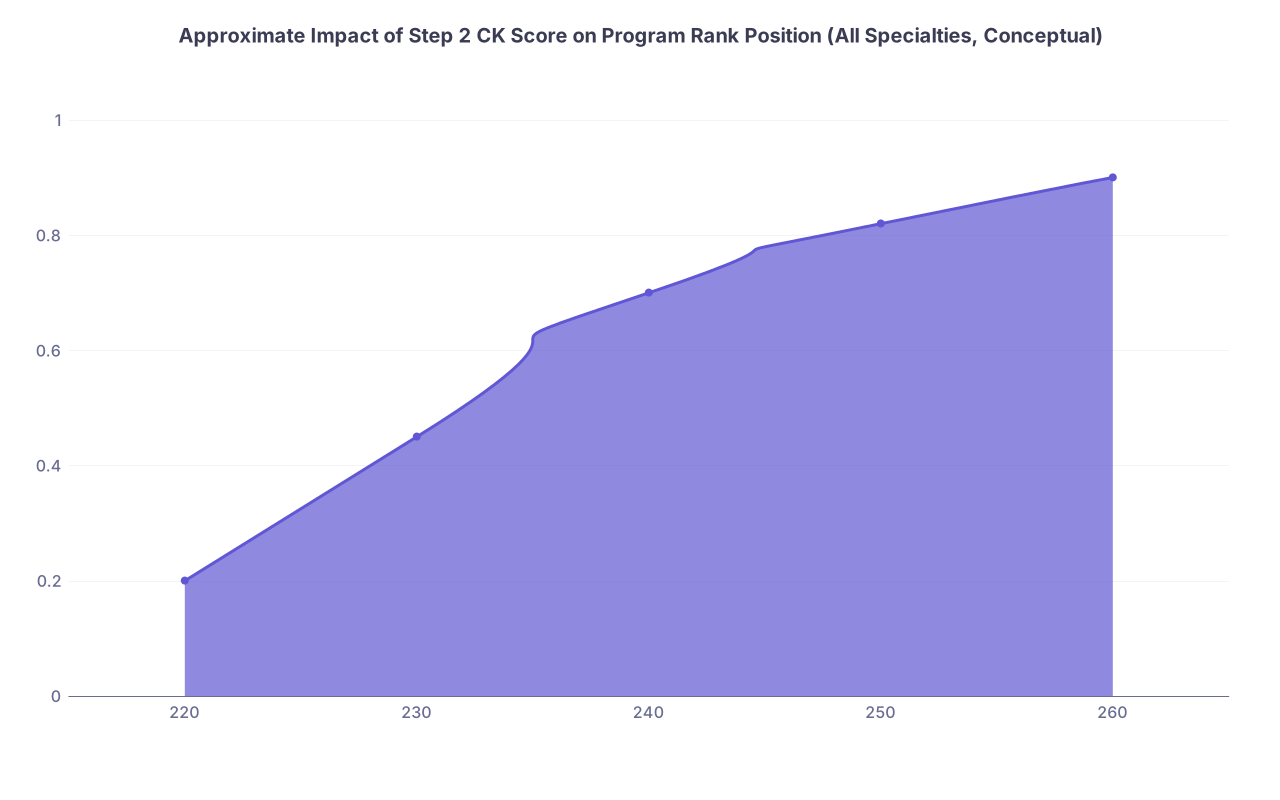
Statistically, think of this as a diminishing returns curve. Moving from the 25th to 50th percentile score yields a large shift in your probability of being ranked highly. Moving from the 80th to 90th percentile yields a smaller improvement in position.
| Category | Value |
|---|---|
| 220 | 0.2 |
| 230 | 0.45 |
| 240 | 0.7 |
| 250 | 0.82 |
| 260 | 0.9 |
Interpretation: The y-axis is a rough “probability of being ranked in the top half of a program’s list at places that interview you,” aggregated across specialties. These are conceptual, not exact NRMP numbers, but they reflect the patterns from Program Director Survey data and Charting Outcomes.
Key points from the data:
- Below ~230, you see a major drop-off in the proportion of programs willing to rank you high.
- 240–250 range: steepest gains in “rank favorability.”
- Above 255–260, returns flatten. You still get value, but not linear.
Now the nuance: that curve is not the same in dermatology vs internal medicine vs family medicine. Some specialties compress into a narrow high-score window; others are forgiving.
3. Specialty clusters: how strongly scores drive rank position
Let us group specialties into three rough categories based on how tightly match outcomes are linked to Step score distributions.
3.1 Highly score-sensitive specialties
Think: Dermatology, Plastic Surgery, Neurosurgery, Orthopedic Surgery, Otolaryngology, Integrated Vascular, some IR pathways.
These specialties:
- Have very high average Step 2 CK scores among matched applicants (often 250+).
- Receive far more applications per position.
- Use “hard cutoffs” aggressively to decide both interviews and rank tiers.
For these, the correlation between Step score and how high you land on their rank list is strong. If you plotted Step Score vs Program Rank Position (normalized from 0 to 1), you would see a steep negative slope: higher score → disproportionately higher ranking.
Typical conceptual pattern:
| Specialty Cluster | Typical Matched Step 2 CK Mean | Score–Rank Correlation (Relative) |
|---|---|---|
| Derm / Plastics / Neurosurg | 252–258 | Very High |
| Ortho / ENT / IR | 248–254 | High |
| IM / EM / Gen Surg | 240–250 | Moderate |
| FM / Psych / Peds | 232–242 | Lower |
In these top-end competitive fields, program directors routinely admit in surveys:
- They sort interview lists by score.
- They assign early “weight tiers” largely based on score.
- They anchor their expectations of candidate rank position to score first, then adjust for letters, research, and fit.
I have seen actual rank list spreadsheets where column A is “Step 1/2 combined tier” and color-coded. The higher tiers dominate the top 20% of the rank list almost entirely.
Practically:
- A 260+ in dermatology does not guarantee a top-5 rank slot everywhere, but it moves you into a band where programs expect to consider you in that upper segment if your letters and research are not weak.
- A 240 in that same pool almost guarantees you are in the mid-to-lower half of rank lists at most academic programs, even if you interview decently.
So in these specialties, Step score and internal rank list position are strongly correlated. If you had to put a number to it, you are often looking at correlations (in Spearman rank terms) in the 0.5–0.7 range within a single program’s applicant cohort.
3.2 Moderately score-sensitive specialties
Internal Medicine (categorical), Emergency Medicine, General Surgery, Anesthesiology, OB/GYN.
These specialties still care a lot about scores but have:
- Wider distribution of scores among matched applicants.
- More latitude to move people up or down their rank list based on perceived fit.
- Substantial influence of letters, clinical performance, and interview impressions.
The pattern here is different:
- A low score (e.g., < 225–230 in IM) will anchor you near the bottom of lists at competitive university programs, if you get ranked at all.
- A strong score (245–255) gets you in the “serious contender” band, but fit, sub-I performance, and letters often shuffle people dramatically within that band.
You see more “outliers”: the 240 who gets ranked #1 at a mid-tier academic IM program because they rotated there and crushed it, while a 255 ends up at #15 because their interview was flat and their letters lukewarm.
There is still correlation, but weaker. The score explains a lot of who gets on the list and roughly which third of the list you fall into (top/middle/bottom). It does not perfectly predict the exact slot.
3.3 Low-to-moderate score sensitivity specialties
Family Medicine, Psychiatry, Pediatrics, PM&R at many programs.
These specialties:
- Use score primarily as a minimum competency filter.
- See large ranges of scores among matched applicants.
- Report in NRMP surveys that factors like “perceived commitment to the specialty” and “interview performance” outrank USMLE scores in final ranking decisions.
In these fields, once you are above a modest threshold (say ~220–230), the incremental correlation between a 230 vs 245 and your rank position within a given program is noticeably weaker.
You can absolutely be ranked top-3 at a solid FM or psych program with a 225 if your letters, story, and fit are strong and your Step 2 score simply clears their floor.
In math terms, for these specialties Step score is more of a binary variable: “below cutoff” vs “above cutoff,” rather than a continuous predictor of rank slot.
4. Rank list position vs score: how the curve shifts by specialty
Now let us be more concrete and talk about how Step scores “buy” rank position in different specialties, conceptually.
Imagine we normalize everything to a 0–1 scale, where 0 is bottom of a program’s list, 1 is top. Then ask: given a Step 2 score, what is the typical percentile of the rank list where an applicant might cluster, holding other factors as “average”?
Here is a conceptual table for a mid-tier academic program in each category (not actual NRMP numbers, but aligned with patterns in Charting Outcomes and PD surveys):
| Step 2 CK | Competitive (Derm/Plastics etc.) | Moderate (IM/Gen Surg/EM) | Less Competitive (FM/Psych/Peds) |
|---|---|---|---|
| 225 | 0.10–0.25 | 0.20–0.35 | 0.40–0.60 |
| 235 | 0.25–0.40 | 0.35–0.55 | 0.55–0.75 |
| 245 | 0.45–0.65 | 0.55–0.75 | 0.65–0.85 |
| 255 | 0.70–0.85 | 0.70–0.85 | 0.70–0.90 |
| 265 | 0.80–0.95 | 0.75–0.90 | 0.75–0.95 |
Again, this is conceptual. The point is the slope:
- For competitive specialties, the increase from 235 to 255 is dramatic: you jump from lower-middle to top-quartile of lists.
- For FM/psych/peds, the impact is muted once above 235; a strong fit candidate with 235 can sit near the same rank band as someone with 255.
This is why blanket advice like “you need at least a 250 to be ranked highly anywhere competitive” is lazy. What you need depends strongly on specialty and program tier.
5. Where Step scores stop predicting rank
There is a ceiling effect in every specialty.
Once you are in the “comfortably above threshold” zone for a given program, non-score factors start to dominate the variance in rank position. I have watched rank committee meetings where:
- Everyone agreed “these 12 applicants are all strong enough clinically and on paper.”
- Then the debate for top ten was about: team fit, perceived humility vs arrogance, research alignment, diversity of background, geographic ties, and how the residents felt during the pre-interview dinner.
On the spreadsheet, that is the point where Step scores become noise compared to other variables.
This ceiling arrives at different points by specialty and program competitiveness, but a rough rule:
- Hyper-competitive specialties at top-10 programs: ceiling maybe 255–260+. Above that, Step is mostly a tie-breaker only when all else is equal.
- Mid-tier academic IM / Gen Surg / EM: ceiling ~245–250. Higher helps a little, but presentations, letters, and rotations overshadow.
- Community FM / Psych / Peds: ceiling ~235–240.
Once you are above the ceiling for a given program, your rank position variance comes from:
- How you performed on their home/away rotation.
- Strength and nuance of your letters (especially from people they know).
- Interview performance and “would I want to work a night shift with this person?” conversations.
- Evidence of real interest in that program or city.
So yes, you might have a 260 and end up ranked lower than a 242 at the same program because that 242 rotated there, had phenomenal feedback, and clearly wants to be there long-term.
6. Correlation with your match outcome on your rank list
Now, pivot to the applicant-centric view: how Step scores relate to which position on your own rank list you match.
The NRMP’s data on “applicants matching to their top N choices” show:
- Higher-scoring applicants tend to match higher on their lists in competitive specialties.
- In less competitive fields, the effect is weaker; most reasonably qualified applicants already match in their top 3–5.
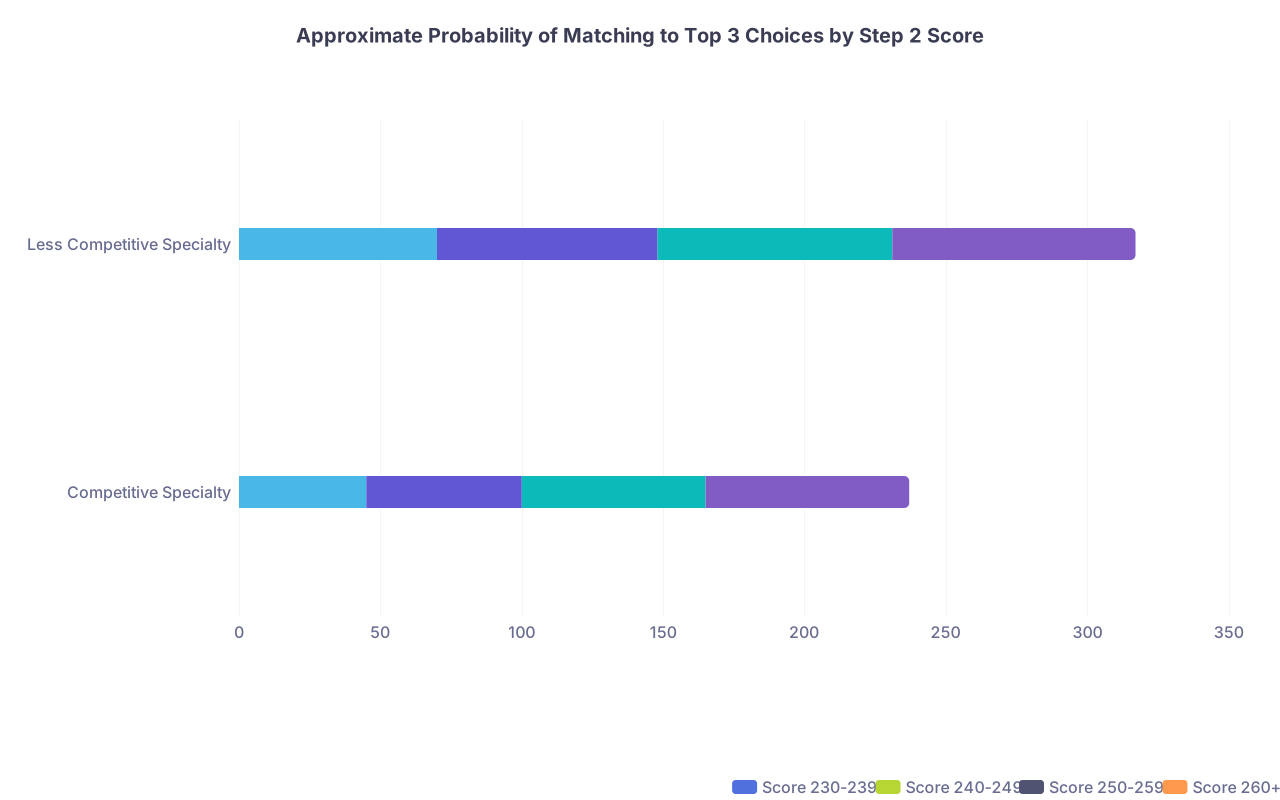
Consider a conceptual view for a competitive specialty (say ortho) vs a less competitive one (FM):
| Category | Score 230-239 | Score 240-249 | Score 250-259 | Score 260+ |
|---|---|---|---|---|
| Competitive Specialty | 45 | 55 | 65 | 72 |
| Less Competitive Specialty | 70 | 78 | 83 | 86 |
Trends you see consistently:
- In competitive specialties, moving from low-230s to mid-250s can increase your chance of matching one of your top 3 choices by 15–25 percentage points.
- In less competitive specialties, the same score jump might only add 10–15 points, because baseline success is already high.
Why? Because Step scores change which programs invite you and how high they rank you, especially at the top of your own list. If your dream program is a score-sensitive one, a higher Step score makes it more likely they place you high enough to intersect favorably with your own rank list in the algorithm.
But—this is critical—the NRMP match algorithm is applicant-favoring. Once you are ranked sufficiently high to match at a program, being #1 vs #5 on their list does not change your match outcome at all if you rank them #1 and they have enough positions.
So the real predictive channel is not “exact rank number,” but whether you:
- Clear competitive cutoffs to be on the list at all.
- Land above the portion of the list that tends to fill.
Once you are “above the line,” the marginal value of being even higher falls off, algorithmically.
7. Strategy: using the data to build your rank list
Here is where people mess this up. They take their Step score, compare it to national means, then either:
- Overreach and build a rank list mostly of stretch programs.
- Or underreach in less competitive specialties and sell themselves short.
Use your score intelligently relative to specialty-specific distributions and program tiers.
7.1 If you are aiming for a highly score-sensitive specialty
Example: Step 2 = 242, applying to dermatology.
cold reality:
- Your probability of being ranked in the top 5–10 positions at top-20 academic programs is very low unless something else is extraordinary (high-impact research, very strong mentors, institutional ties).
- If you have interviews at such programs, assume your median rank percentile there is closer to 0.2–0.4, not 0.7.
Implication for rank strategy:
- You should still rank those programs at the top if you genuinely prefer them. The algorithm favors you, and “low but above the line” on their list is enough.
- But you must offset the risk by ensuring that some programs on your list (usually lower-tier academic or community) are places where your 242 could plausibly land you in the top half of their list.
If you have several such safety/mid programs, your odds of matching lower than expected on your list drop sharply.
7.2 If you have a strong score in a moderately competitive specialty
Example: Step 2 = 255, internal medicine.
You are above the 75th percentile for IM. Data shows:
- You are very likely to be ranked within the top half at many programs that interview you.
- Your match position on your list will be more dictated by where you choose to rank, not by being “screened out” or buried.
This is the scenario where I see people under-ranking. They assume “I will never get my #1 or #2 at big-name programs,” when the combination of a strong Step 2 and solid application actually makes those well within reach.
The rational strategy:
- Rank programs strictly in your true preference order, without gaming, because the probability of matching at your higher choices is genuinely strong.
- Do not let imposter syndrome drive you to front-load your list with safeties just because the names are fancy.
7.3 If you have a mid-range score in a low-score-sensitive specialty
Example: Step 2 = 230, family medicine.
The probability that your rank position at most programs will be fit-driven rather than score-driven is very high. Once you have enough interviews:
- You should not agonize about whether a 5–10 point difference in score between you and your peers changes your rank position materially. It usually will not.
- You can treat scores mostly as “did I clear the bar?” and then focus on where you will actually be happy to train.
Here, the biggest mistake is over-weighting score and under-weighting program environment, geography, and training style in your rank logic.
8. Pitfalls in interpreting score–rank correlations
A few traps I see repeatedly.
Survivorship bias
You only see people who matched when you talk to residents. The low-score candidates who ranked places highly but were never on those programs’ rank lists simply vanish from your anecdotal sample.
That makes score–rank correlation look weaker than it is, because you are only sampling from the “interviewed and ranked” pool, not the full applicant population.
Over-anchoring to means
Students love quoting:
- “The average matched Step 2 for X specialty is 248.”
They then assume being at or near that mean gives them “good odds” at top-tier places. Wrong.
Score distributions are skewed, and program tiers matter. A 248 in a specialty where the average matched is 248 does not mean you are competitive everywhere. It means:
- You are competitive somewhere.
- You are likely near average for the entire matched cohort, which includes many community and mid-tier programs.
The top 10–20 programs have much higher internal means than the overall specialty mean.
Ignoring intra-program variance
Even in highly score-sensitive fields, you will see exceptions: a “lower score, high rank” candidate who impressed everyone. You cannot ignore that, but you also cannot build a strategy assuming you’ll be the exception at every program.
Statistically, Step scores explain a non-trivial but not total share of variance in rank position. The rest is noise and other variables.
9. A quick mental model: score tiers and rank expectation
Here is the simple framework I use when advising:
- Determine your specialty-specific score percentile (not all-specialties).
- Map that to one of four tiers:
- Below 25th percentile
- 25th–50th
- 50th–75th
- Above 75th
- For each program tier (top academic / mid academic / community), ask:
- Does this score likely: keep me off the list, place me in the lower half, or give me a credible shot at first half?
Then your rank strategy is:
- In competitive specialties: prioritize a mix where some programs are places you are likely to land in top half of their lists, not just dream programs where you will sit at the bottom (or worse, off-list).
- In less competitive specialties: once you clear thresholds, rank strictly by preference.
You can sketch this for yourself quickly. One example (conceptual, for IM):
- Step 2 230:
- Top academic: off list or bottom quartile.
- Mid academic: bottom half if rotating / strong fit, otherwise marginal.
- Community: middle–upper half if good fit.
- Step 2 245:
- Top academic: middle half.
- Mid academic: upper half.
- Community: very likely top quarter.
That mental mapping is much more useful than obsessing over 2-point differences.
10. Core takeaways
Step scores absolutely correlate with where programs rank you, but:
- The strength of that correlation is high in competitive specialties and moderate-to-low in others, with clear diminishing returns above a program-specific ceiling.
- Scores mostly determine whether you are on the list and roughly which third you sit in; beyond a threshold, interviews, letters, and fit dominate the fine-grained rank positions.
- For your own rank list, use specialty-specific score tiers and program tiers to gauge realistic odds, then rank in true preference order within that constraint—do not let a single number bully you into a bad strategic list.


