

The biggest mistake dual‑applicants make is treating overlapping specialty applications like a vibes-based decision instead of a probability problem.
You are not “following your heart.” You are managing two correlated, constrained lotteries under rigid NRMP rules. If you do not quantify the risk and structure your rank list accordingly, the data shows you will almost certainly underperform your true match potential—either by not matching at all or by landing far below your realistic ceiling.
Let me walk through how overlapping specialty applications actually reshape your rank strategy, not how people wish they did.
1. The Hard Rules: What The NRMP Algorithm Actually Cares About
Start with the non-negotiables.
The NRMP algorithm is applicant-proposing. That means it tries, in order, to place you into the highest-ranked program on your list that also wants you. It does not:
- “Balance” your interests between specialties.
- Try to maximize your happiness across options.
- “Save” you from a risky strategy.
It only knows: your single ordered list of programs, nothing about your internal specialty preferences.
Once you submit your rank list, three facts govern everything:
- You can only submit one combined rank list (even if you applied to overlapping specialties).
- The algorithm assumes your #1 choice is absolutely preferred over #2, #2 over #3, etc., regardless of specialty.
- It does not stop early because you have an “acceptable backup.” It keeps going until you are matched or run out of ranks.
So if you rank:
- Derm Program A
- Derm Program B
- Internal Medicine Program C
- Derm Program D
The algorithm assumes you would prefer IM C over Derm D. Even if that is not truly how you feel. And it will happily match you to IM C and never even “look at” Derm D.
This is where overlapping specialty applications blow up otherwise solid strategies: people create preference orders that do not match their true utilities.
2. Quantifying Dual-Application Risk: How Often Do People Not Match?
People hand-wave “I’ll apply to both, it’ll be fine.” The numbers say otherwise.
Look at NRMP’s Charting Outcomes and Program Director Surveys (latest data available). For the most competitive specialties—say, dermatology, plastic surgery, neurosurgery, ortho, ENT—unmatched rates even among U.S. MD seniors are non-trivial.
For illustration, think U.S. MD seniors with competitive but not elite profiles:
- Step 2 CK ~245–250
- Top 1/3 of class
- Decent research in the target field
Historically, unmatched rates for these “aspirational but not elite” applicants in very competitive specialties have hovered roughly in the 20–35% range depending on year and specialty.
By contrast, categorical Internal Medicine, Family Medicine, and Pediatrics match rates for comparable U.S. MD seniors often exceed 95%.
So the dual-application setup often looks like this:
- Primary specialty: 70–80% match probability
- Backup specialty: 95–99% match probability
The trap is simple: people behave as if they have “combined safety.” They think:
“I am applying to 30 derm programs and 20 medicine programs—I must be safe now.”
No. What you actually did is create three distinct probability states:
- Match primary (Derm): p ≈ 0.7–0.8
- Fail primary, match backup (IM): p ≈ 0.2–0.3 × 0.95+
- Fail both (unmatched): residual probability
And your rank list design determines how much probability mass you assign to each outcome, not just your application volume.
3. How Overlap Changes Your Rank List Math
Let us make this concrete. Imagine a U.S. MD senior applying to both Dermatology and Internal Medicine.
Assumptions (rough but realistic):
- Probability of matching somewhere in Derm if you rank 15+ programs: 70%
- Probability of matching somewhere in IM with 12+ ranks: 98%
- Joint probability of being shut out of both: low but not zero; let us call it 3–5% for a borderline applicant who has some red flags.
Here is the key: the algorithm does not care about your “overall chance of matching something.” It cares about the sequential process defined by your list.
Two extreme strategies:
Derm-first list
- Rank all Derm programs first (say, 18 of them)
- Then rank 12 IM programs
Mixed-priority list
- Rank a few “dream Derm” first
- Insert “solid IM” in the middle
- Then more Derm
- Then leftover IM
In strategy #1, your path is clean:
- If any Derm program you ranked wants you enough at any position, you match Derm.
- If no Derm program is high enough on their lists for you, you roll down to IM and match there with very high probability.
Your outcome distribution approximates:
- ~70% Derm
- ~27% IM backup
- ~3% unmatched
Strategy #2 is where people sabotage themselves.
Imagine this mixed order:
1–5: Top derms
6–10: IM programs in major cities
11–18: Mid/lower-tier derms
19–24: Remaining IM programs
Now imagine a scenario the data says is pretty common: top derms pass on you, mid/lower derms would happily take you, and IM would also take you.
What happens?
- Algorithm tries 1–5 (derm): all full, or you are ranked too low → no match yet.
- It hits 6–10 (IM): Program 7 has you high enough → you match there as a PGY‑1.
- The algorithm stops. It never reaches 11–18 (the derm programs where you might actually have matched).
Your effective probabilities might end up closer to:
- 40–50% Derm (since some matches will occur in ranks 1–5)
- 45–55% IM (because IM jumps in before your realistic derms)
- 3–5% unmatched
You essentially tax your derm chances to guarantee a slightly earlier “safety net” that you probably do not need.
4. When Overlapping Applications Help vs Hurt
Overlapping applications are not inherently good or bad. The effect size depends on three variables:
- Competitiveness gap between specialties
- Your personal preference gap between them
- How correlated your interview success is between the two
The data pattern I keep seeing:
- If your primary is very competitive (e.g., Derm, Ortho, ENT, Plastics, Neurosurgery)
- Your backup is significantly less competitive (IM, Peds, FM, Neuro, Psych)
- Your preference gap is large (you would much rather do derm than IM)
Then overlapping applications help only if your rank list is strictly tiered: all primary first, then backup.
Where they hurt:
- You start mixing lower-tier primary with high-tier backup based on location or perceived prestige.
- You allow “city preference” to override specialty preference in the rank order.
That is exactly how people who “really wanted derm” end up in medicine at a mid-tier big-city program, instead of derm at a solid regional program that they would have preferred in hindsight.
5. Structuring a Rational Rank List with Two Specialties
You can treat this as a constrained optimization problem. Two objectives:
- Maximize probability of matching in your true preferred specialty.
- Keep overall unmatched risk below your personal threshold.
If we strip out the emotion, a rational strategy usually looks like this:
Step 1: Define your true utility order by specialty first, not by name or location.
Ask: “All else equal, would I rather be a dermatologist in a B‑minus city or a general internist in an A‑plus city?” You need a binary decision here.
Step 2: Split your interviews into buckets:
- Bucket A: Primary specialty (e.g., Derm)
- Bucket B: Backup specialty (e.g., IM)
Step 3: Estimate match probability per bucket.
Rule of thumb from NRMP tables:
- If you are a U.S. MD senior with ≥ 10–12 ranks in a less competitive specialty (IM, FM, Peds, Psych), your match probability is typically >95%.
- For competitive specialties, the “plateau” is more like 15–20 ranks, and even then you may sit at 60–80%.
Step 4: Decide a risk tolerance.
Examples:
- Risk-averse: Will not accept >3–5% chance of going unmatched.
- Moderate: Can tolerate 5–10% risk.
- High-risk: Will accept >10% unmatched risk for a specialty shot.
Step 5: Build the list.
For most dual-applicants with a clear primary preference and a reasonable number of interviews, the clean structure is:
- Rank every program in your primary specialty above every program in your backup, regardless of city, prestige, or gossip.
- Then rank all backup programs after that.
You can adjust only if:
- Your derm (or other primary) interview count is very low (e.g., <8).
- Your backup interviews are plentiful (e.g., >15).
- Your risk tolerance is very low.
In those edge cases, I have seen a hybrid strategy where:
- Top X derm programs go first (your true dream tier),
- Followed by a subset of “can’t miss” backup programs (e.g., home IM, geographically critical locations),
- Then remaining derm,
- Then remaining backup.
But understand: the moment you insert backup above realistic primary options, you are explicitly trading away some probability of matching into your primary field. That is not a neutral choice.
6. Overlap, Geography, and Prestige: Where People Misread the Data
Here is where emotions wreck the math.
I have seen rank lists like:
1–3: Derm in major coastal cities
4–7: Big-name IM programs in same cities
8–15: Solid derm in mid-size or less “sexy” cities
16–22: Remaining IM backups
When you interrogate the applicant, their true preference is:
- Any derm > any IM.
- But they feel pressure about “brand name” and not wanting to “waste” their academic pedigree on a smaller market.
The algorithm will call their bluff.
In practice, this list produces a lot of IM matches at ranks 4–7, bypassing realistic derm opportunities at ranks 8–15.
If you really mean “any derm > any IM,” the list should be:
1–10ish: All derm programs (ordered by your true derm preference)
11–22: All IM programs
If you do not structure it this way, you are lying to the algorithm about your actual preferences, and it will believe you.
The data is merciless here: NRMP modeling shows that the applicant-proposing algorithm is strategy-proof only if your rank list accurately reflects your real preference order. Once you start playing games (location-first, prestige-first, friends-first), you reduce your own expected outcome quality.
7. Special Case: Categorical vs Advanced Programs (Prelim Years and Overlap)
Overlapping specialties interacts in a messy way with advanced programs (e.g., Radiology, Anesthesiology, Derm, PM&R) that start at PGY‑2 and require you to separately rank prelim or transitional years.
Now you effectively have two coupled rank problems:
- Your specialty (advanced) rank list
- Your base/prelim year rank list
You might also be applying to a categorical backup (e.g., IM categorical) that does not need a separate prelim.
Common scenario:
- Applicant applies to Derm (advanced) + IM categorical.
- They also apply to a pile of prelim IM and TY programs.
- They get: 8 Derm interviews, 10 IM categorical interviews, 12 prelim/TY interviews.
If they are not careful, they create rank lists that look like a plate of spaghetti. Which leads to:
- Matched to IM categorical at mid-tier program they ranked around #15 overall.
- Never considered for realistic derm + prelim combos that were ranked below.
The numerically clean approach:
- Rank all derm advanced programs in their true derm order.
- For each, create rank pairs with acceptable prelim/TY programs.
- Only after exhausting your true derm/prelim combinations, start listing IM categorical programs in your true IM order.
- Then, finally, any standalone prelims you would accept without advanced spot (if you are willing to scramble into PGY‑2 later).
This keeps your probability mass concentrated where you actually want to be: derm + prelim > IM categorical > orphan prelim.
8. Red Flags, USMLE Scores, and How They Change the Overlap Equation
Numbers matter. A lot.
If your Step 2 CK is below the mean for your primary specialty by 10–15 points (for competitive fields), the probability curves shift:
- Top-tier primary programs: near-zero probability
- Mid-tier: maybe 10–20% per program
- Lower-tier: 20–40% per program if you have strong other factors
Now your overall primary match probability might be closer to 30–40% even with a solid number of interviews.
In that setting, overlapping applications amplify risk if you insist on putting backup programs too low out of pride. I have seen the opposite mistake of earlier examples:
- Applicant terrified of IM “backup” label.
- Ranks all derm first (including very unrealistic long shots).
- Ranks only a handful of IM programs at the very bottom.
- Ends up completely unmatched despite having had IM interviews that, realistically, would have taken them quite high.
Here, a rational setup might be:
- Tier 1–2 derm (places where you actually are competitive)
- Then a block of IM programs where PDs showed real interest or where you have strong ties
- Then the remaining derm long shots
- Then remaining IM
You are explicitly saying: “I want a shot at realistic derm, but if it is not happening, I would rather match a strong IM program than roll the dice on a bunch of derm reaches and end up unmatched.”
Again, the numbers have to drive the structure, not your ego.
9. Practical Workflow: How To Build a Data-Driven Dual-Specialty Rank List
Here is a simple, concrete method I have used with residents and MS4s in this dilemma.
Step 1: Make two separate lists first.
- A: All programs in Specialty 1, ranked only against each other.
- B: All programs in Specialty 2, ranked only against each other.
Step 2: Assign each program a simple score.
Out of 10, based on your personal utility:
- 10 = Dream scenario
- 8–9 = Very happy
- 6–7 = Acceptable, would not regret
- ≤5 = Only if absolutely necessary (and you should ask why it is even on the list)
Do this separately for each specialty.
Step 3: Overlay realistic match probability.
For each program, in a rough way:
- High likelihood
- Medium
- Long shot
Not perfect. But far better than guessing. Base this on:
- Interview vibe (explicit PD interest vs generic day)
- Your scores vs their published or known ranges
- Your connections / home vs away status
- Previous matches from your school
Step 4: Decide your minimum acceptable outcome.
For example:
- “I would rather go unmatched than do FM in this one specific program.”
- Or: “Any IM in my home region is preferable to derm in a specific undesirable location.”
Be honest. This defines where backup programs can logically jump over primary ones.
Step 5: Merge.
Start at the top and ask, pairwise:
“Would I rather be at my #1 derm or my #1 IM?”
Keep going down. Where you flip answers, you have found the cross-over where backup begins to exceed primary for you. That is the point where backup programs can start appearing on the list before remaining primary programs.
If, for you, the answer is “any derm > any IM,” then the merge is trivial: all derm first, then all IM.
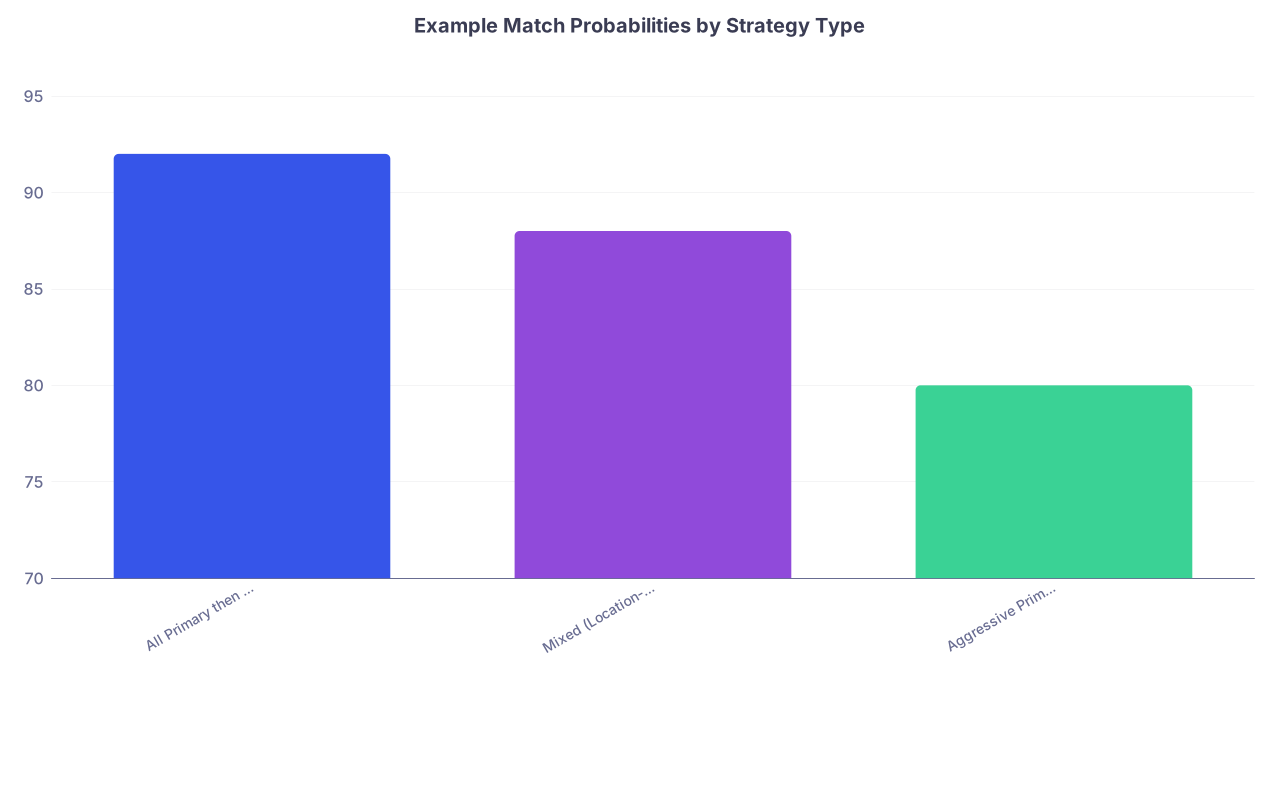
| Category | Value |
|---|---|
| All Primary then Backup | 92 |
| Mixed (Location-Priority) | 88 |
| Aggressive Primary, Sparse Backup | 80 |

| Step | Description |
|---|---|
| Step 1 | List all programs by specialty |
| Step 2 | Rank within each specialty |
| Step 3 | Score preference and competitiveness |
| Step 4 | Place all primary above all backup |
| Step 5 | Identify cross-over programs |
| Step 6 | Interleave select backup above lower-tier primary |
| Step 7 | Submit final combined list |
| Step 8 | Is primary >> backup? |

10. Common Dual-Application Myths (And Why They’re Wrong)
Let me be blunt about some persistent bad ideas.
“Ranking a program lower hurts my chances there.”
False. The algorithm does not see each program’s position in isolation. Your position on their list is what matters, not the other way around. Ranking a highly competitive derm program #3 instead of #1 does not change whether they rank you high enough.
“I should mix specialties to show I’m ‘realistic’.”
NRMP never shows programs your full list. They do not see where you ranked other programs or specialties. There is no signaling benefit to mixing.
“If I put all derm first, I’ll lose my IM chances.”
Only if you do not rank IM at all or you rank an absurdly small number of IM options. Otherwise, your IM chances remain almost entirely driven by how competitive you are for those IM programs, not where they appear relative to derm.
“Location should drive everything.”
Location matters. But your core tradeoff is specialty vs city vs program culture. If you let “NYC or bust” drive you into a specialty you like far less, that is a values decision, not a data-driven one. Just be honest with yourself.

FAQ (5 Questions)
1. If I apply to two specialties, should I always rank all programs in my preferred specialty above my backup?
If you genuinely prefer any program in your primary specialty over any program in your backup, then yes—rank every primary program above every backup program. That maximizes your chance of landing in the field you actually want. The only reason to break this rule is if there are specific backup programs that you honestly value more than some lower-tier primary options due to geography, family, or program culture.
2. Does mixing primary and backup specialties on my rank list increase my overall chance of matching?
Usually not. Your match probability is primarily driven by how many interview offers you converted into realistic ranking options and how competitive you are. Mixing specialties may slightly shift probability from primary to backup outcomes, but it rarely increases the total chance of matching more than 1–2 percentage points. Most of the time, it simply trades away some primary-specialty probability to secure backup outcomes you likely would have gotten anyway.
3. How many interviews do I need in my primary specialty before it is “safe” to put all of them above backup programs?
For less competitive specialties, 10–12 ranked programs for a U.S. MD senior often yields >90–95% match probability. For highly competitive specialties, even 15–20 ranked programs may still only produce 60–80% probability. If you have fewer than 8–10 viable primary programs, you are in a higher-risk category, and inserting a small set of especially desirable backup programs a bit earlier may be rational—if you accept that this sacrifices some primary chances.
4. Do programs see that I applied or ranked a different specialty?
No. NRMP does not share your full rank list with programs. Each program only sees its own rank list and who matched there. ERAS may reveal that you applied to multiple specialties if you reused letters or if faculty talk informally, but your final NRMP rank ordering remains private. So your decision to rank one specialty fully above another has no signaling downside to either group.
5. How should I rank prelim/TY positions if I am also applying to a categorical backup?
Create complete combined ranks for your advanced (primary) specialty programs with prelim/TY options first. For example, rank “Derm Program X + Prelim A,” then “Derm Program X + Prelim B,” etc., for all advanced options you would accept. Only after exhausting realistic advanced combinations should you place categorical backup programs (e.g., IM categorical). If you would accept a stand-alone prelim year even without an advanced match, put those orphan prelim programs at the very bottom, after all categorical backup options.
Key points: overlapping specialty applications do not magically “protect” you; they reallocate probability between primary, backup, and unmatched states. And the only real control you have is the exact order of your combined rank list. Treat it like the quantitative optimization problem it is, not a sentimental wishlist.


