

The way most applicants build a rank list is statistically reckless. They act like it is a vibes-based decision when it is, in reality, a multi-scenario risk problem with clear, quantifiable trade‑offs.
If you treat your rank list like a data problem—because it is—you can design “conservative” and “aggressive” strategies that match your actual risk tolerance instead of your anxiety on a random Sunday night. Let me walk you through how to model that.
1. The Match Is A Probability Engine, Not a Wish List
First principle: the algorithm is applicant‑favoring, but it is not magic. It is a constrained optimization over your list and every program’s list simultaneously. Underneath all the NRMP marketing, it reduces to this:
- You have a set of programs P₁…Pₙ
- Each program Pᵢ has:
- Nᵢ positions
- A rank order of applicants
- Some implicit probability that you will be ranked within those Nᵢ slots
- Your overall match outcome is a function of:
- Where you place each Pᵢ on your list
- Where they place you on theirs
- How many “safer” applicants they rank above you
You do not know exact probabilities, but you can estimate them. That is the entire game.
What “conservative” vs “aggressive” actually means
In data terms, you are trading:
- Probability of matching at all (call this P(match))
- Distribution of outcomes if you match (how likely you are to land at “reach” vs “target” vs “safety” programs)
Conservative strategy:
Maximize P(match) and accept a higher chance of ending at a lower‑tier or less desired program.
Aggressive strategy:
Maximize probability of landing at “top choice” or “reach” programs, accepting a real, sometimes non‑trivial increase in risk of not matching.
When you say “I’m ranking where I’d truly be happy,” what you are doing mathematically is ramping up weight on “utility of best outcome” and discounting “utility of worst‑case”.
We can model that.
2. Building a Simple Risk Model for Your Rank List
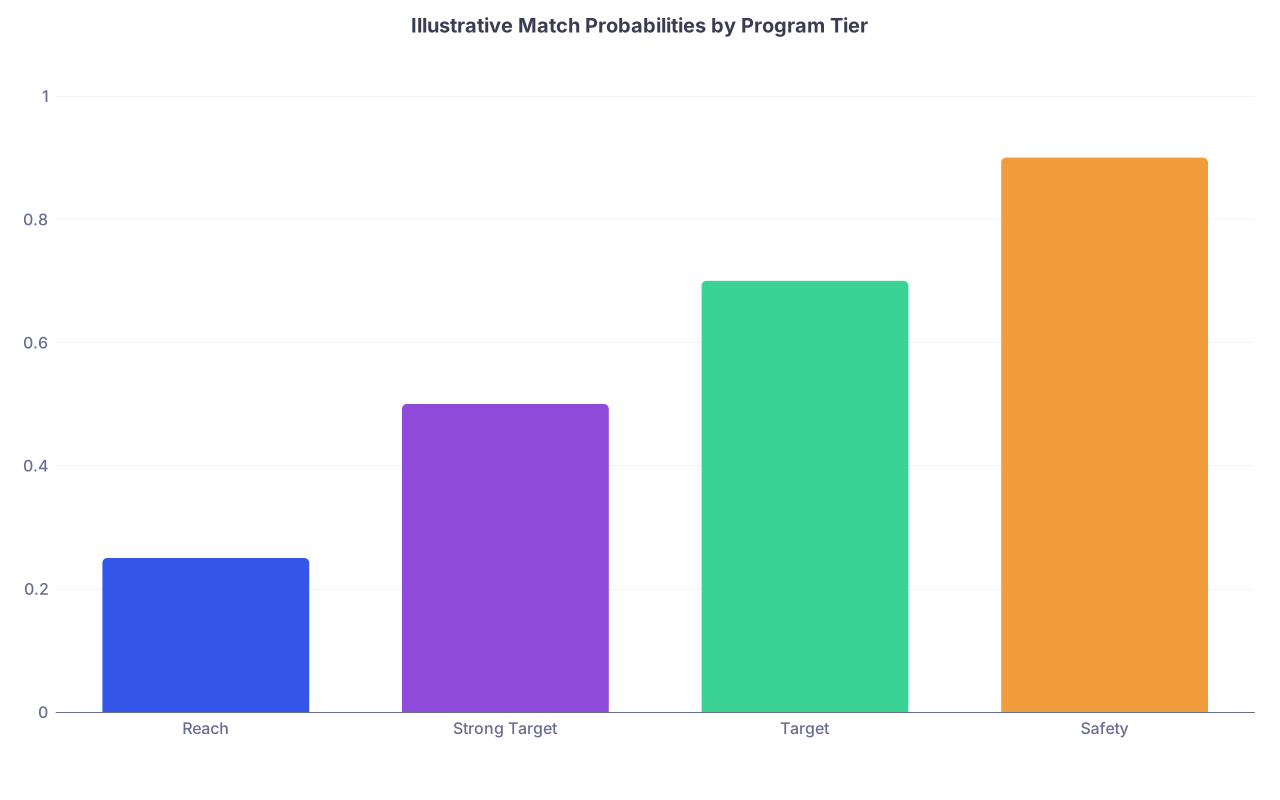
| Category | Value |
|---|---|
| Reach | 0.25 |
| Strong Target | 0.5 |
| Target | 0.7 |
| Safety | 0.9 |
Let me use round numbers. These are not gospel. They are scaffolding to think clearly.
Say you have:
- 4 “reach” programs
- 6 “target” programs
- 4 “safety” programs
You estimate your chance of matching at each individual program if it were the only one on your list:
- Reach: 20–30% → use 0.25
- Strong target: 45–55% → use 0.50
- Standard target: 60–75% → use 0.70
- Safety: 85–95% → use 0.90
These probabilities reflect:
- How you compare to their typical matched residents (Step/COMLEX, research, school reputation, etc.)
- Signals (preference signals, away rotations, relationships)
- Interview feel and feedback (genuine enthusiasm vs generic talk)
You will be wrong on some of them. But being approximately right is vastly better than pretending you can not quantify anything.
The key approximation
To model scenarios, you assume rough independence of match events between programs:
P(no match at any) ≈ Π (1 − pᵢ) over all programs on your list
This is not perfectly true—programs share information and many are correlated by tier—but it is good enough to see how conservative vs aggressive lists behave.
3. Conservative vs Aggressive: Concrete Scenarios
We will walk through 4 archetypal applicants. Numbers are illustrative, but the patterns generalize.
Scenario A: Strong Applicant in a Competitive Specialty (Derm, Ortho, ENT)
You:
- Top quartile in class, strong Step 2, decent research
- Applying to dermatology (substitute your favorite bloodbath specialty)
- 18 interviews
Break your interviews into tiers:
- 5 reach (top academic programs, heavy research) → p ≈ 0.30 each
- 8 solid target (mid‑to‑strong academic, some community) → p ≈ 0.55 each
- 5 safety (community, newer programs, lower historical fill stats) → p ≈ 0.80 each
Conservative rank list
Order: Target and safety programs mixed near the top, reaches pushed down:
1–3: Solid target
4–7: Mix of target/safety
8–13: Remaining safety, then target
14–18: Reach
Mathematically, P(match) is extremely high here because you are giving the algorithm many “easy” shots early.
Approx P(no match at any):
- Assuming at least 8 programs with p ≥ 0.55 and 5 with p ≈ 0.80:
P(no match) ≈ (1 − 0.55)⁸ × (1 − 0.80)⁵
≈ (0.45)⁸ × (0.20)⁵
≈ 0.0002 × 0.00032
≈ 6.4 × 10⁻⁸ (i.e., 0.0000064%)
Yes, this is an oversimplification; correlations will raise that number. But you are in “vanishingly small” risk territory.
Downside: you heavily overweight your chance of landing at a mid‑tier or safety program relative to your true competitiveness.
Aggressive rank list
Order all 5 reach programs first, then all 8 target, then 5 safety:
1–5: Reach (0.30 each)
6–13: Target (0.55 each)
14–18: Safety (0.80 each)
The crucial observation: P(match) overall barely changes. You are not deleting safeties; you are just placing them later.
P(no match at any):
- 5 reach (0.30), 8 target (0.55), 5 safety (0.80):
P(no match) ≈ (0.70)⁵ × (0.45)⁸ × (0.20)⁵
≈ 0.16807 × 0.0002 × 0.00032
≈ 1.08 × 10⁻⁸ (0.0000011%)
In other words: You are still almost guaranteed to match somewhere. But you dramatically increase the chance that “somewhere” is a reach or strong target.
Conclusion for this profile:
Not ranking reach programs first is mathematically irrational. The data pattern: extremely high P(match) either way; the only difference is distribution of where.
Scenario B: Borderline Applicant in a Competitive Specialty
You:
- Middle or lower‑middle stats for the specialty
- Minimal research compared with peers
- 10 interviews in something like Ortho, Derm, Urology, etc.
Distribution:
- 2 reach (you are weaker than their average match) → p ≈ 0.15
- 4 target (you fit mid‑pack) → p ≈ 0.40
- 4 safety (you are stronger than their average) → p ≈ 0.70
Conservative list
You are scared of not matching. You rank all safety and target programs above reaches:
1–4: Safety
5–8: Target
9–10: Reach
Compute P(no match):
P(no match) ≈ (1 − 0.70)⁴ × (1 − 0.40)⁴ × (1 − 0.15)²
= (0.30)⁴ × (0.60)⁴ × (0.85)²
≈ 0.0081 × 0.1296 × 0.7225
≈ 0.00076 (0.076%)
So roughly 0.1% risk in this crude model. Very comfortable.
Aggressive list
You decide to swing:
1–2: Reach
3–6: Target
7–10: Safety
P(no match) is identical under this independence model:
You have not removed any programs; you only changed order. From a pure probability-of-matching standpoint, order does not matter for the existence of any match.
But this is where misunderstanding creeps in.
The fear is: if I put higher‑risk programs on top, I might “waste” the chances at safer programs. That is not how the algorithm is designed. From NRMP’s own technical description: it starts with your first choice and tries to place you there; if that fails, it falls through to the next. It never gives up on you early because you "aimed too high.”
So for this borderline profile, data logic is blunt:
- Overall P(match) ~ the same whether you rank reaches first or last
- Aggressive strategy increases probability that, conditional on matching, you land at a target or reach
- Conservative strategy increases probability you land at a safety even though your overall match probability is already high
The only time this logic breaks is if your estimations are grossly wrong and you are actually far weaker than you think and most of your “safeties” are not safe. That is not a ranking problem. That is a miscalibration problem.
Scenario C: Modest Applicant in a Less Competitive Specialty (IM, Peds, FM)
You:
- Stronger than you think. This is half of internal medicine.
- 12 interviews for categorical IM, mid‑tier U.S. MD, average Step 2.
Split:
- 3 reach academic programs (big‑name, research‑heavy) → p ≈ 0.25
- 5 target university‑affiliated or solid community → p ≈ 0.60
- 4 safety community / smaller hospitals → p ≈ 0.85
You can model conservative vs aggressive the same way:
Conservative: safety and target first, reach late.
Aggressive: reach first, then target, then safety.
Again, P(no match at any):
P(no match) ≈ (0.75)³ × (0.40)⁵ × (0.15)⁴
≈ 0.422 × 0.01024 × 0.000506
≈ 2.2 × 10⁻⁶ (0.00022%)
Near-zero reality. For most IM and FM applicants with 10+ interviews, the question is not “will I match?” but “where on the distribution curve will I land?”
Let me say this directly:
For non-ultra‑competitive specialties, ranking a less‑desired community program over a clearly better‑fit academic program solely out of fear of not matching is almost always a data error.
Scenario D: Truly High-Risk Applicant (Few Interviews)
This is the cohort where conservative vs aggressive actually becomes a probability-of-matching question, not just a distribution question.
You:
- 4 interviews in a competitive specialty or
- 4–5 interviews in a standard specialty with weak application
Example distribution:
- 1 reach → p ≈ 0.10
- 1 target → p ≈ 0.35
- 2 safety → p ≈ 0.60
Compute baseline:
P(no match) ≈ (0.90)¹ × (0.65)¹ × (0.40)²
≈ 0.90 × 0.65 × 0.16
≈ 0.0936 (≈ 9.4%)
Now it is not vanishing. It is almost 1 in 10.
Notice: order still does not change this probability, given the algorithm’s design. But the way you interpret “conservative” should change.
The rational conservative strategy in this high‑risk scenario is not to rank safeties first. That changes nothing about P(match). The rational conservative strategy is:
- Apply to a prelim / TY year as a parallel plan when appropriate
- Apply to more programs early (too late now if it is rank time)
- Consider SOAP risk and what unemployment looks like in your specific context
But at the pure rank-list level, even here, aggressive vs conservative is about where you are comfortable landing if you do match, not whether you match at all.
4. Quantifying “Aggression”: Utility, Not Just Probability
Probability alone is not enough. You care about how much you prefer Program A over Program B, not just which one is ranked higher.
You can approximate this strictly for yourself:
Assign a “utility score” from 0–10 for each program, reflecting:
- Training quality
- Location (family, cost of living, safety)
- Fellowship prospects
- Lifestyle / call schedule
- Gut fit
Now think of each program Pᵢ as:
- Utility: uᵢ (e.g., 3 for a place you’d survive, 9 for a dream)
- Match probability: pᵢ
Your expected utility of a rank list, roughly, is:
E[U] ≈ Σ (uᵢ × incremental probability you ultimately match there)
The math of incremental probability is messy to write out in closed form for the NRMP process. But you can approximate:
- If you are almost guaranteed to match somewhere,
- The main question is the relative ordering of pᵢ and uᵢ
In practice:
- Aggressive strategy: put very high uᵢ programs (9–10s) high even if pᵢ is lower
- Conservative strategy: overweight moderate uᵢ but high pᵢ programs
Let me be blunt: The data reality for most mid‑to‑strong applicants is that raising the rank of a “9/10 dream” program from #5 to #1 is almost all upside and almost no meaningful added risk of going unmatched.
5. Comparing Conservative vs Aggressive Patterns Side-by-Side
| Applicant Profile | # Interviews | Conservative Pattern | Aggressive Pattern |
|---|---|---|---|
| Strong competitive | 15–20 | Targets/Safeties early | Reaches early, safeties late |
| Borderline competitive | 8–12 | Safeties > Targets > Reaches | Reaches > Targets > Safeties |
| Modest non-competitive | 10–15 | Community before strong academic | Strong academic before community |
| High-risk (few interviews) | 3–5 | No real effect by order | Same P(match), focus on parallel plans |
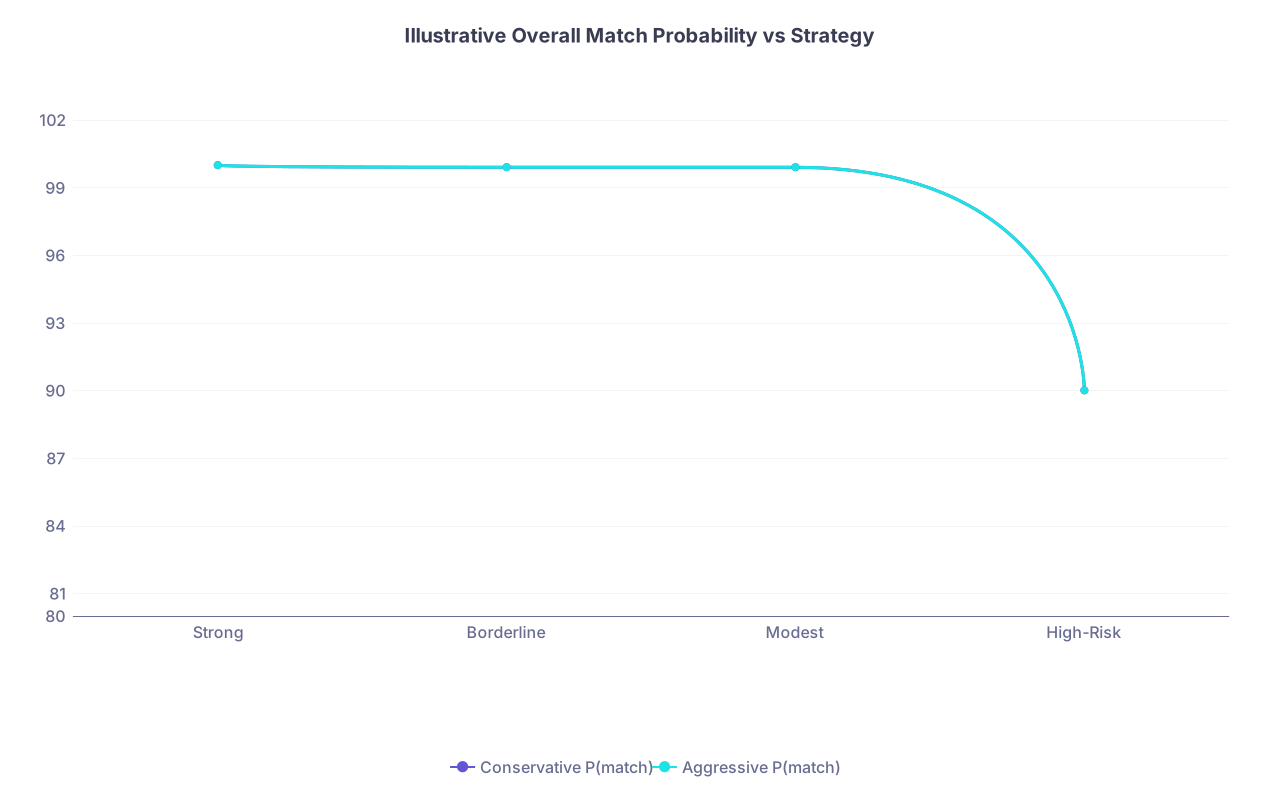
| Category | Conservative P(match) | Aggressive P(match) |
|---|---|---|
| Strong | 99.99 | 99.99 |
| Borderline | 99.9 | 99.9 |
| Modest | 99.9 | 99.9 |
| High-Risk | 90 | 90 |
Notice how the P(match) curves for conservative and aggressive are essentially overlapping for all but the truly high‑risk group. That is the uncomfortable truth many advisors dance around.
6. Geography, Couples Match, and Other Distortions
There are special situations where you legitimately bend the “always rank in true preference order” rule to account for joint probability constraints. Not because of the algorithm directly, but because your personal utility function changes.
Geography constraints
If you must be in a certain city/region (partner job, kids, visa issues), then “being in region X” has a massive utility premium.
I have seen couples who effectively treat “Any program in City A” as u = 9–10 and “Best program in City B” as u = 3–4. That flips the math:
- You may justifiably rank a weaker program in your required city higher than a stronger one elsewhere
- From a data standpoint, your utility function is heavily geography‑weighted
Couples Match
Here the risk model genuinely changes because now:
- Your outcome is a joint event: P(both match in acceptable positions)
- Many “aggressive” choices (both ranking only top programs in one city) can spike the risk of one or both not matching together
Simplify with a thought experiment:
- Partner A: 10 interviews, strong candidate
- Partner B: 6 interviews, weaker, some in the same city, some elsewhere
If B heavily ranks only the shared “dream” locations, the joint probability of both landing where you want can drop. A conservative strategy might:
- B ranks more broadly, including solo sites in acceptable locations
- A aligns list to maximize overlapping ranges where both have realistic pᵢ > ~0.4
This genuinely is a different optimization: you are maximizing the probability of a pair outcome, not individual best match.
7. A Simple Step-by-Step Modeling Workflow
Let’s make this practical. You do not need R or Python. You need a spreadsheet and honesty.

| Step | Description |
|---|---|
| Step 1 | List Programs |
| Step 2 | Assign Utility 0-10 |
| Step 3 | Estimate Match p for Each |
| Step 4 | Classify as Reach/Target/Safety |
| Step 5 | Design Aggressive List |
| Step 6 | Design Conservative List |
| Step 7 | Compare Expected Outcomes |
- List all programs where you interviewed.
- For each, assign:
- Utility uᵢ (0–10)
- Estimated pᵢ (0.0–1.0) given your profile
- Tag each as R/T/S based on pᵢ buckets (e.g., Reach <0.35, Target 0.35–0.7, Safety >0.7).
- Build two hypothetical rank lists:
- Aggressive: sort primarily by uᵢ (dream fit first), breaking ties by pᵢ
- Conservative: sort primarily by pᵢ (higher chance first), then uᵢ
- For each list, compute:
- Product of (1 − pᵢ) to approximate P(no match)
- Visualize which tiers dominate your top 5 / top 10
Then ask: Does the conservative list meaningfully reduce P(no match)? In almost all mid‑to‑strong cases, the difference is negligible. If there is no meaningful reduction, the conservative list is just fear‑weighted, not data‑driven.
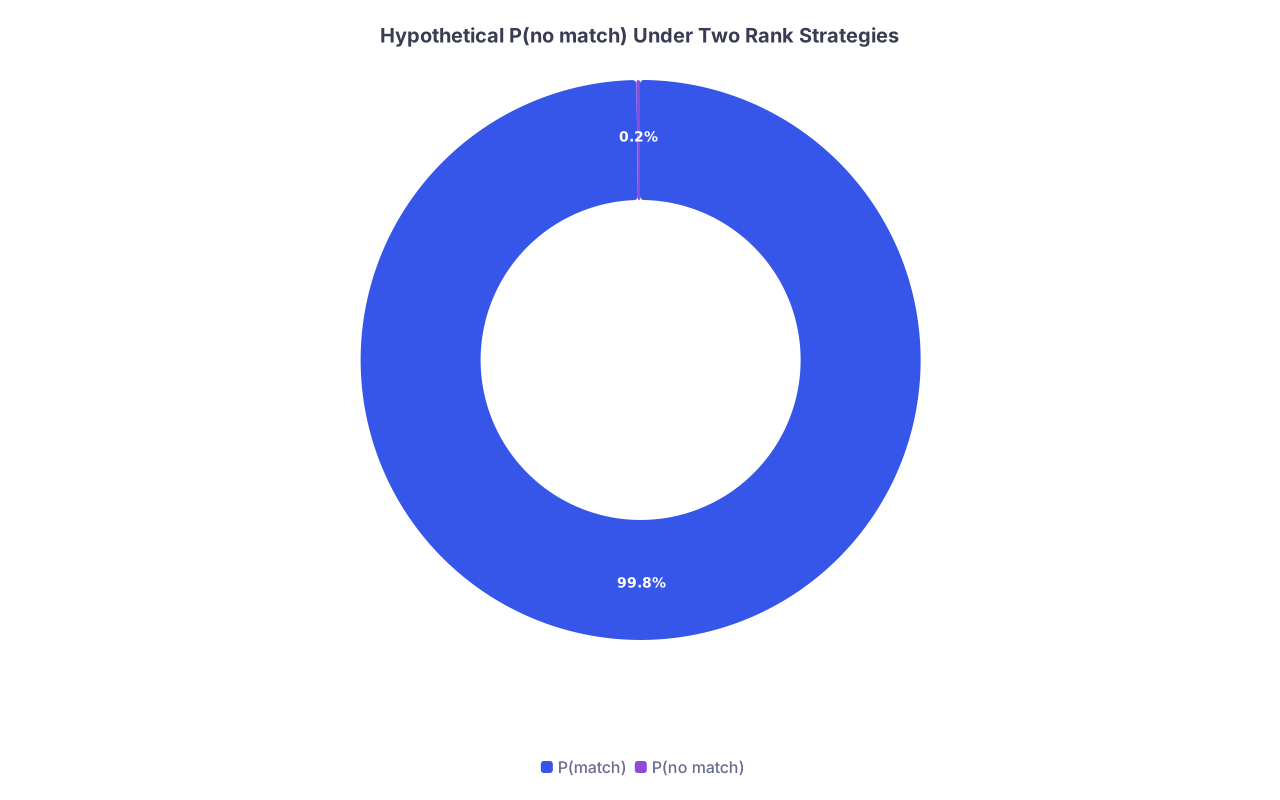
| Category | Value |
|---|---|
| P(match) | 99.8 |
| P(no match) | 0.2 |
8. Where People Go Wrong (And Why Advisors Argue)
I have watched too many rank‑list meetings where:
- Advisor: “Be realistic. Rank the places most likely to take you first.”
- Applicant: “But I really prefer Program A over Program B.”
- Advisor: “Better to be safe than end up in SOAP.”
Data reality: For applicants with a decent number of interviews, ranking a more competitive program higher does not reduce your safety; it just changes which safety you might fall to.
So why the discrepancy?
- Some advisors focus on the worst‑case narrative because they remember the few who did not match, not the hundreds who matched sub‑optimally.
- Many people do not internalize that the algorithm is applicant‑favoring: it does not “use up” your safeties if your reaches reject you.
- Risk communication is bad. “Don’t be too aggressive” sounds safer than “Your chance of not matching is 0.05%, stop sabotaging your preferences.”
Your job is to separate emotional risk perception from actual probability.
9. Bottom Line: When to Be Conservative, When to Be Aggressive
Strip it down to three data‑backed rules:
If you have ≥10 interviews in a non‑ultra‑competitive specialty and are not a catastrophically weak applicant, your P(match) is already extremely high. You should rank primarily by preference (utility), i.e., be “aggressive.”
If you are in an ultra‑competitive specialty but have 8–10+ interviews, the same logic mostly applies. Ranking reach programs first does not materially increase your risk of going unmatched; it mainly increases your odds of matching higher on your own list.
If you have ≤5 interviews, you are in a genuinely higher‑risk category. But even here, “conservative” vs “aggressive” ordering does not change P(match) much. What reduces risk is:
- Having any true S programs (pᵢ ≥ ~0.6–0.7)
- Parallel plans (prelim, TY, backup specialty, SOAP strategy)
The rank list is not where you save a catastrophically weak application. It is where you decide whether your eventual outcome reflects your actual preferences or your anxiety.
If you remember nothing else:
- The data shows that order does not cost you safety; it only rearranges which acceptable outcomes you are most likely to get.
- For most applicants, an “aggressive” rank list that honestly reflects where you most want to train is not reckless. It is rational.


