

Most applicants rank too few programs—and they do it with zero quantitative strategy. The data shows that is one of the most preventable reasons people go unmatched.
If you treat your rank list like a “vibes” exercise instead of a probability problem, you are handing your fate to chance. The NRMP has already run the experiment on tens of thousands of applicants. The patterns are not subtle.
Let me walk through what the numbers actually say about interview‑to‑rank ratios, how many programs you should rank for your specialty and competitiveness, and where people consistently make bad decisions.
1. The Core Fact: More Ranks = More Matches (Up To a Point)
The Match algorithm is applicant‑favorable. That is not a slogan, it is baked into how the algorithm evaluates your preferences first. But “applicant‑favorable” does not mean “magic.” If you rank five programs, your maximum probability of matching is constrained by those five slots. The NRMP Charting Outcomes and the “Results and Data: Match” documents show the same basic curve every year:
- Match rate rises steeply as you add ranks from 1 → ~10.
- It continues to rise more slowly from ~10 → ~15–20.
- After that, the curve flattens; you get diminishing returns, not zero returns.
The slope depends on specialty and whether you are US‑MD, US‑DO, or IMG, but the shape is consistent.
You are not guessing in the dark. There is hard data relating:
- Number of contiguous ranks
- Match status (matched vs unmatched)
- Applicant type and specialty
That is your starting point.
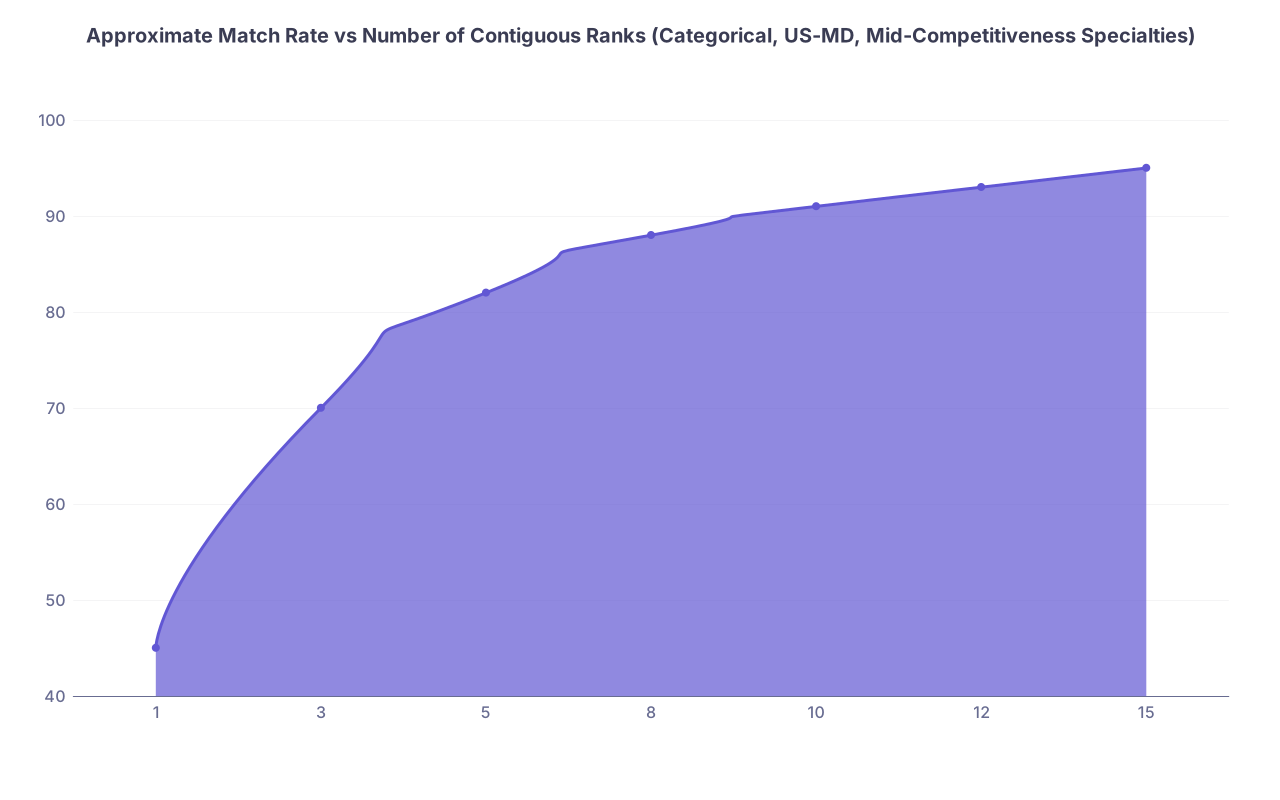
| Category | Value |
|---|---|
| 1 | 45 |
| 3 | 70 |
| 5 | 82 |
| 8 | 88 |
| 10 | 91 |
| 12 | 93 |
| 15 | 95 |
This is stylized but close to what NRMP graphs show for many core specialties. The message is obvious: going from 5 → 10 ranks matters. Going from 15 → 20? Marginal benefit.
2. Translate Interviews into Ranks: The Real “Ratio”
Here is the first big mistake I see every year:
- “I interviewed at 12 programs, but I only really liked 6. I’ll just rank those.”
That is how strong applicants go unmatched.
Your interview‑to‑rank ratio should be extremely simple for >90% of people:
If you would rather train there than go unmatched, it belongs on your rank list.
Which implies:
- Target ratio for almost everyone:
RANK ALL INTERVIEWED PROGRAMS (i.e., ratio ~ 1.0).
Anything else is you voluntarily throwing away probability.
There are a few legitimate exceptions (eg, program with documented toxicity, clear deal‑breaker for family or visa reasons). But “I didn’t like the call rooms” is not a rational reason to sacrifice a several‑percentage‑point increase in match probability.
Let’s be more specific by specialty category.
3. How Many Programs Should You Rank? Specialty‑Level Numbers
The rational number of ranks is driven by three variables:
- Specialty competitiveness
- Applicant category (US‑MD, US‑DO, IMG)
- Your own competitiveness relative to that specialty
I will generalize based on aggregated NRMP patterns. Individual years bounce a few percent, but the order of magnitude is stable.
3.1 Broad‑Access / Less Competitive Specialties
Examples: Internal Medicine (categorical), Family Medicine, Pediatrics, Psychiatry, Pathology (in many cycles).
For US‑MD seniors (average competitiveness), NRMP data repeatedly shows:
- Match rate ~90–95% by about 10–12 contiguous ranks.
- Gains after ~15 are modest but real, especially for weaker applicants.
You should think in these ranges:
- Strong US‑MD: 8–10+ ranks is usually enough to push match probability above ~95%.
- Average US‑MD: 10–15 is safer.
- US‑DO / IMG: 12–20+ is not overkill. You are starting from a lower baseline.
| Specialty Category | US-MD Typical Safe Range | US-DO Typical Safe Range | IMG Typical Safe Range |
|---|---|---|---|
| Less Competitive (IM/FM/Peds/Psych) | 10–15 | 12–20 | 15–25 |
| Mid Competitive (EM/Anes/OB-GYN) | 12–18 | 15–22 | 18–30 |
| Highly Competitive (Derm/Ortho/ENT/Plastics) | 15–25 | 18–30 | 25+ |
These are not magic numbers. They are realistic ranges anchored in how the match curves behave.
3.2 Mid‑Competitive Specialties
Examples: Emergency Medicine (variable), Anesthesiology, OB‑GYN, General Surgery (categorical, depending on year).
Here, the 90–95% match plateau typically happens closer to 12–18 ranks for US‑MDs.
Pattern:
- 1–5 ranks: highly volatile; a single program’s change in preferences can sink you.
- 8–12 ranks: match probability climbs steeply.
- 15–20 ranks: incremental benefit, especially for less competitive applicants.
I generally tell people in this category:
- If you have ≥12 interviews, ranking all of them is rational.
- If you have <10, your probability curve is shallow. You are living in risk land and need to accept that.
3.3 Highly Competitive Specialties
Examples: Dermatology, Orthopedic Surgery, Plastic Surgery, Otolaryngology, Neurosurgery, Integrated Vascular, Integrated CT, Radiation Oncology (depending on cycle).
The data here is brutal:
- High percentage of applicants go unmatched every year.
- Even strong applicants sometimes need 12–15+ ranks to get into the ~80–90% match‑probability region.
- For DOs and IMGs, the curve may never climb that high; it might plateau at 50–70% even with a lot of ranks.
For these fields:
- US‑MD senior, reasonably competitive:
Target 15–25+ ranks if you can get them. Still rank every single interview. - US‑DO / IMG:
Maximize both interviews and ranks. 20+ ranks is very reasonable if you have them.
If you are in derm with 7 interviews and thinking of ranking 4: that is not strategy, it is self‑sabotage.
4. Rank List Length vs Match Probability: What the Graphs Really Say
NRMP “Results and Data” includes graphs of match rate versus number of contiguous ranks by specialty and applicant type. People glance at them, then ignore them.
Let’s approximate the pattern for a mid‑competitive specialty for US‑MD seniors.
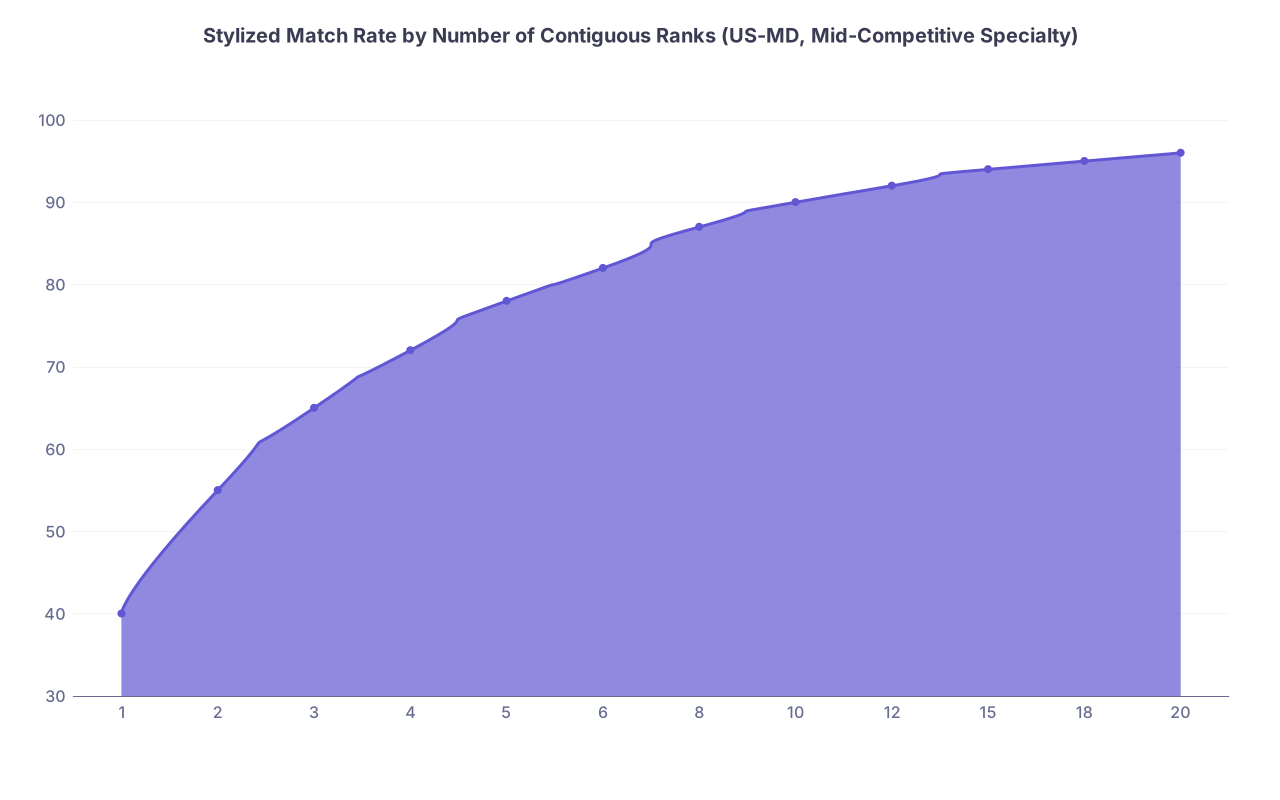
| Category | Value |
|---|---|
| 1 | 40 |
| 2 | 55 |
| 3 | 65 |
| 4 | 72 |
| 5 | 78 |
| 6 | 82 |
| 8 | 87 |
| 10 | 90 |
| 12 | 92 |
| 15 | 94 |
| 18 | 95 |
| 20 | 96 |
Interpretation:
- Jump from 1 → 5 ranks: +38 percentage points.
- Jump from 5 → 10 ranks: +12 percentage points.
- Jump from 10 → 15 ranks: +4 percentage points.
- Jump from 15 → 20 ranks: +2 percentage points.
If you are at 4–5 ranks, your list is short. The risk is real. Once you get into the 10–15 range for many core specialties, you are in safer territory, assuming your competitiveness is aligned with the programs you interviewed at.
That is the statistical core: your match probability is not a straight line. It is a curve with rapidly diminishing returns.
5. The Interview‑to‑Rank Funnel: Where People Drop Probability
Here is a simple reality check I use when advising people:
- Number of programs applied to
- Number of interview invites
- Number of interviews actually attended
- Number of programs ranked
You want that funnel to be as “wide” as possible at the bottom. What usually happens instead:
- Apply to 60 programs
- Get 18 interviews
- Attend 16
- Rank 9
You have effectively thrown away 7 opportunities for a match because you did not “like” some places. The data does not care that the cafeteria food was bad. The probability curve only knows you just cut your contiguous ranks almost in half.
I have seen IM applicants with 15 interviews go unmatched because they ranked 6–7 “top choice” places and left the others off. Their logic: “I would rather SOAP than go there.” When SOAP hits and they are staring at prelim medicine in a location they hate, the earlier decision suddenly looks irrational.
Unless you have a genuine, hard line—unsafe environment, nonviable location for a spouse’s job, major visa issues—expanding the bottom of the funnel is almost always the data‑supported move.
6. Adjusting for Your Competitiveness: Not Everyone Has the Same Curve
You cannot copy‑paste NRMP averages and assume they apply to you. Your position on the curve shifts based on:
- US‑MD vs US‑DO vs IMG
- Step/COMLEX scores and failures
- Class rank, AOA, red flags
- Research and letters (especially for academic fields)
Here is a rough mental model.
6.1 “Above Average” for Your Specialty
You:
- Have board scores around or above the matched median.
- Have no red flags, normal number of interviews.
- Applied broadly enough and got mostly “in‑range” programs.
Your curve is “left‑shifted”:
- You may hit >90% match probability by 8–10 ranks in a broad specialty.
- In a mid‑competitive field, maybe 10–14.
- In ultra‑competitive, you still want 15+; the baseline competition is that intense.
Interview‑to‑rank ratio: 1.0. Rank everything.
6.2 “Average” Applicant
This is what NRMP graphs mostly show. For you, the published curves are a decent approximation.
- In IM/FM/Peds, aim for 10–15+ ranks.
- In EM/Anes/OB‑GYN, 12–18+.
- In Ortho/Derm/ENT, 15–25+.
Again, ratio ≈ 1.0 if at all possible.
6.3 “Below Average” / Red Flags
You:
- Have a Step failure, low scores, leaves of absence, or limited interview count.
- Or you are an IMG in a competitive field.
Your curve is “right‑shifted” and often flatter:
- The same number of ranks confers a lower match probability.
- You offset this by maximizing both interviews and ranks.
In practice:
- Rank every single interview unless there is a truly non‑negotiable problem.
- Do not get cute eliminating “less desirable” programs. Your goal is any categorical slot.
7. Geographic Preference vs Match Probability
Here is where the emotional side fights the math.
Scenario I see constantly:
- Applicant has 12 interviews.
- 6 are in their preferred region.
- 6 are in less desired regions.
- They are tempted to rank only the 6 “preferred” programs.
Let us assign simple illustrative probabilities:
- Per‑program match probability with each of those 12 programs is independent and 10% (this is a simplification, but it makes the point).
- Probability of not matching at any program you rank = (1 − p)^n
Case A: Rank 6 preferred only
Not match probability = 0.9^6 ≈ 0.53 → 53% chance of going unmatched.
Case B: Rank all 12
Not match probability = 0.9^12 ≈ 0.28 → 28% chance of going unmatched.
You cut your unmatched probability almost in half just by ranking all your interviews.
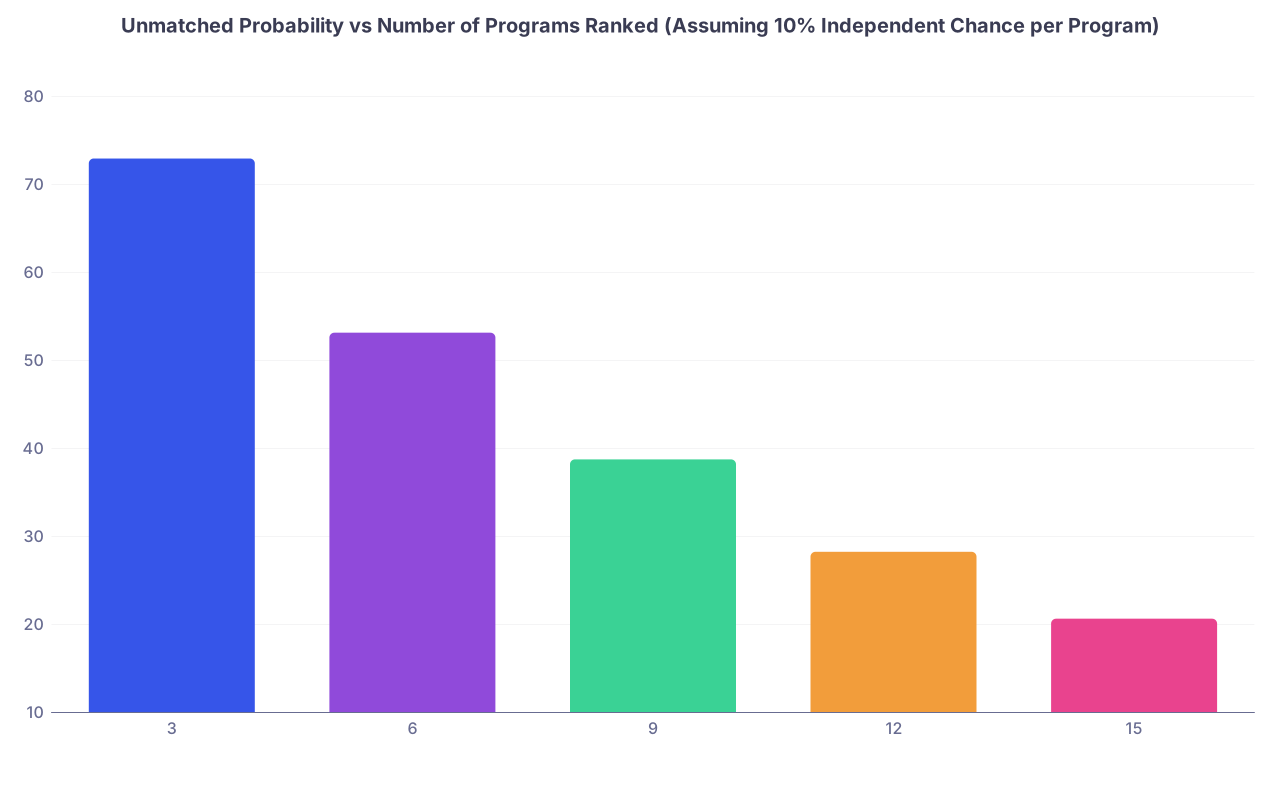
| Category | Value |
|---|---|
| 3 | 72.9 |
| 6 | 53.1 |
| 9 | 38.7 |
| 12 | 28.2 |
| 15 | 20.6 |
The numbers are stylized, but the principle is correct: adding programs shrinks your unmatched probability exponentially, not linearly.
Geographic preference matters. Your life is not just a probability function. But you should know precisely what you are trading off. If you choose to risk a 50% unmatched chance to stay in one region, that is a conscious choice, not an accident.
8. How to Construct a Rational Rank List Step by Step
This is the part almost no one does systematically. They just “go by feel” the night before the deadline.
Here is a simple, data‑aware workflow.

| Step | Description |
|---|---|
| Step 1 | All Interviewed Programs |
| Step 2 | Hard Exclusion Filter |
| Step 3 | Remaining Programs |
| Step 4 | Sort by True Preference |
| Step 5 | Check List Length vs Specialty Targets |
| Step 6 | Finalize and Certify |
| Step 7 | Reconsider Exclusions / Apply for SOAP Backup |
| Step 8 | Enough Ranks? |
Step 1: Start with all interviewed programs.
Create a list of every place you interviewed. No early deletion.
Step 2: Hard exclusion filter.
Remove only programs that fail a true, non‑negotiable constraint:
- Spouse cannot work in that state due to licensing.
- Visa cannot be sponsored.
- Documented toxicity that you consider unacceptable.
- Clear personal safety issue.
If your “constraint” is “I did not like the resident lounge,” that is not a hard exclusion. That is you being picky in a probabilistic game you can lose.
Step 3: Rank by genuine preference.
Now, with the filtered list, sort programs by:
- Training quality (case volume, board pass rates, fellowship outcomes).
- Fit and culture.
- Geography and family needs.
- Research or academic goals.
You know your priorities. Just be honest with yourself.
Step 4: Compare length to data‑driven targets.
Look at how many programs remain.
- Are you hitting a reasonable range for your specialty and applicant type (e.g., 12–15+ for IM, 15–25+ for Ortho, etc.)?
- If you are below, acknowledge that your match probability is materially lower. Do not pretend otherwise.
Step 5: If length is short, reassess exclusions.
Here is where people salvage their situation:
- Go back and ask: “Do I truly prefer going unmatched to ranking program X?”
- For many programs, the honest answer is “No, I would rather match there than scramble in SOAP.”
In that case, they belong back on your list.
9. Specific Edge Cases People Overthink
9.1 Preliminary vs Categorical
For specialties where you dual‑apply or need a separate prelim year (e.g., Radiology, Anesthesia, Neurology depending on program):
- You effectively have two separate rank lists: categorical/advanced, and prelim/transitional.
- For prelim medicine/surgery, the same principles apply: rank all acceptable programs. You do not want to match advanced without a PGY‑1 spot.
9.2 Different Specialties on the Same List
You cannot rank multiple specialties on the same rank list, but you can participate in separate matches (e.g., some early‑match specialties). Each list needs its own strategy, grounded in its own NRMP‑style curves.
If you are dual‑applying (say, EM and IM):
- You must decide which specialty you truly prefer and structure your lists so that the algorithm sees that preference ordering the way you intend.
9.3 Couples Match
Couples match changes the combinatorics:
- The algorithm evaluates pairings of ranks, which explode in number.
- Your effective probability for any single combination is lower, but having more combinations helps.
The practical rule does not change:
- Each partner should rank all programs they could tolerate.
- Together, generate as many viable pair combinations as possible that meet your minimum geographic or distance constraints.
Do not get fancy limiting combinations unless the data (distance, commute, cost) obviously forces your hand.
10. Where People Go Wrong—And How Not To
There are three recurring errors in interview‑to‑rank behavior:
Underranking (short lists).
- Symptom: 6–7 ranks in a field where most matched applicants have ~12–15+ contiguous ranks.
- Outcome: Unmatched despite reasonable interview count.
Over‑indexing on “fit” from 1 interview day.
- Symptom: Cutting half of your interviews because “it did not click.”
- Outcome: You trade a multi‑year training opportunity for a 6‑hour impression.
Ignoring applicant‑category differences.
- Symptom: IMG using US‑MD average curves, assuming 10 ranks gives 90%+ match probability.
- Outcome: False sense of security, then SOAP.
The antidote is not complicated:
- Look up NRMP data for your specialty, applicant type, and number of contiguous ranks.
- Anchor yourself on those curves, not your emotions.
11. The Bottom Line: What Your Interview‑to‑Rank Ratio Should Be
If I strip away the nuance and cut straight to the numbers‑backed advice:
For almost everyone, your interview‑to‑rank ratio should be 1.0.
Rank every program where you would rather train than go unmatched.Use specialty‑specific targets as sanity checks:
- Broad specialties (IM/FM/Peds/Psych): aim for 10–15+ ranks if US‑MD, 12–20+ if DO/IMG.
- Mid‑competitive (EM/Anes/OB‑GYN): 12–18+ for US‑MD, more for DO/IMG.
- Highly competitive (Derm/Ortho/ENT/etc.): 15–25+ ranks if you can get them.
Short lists are not “high standards.” They are quantifiable risk.
That is the actual math under the Match. You can ignore it, but the algorithm will not.


