

The fastest way to sabotage your residency match is to copy your friends’ rank lists.
You will not live your friends’ lives, train with their attendings, or carry their pagers at 3 a.m. So why on earth would you let their preferences dictate yours?
Let me walk you through the peer-pressure traps that quietly wreck smart applicants every year—and how you avoid becoming one of them.
The Hidden Pressure Cooker: Why Peer Influence in Ranking Is So Dangerous
You are vulnerable right now. You may not like hearing that, but it is true.
You are exhausted. You are surrounded by other exhausted people obsessing over programs, prestige, Step scores, “tier lists,” and anonymous Reddit opinions. Group chats are buzzing with “What are you ranking #1?” and “Everyone is putting ___ in their top 3.”
That is the worst possible environment to make a deeply personal, life-altering decision.
Here is the key mistake: treating residency ranking like a group project.
Common forms this takes:
- Copying a friend’s rank order “because they did more research.”
- Shifting programs up or down because “everyone in our class is ranking it high.”
- Feeling embarrassed to rank a less prestigious program over a big-name powerhouse.
- Matching your S.O. or roommate’s geography when you are not actually committed to living that life.
- Letting one loud, confident classmate become the unofficial “ranking expert.”
You are not being “collaborative.” You are outsourcing your future to people who will not be there when you are on night float questioning every decision that put you in that hospital, in that city, in that culture.
The Most Common Peer-Pressure Ranking Disasters (That I Keep Seeing)
Let me be specific, because vague warnings do not help anyone. These are real patterns I have watched play out.
1. The Prestige Copycat: “My Friend Says This Is a Top Program”
This one is everywhere.
You like Program A. The residents seemed happy. Faculty knew their names. The city felt livable. Then your friend says, “Oh, everyone knows Program B is way more prestigious. I’m ranking B #1.”
Suddenly:
- Program A slides to #3.
- Program B—where you felt lukewarm, a bit lost, maybe even uncomfortable—jumps to #1 or #2.
- You justify it with vague talk about “reputation” and “keeping doors open.”
Months later, you match at Program B. And discover:
- The prestige did nothing for your day-to-day misery.
- The call schedule is brutal.
- The mentorship is scattered.
- The residents are burned out and counting days to graduation.
You made a long-term decision to impress short-term peers.
2. The “Couple-By-Association” Trap
You are not couples matching. But you start behaving like you are.
Scenario I have seen too many times:
- Your close friend (or unofficial “med school spouse”) is dead set on City X.
- Their whole rank list is built around that place.
- Group chat energy: “We should all try to end up in City X, it’ll be amazing!”
You:
- Quietly prefer City Y. You liked the programs, the cost of living, the vibe.
- But you “feel weird” ranking different cities.
- So you slide multiple City X programs higher than they deserve.
Then:
- You match in City X.
- Your friend matches somewhere totally different.
- You are stuck in a life built for a friendship that no longer exists geographically.
The mistake was simple: you built your list around a social fantasy, not your actual future.
3. The Overconfident Spreadsheet Guru
Every class has one. The self-appointed expert with the “objective” ranking spreadsheet:
Columns for:
- Program “tier”
- Case volume
- Fellowship match history
- Research output
- US News ranking (which is meaningless for residency, by the way)
- Maybe some hearsay from an alumni they barely know
They show you a color-coded list: “These are the only programs you should rank in your top 5 if you are serious.”
So you:
- Ignore your own gut.
- Mentally downgrade programs you liked because their spreadsheet gave them a “B-.”
- Move overly research-heavy, high-pressure places up because they are “top tier.”
That person will not wake up at 4:15 a.m. for your pre-rounding. You will. Their spreadsheet is not worth your burnout.
4. The “Everyone Is Ranking It High, So I Should Too” Herd Move
Classic FOMO behavior.
You hear:
- “Literally everyone loved ___ program.”
- “I heard from like 5 people that ___ is the best program in the region.”
- “Half our class is ranking ___ in their top 3.”
So you assume:
- If that many people like it, it must be superior.
- If you rank it lower, you are “missing something.”
You slide it up your list.
What you forget:
- You are not “everyone.”
- You may have different needs: family situation, mental health, financial limits, learning style, career goals.
- Programs with intense hype often have real downsides that get minimized in group chatter: malignant culture, weak support, terrible housing costs.
This is how otherwise thoughtful applicants end up in misery: they trusted consensus over their own experience.
How Peer Pressure Quietly Rewires Your Brain During Ranking
Peer influence is not just social. It is cognitive. It changes how you remember your interviews and experiences.
Three dangerous mental rewrites I see:
Memory contamination
You leave an interview thinking, “That program was solid, faculty seemed supportive, not super flashy but I could be happy there.”
Then you talk to a classmate who says, “I thought it was underwhelming. Resident I talked to was kind of negative. I’m ranking it low.”
Suddenly your memory shifts. You start retrofitting your experience to match theirs:
“Maybe I misread the vibe. Maybe it wasn’t that good.”
That is not insight. That is social distortion.Language hijacking
People throw around loaded terms:
“Powerhouse,” “workhorse,” “malignant,” “feels community,” “super academic,” “weak clinical training.”
Often based on:- One interview day.
- One PGY-2 in a bad mood.
- Rumors from older classes.
You start repeating those phrases as if they are personal conclusions—when they are actually borrowed.
Risk re-labeling
Your personal risk (distance from support, childcare, cost) gets downgraded in your head because your peers are excited about the same risky option.
“Yeah the rent is insane but everyone says that city is great.”
No. When you are paying $2,500 for a noisy studio and living on a PGY-1 salary, your “everyone” disappears fast.
Ground Rules: How to Protect Your Rank List From Peer Contamination
You do not need to shut your friends out. You do need to protect your decision-making.
Rule 1: Build a Silent Draft Before Any Group Discussions
Do this in writing. Alone.
Before:
- Group chats about rank order
- “Rank list party” Zooms
- Asking upperclassmen “what’s better”
Sit down and:
- Write a first-pass rank list based only on:
- Your own interview experiences
- Your notes
- Your personal priorities
If you already talked too much with peers: fine. Do it now anyway. But from this point, treat your list as the default. Changes must be justified to yourself, not to friends.
Rule 2: Write a One-Paragraph Justification for Your Top 5
If you cannot explain why a program is above another without using someone else’s language, you have a problem.
For each of your top 5, write a short paragraph:
- Why it fits you specifically (not “it’s top tier”)
- What about the culture, training style, and location works for your life
- What trade-offs you are consciously accepting
If your justification sounds like:
- “Everyone says…”
- “Our PD said it has a great reputation…”
- “People online rank it really high…”
Then it is not your reasoning. Fix that.
Rule 3: Limit Rank List Conversations to Structure, Not Order
You can talk about:
- Number of programs you are ranking
- Geographic strategy
- How to use NRMP functions, couples match, etc.
- Worried about ranking a “reach” program high or not—at a strategic level
You should not be:
- Swapping exact rank orders in detail
- Asking, “Where are you putting ___?”
- Saying, “You’re putting that above ___? Really?”
If someone pushes, you can shut it down politely:
- “I’m keeping my list private, just feels less stressful.”
- “I do not want to get influenced by what other people are doing.”
- “I’ve got my own weird priorities, so my list probably wouldn’t make sense to you.”
That is not paranoia. That is boundaries.
Rule 4: Never Move a Program Up Only Because Friends Like It
Any upward move must pass a simple test:
- What concrete, personal reason do you have—independent of peers—for moving this up?
Acceptable:
- “I re-read my notes and realized I actually connected a lot with the PD.”
- “I talked to a second resident there who confirmed strong mentorship in my area of interest.”
Not acceptable:
- “Three of my closest friends are ranking it high.”
- “People say it’s a powerhouse program.”
- “Our class group chat is obsessed with it.”
If your only new “data” is social noise, you do not alter your list.
Practical Tools: Make Your Rank List Actually Yours
Here is how you structure this so you do not get steamrolled by groupthink.

| Step | Description |
|---|---|
| Step 1 | Draft personal rank list alone |
| Step 2 | Write reasons for top programs |
| Step 3 | Filter for factual info only |
| Step 4 | Refine based on your notes |
| Step 5 | Lock final list privately |
| Step 6 | Peer input? |
| Step 7 | Change ranking? |
Use a Comparative Fit Table (Not a Prestige Table)
Build something that tracks what actually matters to you, not what looks good in conversation.
| Factor | Program A | Program B | Program C |
|---|---|---|---|
| Resident Happiness | High | Medium | High |
| Cost of Living | Low | High | Medium |
| Family Proximity | Close | Far | Moderate |
| Fellowship Support | Strong | Very Strong | Moderate |
| Call Schedule | Reasonable | Heavy | Reasonable |
Then ask yourself:
Would you really sacrifice 3–4 years of livable hours, mental health, and support for a tiny bump in “prestige”? Many people do. Regret follows.
Track Emotional Reality, Not Just Features
After each interview, if you did not already, write:
- One sentence: “I could / could not see myself being happy here.”
- One sentence about the residents: “Would I trust these people on my worst day?”
- One sentence about the city: “Would I resent living here in winter / with kids / with my partner?”
Later, if peers’ opinions contradict your notes, you have a record of what you actually experienced.
How Group Hype Distorts Risk: A Quick Reality Check
You and your friends are not averaging your futures. You each absorb 100% of your own outcome.
Peer-pressure pushes a lot of people toward risk they would never choose alone:
- Expensive coastal cities when they are already debt-heavy.
- Super research-heavy programs when they hate bench work.
- High-volume, low-support “workhorse” places when they are already barely holding their mental health together.
Here is what usually happens when people ignore their own risk limits:
- They withdraw socially to survive.
- They develop resentment—toward the program, the city, sometimes even toward the friends whose judgment they copied.
- They start fantasizing about early exit strategies: switching programs, leaving the specialty, or just “making it through” rather than growing.
If you match somewhere challenging because you accepted the tradeoff consciously, you can own that. If you matched there because you did not want to be the “only one” ranking differently, that eats at you.
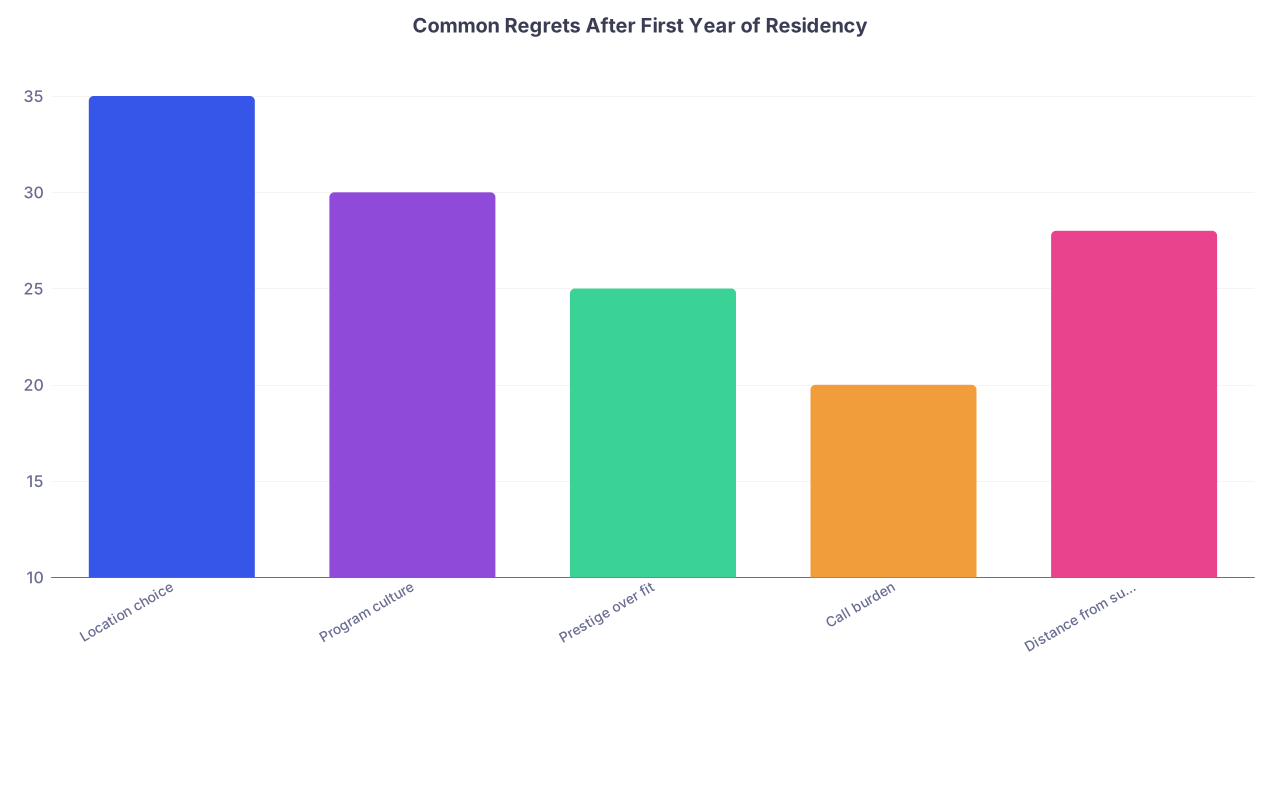
| Category | Value |
|---|---|
| Location choice | 35 |
| Program culture | 30 |
| Prestige over fit | 25 |
| Call burden | 20 |
| Distance from support | 28 |
Those numbers are hypothetical, but the pattern reflects what I see: people rarely regret ranking for authentic fit. They often regret ranking for image.
Red Flags You Are Letting Friends Drive Your Rank List
If any of these feel familiar, pause.
- You are more worried about justifying your rank list to classmates than about living the result.
- You feel defensive when someone questions your top choice, even if you are not fully sure you like it.
- You changed your #1 or #2 after a single group conversation—with no new real data.
- You keep using phrases like “everyone says” and “we all know” to explain your list.
- You are hiding your true preferences because you think they look “less ambitious.”
That last one is huge.
Ranking a community program over a brand-name academic center is not “settling” if it gives you the training, mentorship, and life stability you want. It is actually harder, psychologically, to say: “I know what works for me, and I am choosing it, even if it sounds less impressive in the short term.”
Most people are not that honest with themselves at 26. Try to be.

Who Should Influence Your Rank List?
Not your loudest classmates. Not anonymous Reddit threads. Not the person with the prettiest spreadsheet.
If anyone shapes your list besides you, it should be:
- A mentor who knows you personally and has watched you on the wards.
- Someone in your target specialty who actually understands program realities.
- Your partner or close family, if their lives will be heavily affected by your location.
And even then:
- Their role is advisory, not decisive.
- They can raise questions: “Are you sure you want to be that far from support?”
- They should not dictate rank order: “You must put ___ as #1.”
You listen. You reflect. You decide.
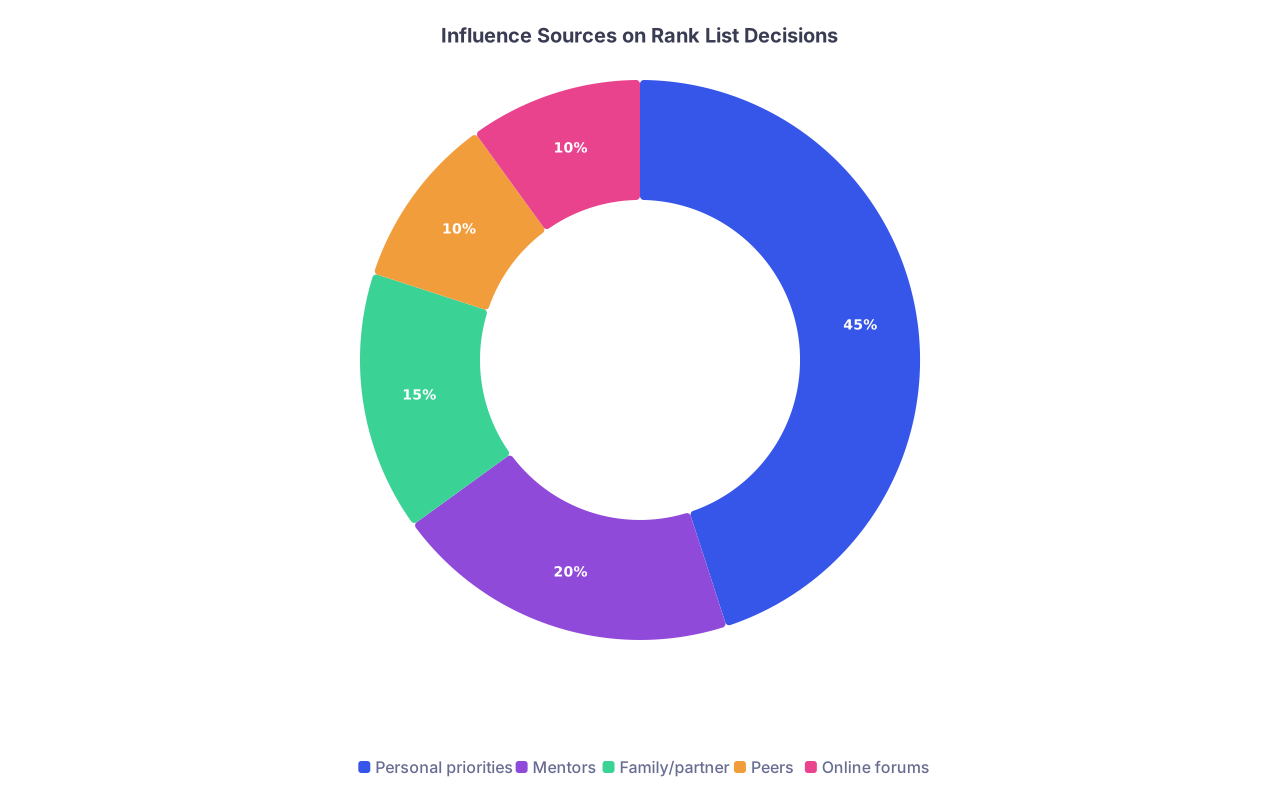
| Category | Value |
|---|---|
| Personal priorities | 45 |
| Mentors | 20 |
| Family/partner | 15 |
| Peers | 10 |
| Online forums | 10 |
If “Peers” is anywhere near “Personal priorities” for you, that is a warning sign.
A Quick Reality Reminder About the Match Algorithm
One more technical point people routinely misunderstand.
The NRMP algorithm:
- Tries to match you to the highest program on your list that also ranks you.
- Does not reward you for “gaming” prestige or matching your friends’ lists.
- Does not care what your classmates are ranking.
So when you copy friends’ preferences, you:
- Do not increase your odds of matching.
- Do increase your odds of matching somewhere that was never actually your true top choice.
Copying rank lists is not just socially dangerous. It is mathematically pointless.

| Step | Description |
|---|---|
| Step 1 | Applicant Rank List |
| Step 2 | Match Algorithm |
| Step 3 | Program Rank List |
| Step 4 | Match Outcome Based on Applicants True Preference Order |
The algorithm already favors you. The only way to mess that up is to lie to it about your actual preferences.
What You Should Do Today
Before you read one more thread or answer one more “What are you ranking?” message, do this:
- Open your draft rank list.
- For your top 5 programs, write one honest sentence that starts with:
“I am ranking this here because I personally…”
If you cannot finish that sentence without referring to other people, your list is compromised. - Adjust at least one program placement based solely on your lived experience and priorities, not anyone else’s opinion.
That one change might be the difference between three years of resentment and three years of growth.
FAQ: Peer Pressure and Residency Rank Lists
1. Is it ever helpful to compare rank lists with friends?
It can be, but only in a narrow way. You can use conversations to identify programs you might have overlooked or to surface factual information (new leadership, accreditation issues, major changes to call structure). The danger is when comparison turns into conformity. If you leave a conversation feeling pressured to justify your list or ashamed of liking a “lesser” program, the discussion stopped being useful.
2. What if my mentor strongly disagrees with my top choice?
Take it seriously, but do not blindly obey. Ask them to be specific: Are they worried about training quality, reputation in your subspecialty, or your personal fit? Then check that against your own priorities and experience. Sometimes mentors are stuck in old reputations that no longer reflect current reality. Use their concern as a prompt to dig deeper, not as an automatic override of your decision.
3. How do I handle a close friend who wants us to end up in the same city?
Be kind but clear. You can say: “I would love to be in the same place, but my priorities are a bit different, and I need to rank based on what fits me best.” If they react poorly, that is a sign they are not respecting your autonomy. Your responsibility is to your own well-being and training, not to maintaining a fantasy of recreating med school in residency.
4. I changed my list after talking with classmates. Should I revert it?
Not automatically. Ask yourself why you changed it. If it was due to new, concrete information that actually matters to you (e.g., a program just lost its only fellowship in your area, or residents are leaving mid-program), the change may be justified. If you cannot point to a clear, personal reason beyond social influence, strongly consider returning to your original order.
5. I feel guilty ranking a “lower tier” program over a famous one. Am I making a mistake?
Not necessarily. You are only making a mistake if you are ignoring your own non-negotiables—like needing strong fellowship placement when you are dead set on an ultra-competitive subspecialty. But choosing a program where you will be supported, taught well, and able to live a tolerable life over a name-brand grindhouse is often the wiser move. Guilt is not a good decision tool. Fit is.
Open your rank list right now and underline every program where your reasoning includes “because everyone says…” or “because people think…” Those are the ones you must re-evaluate before you certify.


