

The obsession with prestige in residency ranking is quietly blowing up a lot of careers.
You’re told to “aim high,” “shoot for the top places,” “you can always rank the big-name programs first and see what happens.” That advice, taken literally and without nuance, is how people end up mismatched, miserable, or—yes—unmatched.
Let me be very clear: ranking for prestige only is a trap. And it backfires more often than anyone wants to admit on Reddit or in those smug group chats.
This isn’t about bashing strong academic programs. It’s about you not making the single most common, high-stakes mistake I see: building a rank list that flatters your ego instead of supporting your life, learning, and long-term career.
The Prestige-Only Trap: What It Actually Looks Like
, Training Quality (case mix), Family/Personal](https://cdn.residencyadvisor.com/images/articles_svg/chart-primary-motivations-students-admit-for-ranking-pro-1537.svg "Primary Motivations Students Admit for Ranking Programs")
| Category | Value |
|---|---|
| Prestige/Name | 40 |
| Location | 20 |
| [Program Culture](https://residencyadvisor.com/resources/residency-ranking-strategy/ignoring-program-culture-fit-the-rank-list-mistake-youll-regret-pgy1) | 15 |
| Training Quality (case mix) | 15 |
| Family/Personal | 10 |
The mistake isn’t just “liking good programs.” The mistake is letting reputation bulldoze every other factor that matters.
I’ve seen versions of this over and over:
- The student with 240s on Step 2, a solid but not superstar application, who ranks 10 ultra-elite university programs in big coastal cities… and nothing else.
- The applicant who had a great interview at a mid-tier community program, loved the residents, felt supported—then drops it way down the list because “my med school classmates will think it’s a downgrade.”
- The couple in a couples match who both shove all the “top 10” places at the top of their list, despite one of them clearly being a stretch applicant and both of them disliking the vibe at several of those programs.
On paper, it looks “ambitious.” In reality, it’s reckless.
You can almost predict who’s going to regret their list just by listening to how they talk:
- “I mean, it’s [insert big-name place], I can’t not rank it #1.”
- “Everybody says that program is super prestigious; I’ll figure out the rest later.”
- “Worst case, I just grind it out. It’s only three years.”
That last sentence? Famous last words.
How Prestige-First Lists Actually Backfire

Let’s walk through what can go wrong when you treat prestige as the dominant or only variable in ranking.
1. You increase your real risk of not matching
People love to parrot, “The algorithm favors the applicant.” True. But the algorithm can’t save you from a suicidal rank list.
If you load the top of your list with places where:
- You’re well below their usual Step 2 or COMLEX ranges
- You had lukewarm or awkward interviews
- You have no geographic ties and a generic application
…you’re building a fantasy list, not a strategy.
The algorithm can only match you where programs have actually ranked you. Name recognition doesn’t create a rank on their list. If Program X never ranked you, it doesn’t matter that it’s your #1. The algorithm just keeps falling until it hits somewhere that did rank you—if such a place exists high enough on your list.
The nightmare scenario I’ve seen:
You over-rank a group of ultra-competitive academic programs that are unlikely to list you high enough to get you. You then shove realistic, solid programs way down on your list because they “don’t sound impressive.” Those realistic programs had you ranked quite high. But by the time the algorithm gets to them, it’s already filled their spots with people who respected them more.
You don’t “miss” the top places because you aimed high. You miss everywhere because you disrespected the places that actually wanted you.
2. You match… and then you hate your life
This is the more hidden failure mode. Less visible than being unmatched. More common.
You get the prestigious spot. The name is fantastic. Your relatives are bragging. LinkedIn is glowing.
But day-to-day?
- You’re working 80+ hours in a malignant or indifferent culture.
- Senior residents normalize exhaustion and humiliation as “paying your dues.”
- Faculty don’t know your name unless you’re already on a research grant.
- You feel completely replaceable.
If that matches your personality—hyper-competitive, thrives in sink-or-swim—fine. For a lot of people, it’s a slow bleed.
I’ve watched PGY-2s at “top 10” places openly say, “If this weren’t [famous name], I’d have transferred or quit already.” That sentence should scare you.
3. The “prestige boost” is smaller than you think
This will annoy some people, but it’s true: outside a handful of subspecialties and certain research-heavy careers, the prestige of your residency matters less than:
- Your board scores
- Your letters of recommendation
- Your actual skills and reputation
- How well you perform within whatever program you’re at
Plenty of highly competitive fellowship directors quietly prefer solid, well-trained, grounded residents from “mid-tier” programs over burned-out, half-bitter graduates from famous departments with weak letters.
Nobody on the wards cares what the website ranking said about your program. They care if you can manage septic shock at 3 a.m. without melting down.
If you’re sacrificing fit, training volume, and support just to get a logo on your CV, you’re trading real value for imagined value.
The Factors Prestige Blinds You To (But Shouldn’t)
| Factor | What Prestige-Obsessed Applicants Assume | What Actually Matters Long-Term |
|---|---|---|
| Brand Name | Determines career success | Opens *some* doors, but limited |
| Program Culture | “I can tolerate anything for 3+ years” | Determines burnout, growth |
| Case Volume/Mix | “Top places must have great cases” | Varies wildly; not guaranteed |
| Location/Cost of Living | “I’ll just suck it up” | Affects mental health, debt |
| Support/Mentorship | “Big name = big mentors” | Mentorship is hit-or-miss anywhere |
Let’s go through the biggest blind spots that prestige-chasing creates.
Program culture and how you’re treated
This gets hand-waved all the time. Don’t be that person.
Red flags you ignore when you’re dazzled by prestige:
- Residents can’t or won’t answer “Are you happy here?” directly.
- Everyone jokes (too much) about being “crushed,” “annihilated,” or “destroyed.”
- Faculty openly belittle residents in front of you, and everyone acts like it’s normal.
- Turnover is high, or people transferring out is “a sensitive topic.”
People tell themselves, “It’s just residency, it’s supposed to be hard.” Yes, it’s hard everywhere. But there’s a big difference between hard and toxic.
No name is worth three to seven years of chronic stress, humiliation, and zero support.
Case volume and autonomy
Big academic name does not automatically equal strong hands-on training.
I’ve watched residents at some lesser-known community programs leave with far better procedural numbers and confidence than residents from shiny university hospitals where:
- Fellows do everything.
- Residents stand back and “assist” or just watch.
- Every interesting case is siphoned to subspecialty teams.
If your goal is to be a competent, confident attending, you need reps, not just fancy conferences.
Look at:
- Case logs of graduating residents.
- How often residents run the show vs. watching fellows.
- Whether upper levels get real autonomy or are constantly micromanaged.
Location, support system, and cost of living
“Prestige” convinces people they’re above being affected by geography. They’re not.
Be very suspicious if you’re saying things like:
- “I don’t know anyone in that city, but it’s [elite institution], so I’ll make it work.”
- “Rent is insane there, but whatever, I’ll figure it out.”
- “I hate the climate and the lifestyle, but it’s only a few years.”
Residency + no social support + brutal hours + high living costs is a fast track to depression, burnout, or both.
Debt also matters. The difference between living somewhere where you can have a reasonable apartment and a car versus somewhere you’re paying 2k+ a month for a closet adds up over three to seven years.
A Smarter Way To Use Prestige (Without Letting It Own You)

| Step | Description |
|---|---|
| Step 1 | Start Rank List |
| Step 2 | Rank lower or remove |
| Step 3 | Think hard before ranking high |
| Step 4 | Middle of list |
| Step 5 | Higher on list |
| Step 6 | Did I like the people? |
| Step 7 | Good training & case volume? |
| Step 8 | Location & life workable? |
| Step 9 | Prestige & career goals align? |
I’m not saying ignore reputation. That would be stupid. I’m saying put it in its proper place.
Here’s how to treat prestige correctly:
Use prestige as a tiebreaker, not the driver.
Two programs feel similar on culture, training, and location? Sure, pick the one with the stronger name. Fine.Align prestige with your actual career plan.
If you’re dead set on academic subspecialty at a narrow set of fellowships, a well-known academic program may make more sense—if the culture and training are decent. But if you plan to be a generalist in a community setting, killing yourself for a famous name is usually wasted effort.Separate true reputation from gossip.
“Top tier” on Reddit does not automatically equal the right program for you. Plenty of “mid-tier” places have killer training and strong match lists in fellowships that matter to you.
Think of prestige as a multiplier, not a substitute. It can enhance a good fit. It cannot rescue a bad one.
Concrete Safeguards: How Not To Build a Prestige-Only Rank List
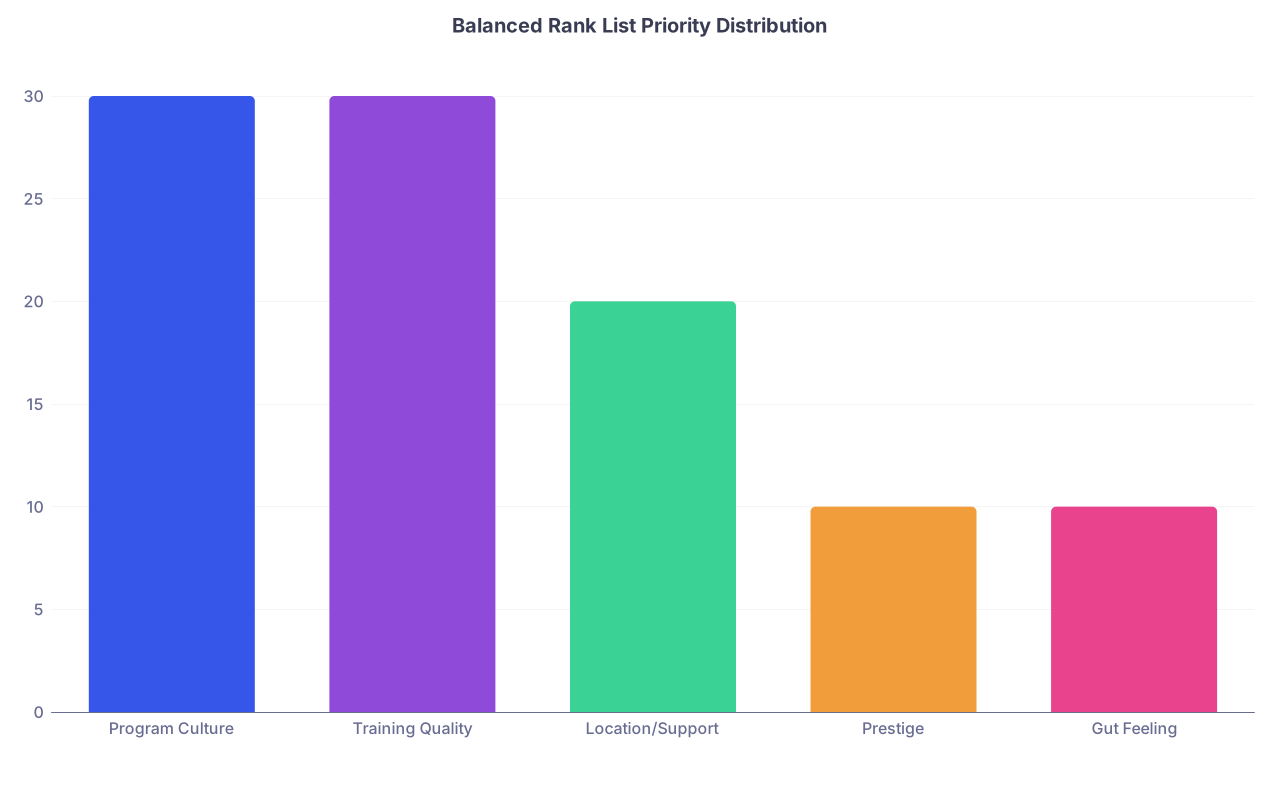
| Category | Value |
|---|---|
| Program Culture | 30 |
| Training Quality | 30 |
| Location/Support | 20 |
| Prestige | 10 |
| Gut Feeling | 10 |
Let’s talk about how you actually avoid this mistake when you sit down with your spreadsheet, your notes, and your anxiety.
1. Force yourself to write non-prestige reasons for every program
For each program you’re considering ranking high, write down:
- One concrete thing about the residents you liked
- One concrete strength in training or curriculum
- One concrete thing about lifestyle or logistics that works for you
If the only honest sentence you can write is “It’s very prestigious,” that program has no business in your top three. Maybe in the middle. Maybe.
2. Do a brutal reality check on your competitiveness
Overconfidence wrecks ranking lists.
Compare your profile honestly to typical matched residents at those “dream” programs:
- Board scores
- Research output in that specialty
- Med school reputation (yes, it can matter for some top places)
- Honors/awards, AOA, Gold Humanism
- Red flags (gaps, failures, leaves)
If you’re clearly below their typical range in multiple categories, don’t load the top of your list with them. Sprinkle a few at the top or middle, then anchor your list with strong realistic options.
Dreams are allowed. Denial is not.
3. Protect your realistic programs from your ego
This is the part many people skip—and regret.
Take the programs where:
- You had genuinely good interviews
- Residents seemed happy
- You’d realistically thrive
Then make sure at least some of those are in your top 5–8, even if the brand names are mid-level.
This doesn’t mean you can’t put prestigious ones above them. It means you don’t shove your best-fit realistic options to #15 “just because.” That’s how you end up missing them entirely.
4. Trust your gut on bad vibes—even at big-name places
If you walked out of an interview day at a famous program thinking:
- “Those residents looked dead.”
- “I felt small or talked down to.”
- “No one asked about me as a person.”
Do not ignore that. If the red flags were obvious during the performance of interview day, they will be worse when the show is over and you actually work there.
No prestige fixes a fundamentally bad fit.
Quick Reality Checks Before You Finalize Your List
Before you certify your rank list, ask yourself these uncomfortable questions and answer them honestly, not how you’d answer in front of your classmates.
- Would I still rank this program this high if it had a generic name but the exact same people, culture, and training?
- If I matched at my #3 instead of my #1, would I still be proud of where I’m going, or embarrassed because of what others will think?
- Am I ranking anything high that gave me genuine “this feels wrong” vibes just because of the logo?
- On my worst day, at 3 a.m., in the middle of winter, can I survive this city, this hospital, these people for years?
- Would future-me thank present-me for this choice, or curse me for chasing external validation?
If the honest answers make you squirm, fix your list. That discomfort is you noticing you’re about to make the prestige mistake.
FAQ (Exactly 5 Questions)
1. Isn’t it smart to rank the most prestigious programs first since the algorithm favors applicants?
It’s smart to rank the programs where you genuinely want to train first. Very prestigious programs belong at the top of your list only if three things are true: you liked them, you’re a reasonably good fit/competitive, and the training and lifestyle are tolerable for you. The algorithm can’t conjure a match where a program hasn’t ranked you high enough. Overloading the top of your list with unrealistic, prestige-only choices just increases the risk that you’ll miss out on strong, realistic programs that actually wanted you.
2. Will going to a less prestigious residency hurt my chances at fellowship or jobs?
Not if you perform well. Program name is one factor, but strong letters, good evaluations, solid board scores, and real clinical ability matter more. I’ve seen residents from “no-name” places match competitive fellowships because they were excellent and well-supported. A famous program with weak performance and lukewarm letters is worse than a solid program where you thrived and people will go to bat for you.
3. What if I hated a top program’s vibe but love the name—should I still rank it high “for options”?
No. Ranking somewhere you actively disliked high “just in case” is gambling your happiness and mental health for a logo. If your gut said no—residents looked miserable, culture felt malignant, or you felt dismissed—believe that. You’re signing up for years, not a weekend conference. That program should be low on your list or off it entirely, no matter what its reputation is.
4. How many reach or prestige-heavy programs is reasonable near the top of my list?
It depends on your competitiveness, but a rough rule: a few reaches at the top (maybe 2–4) are fine if you truly liked them. After that, you should be stacking programs where your chances of matching are solid and the fit is good. If your top 10 is basically all “reach” or ultra-elite places and you’re not a top-of-the-pile candidate, you’re courting trouble. Balance ambition with realism.
5. My classmates are all gunning for big-name programs. Won’t I look weak if I choose a strong but less famous place?
Your classmates aren’t living your life, working your call shifts, or carrying your pager. You are. Looking “impressive” for a week after Match Day is meaningless compared to three to seven years of training quality, mental health, and career growth. The people whose opinions actually matter—future colleagues, attendings, fellowship directors—care far more about how good you are than what your program’s Instagram looks like. Choose the place that will make you excellent, not just impressive on paper.
If you remember nothing else:
- Prestige is a bonus, not a foundation.
- Program culture, training quality, and a livable life beat a big logo every time.
Do not sacrifice three to seven years of your life just to impress people who won’t even be on your sign-out list.


