

The residency match does not punish weak students as harshly as it punishes disorganized ones. Rank list procrastination is how strong applicants lose good matches to people with lower scores but better planning.
You can survive a mediocre Step score. You will not survive a chaotic, last‑minute rank list built in a panic 2 hours before the deadline.
Let me walk you through the biggest last‑minute errors that quietly sabotage solid applications every single year—and how to avoid joining that group.
The Silent Disaster: Treating the Rank List as “Admin Work”
The first mistake is conceptual: thinking your rank list is paperwork instead of strategy.
I have watched people treat ERAS and NRMP like airline portals. Interviews done, brain exhausted, so they open the rank portal at 10:30 p.m. on deadline day and think, “I’ll just put them in order real quick.”
That “real quick” is how you get:
- Emotional decisions based on the last interview instead of the best program
- Sloppy ordering that contradicts what you actually want
- Typos and misclicks that reorder your entire future
Here is what procrastination usually looks like:
You tell yourself in January: “I’ll make my list after my last interview.”
Then: “I’ll do it after my away rotation.”
Then: “I’ll work on it this weekend.”
Suddenly it is the final week. You are post‑call, exhausted, and staring at 14 programs with half‑remembered details.
By that point, you are not “deciding.” You are reacting. And reactive ranking is dangerous.
The rank list is not admin. It is the single highest‑leverage decision in your medical training since choosing your specialty.
So the first rule: you do not “fit in” your rank list. You schedule it like an exam.
Mistake #1: Ignoring the “Rank by True Preference” Rule
Let me be blunt: if you are gaming the algorithm in the last 48 hours, you are already in trouble.
The NRMP algorithm favors the applicant’s preferences. Not the program’s.
Yet every February, people still say absurd things like:
- “I think Program X likes me more, so I’ll rank them higher even though I prefer Y.”
- “They told me I’m ‘very high on their list,’ I should bump them up.”
- “I heard Program Z doesn’t rank people who did not do an away, so I’ll drop them.”
This is how procrastination plays out: there was plenty of time months ago to read how the algorithm works. They did not. So at the last minute, rumor becomes strategy.
You absolutely must internalize this:
- You rank programs in the EXACT order you would choose them if all options were guaranteed.
- You do not try to predict where programs rank you.
- You do not lower a program you prefer because you “probably won’t match there.”
That is how people end up at a “safety” program they did not even like, while an aspirational program that would have ranked them high is sitting just below it on their list.
If you want to avoid this mistake:
- Stop reading Reddit “match algorithm hacks.”
- Read the NRMP’s own explanation of the algorithm early in the season, not at midnight on rank day.
- Make any program move explainable in plain language: “I prefer this program more because ___,” not “I heard they…”
Mistake #2: Confusing Recency Bias With Genuine Preference
Procrastinators build rank lists from memory. Memory lies.
Your last 2–3 interviews will feel sharper, warmer, more “real” than the ones you had 6 weeks ago. Not because they were better. Just because they were recent.
I have seen this pattern over and over:
- Early‑season program: strong training, great procedural volume, residents you genuinely clicked with.
- Late‑season program: solid but nothing special, happened to be on a sunny day with a nice lunch and an enthusiastic chief.
- Rank day: you vaguely remember being “tired” at the first; the last one is vivid and friendly, so it climbs.
This is how otherwise rational students suddenly put a mid‑tier program over a place that fits their goals far better.
The antidote is boring and unglamorous: structured notes taken immediately after each interview.
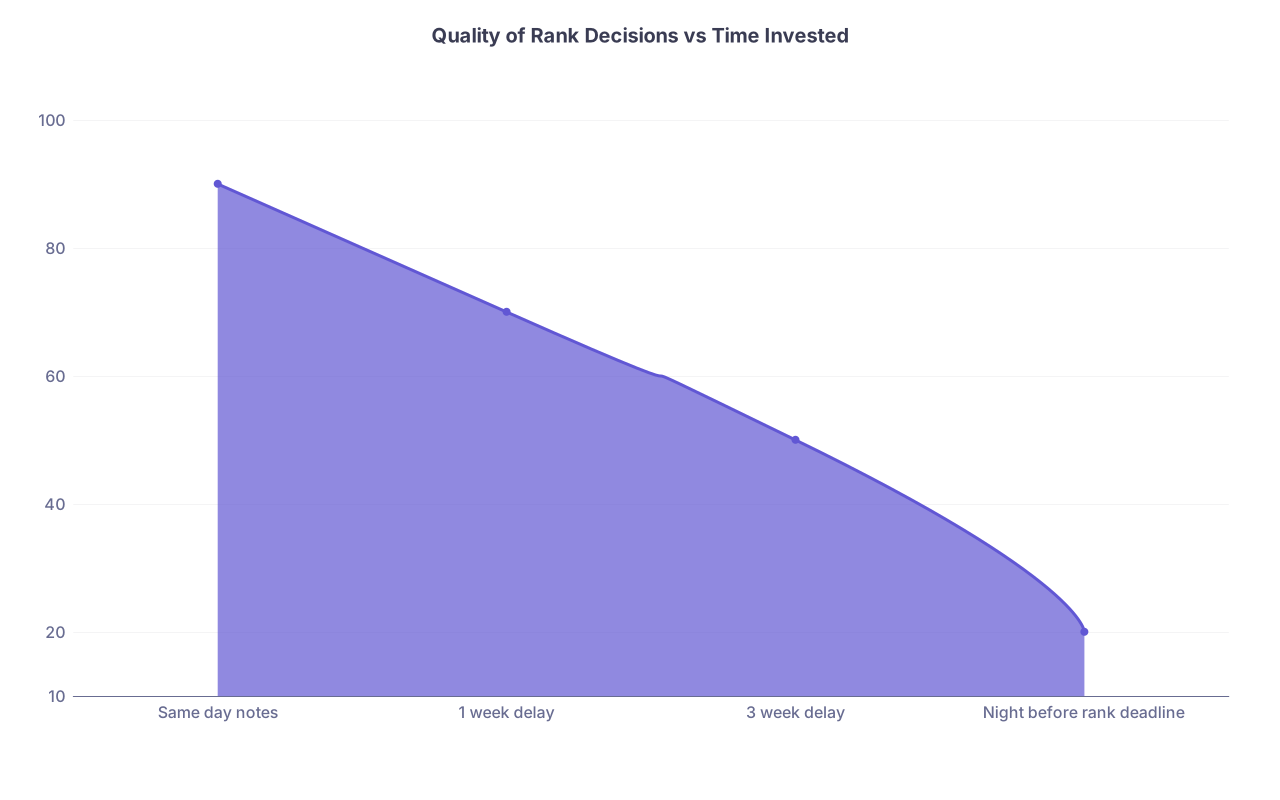
| Category | Value |
|---|---|
| Same day notes | 90 |
| 1 week delay | 70 |
| 3 week delay | 50 |
| Night before rank deadline | 20 |
Notice the cliff. You think you remember. You do not.
If you procrastinated and you are already late in the season, do damage control:
- Write down everything you still remember for each program right now
- Pull up your interview day emails, schedules, and brochures to jog your memory
- Message co‑applicants you trust: “What did you think of X vs Y?” to fill gaps (not to copy their ranks)
You are trying to reconstruct objective impressions to fight your brain’s obsession with “recent = better.”
Mistake #3: Ranking on Vibes, Not Training Realities
When you cram your rank list at the end, you over‑weight superficial things because deeper analysis takes time you no longer have.
The classic last‑minute distortions:
- Overvaluing free food, fancy lounge, or a shiny new hospital
- Undervaluing resident workload, case volume, and fellowship placement
- Confusing “fun interview day” with “sustainable 3–7 years of training”
You will see this most brutally in competitive fields like surgery, EM, or anesthesia. A program with a very charming PD and cute social hour suddenly leaps above a place with consistently strong board pass rates and fellowship matching.
You can like both. But if it is 1:00 a.m. and you are dragging programs up and down based on who was funniest on Zoom, you are not ranking. You are gambling.
At minimum, you should have these factors written down and weighed for each program:
| Factor | Why Last-Minute Thinkers Miss It |
|---|---|
| Case/clinic volume | Requires looking up hard data |
| Board pass rates | Buried on websites, not in slides |
| Fellowship placement | Takes time to interpret |
| Resident workload | Easy to ignore if not written |
| Culture/support | Fades without notes |
When you procrastinate, you default to what is loudest and easiest: the resident who cracked jokes, the nice hotel, the way someone said, “We really like you.”
You must anchor yourself to training realities first. Then layer in lifestyle and vibes.
If you have already procrastinated and you are short on time:
- Pick your top 6–8 programs.
- For those only, force yourself to check: board pass rates, fellowship lists, call schedule, and whether graduates get jobs you actually want.
- Use that to finalize the top of your list. The bottom half matters less than the top 5–7 in terms of happiness.
Mistake #4: Panicking About Geography and Family at the Last Second
Genuine family constraints are valid. Throwing your rank list into chaos because of a single emotional phone call the night before the deadline is not.
This is another procrastination special. People avoid real conversations with partners or family for months because they are uncomfortable. Then:
- Parent suddenly says, “I thought you would be closer to home.”
- Partner says, “I didn’t realize you were serious about moving 3 states away.”
- Friend says, “Why are you ranking that program so high? The city is awful.”
Cue: mass last‑second reshuffling based on guilt, fear, or drama—not on serious, pre‑discussed priorities.
The problem is not caring about geography. The problem is caring about it late, without structure.
Ideally, months before rank day, you would have:
- A clear hierarchy like: “Career opportunities > partner’s job > distance to family > climate”
- An honest conversation with your partner about worst‑case scenarios: long‑distance, job market, kids
- A reality check on cost of living and safety vs hype and nostalgia
If you skipped all that and you are at the end, you need a stripped‑down version:
- Write down your top 3 non‑negotiables (e.g., “Must be within X miles of partner,” “Must have strong fellowship placement”).
- For each program in your top 10, check: does it violate any non‑negotiable?
- Do not let guilt alone promote or demote a program that still meets your core needs.
You cannot untangle 10 years of family dynamics in 48 hours. Do not let that chaos rearrange your rank list into something you will quietly resent later.
Mistake #5: Overreacting to “Signals” From Programs
Last‑minute rankers are highly suggestible. Any email, phone call, or off‑hand comment from a PD in February can blow up weeks of careful thinking—if you have not actually committed your preferences to a draft list.
Classic traps:
- “You’re very high on our list.”
- “We hope to see you here in July.”
- Handwritten cards with warm language.
- Residents saying, “We really want you to come.”
Some of this is genuine enthusiasm. Some is code for “you are on our massive middle tier of rankable people.”
The worst consequence of procrastination is that your rank list lives mostly in your head, not in a doc. So these signals feel like new, privileged information instead of what they are: noise.
Then you get the late‑night move: “They called me. I owe them. I should bump them up.”
No, you do not “owe” any program your top spot because they said something nice.
The algorithm does not care who emailed you. It cares what order you put the programs in.
Healthy way to incorporate genuine positive signals:
- Use them as a tiebreaker between programs you like equally
- Do not use them to leapfrog a program you genuinely prefer in training, location, or fit
- Remember some specialties (like EM, anesthesia, derm) are notorious for over‑flattering applicants
If you want to be especially safe: draft your rank list before the heavy “love letter” season kicks in, then only make changes that you can justify on your terms, not theirs.
Mistake #6: Technical Sloppiness and Portal Errors
This is the most boring mistake—and the one people regret the most.
I have seen:
- Rank lists not certified because the applicant thought “saving” was enough
- Programs accidentally left off
- Duplicated prelim / advanced ranks that made no sense
- Applicants mis‑ordered advanced and prelim programs and ended up unmatched in one or both
Procrastinators do not leave time for basic QA. They hit “submit” and run.
You cannot afford that. The portal is clunky and unforgiving. And if you are dual‑applying (categorical + advanced, or prelim + advanced), it is very easy to misconfigure things.
At minimum, you must:
- Confirm you have included every program where you interviewed that you would genuinely attend
- Double‑check advanced specialties (radiology, anesthesia, neuro, derm) have linked prelim TY or medicine/surgery years ranked appropriately
- Make sure you hit “Certify” and see the confirmation, not just “Save”

| Step | Description |
|---|---|
| Step 1 | Draft list in document |
| Step 2 | Enter list in NRMP |
| Step 3 | Check all programs included |
| Step 4 | Verify order program by program |
| Step 5 | Confirm prelim/advanced links |
| Step 6 | Step away 30 min |
| Step 7 | Re-check from top to bottom |
| Step 8 | Certify list |
| Step 9 | Verify certification date/time |
If you are reading this within 24–48 hours of the deadline, force yourself to do the “step away 30 minutes” step. Your brain catches obvious mistakes only when you are not frantic.
Mistake #7: Neglecting Prelim / Transitional Year Strategy
Prelim years are where procrastination wreaks havoc quietly.
I have seen advanced‑match applicants (radiology, anesthesia, ophtho, derm, PM&R) obsess over their advanced program ranks, then slap together prelim lists on the final day. They tell themselves, “It’s just one year.”
Then they discover:
- Their prelim program has brutal call and no elective time, killing fellowship opportunities
- Their prelim city is so expensive or unsafe that they are miserable
- Their prelim schedule makes it almost impossible to move or coordinate with the advanced site
Because they waited so long, they made no real comparison between prelim options.
Do not forget: a toxic, malignant prelim can wreck your mental health and torpedo your early career just as effectively as a bad advanced program.
You must:
- Rank prelim programs seriously based on workload, culture, and location
- Consider how far they are from your top advanced programs (for moves, partner logistics)
- Avoid treating any prelim as “filler” you just toss at the bottom if you would truly hate being there
If there is a prelim you would never attend under any circumstances, do not rank it. Ranking = consenting to match there.
Mistake #8: Copying Friends’ Rank Logic Instead of Owning Your Priorities
Last‑minute applicants copy. There is no time to think from first principles, so they ask:
- “Where are you putting X?”
- “Are you ranking Y above Z?”
- “I heard everyone hates Program W; I’m moving it down.”
This is not collaboration. It is outsourcing your life.
Your friends:
- Do not have your debt, your family situation, your tolerance for call, or your long‑term career goals
- May be regurgitating gossip from people who did not interview at that program
- Are just as sleep‑deprived and biased as you
Discussion with trusted classmates can be helpful. But if your rank list ends up looking suspiciously similar to your group chat’s, you have probably given away agency.
Late in the game, if you are seeking input, keep it narrow:
- Use friends to recall specific facts: “Was the night float q4 or q6?”
- Ask targeted questions of mentors: “Between these two for GI fellowship prospects, who would you choose and why?”
- Do not ask: “What should my rank order be?” That is your job.
If you feel tempted to mirror someone else’s list, stop and write down your top 3 values for residency. Then re‑evaluate whether your current rank list actually matches those values—or just someone else’s.
Mistake #9: Over‑Compressing the Timeline
The real structural error under all of this: treating rank list creation as a single event instead of a process.
Procrastinators do this:
- “I’ll sit down on Sunday and just crank it out.”
They compress what should be a multi‑step process into one frantic session.
A safer structure spreads the cognitive load:
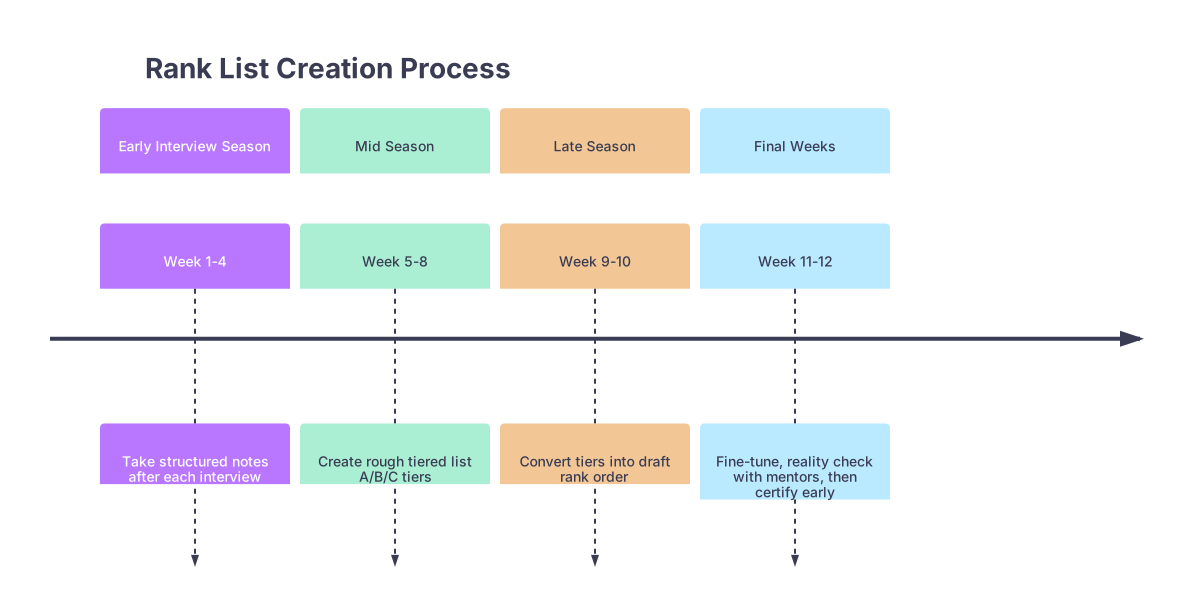
| Period | Event |
|---|---|
| Early Interview Season - Week 1-4 | Take structured notes after each interview |
| Mid Season - Week 5-8 | Create rough tiered list A/B/C tiers |
| Late Season - Week 9-10 | Convert tiers into draft rank order |
| Final Weeks - Week 11-12 | Fine-tune, reality check with mentors, then certify early |
If you are late and reading this in the “final weeks” box, you cannot fully undo the compression. But you can still simulate the steps in a shorter window:
Day 1–2: List all programs and assign crude tiers (top/mid/lower).
Day 3–4: Order within each tier.
Day 5: Merge into one continuous list, check against your written priorities.
Day 6: Sleep on it, small adjustments only.
Day 7: Enter and certify.
Anything is better than “jam it all into one exhausted evening.”
Mistake #10: Letting Anxiety Drive Endless Re‑Shuffling
There is a special flavor of procrastination near the deadline: obsessive tinkering.
Not doing nothing. Doing too much. Moving Program A above B, then back down, then above again, ten times in one night.
You tell yourself you are “refining.” You are not. You are pacifying anxiety.
Common red flags:
- You have no new information, but keep swapping the same 2–3 programs
- You are measuring decisions in feelings of relief rather than in clear reasons
- You keep reopening the portal “just to check”
At some point, your rank list stops getting better and starts reflecting your moment‑to‑moment mood swings.
The fix is harsh but necessary: set a personal deadline 48–72 hours before the official one. When you hit that, you stop re‑ordering without new, significant data.
If you fear “what if I am wrong,” write down your rationale for your top 5–6 choices. Then, when you feel the urge to change them again out of anxiety, force yourself to write a new rationale. If you cannot produce genuinely better reasoning, leave it alone.
What To Do Today
You avoid match‑day regret by doing unglamorous work now, not by hoping for luck later.
Here is your immediate, concrete next step:
Open a blank document and list every program where you interviewed. For each, write:
- 3 pros
- 3 cons
- Your gut 1–10 preference score, ignoring what you think they think of you
Do it today, even if you think you remember everything. That document becomes your anchor against every last‑minute rumor, love letter, or panic spiral.
Then, highlight your top 5–7 by that gut score. Those are the programs that deserve your deepest attention and most deliberate ordering.
Do not wait for “when I have a full free day.” That day is not coming.
Start the list. Now.


