

What if the “safety programs” you’re clinging to on your rank list are actually the single biggest threat to your match — not your protection from it?
Let me be blunt: the idea of “safety programs” on your rank order list is one of the most persistent, dangerous misunderstandings I see every single match season. It feels comforting. It feels strategic. It is usually neither.
Residents do not talk about this enough: people get burned every year because they misunderstand how risk really works in the Match. They either:
- Rank too many “safeties” way too high and end up unhappy — and stuck
- Or act like they have true safeties when they absolutely do not
Both are preventable. If you avoid a few very common errors.
The “Safety Program” Myth: Why It’s So Seductive — and So Wrong
Here’s the core mistake: treating residency like college admissions.
In college apps, you have “reach, target, safety” based on stats. Lower-ranked school? Higher acceptance rate? Good SAT? That’s a safety. You can game it with numbers.
Residency doesn’t work that way.
You do not have “acceptance rates.” You have:
- An algorithm
- Program subjectivity
- Small numbers
- And a lot of noise
Students sit in advisor offices saying things like:
“I’ll rank that community program high — it’s my safety.”
They think “less competitive reputation = safe.” That’s not how the Match thinks. That’s not how program directors think. And that’s not how the algorithm works.
The big truths you can’t ignore:
- A lower-tier or community program is not automatically more likely to rank you highly
- A program that interviewed you is not automatically “safer” than one with a stronger reputation
- You do not control where you’re ranked on their list — only where they are on yours
Assuming any specific program is a “guarantee” (or even “highly likely”) just because it’s less prestigious is how people end up either:
- Going unmatched, or
- Matching at a place they secretly never wanted but ranked too high “for safety”
Both outcomes feel awful. And they don’t need to happen.
How the Algorithm Really Destroys the “Safety” Illusion
Let’s walk through what actually happens. Not the fantasy version.
The NRMP algorithm is applicant-proposing. That means it tries to give you the highest-ranked program on your list that also ranks you high enough on their list to fill a spot.
Notice what’s missing: “least competitive” isn’t a concept the algorithm cares about.
Here’s the real danger: most applicants misinterpret the risk.
They think:
“If I put some safety programs at the top, I reduce my chance of not matching.”
What they often really do is:
Increase their chance of matching somewhere they never truly wanted, while not meaningfully changing their risk of going unmatched.
Because if a “safety” program ranks you high enough to match there, you would probably have matched at one of your higher, actually-desired programs if you had listed them first.
The classic mistake scenario
You rank like this (for a core specialty like internal medicine):
- Program A – academic, strong university
- Program B – solid university + good location
- Program C – community, you didn’t like the culture, but “safety”
- Program D – community, felt off, but “super safe”
What actually happens:
- Program A ranks you within their matchable range
- Program B ranks you within their matchable range
- Program C ranks you even higher
- Program D ranks you high enough too
The algorithm goes to your #1, sees if Program A can take you. If yes — you match there. It doesn’t “penalize” you for also ranking C or D.
But if you panic and do this:
- Program C – “safety”
- Program D – “super safety”
- Program A
- Program B
Now if C ranks you high enough to get you, you match there. The algorithm never even looks at A or B for you.
You didn’t increase your safety. You just voluntarily blocked yourself from places you liked more.
That’s the part students refuse to internalize until they see it happen to a friend. “I thought I was just being realistic.” No — you were misusing risk.

| Step | Description |
|---|---|
| Step 1 | You rank programs |
| Step 2 | Best fit program that ranks you highly becomes your match |
| Step 3 | You match at lower preferred program if they ranked you highly |
| Step 4 | Higher preferred programs never even considered |
| Step 5 | Do you list true preferences in order? |
Five Specific “Safety” Mistakes That Blow Up Rank Lists
I’ve lost count of how many times I’ve watched these exact errors.
1. Ranking a program high just because “they seemed really interested”
Common self-delusion:
“They sent me a nice follow-up email.”
“The PD said they’d love to have me.”
“They asked about couples matching — that must mean I’m high on their list.”
None of that equals safety.
Programs send warm emails to tons of applicants. Sometimes to everyone. Some PDs over-promise or speak loosely. I’ve heard lines like:
“We rank all interviewed applicants to match.”
You know who still went unmatched from that interview group? At least one person.
If you don’t actually want to train there, do not rank it high just because you think they “like” you more than your dream place. You’re guessing. And often wrong.
2. Using geography as a lazy “safety” proxy
“I’ll put this rural program high — no one else wants to go there.”
You don’t know that. What you do know:
- Geography heavily clusters applicant preference
- People with ties to that region are disproportionately applying and interviewing there
- Program directors know that and select for fit and commitment
So your “no one wants to go there” assumption is usually false. Especially if:
- You have no regional ties
- You’re vague about why you want that city
- Your application screams “big academic center”
That rural “safety” might like you less than the urban university you’re scared to rank above it.
3. Treating community programs as inherently “safer”
I hear this all the time:
“It’s not university-affiliated, so it’s my backup.”
Reality: some community programs in popular cities (think Southern California, NYC suburbs, Florida coastal areas) are more competitive than mid-tier university hospitals in less flashy places.
What actually drives community program competitiveness:
- Desirable city or lifestyle
- Strong fellowship pipeline (unofficial but known)
- Big emphasis on resident autonomy and procedure volume
- Word-of-mouth reputation among residents, not students
You, as a student, often have no idea which “small” programs are hot targets for savvy applicants.
4. Confusing “I could survive here” with “I’d be okay matching here”
This one’s sneaky.
“I mean, I didn’t love it, but I could tolerate it for 3 years.”
That’s not realism. That’s you underestimating how long and hard residency feels when you hate your environment.
If you rank a “safety” you dislike above a place you loved because you think it’s “more realistic,” you’re setting yourself up for:
- Chronic resentment
- Second-guessing your entire career choice
- Wondering every night call “Why did I do this to myself?”
Do not underestimate how much culture, support, and fit matter when you’re working 60–80 hours a week.
5. Believing “more safeties = less chance of going unmatched”
If you already interviewed at a reasonable range of programs for your specialty risk profile, adding more low-desire, mid-tier places high on your list almost never meaningfully reduces your unmatched probability.
You know what reduces unmatched risk? Having:
- Enough total interviews
- A realistic specialty choice for your stats
- A long enough rank list — but in your true order
Not: “five places I hate at the top so I’ll ‘definitely’ match.”
You might succeed — and hate your success.
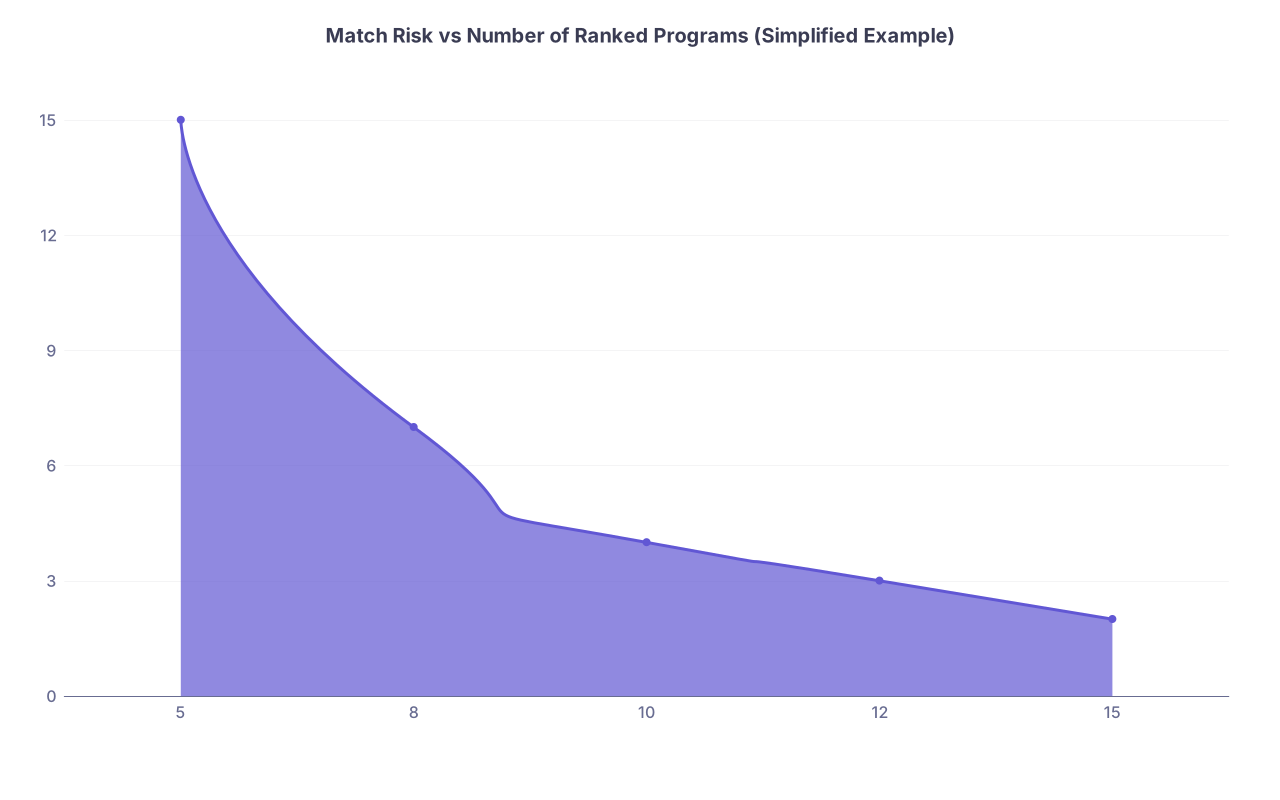
| Category | Value |
|---|---|
| 5 | 15 |
| 8 | 7 |
| 10 | 4 |
| 12 | 3 |
| 15 | 2 |
(Illustrative example: past NRMP data show unmatched risk drops mainly with total number of ranked programs, not with “safetiness” of specific ones.)
The Right Mental Model: Preference, Not Protection
You need to tattoo this somewhere in your brain:
Your rank list is not a risk management tool. It is a preference list.
The algorithm is already structured to give you the best outcome it can based on your stated preferences. When you try to outsmart it with “strategy,” you usually sabotage yourself.
The safest way to rank programs is ironically the simplest:
Rank programs in your honest order of desirability, from “I’d be thrilled to train here” to “I’d still rather match here than go unmatched.” In that order. Nothing else.
If you would be genuinely upset to match at a program, it doesn’t belong above a program you’d be happier at. Ever.
Not because of:
- Perceived competition
- Hearsay about “they rank aggressively”
- Your imagination about where you stand
Program lists are black boxes. Your only lever is your own list.

When a “Safety” Does Make Sense — And How Not to Abuse It
Let me be fair: there are situations where having “lower preference but acceptable” programs on your list is appropriate. The mistake is calling them “safety” and then putting them too high.
Use this test:
- Would you rather do a prelim year at a less desired program than go unmatched?
- Would you rather SOAP re-enter, take a research year, or reapply than spend three years in that environment?
Your answer to those questions should determine whether — and where — a program belongs on your list.
Example: Reasonable use of lower-preference programs
A realistic, honest list might look like:
1–6: Programs you’d be genuinely happy and proud to attend
7–10: Programs you’re neutral on, but could imagine having an okay experience
11–14: Programs you’re lukewarm on, but still prefer over going unmatched or SOAP
Nothing above is placed for “strategy.” It’s ranked by: “Would I prefer three years here vs three years there?”
That’s the only metric that matters.
Now compare that with what I actually see:
1–3: Decent programs you liked
4–6: “Safer” programs you didn’t like as much but felt were more realistic
7–8: Your true dream programs you put lower “to not waste a spot”
This is backward. You are voluntarily lowering your probability of matching at the place you want most.
| Approach | What It Looks Like |
|---|---|
| Good use of “lower preference” | Ranked *after* all programs you truly prefer |
| Bad “safety strategy” | Ranked *before* programs you actually want more |
| Algorithm-friendly | Ranks reflect true happiness order |
| Algorithm-fighting | Ranks reflect guesswork about “where I’ll match” |
Specialty Differences: Where the Myth Is Especially Dangerous
Not all fields are equal here. The “safety program” myth is particularly toxic in certain specialties.
Competitive specialties (Derm, Ortho, ENT, Plastics, Ophtho, etc.)
In highly competitive fields, students often try to “safety” with:
- Less famous academic programs
- Smaller cities
- “Friend-of-a-friend” programs where someone said, “We like your med school”
Big mistake. In these specialties:
- Applicant pools are small
- Subjective fit matters a lot
- PDs know they can be selective even if they’re not brand-name
You’re not going to outsmart a tiny market by ranking “non-elite” places first. You’re just as likely to be wrong about your chances there as anywhere else.
Primary care (FM, IM, Peds, Psych)
Here people make the opposite error:
- They massively underestimate some “quietly strong” community programs
- They assume “FM is less competitive so everything is safe”
- They rely on a couple of nearby “safeties” and don’t build a broad list
Then March comes, and they’re shocked how many community-heavy interview groups still have applicants unmatched.
Again: no program is your personal safety unless you have an actual signed contract. Which you do not.
, Location-based guessing, Advisor insight, Program track record, Algorithm understanding](https://cdn.residencyadvisor.com/images/articles_svg/chart-perceived-vs-actual-safety-of-programs-2180.svg "Perceived vs Actual Safety of Programs")
| Category | Value |
|---|---|
| [Prestige-based guessing](https://residencyadvisor.com/resources/residency-ranking-strategy/ranking-for-prestige-only-the-residency-list-mistake-that-backfires) | 80 |
| Location-based guessing | 70 |
| Advisor insight | 40 |
| Program track record | 30 |
| Algorithm understanding | 10 |
(High = commonly used. Low = rarely used. The most accurate signals — actual track record + understanding the algorithm — are used the least.)
SOAP, Prelim Years, and the “I’ll Figure It Out Later” Trap
A quiet, dangerous thought creeps in around February for weaker applications:
“I’ll just rank safer and if it’s bad, I can always transfer or use SOAP or do a prelim year and reapply.”
You’re playing with fire.
Reality checks:
- Transfers are rare, political, and often painful. You’re not just trading programs like fantasy football.
- SOAP is chaotic, stressful, and offers limited, rapidly shifting options. It is not a controlled “Plan B” experience.
- A prelim year + reapply path is absolutely brutal. You’re working full-time as a resident while trying to rescue your future. Not fun.
I’ve seen people survive those paths. Some land on their feet. But many regret ever assuming those were easy escape hatches from a “safety” they didn’t really want.
SO: rank as if you are going to live with this outcome. Because you probably are.

A Practical Way to Build a Rank List Without the “Safety” Trap
Here’s a straightforward method that keeps you out of trouble.
Make a completely unfiltered list
Write down every program where you interviewed. No order. Just the set.Mark each one with a gut-level category
Use something simple:- A = I’d be happy or excited to match here
- B = I’d be fine / neutral here
- C = I’d only go here rather than be unmatched or SOAP
- D = I’d honestly rather go unmatched / SOAP / reapply
Delete all D’s from your list
Yes, even if you think they’re “safe.”
If you would actually prefer to re-apply than train there, they should not be ranked at all.Rank all A’s in your true preference order
Don’t overthink “chances.” Just ask:
“If I woke up on Match Day and got this program, would I be happier than if I’d gotten that one?”Rank all B’s next, in true preference order
Same principle. Don’t play guessing games about their competitiveness.Add C’s only if you truly accept that choice
If you rank them, you are explicitly stating: “Matching here > going unmatched.”
If that’s not true, don’t rank them.
This forces you to think about your actual life, not your speculative odds.

The Three Quiet Red Flags You’re Falling for the Safety Myth
If you catch yourself saying any of these, pause and re-evaluate:
“I’m ranking them higher because they’re more realistic.”
Translation: “I’m guessing they like me more.” Dangerous and usually wrong.“I didn’t love it, but I know I’ll match there.”
No, you don’t know that. And if you’d be unhappy, that’s an awful reason to rank high.“I’ll just transfer if it’s bad.”
That’s not a strategy. That’s an escape fantasy.
Stop and re-anchor to the only safe rule: rank by genuine preference among programs you can live with.
Key Takeaways
- There is no such thing as a guaranteed “safety program” in the Match. Lower-tier or community does not equal safe.
- The algorithm already favors you; trying to “strategize” by ranking safeties higher usually only blocks you from places you’d prefer.
- Build your rank list in your honest order of where you’d want to train, among programs you can truly accept — and leave everything else off.


