

The illusion that programs “have no idea” where you ranked them is comforting. It is also false.
Program directors do try to guess where you ranked their residency. And they’re better at it than you think—especially at the top and bottom of your list.
Let me walk you through what actually happens in those rooms, what PDs read between the lines, and how they decide which applicants probably ranked them #1… and which ones used them as filler.
How Programs Actually Try To Guess Your Rank
Here’s the first secret: nobody has a formal “rank prediction” field in the software. There’s no button that says “Applicant X ranked us #3.” But people absolutely say the quiet part out loud during ranking meetings.
You’ll hear things like:
- “He’s clearly ranking Cardinal higher than us, but we should still keep him in our top 10.”
- “She told me we were her #1; I believe her.”
- “If he ranks us, we’ll match him. The question is: will he?”
That last one is the key dynamic:
Programs are constantly estimating: If we rank this person here, what’s the probability they rank us high enough that a match actually happens?
They build that probability from specific signals:
- Your pre-interview communication
- How you behaved on interview day
- What you wrote in your thank-you emails
- Whether you sent a “you’re my top choice” message
- Who else interviews you (they track this)
- Your geographic patterns
- The vibe from your conversations with residents
No single factor proves anything. But PDs stack clues until the pattern is obvious.
The Signals PDs Use To Guess Where You Ranked Them
This is what you came for. I’ll go through the actual levers program directors and rank committees pay attention to, one by one.
1. Your Behavior On Interview Day
Nobody says, “I ranked you #4.” But they don’t have to. People give themselves away constantly.
I’ve watched PDs and core faculty debrief right after a full interview day. They’re not talking about your Step score. That’s already in the spreadsheet. They’re talking about where they think you’ll rank them.
Here’s what moves the needle.
A. Comparative language
The moment you say something like:
- “This has been my favorite interview so far.”
- “Your program is very high on my list.”
- “I really see myself here more than at some of the others I’ve seen.”
They note it. Literally. In their post-interview form, there’s almost always a free-text comment box. Faculty will write:
- “Said we were his top choice so far.”
- “Very enthusiastic; implied we were top 3.”
- “Noncommittal about interest.”
Faculty are not subtle with each other. They’ll say in the meeting: “He basically told me we’re his #1.” Or: “She’s clearly aiming for Big Name programs; we’re a backup.”
B. Emotional congruence
You can’t fake this well.
Programs see hundreds of applicants. They can tell the difference between:
- Polite, generic “this is a great program, excellent teaching, strong clinical volume”
- Versus someone who lights up when talking about what this program offers specifically
If you’re animated, asking detailed questions about their curriculum, elective structure, fellowship match, niche tracks—programs correctly infer you’ve actually thought about yourself there. That usually means they’re higher on your list.
If you’re obviously on autopilot, reading from a script, or asking questions you could have answered from the website, they read that as: “We are mid-pack or lower on this person’s list.”
C. Micro-signals residents notice
Residents are brutal and usually right. In debrief, I’ve heard:
- “She kept asking about moonlighting and time off. Didn’t care about our research or conferences.”
- “He said he hates cold weather; we’re in Minnesota.”
- “They clearly want to be in California; all their questions were about fellowship and leaving.”
Residents will explicitly say, “I don’t think we’re high on his list.” PDs take that seriously. Residents are the best BS detectors in the building.
2. Follow-Up Emails, Thank-Yous, and “Love Letters”
You’ve heard conflicting advice about post-interview communication. Let me cut through the noise.
Programs absolutely read them. They absolutely categorize them. And they absolutely try to infer your rank position from them.
But they’re not stupid. They know half of you are lying.
The hierarchy of strength in signals looks like this:
| Signal Type | How Strong PDs Consider It |
|---|---|
| Explicit, personalized “You are my #1” | Very strong (if believable) |
| “You’re one of my top choices/top tier” | Moderate |
| Generic thank-you with light enthusiasm | Weak |
| No communication at all | Very weak / negative |
The trick is: believability.
A. The “You are my #1” email
Programs remember these. In rank meetings, you will hear: “She sent me a sincere email saying we’re her #1. I believe her.” Versus: “He told 4 programs the same thing according to Twitter/rumors; I don’t trust it.”
What makes it believable:
Very specific reasons (and I don’t mean “diversity, teaching, and research”). I mean:
“Talking with Dr. Smith about your ICU rotation structure and the way you allow seniors to run family meetings is exactly the responsibility I’m looking for.”
That reads like someone who recalled the day in detail. Not boilerplate.References to specific resident or faculty conversations.
A consistent story that matches what you said during interview day.
If you say: “You are my top choice” and a week later you’re asking for interview accommodations from an obviously more prestigious program 2 blocks away (yes, coordinators talk), PDs know what game you’re playing.
B. “Top tier” / “high on my list” emails
These are background noise. They’re better than silence, but nobody bets the rank list on them. At most, they serve as a tiebreaker.
I’ve seen the conversation:
“Any signs she likes us?”
“She sent a generic email: ‘You’re one of my top choices.’ Nothing special.”
“Okay, so probably we’re somewhere in her top 5–8. Good to know, but not decisive.”
C. Silence
This is a signal.
I’ve heard PDs say, “We got a lot of interest follow-up from this group, but nothing from Candidate X. Either we’re low on their list or they’re disengaged. We’ll still rank them high because of their strength, but I doubt we match them.”
Silence doesn’t automatically kill you. But when they’re choosing between two similar applicants and one has clearly expressed enthusiasm and one hasn’t, the guess is straightforward: the engaged one has them higher.
3. Geography and Life Circumstances
This is one of the most underestimated predictors of where you ranked a program.
PDs and coordinators sit with your file and your ERAS geography distribution. They see:
- Where you went to medical school
- Where you grew up
- Where your significant other is (yes, you tell them)
- Which programs you interviewed at in which regions
Then they do quiet math in their heads.
Patterns they trust:
You’re from the region, went to med school nearby, interviewed mostly in the same area: they assume local programs are high on your list.
You grew up in New York, med school in Philly, but flew out for 8 West Coast interviews and only did 3 on the East Coast: guess what—they think the coastal shift is intentional, not random.
You mention a partner in Boston while interviewing in the Midwest? They instantly downgrade their “probability this applicant ranks us high” unless you’ve explicitly said you’re both moving.
I’ve literally watched an APD draw a map of one applicant’s interviews on a whiteboard. “She’s got us, Cleveland, Pittsburgh, and then all her other interviews are New York and Boston. If she matches Northeast, she’s gone. If not, we’re her best Midwest option.”
They’re not just ranking in a vacuum. They are gaming your likely behavior.
4. The Programs That Interview You: They Track That Too
You’re not the only one spreadsheeting this process. Program coordinators and PDs:
- Talk to each other.
- Attend the same meetings.
- See overlapping interview lists from applicants who email about schedule conflicts.
They start to recognize patterns:
“He’s also interviewing at Hopkins, Penn, Columbia, MGH.”
Translation: if you’re a mid-tier academic program, you assume you’re not #1.“Her other interviews seem similar tier-wise—us, our peer institutions, and some community places.”
Translation: there’s a decent chance we’re top 3.
This isn’t perfectly accurate, but as a probabilistic guess, it’s often close. Programs know what their “tier peers” are. If your interview list is stacked heavily with “higher tier” programs than they are, they will assume you’re reaching upward and using them as a safety.
5. The Way You Talk About Other Programs
Yes, they hear it. Yes, they remember. Yes, they extrapolate from it.
Common slip-ups:
“I really loved [much more prestigious program]—their research is incredible.”
Said two or three times in the day? People pick up the obsession.“I’m hoping I can stay in [city X]; I really prefer it to here.”
Said to a resident during a casual lunch? That gets reported in the debrief.“You guys and [one specific other program] are my top two.”
PDs now assume the competition is that other program. They will explicitly say in rank meetings, “If [other program] ranks her high, she’s probably going there.”
Residents especially remember when you fangirl/fanboy over another program. Then in the debrief they’ll say, “She was clearly in love with Michigan; we’re her backup.”
6. Your “Story” Consistency Across Interviewers
One of the things that’s different from what you imagine: interviewers compare notes—not just on your personality, but on how consistent your narrative is.
If you say to the PD:
- “I want a heavy research program and plan on an academic career,”
and then to a senior resident:
- “Honestly, I just want good training and then I’m leaning private practice,”
they will notice the mismatch. Not because they care which is true—but because it tells them you’re tailoring your message. Which means your “we’re my top choice” line may also be tailored.
When PDs feel you’re running customized scripts, it makes them discount your interest signals. They’ll still rank you based on your strength, but they won’t assume you ranked them highly.
How Much Their Guess Actually Affects Your Outcome
Here’s the part everyone gets wrong.
The Match algorithm is applicant-optimal. So in theory, programs shouldn’t need to guess where you ranked them; they should just rank in order of preference and let the algorithm work.
In practice, humans are involved. Humans are risk-averse and extremely bad at ignoring information that feels predictive.
What actually happens inside rank meetings:
- They do not say: “Let’s rank this person lower because they won’t rank us first.” That’s mostly myth.
- They do say: “We love her, but she’s almost certainly going to [prestigious place]. Let’s still rank her high, but we shouldn’t build our whole class assuming we’ll get her.”
Where it matters most is at the margins:
- When choosing between two applicants of similar strength for the same approximate rank position.
- When deciding how many “reach” candidates to put very high vs slightly lower.
- When building backup depth: “We need enough applicants who are likely to actually come here.”
I’ve seen this scenario multiple times:
Two strong applicants for Internal Medicine.
Candidate A: Insane CV, interviewed at all the top 10 programs, polite but noncommittal, no follow-up.
Candidate B: Slightly less flashy, strong fit, sent a believable “you’re my top choice or close” email, clear regional ties.The committee: “We like them both. Let’s put A at 4 and B at 5. We might not get A, but we’ll almost certainly get B if we don’t.”
They’re guessing your rank choice and using that to shape their risk tolerance.
The algorithm will still favor your rank list. But whether you’re within striking range of their top chunk or pushed slightly down into a section where you’re less likely to sync with them? That’s where this matters.
What You Should Actually Do (Without Playing Dumb Games)
You can’t control everything they infer. But you can control what you signal. The goal isn’t to manipulate; it’s to stop accidentally telling a program they’re your #11 when they’re actually your #2.
1. On Interview Day: Show Targeted, Real Interest
If a program is likely to be in your top 3–5, act like it on the day:
- Ask detailed, program-specific questions that show you did real homework.
- Reference specific things you liked: “On the website I saw your X track; could you tell me more about how residents get involved?”
- Make at least one comment to residents or faculty that clearly signals they are a serious contender: “I can absolutely see myself training here.”
Do not say “you’re my #1” to multiple places. That’s how you get caught and discounted.
2. Use One True #1 Email, and Be Surgical With “High Interest” Notes
You get one credible “you are my first choice” message. Use it on the program that:
- You’d genuinely choose over all others.
- Would realistically consider you (don’t waste it on an extreme reach if you have safer programs you’d actually be happy with).
For programs you’ll rank highly but not #1, a targeted, specific “very strong interest” email is still useful:
- Reference specific conversations.
- Connect your goals to their strengths.
- Don’t play games about exact ranking position.
They’ll interpret this as: “We’re probably somewhere in this person’s top cluster.”
3. Watch Your Offhand Comments to Residents
Residents will out you faster than attendings.
Don’t:
- Trash-talk their city.
- Gush about a competitor.
- Say “This is my backup if I don’t get X.”
Do:
- Be honest about considering multiple regions, but emphasize what you like about their situation.
- Keep your internal rank calculus out of casual conversation.
4. Accept That They’ll Make Guesses—But The Algorithm Still Protects You
You do not need to under-rank your true #1 because you’re afraid they’ll somehow “know” they’re a reach and drop you. They’ll rank you where they want you, you rank them where you want them, and the algorithm still prioritizes your list.
Your job is not to micromanage their paranoia. Your job is to avoid clearly signaling, “I don’t actually want to be here” at places you might end up needing.
Visualizing How Programs Think About “Likelihood You Rank Them High”
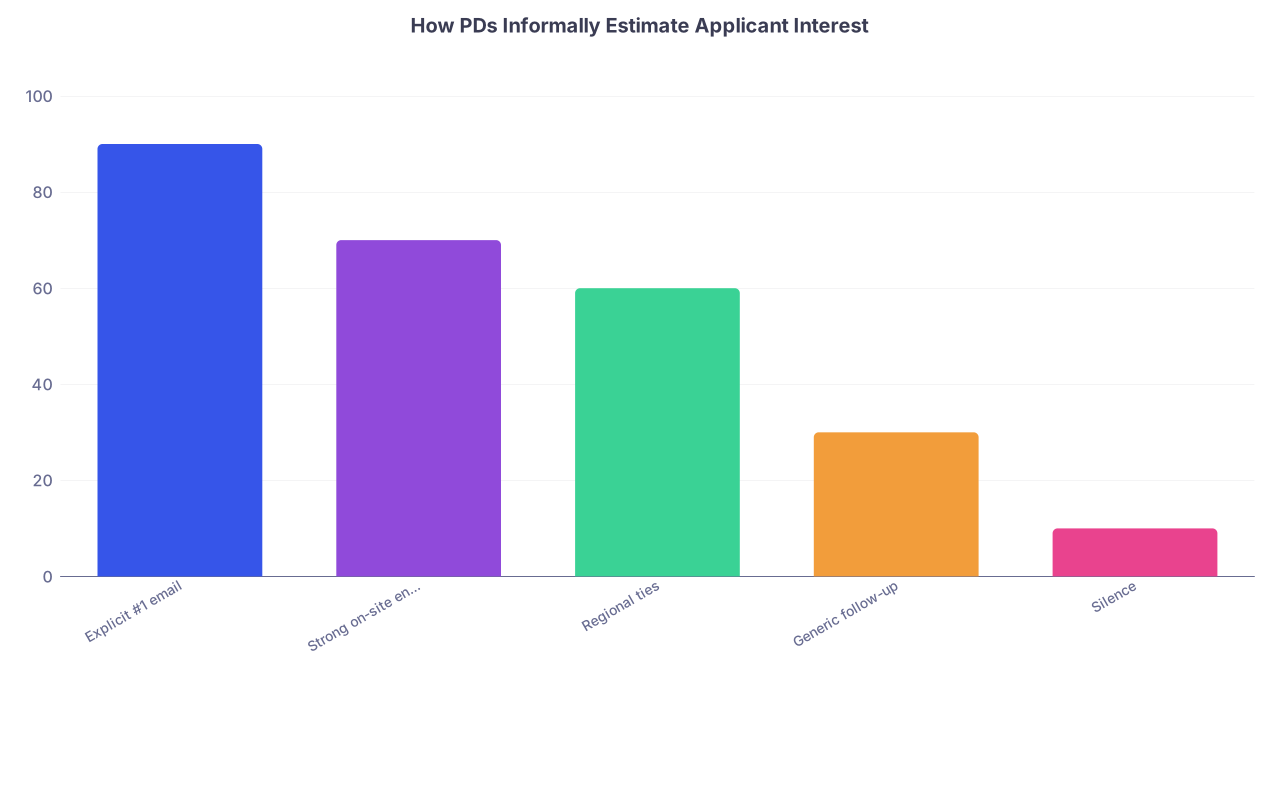
| Category | Value |
|---|---|
| Explicit #1 email | 90 |
| Strong on-site enthusiasm | 70 |
| Regional ties | 60 |
| Generic follow-up | 30 |
| Silence | 10 |
Is this scientifically exact? Of course not. But this is roughly how they weight the signals in their heads. Explicit, believable commitment and obvious day-of enthusiasm dominate. Generic fluff and silence barely move the needle.
The Quiet Truth: PDs Talk About You Like You Talk About Them
Here’s the part nobody tells you. When your name comes up in the ranking meeting, the conversation is eerily similar to how you and your classmates talk about programs.
You say:
“She’s great but I’m sure she’s going to UCSF.”
“He seems like a solid backup.”
“I’d love to go there, but they’re a reach; I’ll still rank them #1.”
They say the mirror image:
“He’s a star, but he’ll probably go to a bigger name place.”
“She’d be a great resident here and seems very likely to rank us high.”
“I’m not sure we’ll get him, but let’s try.”
Everyone’s guessing. Everyone’s game-planning everyone else. And then the algorithm does exactly what it’s designed to do: it gives you your highest possible choice that also wants you back.
The PDs’ guessing doesn’t override that. But it can change whether you’re in the good part of their list or barely hanging on further down.
And that’s why your signals matter.

| Step | Description |
|---|---|
| Step 1 | Interview Day |
| Step 2 | Strong Enthusiasm Notes |
| Step 3 | Neutral/Low Interest Notes |
| Step 4 | Targeted Follow-Up Email |
| Step 5 | Weak or No Follow-Up |
| Step 6 | PD Assumes High Rank Probability |
| Step 7 | PD Assumes Lower Rank Probability |
| Step 8 | Higher in Rank List (when tied) |
| Step 9 | Lower in Rank List (when tied) |
| Step 10 | Show Real Interest? |

Key Takeaways
- Program directors absolutely try to infer where you ranked them using your behavior on interview day, your follow-up communication, geography, and who else is interviewing you.
- Believable, specific enthusiasm—especially a single honest “you are my #1” message—carries far more weight than generic thank-yous or silence.
- The Match algorithm still protects your preferences; your job is not to manipulate programs, but to avoid unintentionally signaling that places you might actually want are just filler.


