

The way most applicants build their residency rank list is emotionally dangerous.
Not dramatic. Accurate.
They overvalue “vibes” from one interview day and underweight the stuff that will define the next 3–7 years of their life: workload, education, culture when no one’s performing for you. If you build your list on charm, flattery, and free sushi, you’re setting yourself up for avoidable misery.
You’re in the Residency Match and Applications phase. This is the part where smart people do very dumb things because they’re exhausted and flattered and scared. Let’s make sure you’re not one of them.
The Core Mistake: Letting Interview Vibes Run the Whole Show
You are not ranking programs. You are ranking a carefully staged performance of those programs. One day. Sometimes half a day. During which:
- Everyone’s on their best behavior
- Residents are selectively chosen
- Hard truths are softened or omitted
- You’re stressed, dressed up, and trying to be liked
Yet I keep seeing applicants say things like:
“I know Program A has rough call and weaker fellowship placement, but I just clicked with them. They’re #1.”
That’s the mistake.
Liking people you met = good. Making it the primary driver of your list = bad. You should treat interview vibes as one data point, not the headline.
Here’s the pattern I’ve watched play out too many times:
Year 4:
“Everyone was so fun and friendly on the interview. The PD remembered my research. It just felt right.”
PGY-1, six months in:
“Turns out those ‘fun’ residents were miserable, just really good at joking about it. Half of them are trying to leave. I should’ve listened when people hinted the PD was unpredictable.”
Charm is not a working condition. Vibes are not curriculum. Chemistry is not a call schedule.
Use your emotions as information, not a steering wheel.
Why Your Brain Can’t Be Trusted on Interview Day
You’re not broken. You’re just human. Interview days are engineered to hijack your judgment.
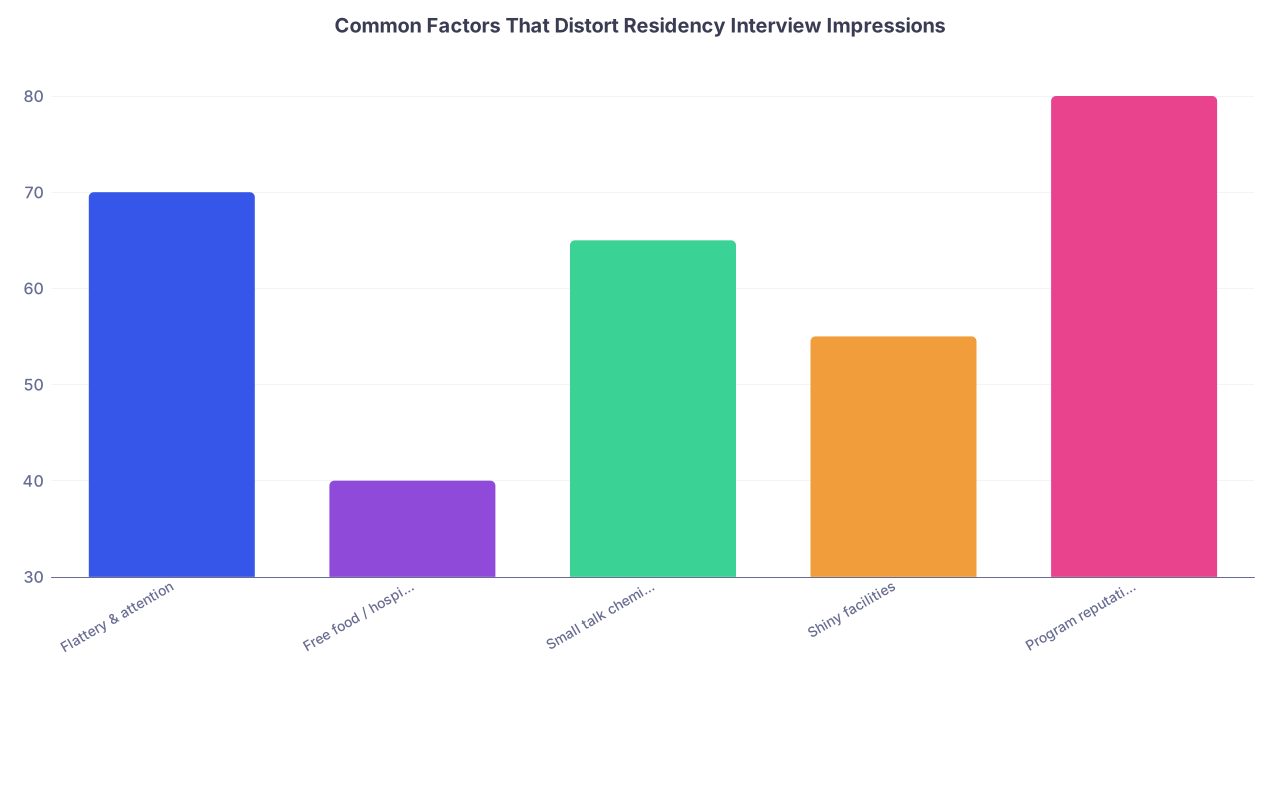
| Category | Value |
|---|---|
| Flattery & attention | 70 |
| Free food / hospitality | 40 |
| Small talk chemistry | 65 |
| Shiny facilities | 55 |
| Program reputation | 80 |
Let me call out a few specific traps that corrupt your ranking decisions.
1. Halo Effect: “They Were Nice, So Everything Must Be Good”
The program coordinator was organized. The residents were funny. The PD laughed at your joke. Suddenly:
- Mediocre case volume = “Probably fine”
- Weak didactics = “They said they’re revamping it, so that’s exciting”
- Vague answers on wellness = “They seemed sincere”
No. Stop.
Being kind and being competent are different things. You need both, but you can’t let one camouflage the absence of the other.
Practical fix: After each interview, force yourself to write three concrete weaknesses you observed or heard, even if you loved the place. If you “can’t think of any,” that’s a red flag about your objectivity, not their perfection.
2. Recency Bias: Last Program = “Best Program”
Your last couple of interviews feel sharper, clearer, more vivid. So they slide up the list. Not because they’re better. Because they’re recent.
I’ve seen applicants move a well-rounded, excellent November program below a flashy January program that:
– had worse board pass rates
– more malignant call stories online
– but “felt more exciting.”
Excitement is a horrible predictor of long-term satisfaction when you’re sleep-deprived and carrying a pager.
Practical fix: Freeze your initial rank impressions within 24 hours after each interview. Then when you build your final list, you’re comparing fresh emotional reactions across time, not just “whatever I remember from the last two weeks.”
3. “I Want Them to Want Me” Syndrome
Programs that gush over you—extra PD time, emails, resident messages—can feel intoxicating. I’ve heard this more than once:
“Program B made me feel so wanted; I have to rank them high. Program C seemed more reserved… maybe they don’t like me.”
You’re not picking a date. You’re picking a training environment.
Programs that over-woo can be compensating for something: high attrition, poor reputation, rough call, unsustainable expectations. Not always. But often enough that you should be suspicious.
On the flip side, some top-tier places play it cool or are simply professional and reserved. That doesn’t mean they like you less. It means they’re acting like grown-ups.
Practical fix: Strip away “program enthusiasm about me” as a ranking factor. Assume every place that interviewed you would be fine having you. Your task is to decide if you’d be fine having them.
Red Flags Hiding Behind “Great Vibes”
If all you remember is that the residents were “so chill” and the lunch was good, you’ve probably missed something important.

Here are quiet red flags that get buried under positive emotions on interview day.
1. Residents Overselling Happiness
Watch for exaggerated, rehearsed-sounding positivity:
- “We’re like a family here” repeated five times
- “We work hard but play harder” with forced laughter
- “We’re changing things” but no specifics on timeline, who’s responsible, or what’s already changed
Truth: truly functional programs sound boring and specific, not shiny and vague.
Example of healthy answers:
“We do six ICU months PGY-1. It’s heavy but structured. Interns average 60–70 hours that year. We’ve added a second night float resident to distribute the work and protected post-call time. Our last three graduates all matched into cardiology, GI, and hospitalist jobs.”
Example of “run away” answers:
“Oh people say we work a lot but we’re actually super chill. We hang out all the time. Our PD really cares about us—he’s so supportive.”
One is data. The other is vibes.
2. Evasive Answers About Bad Stuff
Every program has weaknesses. When you ask about them, you’re not testing their perfection; you’re testing their honesty.
Take note if:
- Questions about duty hour violations turn into jokes and subject changes
- You ask, “What’s the worst part of this program?” and they say, “Honestly, nothing comes to mind, I love it here”
- Residents exchange glances but don’t elaborate when someone mentions a specific rotation or attending
That’s not good energy. That’s suppression.
3. Overemphasis on Social Life, Minimal Emphasis on Training
I’ve seen applicants get dazzled by:
- Fancy resident lounge
- Big social events
- Lifestyle talk
- City perks
All while blowing past:
- Case logs
- In-house vs home call
- How often attendings scrub or are present
- Research or fellowship track support
- How many graduates get the jobs/fellowships they want
Your social life matters. Burnout is real. But you are not doing a 3-year vacation with occasional patients. You need to come out competent.
If half the interview day is social hype and no one can answer basic questions like, “What are your board pass rates?” or “How many clinic sessions per week?”, you’re being sold a vacation brochure, not a training program.
What Actually Deserves More Weight Than Vibes
You still get to care how a place feels. Just don’t let feelings bulldoze these fundamentals.
| Factor | Impact on Your Life | Typical Applicant Weight |
|---|---|---|
| Case volume & pathology mix | High | Medium |
| Resident culture when unobserved | High | Low |
| Fellowship/job placement | High | Medium |
| Call schedule & workload | High | Medium |
| Interview-day social chemistry | Low–Medium | Very High |
| Free food, swag, hotel, tours | Essentially none | Embarrassingly high |
1. Hard Outcomes: Where Graduates End Up
If you want cardiology, and a program puts 3 people into cards every year, that is not the same as a place where “someone did cardiology once… I think… maybe.”
You should care about:
- Board pass rates
- Fellowship match (if relevant to your specialty)
- Where graduates practice (community vs academic, geographic spread)
- Job placement in your desired type of practice
If a program hand-waves this with “our residents do really well,” push for specifics. Vibes don’t get you a fellowship. Numbers and mentorship do.
2. Actual Resident Life: Hours, Autonomy, Support
Ask pointed questions:
- “On an average ward month, what are your hours Monday–Friday and weekends?”
- “How often are duty hours violated, and what happens when they are?”
- “Do you ever feel unsafe or unsupervised when handling sick patients?”
- “Who has your back at 2 a.m. when something goes sideways?”
You’re about to live that. Repeatedly. On holidays, when you’re sick, when you’re exhausted.
I’ve watched applicants ignore firm residents quietly saying, “We’re tired. The hours are real,” because the PD was charismatic and the residents joked about it. That’s how you end up crying in a call room at 3 a.m. wondering why you ranked this place #1.
3. Culture When No One’s Watching
You get tiny glimpses of the real culture. Don’t ignore them.
Notice:
- How residents talk to nurses in front of you
- How staff talk about each other when they think you’re not listening
- Whether residents feel comfortable criticizing aspects of the program openly
- Who shows up to resident noon conference: are attendings present? Is anyone awake?
A program that treats support staff poorly will eventually treat you poorly. A place where residents are afraid to mention weaknesses is not a place that fixes problems.
How to De-Emotionalize Your Rank List (Without Becoming a Robot)
You’re never going to be 100% rational about this. That’s fine. The goal is less dumb emotion, more deliberate emotion.

| Step | Description |
|---|---|
| Step 1 | After Each Interview |
| Step 2 | Write Immediate Impressions |
| Step 3 | Score Objective Factors |
| Step 4 | Score Emotional Fit |
| Step 5 | Wait 72 Hours |
| Step 6 | Re-read Notes & Adjust Scores |
| Step 7 | Compare All Programs Side by Side |
| Step 8 | Build Final Rank List |
Step 1: Create a Simple Scoring System
Not a 20-variable monstrosity you’ll abandon halfway through. A simple, ruthless one. For every program, rate 1–5 on:
- Training quality (cases, teaching, supervision)
- Resident wellbeing (hours, support, culture)
- Career fit (fellowships, jobs, geography)
- Gut feeling (how you felt after the day, not during a single high point)
Force yourself to justify each number in writing. “Felt good” is not a justification.
Step 2: Separate “During the Day” vs “After the Day”
Right after the interview, you’re amped up. Adrenaline, relief, flattery. That’s when vibes are loudest and your judgment is weakest.
The more honest signal is how you feel 24–72 hours later when the sugar high is gone. Do you find yourself:
- Still thinking about their red flags?
- Still making excuses for things that worried you?
- Or still smiling remembering residents who seemed genuinely balanced and credible?
That delayed emotional reaction is worth more than the initial high. Weight it more.
Step 3: Compare Programs Directly, Not in Isolation
Most applicants review one program at a time and convince themselves, “It could work.” That’s not helpful. You’re not deciding “yes or no” for each program. You’re choosing relative preference.
Take two programs at a time and ask:
- “If both offered me a spot tomorrow, which would I choose and why?”
- “If I removed the interview day and only kept the data, which wins?”
- “If I ignored prestige, which one seems more livable for me personally?”
Make yourself answer without looking at your notes first, then check if your reasoning holds up against the facts you wrote down.
Common Emotional Ranking Scenarios You Should Avoid
Let me be specific about the stories I’ve watched unfold. Because they repeat.
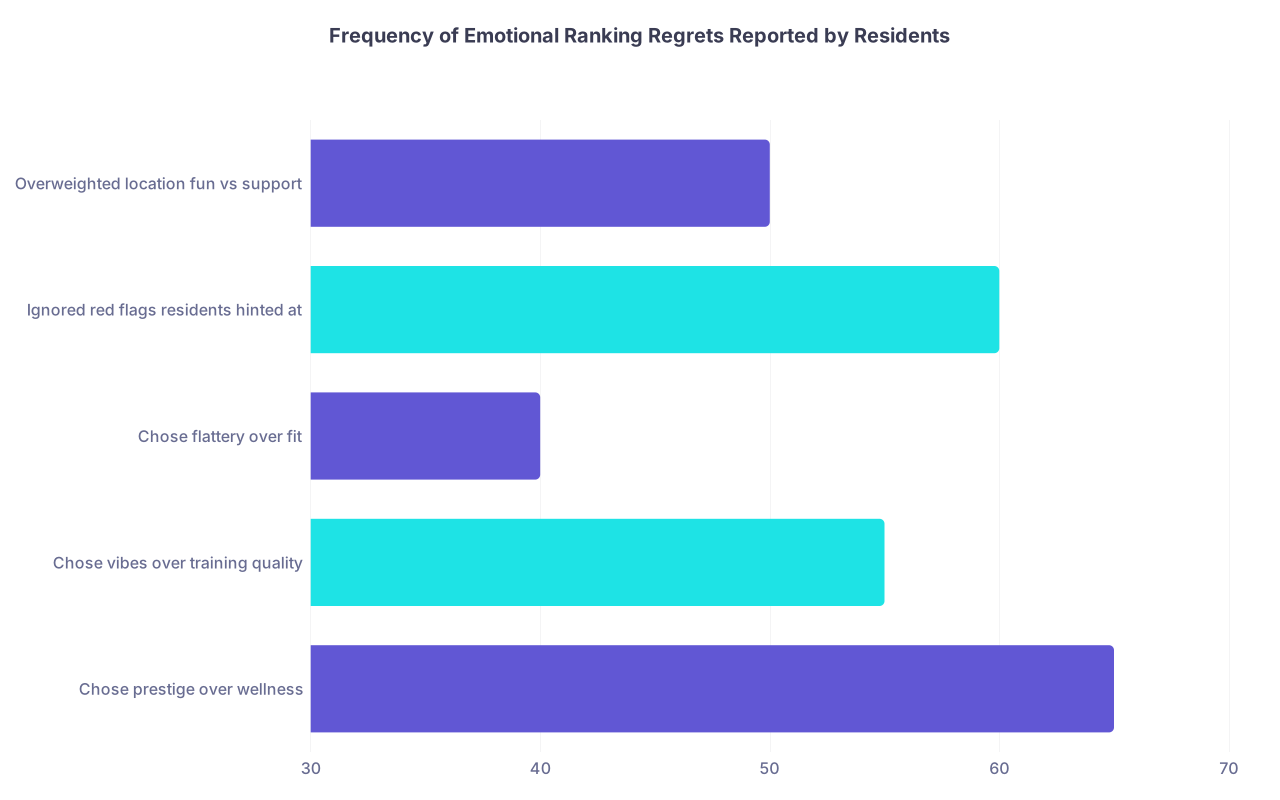
| Category | Value |
|---|---|
| Chose prestige over wellness | 65 |
| Chose vibes over training quality | 55 |
| Chose flattery over fit | 40 |
| Ignored red flags residents hinted at | 60 |
| Overweighted location fun vs support | 50 |
Scenario 1: The “Prestige + Vibes” Trap
You interview at a name-brand academic center. The residents are impressive. The PD is charismatic. You’re thinking fellowship, big name, “doors opening.”
But you also heard:
- 80-hour weeks are “normal”
- Residents joked about “surviving, not thriving”
- Mentions of people taking leave or quitting met with awkward silence
You rank it #1 anyway because the combination of brand + interview day energy feels too good to pass up.
Three years later, you’ve got a solid CV—and a shredded sense of self, health problems, and zero interest in staying academic. You could’ve matched into a slightly less “shiny” place that would have made you both competent and not broken.
Scenario 2: The “They Liked Me More” Illusion
Program A: Strong training, stable leadership, residents seem real and balanced. The day was professional, maybe a bit subdued.
Program B: Slightly weaker training, PD keeps telling you, “We’re ranking you highly,” residents say, “You’d be a great fit, we loved you!” You leave feeling adored.
You put B above A because, subconsciously, you’re ranking your own ego. Not your future.
People rarely admit this out loud, but I’ve had multiple PGY-1s tell me later, “I chose the program that felt most excited about me. I regret it.”
Programs are not your validation machines. They’re your employers and your training environment. Pick like an employee with options, not a kid desperate for approval.
Scenario 3: The “Fun City, Whatever Program” Mistake
Yes, city matters. Your support system matters. But I’ve watched people anchor on:
- “I’ve always wanted to live in [cool city]”
- “Tons of restaurants and nightlife”
- “So many outdoorsy things nearby”
And minimize massive issues:
- Chaotic schedules
- Little supervision
- High burnout, high attrition
- Toxic interpersonal dynamics
The hard reality: you will not be fully enjoying the city if you’re constantly post-call, behind on notes, or crying in your car.
Your environment outside the hospital matters. But your environment inside the hospital will dominate your life for years. Give it more weight than you’re currently giving it.
How to Use “Vibes” Without Letting Them Wreck You
I’m not telling you to be a robot. You’re going to live there. You should feel basically comfortable with your future colleagues.
Here’s how to use vibes correctly:
- Use good vibes as a tiebreaker when the objective data between two programs is reasonably similar
- Use bad vibes as a warning siren that demands more data, not something to ignore because the program is prestigious
- Pay particular attention to how interns talk; PGY-3s are often already in “sales mode” and nearly out the door
- Note whether you felt like you could be yourself, ask honest questions, and get real answers without tension
If a place felt great and the data checks out? Excellent. Rank it high with confidence.
If a place felt great but multiple objective markers are weaker? That’s when you pause and re-check whether you’re overvaluing the warmth of one specific day.

Quick Self-Check Before You Submit Your Rank List
Before you click “Certify,” ask yourself:
- “If I got my #1 program, would I be relieved or a little scared I made the wrong bet?”
- “Did I lower a program mostly because the interview day was awkward, even though the training looks excellent?”
- “Am I ranking anywhere high only because they seemed to love me or the day felt fun?”
- “If no one knew the name of these hospitals, would my list look different?”
- “If I strip away food, flattery, and city, do my top choices still make sense?”
If your honest answers make you uneasy, fix your list. Now. Not in retrospect during PGY-2.

Final Thought
You will forget half the interview lunches you ate and 90% of the jokes residents told you. What you will not forget: how it feels to walk into that hospital at 4:45 a.m. for another call shift after three bad nights in a row.
Do not let a single charismatic day dictate years of your life.
Boil it down:
- Interview vibes are data, not destiny; weigh them, but don’t let them overrule training quality, culture, and outcomes.
- Be suspicious of places that oversell happiness or dodge specifics—real programs admit flaws and back their strengths with numbers.
- Build your rank list with structure and delayed reflection, not adrenaline and flattery; let emotions refine your choices, not run them.
FAQ (Exactly 5 Questions)
1. Should I ever rank a program highly if I had bad vibes but great objective data?
Sometimes, yes—but cautiously. If the “bad vibes” were just an awkward interviewer or one resident you didn’t click with, and everything else (resident testimonials, outcomes, schedule, culture evidence) is strong, you shouldn’t tank a program over that. If the bad vibes came from multiple residents seeming afraid, exhausted, or evasive, I’d treat that as a serious red flag even if the metrics look good on paper.
2. How much should location factor into my rank list compared to program quality?
Location matters, but most applicants overemphasize it. If two programs are roughly equal in training and culture, use location as the tiebreaker. If location is great but training and support are clearly worse, you’re probably choosing a harder, more miserable residency in a more fun city you won’t fully enjoy. I’d put program quality and culture ahead of location unless you have immovable personal reasons (family, partner’s job, health).
3. What if my top choice is clearly “lower tier” but I loved the residents and felt I’d be happy there?
That can be completely reasonable—if you’ve confirmed the training is solid enough for your goals. Many so-called “lower tier” programs offer excellent clinical experience, strong mentorship, and happy graduates in great jobs. Check: board pass rates, where graduates work, and whether people get the fellowships or positions you want. If those boxes are checked and you felt genuine belonging there, ranking it highly is not a mistake.
4. How can I tell if residents are being honest versus performing for the program?
Look for small cracks. Do their stories line up across different people? Are they comfortable admitting downsides without glancing at faculty? Do they give specific examples instead of generic lines? Pay special attention in resident-only sessions. If the tone suddenly shifts or details emerge there that contradict the polished version, believe the residents when authority figures aren’t in the room.
5. Is it a mistake to create a detailed spreadsheet for ranking, or is that overkill?
A simple spreadsheet is smart; an absurdly complicated scoring monster is overkill. Track core things: hours, call structure, fellowship/jobs, location, culture impressions. Then add one column for “gut feel after 72 hours.” The mistake isn’t using a spreadsheet—it’s either having no structure at all and going purely on vibes, or hiding behind fake precision (e.g., 27-category scoring) that just gives you the illusion of objectivity without better decisions.


