

The blunt truth: a few negative resident comments should NOT automatically drop a program on your rank list—but consistent, specific patterns absolutely should.
If you treat every complaint like a red flag, you’ll end up with no list. If you ignore real patterns, you’ll end up miserable. Your job is to tell the difference.
Let’s walk through how to do that like a grown-up and not like a panicked MS4 on Reddit at 2 a.m.
Step 1: Understand the “Resident Complaint Tax”
Residency is hard. Even in good programs, residents vent. A lot.
You’ll hear:
- “The hours here are brutal.”
- “Administration doesn’t care about us.”
- “We’re always short-staffed.”
- “The call schedule is terrible.”
That’s…everywhere. That’s the background noise of GME.
So first rule: you pay a “resident complaint tax” at every program. Some amount of negativity is baked in and means nothing by itself.
Where you should perk up isn’t with the existence of complaints. It’s with:
- The specificity of what they’re saying
- The consistency across multiple residents / multiple settings
- The tone (frustrated but coping vs defeated and bitter)
- The trajectory (getting better, worse, or stuck)
Isolated grumbling = noise.
Coherent, repeat patterns = data.
Step 2: Separate 3 Categories of Negative Comments
Almost every negative resident comment you hear falls into one of three buckets. Treat them differently.

1. Universal Pain Points (Usually Not Ranking Killers)
These are things that suck almost everywhere:
- “We work long hours.”
- “Night float is rough.”
- “Epic/EMR here is annoying.”
- “The ICU months are brutal.”
You do not drop a program for this. You note it, you calibrate your expectations, and you move on.
Use these to compare degree, not presence. If one program’s residents say “night float is rough but we get golden weekends” and another says “night float is soul-crushing and we’re constantly covering extra shifts,” that’s a useful contrast. But the baseline complaint itself is normal.
2. Preference Mismatches (Depends on You)
These are negatives only if they clash with your priorities:
- “There’s not much research here.”
- “We’re very service-heavy and not super academic.”
- “Fellowship placement is mostly community programs.”
- “This is a very independent program. Not a lot of hand-holding.”
- “Tons of procedures. Less didactic time.”
If you want a big-name fellowship, a “not academic” program may be a real problem.
If you just want to be a solid community doctor and hate research, that same “negative” might be a plus.
Don’t copy someone else’s rubric here. Decide what matters to you:
- Academic vs community
- Geographic ties vs prestige
- Research vs lifestyle
- Procedural volume vs cognitive focus
- Big-city vs smaller city
Then ask: “Is this complaint actually a dealbreaker for me, or just for this particular resident?”
3. True Red Flags (Ranking Changers)
These are the ones you should consider dropping a program over if they’re consistent:
Systematic abuse or disrespect
- Attendings routinely humiliate residents
- Sexist, racist, or toxic culture that’s brushed off
- “If you speak up, you’re labeled ‘not a team player’”
Unsafe patient care or unsafe workloads
- Residents consistently covering dangerously high numbers of patients
- “We cut corners because there’s no time”
- No attending backup when needed
Chronic violation of duty-hours / retaliation
- “We’re told not to log hours accurately”
- Residents punished for raising duty-hour violations
- Regular 28–30 hour shifts with no recourse
Program instability and dishonesty
- Leadership turnover every year, and residents are in the dark
- Sudden loss of key rotations or sites, and no clear plan
- “They promised X during interview, but it never materialized”
Repeated theme of ‘I’d never come back here’
- Multiple residents (especially seniors) bluntly saying:
- “I wouldn’t rank this again.”
- “I tell students not to come here if they have other options.”
- Multiple residents (especially seniors) bluntly saying:
That last one? I take that very seriously. A tired resident saying “this year has been rough.” Normal. A PGY-3 saying “I regret matching here” in front of a student? That’s not nothing.
Step 3: Weigh the Source, Not Just the Statement
Every comment is not equal. Who says it matters.
Ask yourself:
- Is this one very burned-out PGY-2 on a post-call day?
- Or is it 3–4 different residents, at different times, giving the same story?
Pay special attention to:
Senior residents (PGY-3+): They’ve seen leadership changes, multiple rotations, and can judge trajectory. If chiefs sound bitter and hopeless, that’s a real sign.
Residents who trained elsewhere (prelims, transfers, FMGs with prior experience): They can compare programs. When they say, “I was at another residency before—this is much better/worse,” that’s useful.
Residents who disagree politely: If one resident is negative and another says, “I see it differently…” and gives a rational counterpoint, that’s actually a good sign. It means you’re getting nuance, not groupthink.
What worries me more is when:
- Residents glance at each other before answering.
- They lower their voice to talk about administration.
- Someone says, “We’ve been told not to talk about that.”
I’ve seen that. It’s not a good look.
Step 4: Look for Patterns Across Data Sources
Don’t let one offhand complaint derail months of work.
Instead, cross-check:
- Pre-interview reputation: Doximity, word-of-mouth, Reddit/SDN (lightly).
- Interview day vibe: How did faculty talk about residents? How did residents talk about faculty?
- Post-interview resident contact: Emails, second looks, alumni from your med school.
- Your own experience: How did it feel walking the wards, seeing interactions, observing consults?
If the only place you ever hear negativity is one random resident who seems uniquely unhappy, that’s a weak signal.
If the emails you get after the interview, the vibe on the wards, and what alumni told you all line up with the negative comment? That’s much stronger.
Here’s a simple framework:
| Situation | Impact on Rank List |
|---|---|
| Single vague complaint, no pattern | Minimal |
| Multiple similar complaints from different residents | Moderate |
| Multiple specific complaints + you observed issues | Strong |
| Multiple complaints + program has known bad reputation | Very strong |
| Residents discourage you from ranking if you have other options | Potentially drop or move way down |
Step 5: Don’t Overreact to “The One Bad Conversation”
You’re going to have at least one weird, uncomfortable, or negative conversation on the trail. Everyone does.
Common overreactions:
- Dropping a strong program because one resident was cold on Zoom.
- Moving a program way down because someone complained about a single rotation.
- Letting another applicant’s horror story at a pre-interview dinner get in your head.
Check yourself with these questions:
- Was this comment specific and verifiable, or just “this place sucks”?
- Did other residents echo this, or directly contradict it with plausible explanations?
- Did what you saw with your own eyes match the negativity?
If the answers are: vague, not echoed, and doesn’t match your experience? Don’t torch the program. At most, move it down a spot or two if the comment sticks with you.
Step 6: Watch for the “Smiling Misery” Pattern
Negative comments aren’t always blunt. Some programs spin hard. Residents may be scared to say what they really think.
Red flags here:
- Every answer sounds rehearsed: “We’re like a family, we work hard and play hard.”
- You ask a pointed question (“How does the program respond to resident feedback?”) and get something vague like, “We’re working on it.”
- Residents won’t answer direct questions about duty hours or program responsiveness.
Sometimes what matters isn’t what they say. It’s what they won’t say.
If residents look at each other before answering, or give you an obviously sanitized answer, assume there’s more under the surface. That doesn’t mean instantly drop them, but I’d absolutely factor that in, especially if you have other solid options.
Step 7: How Much Should a Serious Red Flag Move a Program?
Here’s how I’d calibrate, assuming you’re not desperate for any match:
Mild concern: “A couple of rotations are disorganized, but leadership is changing it.”
- Move the program down slightly relative to more stable choices.
Moderate concern: Consistent complaints about workload, but culture seems supportive and people are honest about it.
- Weigh against your priorities. If location/fellowship are big wins, maybe it stays mid-list.
Major concern: Abuse, retaliation, unsafe care, or residents strongly discouraging you from coming.
- If you have a reasonable number of other programs ranked, I’d seriously consider moving it near the bottom or off entirely.
You don’t get extra points in life for suffering through a toxic program when you had other choices.
Step 8: How to Ask Better Questions So You Get Real Answers
If you want honest, useful negative comments, stop asking, “So, what are the weaknesses of the program?” Everyone gives the same canned answers.
Ask things like:
- “What’s one thing you’d change about the program if you had a magic wand?”
- “Has anyone ever raised a concern that didn’t go well? What happened?”
- “If your best friend were deciding between here and a similar program, what would you tell them?”
- “How has the program changed over the last 2–3 years—for better or worse?”
- “Tell me about a time the program really supported (or failed) a struggling resident.”
Those questions get you the real stuff. The tone of the answer will tell you almost as much as the content.
Step 9: Anchor Your Rank List in Fit, Then Adjust for Negativity
Don’t build your list centered on fear. Start with fit:
- Where did you actually feel like you could belong?
- Where does the training align with your career goals?
- Where is the geography/life situation workable for you and your support system?
Then adjust for negative data:
- Mark any program with true red-flag themes (abuse, unsafe, dishonest).
- Decide: off the list, bottom of list, or just lower than initially placed.
- Re-check: Are you torpedoing a good fit because of a single shaky comment? Or correcting for a real, consistent pattern?
You’re allowed to trust your gut, by the way. If you left a place thinking, “Something’s wrong here,” that matters. It just shouldn’t be based on one random grumpy PGY-1.
A Visual Snapshot: Negative Resident Feedback Types
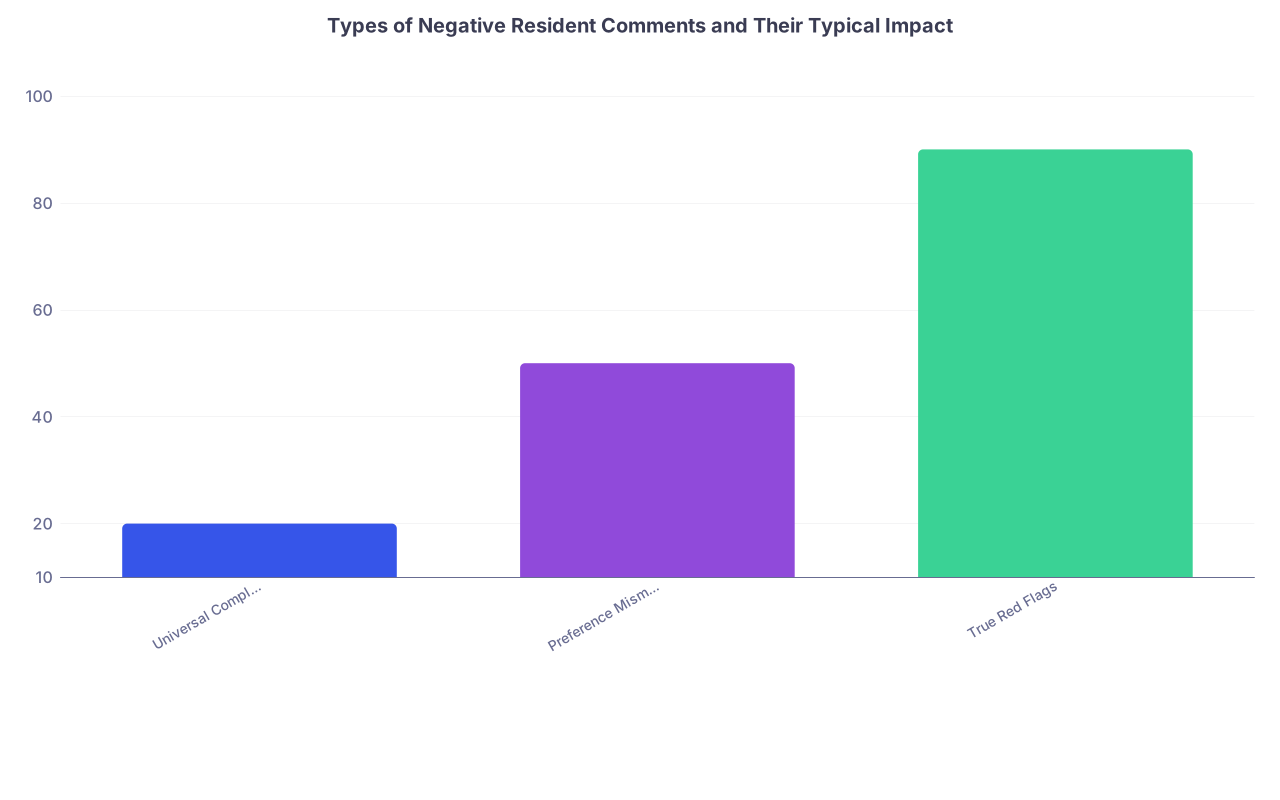
| Category | Value |
|---|---|
| Universal Complaints | 20 |
| Preference Mismatches | 50 |
| True Red Flags | 90 |
(Think of the numbers as “how much they should influence your ranking” on a 0–100 scale.)
Example Scenarios: What I’d Actually Do
Scenario 1: Single Harsh Comment, Otherwise Great
You loved Program A. Location perfect, strong fellowship placements, residents mostly upbeat.
One resident at dinner: “Honestly, I’d leave if I could. The workload on wards is insane.”
You:
- Ask 2–3 other residents about inpatient workload.
- They say, “Yeah, it’s busy, but we’re protected on call and seniors are supportive.”
- No other red flags, your gut feels good.
Decision: Keep it high. Maybe drop it one notch if it nags at you, but don’t punish a whole program for one outlier.
Scenario 2: Multiple Subtle Red Flags
Program B is mid-tier academically, great city. On interview day:
- Residents keep saying “We’re like a family,” but dodge questions about duty hours.
- You hear “leadership is in transition” three times with tight smiles.
- A chief reluctantly says, “We’ve had some issues with burnout, but we’re ‘working on it.’”
You email a grad from your med school:
They respond: “Training is solid but the culture is rough. Lots of people are quietly unhappy.”
Decision: This moves down. Not necessarily off the list, but I’d rank clearly happier, similarly strong places above it.
Scenario 3: Clear Major Red Flag
Program C, smaller community program. On your second look:
- Multiple residents: “Don’t come here if you have other options.”
- They describe:
- Calls where they cover 30+ patients alone
- Being told not to report hours
- Faculty berating residents publicly
You check online. Old forum threads mention similar issues.
Decision: Unless you have extremely few interviews and are worried about going unmatched, this goes at the bottom or off the list entirely. Life’s too long for three years of that.
Quick Flow: Should Negative Comments Drop a Program?

| Step | Description |
|---|---|
| Step 1 | Heard Negative Resident Comments |
| Step 2 | Cross-check with Others |
| Step 3 | Note but Dont Change Much |
| Step 4 | Move Slightly Down |
| Step 5 | Move Low or Drop |
| Step 6 | One-off or Repeated? |
| Step 7 | Specific & Serious? |
| Step 8 | Matches Other Data & Your Gut? |
FAQ: Negative Resident Comments & Your Rank List
1. Should I ever completely remove a program from my rank list based on resident comments?
Yes—if you’re hearing consistent, specific reports of abuse, unsafe patient care, chronic duty-hour violations with retaliation, or residents bluntly telling you not to come if you have other options. If you have a reasonable number of other interviews, you don’t need to keep a clearly toxic program on your list “just in case.”
2. What if I only have a few interviews? Can I afford to drop any programs?
If you’re sitting on 3–4 interviews total, the bar for completely dropping a program is higher. You might rank a problematic program last instead of cutting it, because matching somewhere often beats going unmatched. But I’d still strongly consider removing places with truly dangerous or abusive environments. Matching there may create more long-term damage than taking a different path.
3. How seriously should I take anonymous online reviews or Reddit threads about a program?
Treat them like smoke, not proof of fire. If you see the same complaints over several years about the same program—especially around culture and safety—pay attention. But never decide your rank list solely off Reddit. Use online chatter as a prompt to ask better questions of residents and alumni who actually know the current state of the program.
4. What if the faculty seemed amazing but the residents seemed unhappy?
Believe the residents. Faculty can be charismatic on interview day and still preside over a miserable resident culture. If there’s a mismatch—smiling PD talks about wellness, exhausted residents say they’re burned out and not heard—give the residents’ experience more weight. They’re living your future reality.
5. I heard a negative comment that’s stuck in my head, but everything else about the program is great. How do I decide?
Write it out. Literally one paragraph: what was said, who said it, how many others echoed it, and whether it conflicts with what you saw and what others told you. If, after that, it still feels like a meaningful concern, move the program down a notch or two—but not off the list—unless it’s a clear red flag. Then compare it side-by-side with your other top choices and ask: “Where would I be more okay waking up at 3 a.m. for a terrible call?” That’s usually your answer.
Open your draft rank list right now. For each program where residents said something negative, label it: “Universal,” “Preference mismatch,” or “True red flag.” Then adjust only the ones in that last category.


