

Is It Ever Smart to Leave a Program Off My Rank List Entirely?
It’s late January. You’ve got a half-eaten granola bar on your keyboard, your ERAS dashboard open on one screen, and the NRMP rank list page open on the other. You’re staring at a couple of programs you interviewed at and thinking, “Do I have to rank these? Or should I just leave them off completely?”
Here’s the blunt version:
Yes, it is sometimes absolutely smart to leave a program off your rank list. But people get this wrong all the time—either they rank programs they should have cut, or they cut programs for bad reasons and hurt their chances of matching.
Let’s sort that out.
First: The Core Rule of Ranking
You should only rank a program if you would rather match there than go unmatched.
That’s the spine of your whole decision tree. Let me repeat it more practically:
- If you’d genuinely prefer going unmatched (SOAP, reapply, different specialty, career pivot) over spending years in that program → do not rank it.
- If you’d prefer training there over not matching at all, even if it’s not your dream → rank it, somewhere below your better options.
People overcomplicate this with “but what about the algorithm?” or “will I hurt my chances?” The match algorithm works in your favor if you rank programs in your true preference order. It never punishes you for ranking more programs.
The real question you’re asking is:
“When is a program so bad (for me) that matching there is actually worse than going unmatched?”
That’s where you need a framework.
When You Absolutely SHOULD Leave a Program Off
There are a handful of situations where I tell people flat out: do not rank that program. At all. Not even last.
1. True Safety or Abuse Concerns
If during the interview or from credible sources you picked up:
- Routine bullying, harassment, or discrimination that’s ignored
- Attending or resident behavior that sounds physically or emotionally abusive
- Hostile culture you personally experienced, not just rumors
- Retaliation against residents who report issues
- Serious boundary violations (sexual, racial, religious)
That’s a no. Full stop.
Residency is already stressful. Add toxic leadership or targeted harassment and you’re setting yourself up for burnout, mental health crises, even patient safety problems. I’ve seen residents spend years trying to escape programs like this, sometimes ending up leaving medicine altogether.
If you have credible reasons to believe you’d be unsafe or targeted there, being unmatched is better.
2. Repeated Accreditation or Safety Red Flags
There’s a difference between a program with some warts and a program in chronic trouble.
Serious red flags:
- Ongoing or repeated ACGME citations (especially around supervision, duty hours, clinical volume, patient safety)
- Recent or threatened loss of accreditation
- Multiple residents leaving, being non-renewed, or “mysteriously” disappearing year after year
- Consistent stories of residents not meeting case requirements or board pass issues they’re clearly not fixing
- Hospital that’s on the edge financially and cutting services that your training relies on
Newer programs can have minor growing pains. That’s not what I’m talking about. I’m talking about programs where the issues are chronic and residents are not being protected or properly trained.
If you think, “I might not even be board eligible if I go there,” or, “I could get stuck in a sinking ship,” it may be rational to leave it off completely.
3. Deal-Breaker Lifestyle or Personal Constraints
Sometimes the program is fine. You’re not.
Examples:
- Your partner absolutely cannot move to that city and long-distance isn’t viable for you
- You have a medical condition that’s incompatible with that location (altitude, allergens, access to specialty care)
- You have dependents, custody arrangements, or visas that simply will not work in that specific state or area
- The call structure or schedule would be genuinely unsafe given your health or disability, and the program was dismissive of reasonable accommodations
If matching there would blow up your family, your health, or your legal situation, it’s not a realistic option. Do not kid yourself that “maybe it will work out.” If it cannot work, do not rank it.
4. You’re 100% Sure You’d Rather Go Unmatched
Sometimes people reach this point late in the cycle:
“I’d rather SOAP into a prelim, reapply next year, or change specialties than spend 3–7 years at this specific program.”
If that thought is clear, calm, and consistent (not just a post-interview mood swing), then you have your answer.
I’ve seen applicants rank “any categorical spot” above reapplying because they’re desperate to avoid the shame of not matching. Two years later they’re emailing desperately about how to transfer out of a malignant program they knew they hated on interview day.
The shame of going unmatched is temporary. A bad residency match can shape your entire career and health.
When You Probably SHOULD Still Rank the Program
On the flip side, I see people wanting to cut programs for reasons that are honestly weak. These can cost you a match for no good reason.
1. It’s Not Your “Vibe,” But It’s Safe and Solid
You didn’t love it. Residents didn’t seem like your future best friends. Faculty weren’t super charismatic.
But:
- Training is solid
- Graduates match into fellowships or jobs you’d be happy with
- No serious culture, safety, or accreditation issues
- City is livable, even if not exciting
That program belongs on your list, probably somewhere near the bottom. Residency doesn’t need to be a rom-com meet-cute with your perfect program. It needs to be good enough for you to become a competent, board-certified physician with your sanity intact.
2. It’s In a Less-Desirable Location, But Everything Else is Fine
“I don’t like cold.”
“I prefer big cities.”
“I wanted to be closer to family.”
All reasonable preferences. But if this is the only thing you don’t like about the program, and you still want to be in that specialty, be careful.
You’d be surprised how quickly you adapt to “non-ideal” places when:
- Your colleagues are decent
- Your days are busy
- You’re learning real medicine
Plenty of residents quietly end up loving places they swore they would hate. Location alone is rarely a strong enough reason to risk going unmatched—unless it crosses into the hard deal-breaker territory we just discussed.
3. You’re Overreacting to One Weird Interview Day
Bad interviewer? Awkward vibe? One resident who complained a lot? Sure, that matters. But you’re seeing a tiny, artificial slice of a complex program.
Things I would not leave a program off for, by themselves:
- One faculty member seemed arrogant
- Residents looked tired (it’s residency)
- Someone made an offhand comment that rubbed you wrong but wasn’t clearly abusive or discriminatory
- You didn’t “click” with anyone in 4–5 hours on Zoom
Weigh it, yes. Nuke the program from your list? Usually no, unless it fits into the more serious categories above.
How to Decide: A Simple Decision Framework
Here’s a blunt flow, no fluff.

| Step | Description |
|---|---|
| Step 1 | Program I Interviewed At |
| Step 2 | Rank it somewhere below better options |
| Step 3 | Leave OFF rank list |
| Step 4 | Rank low, but keep ON list |
| Step 5 | Re-evaluate reasons honestly |
| Step 6 | Would I rather go unmatched than train here? |
| Step 7 | Why? Safety/Abuse/Impossible Life? |
| Step 8 | Just low vibe/location? |
Ask yourself, out loud if you have to:
“If this is the only program that ranks me, and I match here, will I be relieved to have a spot or devastated enough that I wish I’d gone unmatched?”
Your gut answer matters. Not the one you say to friends. The one that hits your stomach.
What the Match Algorithm Actually Does (So You Don’t Game It Wrong)
A lot of the fear behind “should I leave this off?” comes from misunderstanding the algorithm.
Quick and dirty explanation:
- The algorithm tries to match you to your highest-ranked program that also ranks you.
- It does not reward you for playing games like:
- “If I rank fewer programs, they’ll know I’m serious.”
- “If I leave this medium program off, maybe I’ll be more likely to match at a top one.” (No.)
- Ranking a program cannot hurt your chance to match at a program higher on your list.
So:
- If you like a program more than being unmatched → put it on the list.
- If you don’t → leave it off.
That’s it. Everything else is noise.
Concrete Examples: When to Cut vs When to Keep
Let’s make this less abstract.
| Scenario | Smart Move |
|---|---|
| PD openly joked about residents as 'cheap labor', multiple stories of retaliation | Leave OFF |
| New program, but residents say they feel supported and graduates getting decent jobs | Keep ON (maybe lower) |
| City is far from family, but training is strong, no major red flags | Keep ON |
| Two residents quietly tell you they're trying to transfer out due to harassment ignored by leadership | Leave OFF |
| You were bored on interview day, but can’t point to anything concretely wrong | Keep ON |
What About Competitive Specialties?
This is where people panic the most. Derm, ortho, plastics, ENT, rad onc—anything where the match rate is brutal.
Here’s the temptation:
“This one program felt awful, but if I don’t rank it, I might not match anywhere in this specialty.”
Ask yourself two questions:
- If you matched there, would you actually stay? Or would you immediately start planning to transfer or quit?
- If you don’t match, do you have a viable plan? (SOAP into prelim/transitional, research year, reapplying, switching specialties)
If the answer to #1 is “I’d be seriously miserable and probably try to escape,” and you have any workable path through #2, it may still be rational to leave that program off.
On the other hand, if you’re committed to this specialty above all else and the program is just “meh” but safe, then being choosy to the point of self-sabotage doesn’t make sense. Rank it low and accept that your first job in this field may not be glamorous.
Special Situations That Change the Math
Couples Matching
When you’re couples matching, each individual program is part of a pair. Do not forget that.
You might tolerate Program X alone, but hate the combo of:
- Your Program X + partner’s Program Y
- City logistics, commutes, housing costs for that combined setup
Or vice versa: you dislike a program solo, but as part of a pair in the same city where your partner is at a dream program, it becomes acceptable.
You still follow the same core rule:
Only rank pair combinations where you’d rather match into that pair than not match as a couple.
Visa or Immigration Constraints
If you need visa sponsorship (J-1, H-1B), your “only rank what you’d attend” rule still holds—but with a twist: your realistic options might be fewer.
If a program:
- Does not sponsor the visa you need
- Gave you mixed answers about visa support
- Has a history of last-minute visa failures
You should treat it as effectively non-viable and leave it off. Ranking a program that literally cannot hire you is pointless.
Dual-Path Plans (Reapply vs Take What You Get)
Sometimes your real plan is:
“I’ll either match somewhere decent this year, or I’ll reapply next year to aim higher.”
If that’s your mindset, then some of the lower-tier programs that technically would accept you become optional. You’re then choosing between:
- A sure but unhappy residency now
vs. - Delayed training with another cycle of risk, but a shot at something better
There’s no universal right answer, but you need to admit to yourself if you’re actually willing to delay. Many people say they are—but they’re not.
The Emotional Trap: Fear vs Reality
A lot of ranking decisions are driven not by logic but by fear:
- Fear of telling friends/family, “I didn’t match.”
- Fear of being “behind”
- Fear of making the wrong choice and regretting it later
Those are normal. But they’re a lousy basis for a 3–7 year decision.
Better anchors:
- Will this program train me well enough to be the kind of physician I want to be?
- Can I see myself physically and mentally surviving here?
- If it’s my only match, will I feel relief or dread?
You are allowed to protect yourself. You are also allowed to be practical and take a “good enough” option instead of chasing perfection.
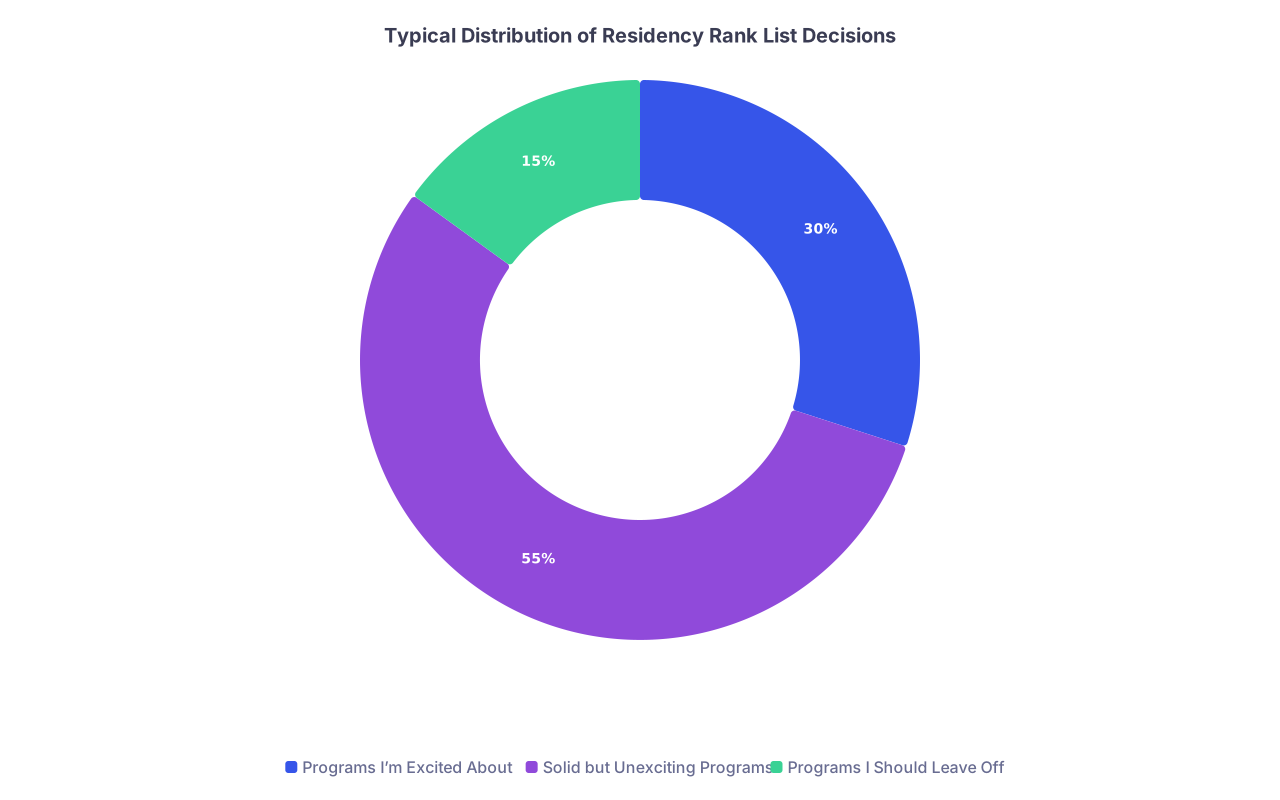
A Quick Visual: How Many Are Truly “Do Not Rank”?
| Category | Value |
|---|---|
| Programs I’m Excited About | 30 |
| Solid but Unexciting Programs | 55 |
| Programs I Should Leave Off | 15 |
Most people find that only a small minority of their interview programs fall into the “I truly should not rank this at all” bucket. If your “do not rank” pile is 50–70% of your interviews, you’re either:
- In a very unhealthy specialty/region, or
- Being unrealistically picky and letting anxiety run the show
Double-check which it is.
What You Should Do Today
Pull up your interview list and do this, right now:
- Make three columns on a page:
“Definitely Rank,” “On the Fence,” “Do Not Rank?” - Put each program into one of these buckets based on your gut first, not overthinking.
- For everything in “Do Not Rank?”, write one specific sentence why.
If the reason isn’t safety/abuse/impossible life/logistical impossibility or “I would rather be unmatched,” move it to “On the Fence” and keep it in contention.
Then, for that “On the Fence” group, ask the key question individually:
“If this is my only match, would I rather have it than go unmatched?”
Your honest answer to that one question will tell you which programs to leave off and which to keep.
Open your draft rank list right now and label every program with one of three tags: “Yes,” “No,” or “Only if I have to.” Everything tagged “No” should not appear on your final list.


