

Most people are ranking too many programs they actively dislike—and it backfires more often than it saves them.
Let me be blunt: you should not automatically rank every program you interviewed at. That’s lazy advice people repeat because it sounds safe. The real answer is a lot more strategic and a lot more personal.
Here’s the rule I use when I advise applicants:
Only rank programs where you’d rather train than go unmatched.
That’s the line. Everything else is details.
Let’s walk through how to actually apply that rule without panicking the week before the ROL deadline.
The Core Rule: Rank vs. Unrank vs. Don’t Rank
Here’s the clean framework:
- Programs you definitely should rank
- Programs you should consider ranking cautiously
- Programs you should probably leave off entirely

1. Programs you definitely should rank
You should almost always rank a program if these are true:
- You can realistically see yourself completing residency there
- There are no major safety concerns (personal, professional, or ethical)
- You’d rather match there than scramble/SOAP or go unmatched
This includes:
- “Dream” programs (obvious)
- Solid but unsexy community programs
- Programs in locations that aren’t your favorite but are livable
- Programs with minor issues (clunky EMR, older facilities, not your ideal schedule) but good training
In other words: if the main complaint is “it’s not perfect” or “I don’t love the city,” you still rank it.
The algorithm is on your side. It maximizes your preferences, not the program’s. Ranking more programs you can tolerate doesn’t hurt you; it protects you from not matching.
2. Programs you should consider ranking cautiously
This is the gray zone where people get stuck. These are programs that:
- Made you uncomfortable but not unsafe
- Seemed disorganized, but not malignant
- Have red flags, but you’re in a very competitive specialty or you’re a weaker applicant on paper
Ask yourself:
- Is this truly worse than not matching and repeating the cycle?
- Would I regret doing residency here more than I’d regret taking another year, reapplying, maybe changing specialties?
- Are my concerns based on a bad vibe from one person or consistent themes (multiple residents, multiple conversations)?
This group is where your competitiveness matters.
| Situation | Likely Smart to Rank | Probably Don’t Rank |
|---|---|---|
| Specialty | Ultra-competitive (Derm, Ortho) | Less competitive (FM, Psych) |
| Application strength | Below average | Very strong |
| Concerns | Annoying but tolerable | Serious culture/ethics worries |
| Backup plan | Weak / unclear | Strong backup (reapply, alternate specialty) |
If you’re borderline for matching at all in your specialty (low Step scores, limited interviews, major red flags), it may be rational to include some programs you’re not excited about—but only if you would genuinely rather go there than go unmatched.
3. Programs you probably should not rank
There are clear reasons to leave a program off your list entirely. You should almost never rank a program if:
- You felt unsafe (harassment, discrimination, hostility that felt systemic)
- Residents repeatedly described the program as toxic, malignant, or abusive
- You saw or heard things that suggest ethical problems (falsifying notes, bad patient care culture, illegal labor practices)
- You had a strong “I cannot spend 3–7 years here without serious damage to my health or sanity” reaction—and that feeling held up after a few days of thinking
This is the part people are scared to admit:
There are programs where not matching is better than matching there.
If matching there would make you consider quitting medicine entirely, don’t rank it. That’s not drama—that’s self-preservation.
How the Match Algorithm Actually Treats Your List
People make bad choices because they misunderstand how the algorithm works.
Here’s the short version:
- The algorithm is applicant-proposing
- It tries to give you the highest program on your list that also ranks you high enough
- Ranking a “safety” program below your favorites does not push you down at your top choices
- Ranking more programs can’t hurt your shot at higher ones
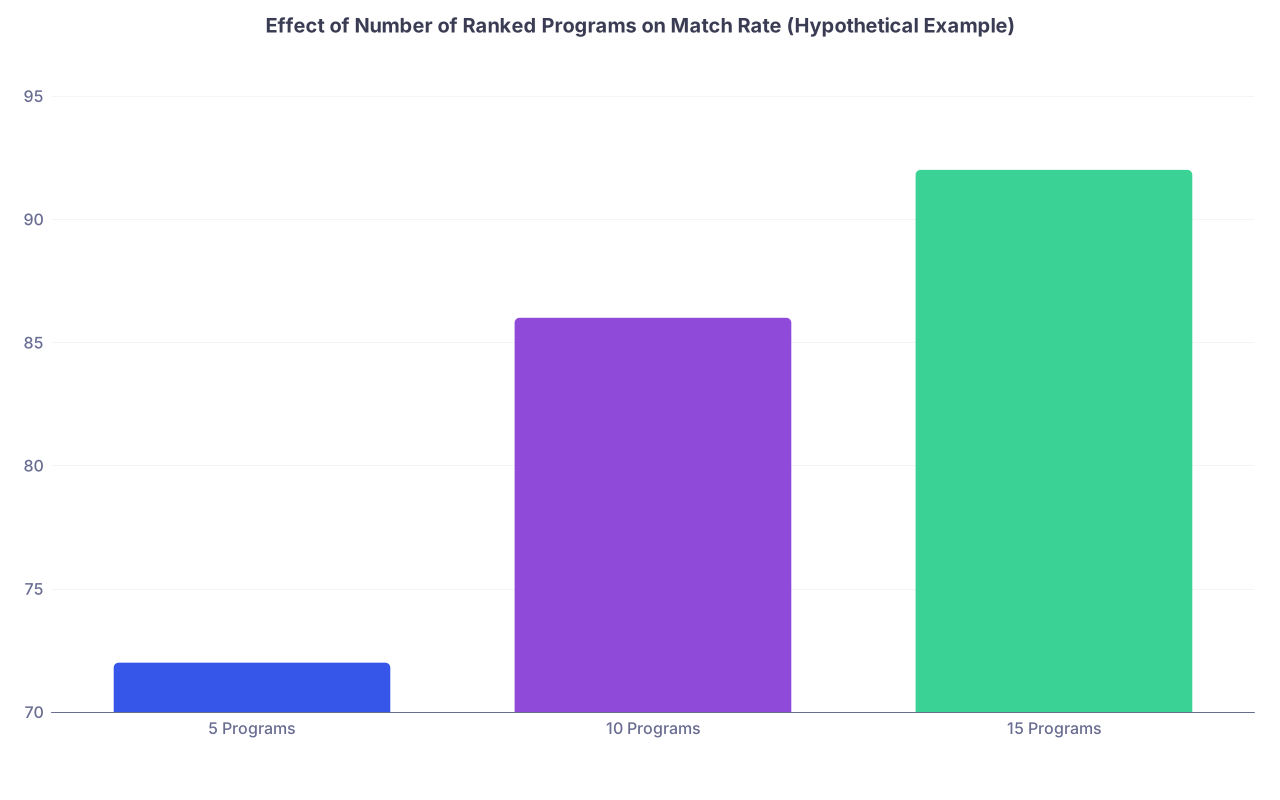
| Category | Value |
|---|---|
| 5 Programs | 72 |
| 10 Programs | 86 |
| 15 Programs | 92 |
So why not just rank every program? Because the algorithm takes your list literally. If you put a malignant program at #12, and everything above it fills with other applicants, the algorithm will happily stick you there. It doesn’t know you “didn’t really want it.”
If you’d rather go unmatched than land there, it has no way to infer that. You have to say it with your list.
Step-by-Step: How to Decide for Each Program
Here’s the practical process I’d use if I were sitting with you and your spreadsheet.

| Step | Description |
|---|---|
| Step 1 | List all interviewed programs |
| Step 2 | Remove obvious NOs with serious safety/ethics issues |
| Step 3 | For each remaining: Would I prefer this to going unmatched? |
| Step 4 | Remove from list |
| Step 5 | Compare to other programs and sort by true preference |
| Step 6 | Finalize rank order |
Step 1: Immediate “absolutely not” cuts
Write down every program you interviewed at. Then mark:
- “Hard No” – never rank
- “Maybe” – not sure
- “Yes” – you’d be okay training there
Hard No usually means:
- Safety issues
- Malignant culture
- Geographic dealbreakers (partner can’t move, immigration issues, etc.)
- You left the interview day thinking, “If this is my only match, I’ll be miserable”
Those you delete. Not move to the bottom. Delete.
Step 2: Reality check with your competitiveness
Be honest about where you stand:
- How many interviews did you get in your specialty?
- For most specialties, <8–10 interviews = increased risk
- Any red flags? Fails, leaves of absence, professionalism issues?
- Are you applying to a very competitive specialty with average or below-average stats?
If you’re strong (many interviews, solid application, normal specialty), you can afford to be more selective.
If you’re borderline for matching at all, the threshold of “I’d rather be unmatched than go here” gets higher. But it should still exist.
Step 3: Ask the brutal question for each “maybe”
For every “maybe” program, ask yourself directly:
“If this is my only match, would I go?”
Not: “Would I like it?”
Not: “Does it compare to my top 3?”
Just that one question.
Your choices:
- If the honest answer is yes → it belongs somewhere on your list
- If the honest answer is no → remove it
If you’re agonizing over a program for days, it might already be a no—you’re just afraid to admit it.
Common Bad Reasons People Keep Programs On Their List
Let me cut down a few myths I hear every year.
“I feel bad, they were so nice to me”
This is not a dinner party. Programs are not emotionally harmed if you don’t rank them. They rank far more applicants than they want, too. This is business.
Ranking a program you’d hate just because you liked the coordinator is a terrible trade.
“Everyone says to rank every place I interviewed”
“Everyone” is usually:
- People in non-competitive specialties
- People who matched fine and now speak with hindsight bias
- Advice copied from a generic blog for the entire country
They’re not wrong that in most cases you should rank most programs. They’re wrong when they say all.
“I’m scared of going unmatched”
That’s fair. Use that fear correctly.
Instead of, “I’ll rank everything,” try:
- “What’s my realistic risk of going unmatched?”
- “Would I truly repeat this process rather than go to X?”
- “Do I have a backup plan if I don’t match?”
Fear is a data point. It shouldn’t be your only decision-maker.
Special Situations: When the Decision Gets Tricky
Couples matching
Couples match blows up the simple framework because now your list interacts with another person’s list.
But the same core rule still applies:
Don’t include pairings where either of you would rather go unmatched than accept that combination.
If there’s a program you’d never attend solo, don’t hide it inside a couples pair. The algorithm still may land you there.
Transitional year / prelim positions
For prelim medicine/surgery or TY spots (for advanced specialties):
- If you need a prelim year to start your advanced program, the bar changes. A rough prelim year you survive might still be better than not starting your advanced training at all.
- But even here, extremely malignant or dangerously overworked prelim programs can absolutely break people. Be cautious.
Practical Tips to Build Your Final Rank List
Here’s how I’d structure the actual list-building process.
- Start with “gut top tier” – the programs you’d be thrilled with. Rank these in true preference order. Don’t overthink.
- Next, “solid but not dream” tier – good enough, decent vibe, maybe not ideal city or schedule. Order these honestly.
- Finally, “only if necessary” tier – these are still above your “I’d rather go unmatched” line, but barely. Put them at the bottom.
Then ask yourself:
- If my list stopped at #X, and I went unmatched, would I regret not adding #X+1 and below?
- Where is the real cutoff where I’m okay saying, “Below this, I’d rather reapply or pivot”?
That cutoff is where your list should end.
FAQ: Residency Rank Lists and “Should I Rank Every Program?”
1. Does ranking more programs lower my chances at my top programs?
No. That’s a persistent myth. The algorithm always tries to match you to the highest-ranked program on your list that also ranks you. Adding more programs lower on the list cannot hurt your chances at higher ones. It just gives you a safety net if those don’t work out.
2. Is it ever logical to leave a program off even if I’m worried about going unmatched?
Yes. If you believe training at that program would be worse for your mental health, career, or safety than going unmatched and reapplying, you should leave it off. I’ve seen people regret matching more than I’ve seen people regret going unmatched and trying again. Not often—but it happens.
3. How many interviews do I need before I can safely be selective?
There’s no magic number, but rough ballparks:
- Many core specialties: if you have 10+ interviews, you can usually afford to drop a few programs you strongly dislike.
- Highly competitive (Derm, Ortho, Plastics, ENT): even with 10+, your risk is higher, so decisions are more personal.
- If you have <6 interviews, you’re at meaningful risk. You might still leave off truly toxic programs, but you should think carefully before cutting anything else.
4. What if my only “bad” programs are in perfect locations (near family, partner’s job, etc.)?
Then the equation shifts. Location matters a lot for quality of life. If a program is mediocre but safe, and it’s in your ideal city with strong personal support, I’d generally still rank it. Burnout often comes more from isolation and life stress than from a slightly weaker curriculum or annoying EMR.
5. I had one awkward interview or didn’t “click” with my interviewer. Is that enough to leave a program off?
Usually no. One weird interview is noise, not signal. People have off days. You may have met the one faculty member everyone avoids. Unless that bad interaction was paired with multiple red flags from residents or staff, it’s almost never a good reason to drop a program entirely.
6. Should I tell a program I didn’t rank them or ranked them low?
Absolutely not. There’s no upside to that. It’s unprofessional, and you gain nothing. Ranking is private by design. You don’t need to manage their feelings; you need to manage your own career.
Key takeaway #1: Don’t rank every program automatically. Rank every program you’d rather train at than go unmatched. Nothing below that line belongs on your list.
Key takeaway #2: More programs on your list never hurt your shot at top choices—but they can trap you in a place you already know you don’t want. Be honest with yourself about that bottom tier.


