

You’re asking the wrong question.
Location vs training quality isn’t 50/50. It’s not even close.
For most people, training quality needs to come first – but not 100%. The real answer is: you probably should give about 60–80% weight to training quality, and 20–40% to location. Then you adjust based on your priorities, specialty, and life situation.
Let me walk you through how to actually decide your own numbers, not someone else’s.
The Core Rule: Don’t Sacrifice Future You for Present You
Here’s the blunt reality:
- Residency is temporary (3–7 years)
- Your training and reputation last 30–40 years
- Your location in residency does not lock you into that city forever
- But your training quality absolutely affects:
- How competent you are
- How confident you feel
- What jobs/fellowships you can get
- Who will pick up the phone for you later
So the default rule is simple:
Default weighting: 70% training quality, 30% location.
You shift from that only if you have strong reasons.
Where people screw this up:
- Ranking a weak program high because “my partner has a job here”
- Choosing a chill lifestyle city over a program that would open doors in a competitive field
- Overweighting weather and underweighting case volume and teaching
- Pretending being near family will fix a toxic or disorganized program
I’ve seen people chase “dream cities” and come out undertrained, stressed, and scrambling for jobs. I’ve also seen people choose strong but miserable fits and burn out halfway through PGY-2.
You’re not choosing city vs career. You’re choosing how much short-term comfort you’re willing to trade for long-term capability and options.
What “Training Quality” Actually Means (Not the Shiny Stuff)
People confuse “prestige” with “training quality.” They’re related, but not the same.
Training quality is mostly about:
Clinical exposure
- Case volume: Are you actually doing enough bread-and-butter and complex cases?
- Variety: Do you see diverse pathology, not just routine “easy” stuff?
- Patient mix: Community + complex + underserved = better clinician
Responsibility and autonomy
- Do senior residents actually run the show (with backup)?
- Or are attendings doing everything while you watch and “assist”?
Teaching and culture
- Structured teaching: conferences that are actually protected, not constantly canceled
- Faculty who like to teach (you can feel this on interview day)
- Feedback: Do you know where you stand? Or only hear about problems at CCC?
Outcomes
- Board pass rates (consistently high, not 1 good year)
- Fellowship placements (for fields where this matters)
- Where grads work: solid jobs, happy alumni, not “everyone leaves medicine or disappears”
-
- Low constant leadership turnover
- Not hemorrhaging residents
- Accreditation solid; no surprise probation statuses
Here’s a quick comparison view:
| Factor | Usually Favours | Weight for Most Applicants |
|---|---|---|
| Case volume & complexity | Training | Very High |
| Board pass rates | Training | High |
| Fellowship match strength | Training | Medium–High |
| Proximity to partner/family | Location | Medium–High (situational) |
| Cost of living | Location | Medium |
| Weather / lifestyle perks | Location | Low–Medium |
If a program is weak on multiple training-quality pillars, no amount of sunshine or rooftop bars makes up for that.
What “Location” Really Buys You (and What It Doesn’t)
Let’s be honest about location.
Location can give you:
Support system
- Family nearby to help with kids
- Partner’s career not getting nuked
- Friends outside medicine who keep you sane
Quality of life
- Reasonable commute, safe neighborhoods
- Outdoors, culture, scene you actually enjoy
- Cost of living low enough that you’re not constantly broke
Long-term networking
- If you want to stay in that region, local residency helps a lot
- Local attendings know local groups and jobs
But it doesn’t give you:
- Automatic happiness in a toxic program
- Extra sleep in a malignant call schedule
- Better training magically appearing in a low-volume or chaotic place
The trap is thinking:
“I’ll be miserable in a cold/rural city, so I need to be near family / in a big city to cope.”
Sometimes true. But often what actually breaks people is:
- No support from co-residents
- Poor scheduling
- No teaching, constant scut, feeling incompetent
- Leadership that doesn’t care
Those are program issues, not city issues.
A Simple Framework: How to Set Your Own Weights
Let’s build you an actual decision framework. Not vibes.
Step 1: Decide your default ratio
Start with a template:
You care a lot about future career, not tied to a city:
75% training / 25% locationYou have a serious partner, kids, or major support needs:
60% training / 40% locationYou’re dead set on a specific city/region long term AND it has multiple decent programs:
60% training / 40% location (within that region)
Notice what’s missing? Any version where location is >50%.
If you’re weighting location > training, be honest: you’re optimizing life now over life later. Sometimes justified, but don’t lie to yourself.
Step 2: Score your top programs
For each program in serious contention (let’s say top 10–15), give 1–10 scores:
Training quality score (T):
- Clinical volume and variety
- Autonomy and hands-on experience
- Teaching culture and support
- Outcomes (boards, fellowships, jobs)
- Program stability
Location score (L):
- Support system (partner, family, friends)
- Cost of living
- Commute/traffic
- City fit (size, culture, weather, safety)
- Region you might want to work in later
You’re not doing perfect science. You’re just forcing your brain to be explicit.
Then apply your weights:
Weighted score = (T × training_weight) + (L × location_weight)
Example:
- Program A: amazing training (9/10), “meh” location (5/10)
- Program B: solid training (7/10), great location (9/10)
You’re a typical applicant with no kids, no dependent family:
Use 70/30 split.
- Program A: 9×0.7 + 5×0.3 = 6.3 + 1.5 = 7.8
- Program B: 7×0.7 + 9×0.3 = 4.9 + 2.7 = 7.6
So Program A edges out.
But if you have a partner whose whole world is in that city, maybe you go 60/40:
- Program A: 9×0.6 + 5×0.4 = 5.4 + 2.0 = 7.4
- Program B: 7×0.6 + 9×0.4 = 4.2 + 3.6 = 7.8
Now Program B wins. And you can see why, not just “it felt right.”
Here’s a visual example of how your priorities might split:
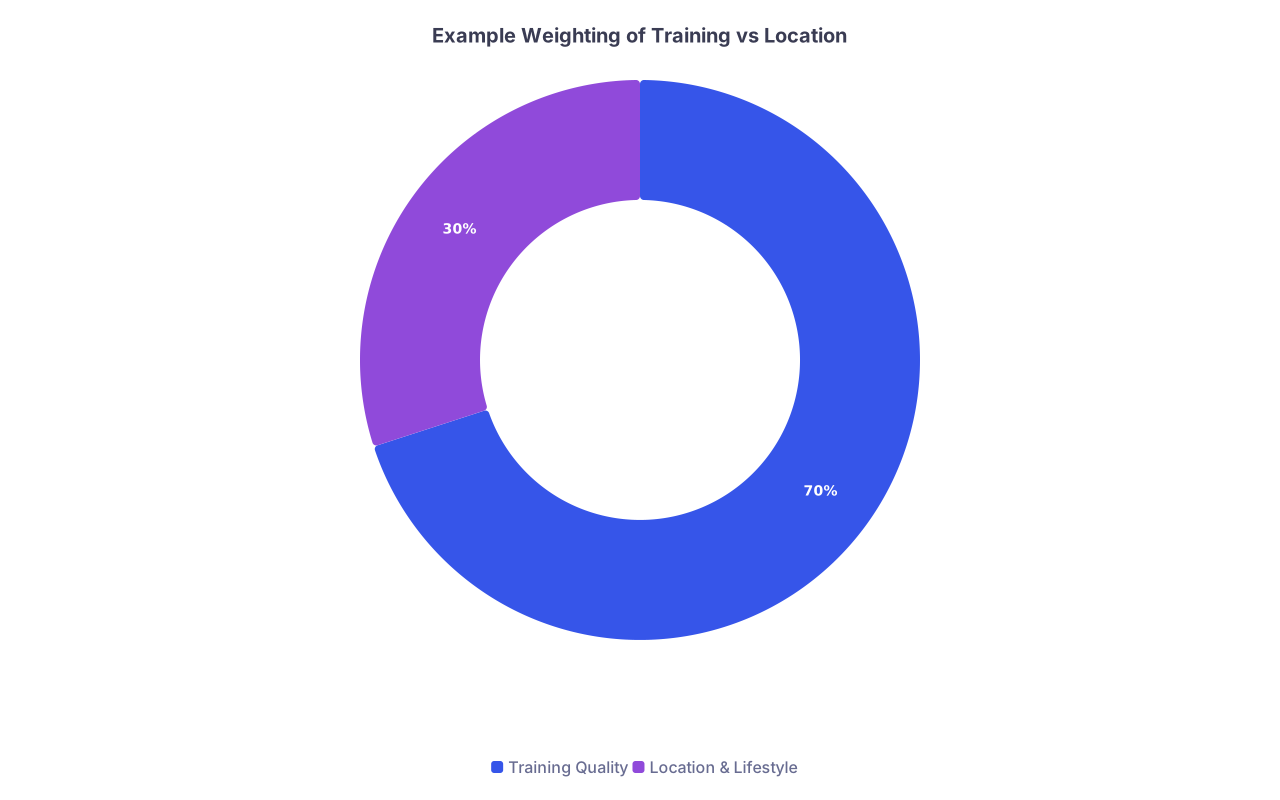
| Category | Value |
|---|---|
| Training Quality | 70 |
| Location & Lifestyle | 30 |
Special Cases: When Location Matters More Than Usual
There are situations where location deserves more weight. Just not infinite weight.
1. Serious family or health needs
If you or a close family member has:
- Major medical issues
- Disability
- Caregiving responsibilities
Then yes, being near specific hospitals, doctors, or family support can be non-negotiable. That can justify:
- 55–60% training / 40–45% location weighting
- Or restricting your list to one region, then optimizing training within that region
Just don’t pretend a weak program is “good enough” if it clearly isn’t. Be picky within your constraints.
2. Dual-physician or dual-career couples
Couples Match changes the calculus:
- You’re optimizing two careers, not one
- The risk of one person landing somewhere awful is higher
You may need to:
- Accept “very good” training in a strong city instead of “elite” training in a city your partner can’t work in
- Weight stability and reasonable hours a bit higher if both of you will be in demanding jobs
Think 60/40 or 65/35 training/location, not 80/20.
3. You already know you want to work in one region
Reality: most people practice near where they train, especially for community jobs.
If you strongly want to end up in:
- The West Coast
- The Northeast
- The Southeast
- Rural Midwest
Then it makes sense to:
- Prioritize programs in that region
- Within that region, still pick the best training you can get
So the weighting shifts from “national training vs location” to “training vs lifestyle within a region.”
When Training Quality Should Completely Trump Location
There are hard lines I’d draw.
Location should not save a program if:
- Board pass rates are consistently poor
- Graduates struggle to get jobs or fellowships you want
- Residents warn you off the program with real concern
- Case volume is objectively low and there’s no workaround
- Program is unstable: frequent PD turnover, recent probation, residents leaving
If training is dangerously weak, you don’t fix that with brunch spots and being close to Mom.
In those cases, your weighting stops being 70/30. It’s 100/0 until the program clears a basic bar of safety and adequacy.

| Step | Description |
|---|---|
| Step 1 | Evaluate Program |
| Step 2 | Do NOT rank, regardless of location |
| Step 3 | Use 60/40 or 65/35 Training/Location |
| Step 4 | Use 70/30 or 75/25 Training/Location |
| Step 5 | Score Programs and Rank |
| Step 6 | Meets Basic Training Standard? |
| Step 7 | Serious Family/Couples Constraints? |
Reality Check: How Much Does City Actually Matter in Residency?
Some hard truths I’ve heard straight from residents:
- “I thought I needed a big city. Turns out as a PGY-2 I just need sleep and decent co-residents.”
- “I moved to my ‘dream city’ and saw the inside of the hospital and my apartment for 3 years.”
- “Being near my parents saved me when we had our baby. I’d pick that again even though my program was mid-tier.”
Patterns I’ve actually seen:
- Interns think city matters more than it does.
- PGY-2s and 3s care way more about schedule, call burden, and program culture.
- Graduates mostly care that they feel competent and matched into a job/fellowship they like.
Location matters. Just not as much as people hype during interview season when everyone’s fantasizing about coffee shops instead of thinking about 28-hour calls.
Here’s how residents often actually spend their time:
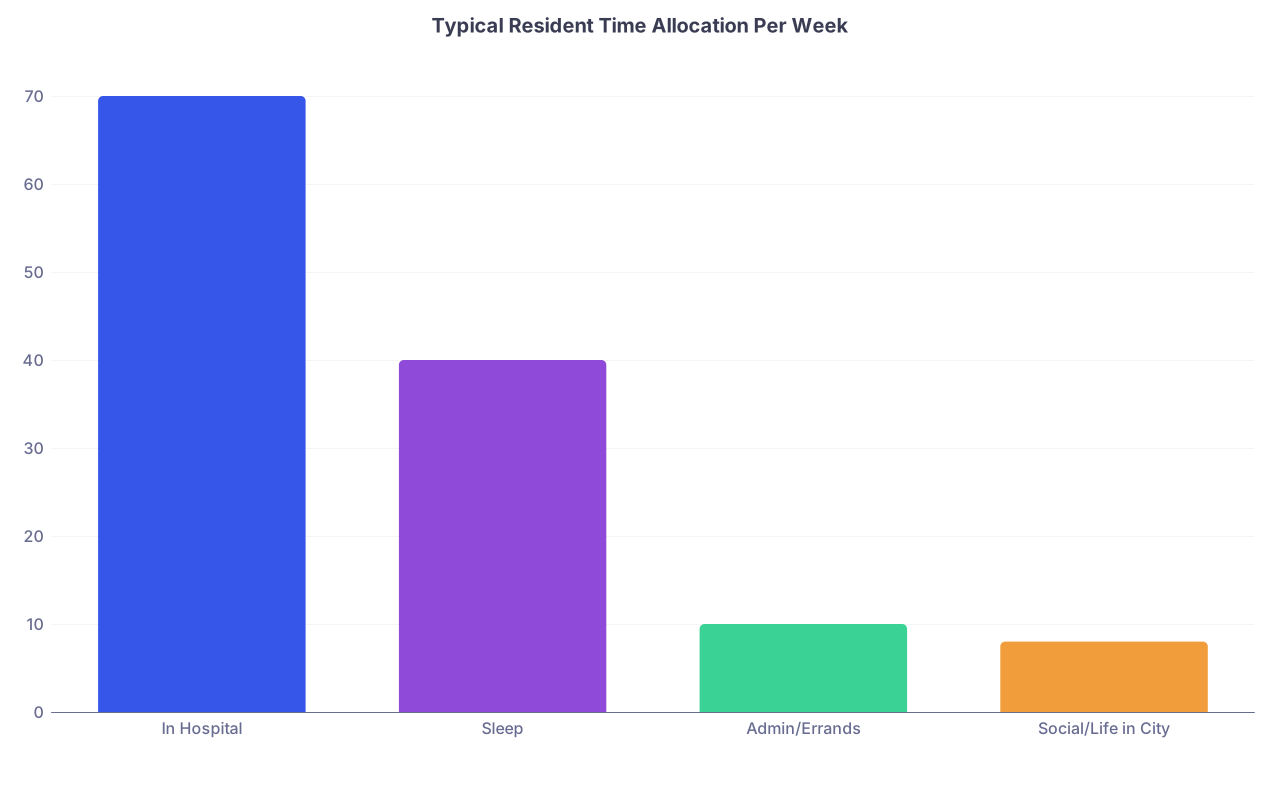
| Category | Value |
|---|---|
| In Hospital | 70 |
| Sleep | 40 |
| Admin/Errands | 10 |
| Social/Life in City | 8 |
That “cool city” time? Notice how small that bar is.
Putting It All Together: How to Rank Without Regretting It
Here’s a clean way to approach your final rank list:
-
- Minimum training bar (boards, volume, culture)
- Any mandatory location constraints (family care, legal issues, visas)
Eliminate programs below your safety floor
- If you’d be scared to train there, don’t rank it. Period.
Pick your weighting ratio
- Default: 70/30 training/location
- Couples/family-heavy: 60/40 or 65/35
- Ultra career-focused, flexible on geography: 75/25 or 80/20
Score each serious program
- Training: 1–10
- Location: 1–10
- Multiply by your weights
Then gut check the top 5–7
- Look at your top few. Ask:
“If I matched here, would I be more relieved or more disappointed?” - If the numbers fight your gut across the board, you mis-scored something. Fix it.
- Look at your top few. Ask:
Accept that there’s no perfect program
- You’re trading one set of problems for another.
- Your goal isn’t zero problems. It’s the problems you’re most willing to live with.

FAQ: Location vs Training Quality in Residency Ranking
1. If I want a competitive fellowship, should I ignore location completely?
No, but you should heavily bias toward training. For competitive fellowships (cards, GI, derm, ortho, ENT, etc.), you want:
- Strong case volume
- Good research or academic connections
- A program with a track record of matching into that fellowship
In that scenario, I’d go something like 80% training / 20% location, unless you have major personal constraints.
2. Does training in a big city automatically mean better training?
Not at all. I’ve seen community programs in smaller cities that produce fantastic clinicians with great case volume and autonomy. And I’ve seen big-name city programs where residents barely touch procedures because fellows do everything. You judge by case volume, autonomy, and outcomes, not skyline.
3. Will doing residency in one region hurt my chances of working somewhere else later?
It can make it a bit harder, but not impossible. Networking is regional, but:
- Strong programs place people nationally
- Fellowships are a major way to “switch regions”
- For primary care and hospitalist jobs, being a solid clinician + decent references matters more than your zip code
If you know you want a specific region later, training there helps. But it’s not mandatory.
4. How do I factor in my partner’s career into this?
You treat your partner’s career as a major part of the “location” score. If certain cities make their career impossible, those cities drop. Among feasible cities, you still prioritize the best training you can get. Realistically, you and your partner should agree on acceptable cities, then you rank programs within those.
5. What if my “best training” program felt cold and my slightly weaker program felt like home?
Then the slightly weaker-but-still-solid program might be the better choice. A program where you feel supported, known, and not miserable can make you a better learner than a “perfect” program where you’re constantly burned out. The key is: is the training still clearly good enough? If yes, community and culture can absolutely be a tie-breaker.
6. Is it dumb to rank a slightly weaker program first just to be near family?
No. It’s dumb to do that without admitting that’s what you’re doing. If training is still solid, family support can be a rational reason to choose a slightly lower-tier but still good program. Just don’t pretend the training is “the same” if it clearly isn’t. You’re choosing to value support and quality of life. That’s allowed.
7. How do I know if a program’s training is “good enough” to not worry?
Look for:
- Board pass rates consistently high (not just cherry-picked years)
- Residents who seem competent and not terrified to graduate
- Graduates getting normal jobs or fellowships that match their goals
- Adequate case volume and variety for the specialty
- Residents who, when you talk off-script, say: “It’s hard, but I feel well-trained.”
If you check those boxes, you’re above the safety floor. After that, it’s all tradeoffs.
Bottom line:
Give training quality the majority of the weight—usually 60–80%.
Let location and support take the remaining 20–40%, scaled up only when your life circumstances demand it.
And don’t let a pretty city or a “big name” blind you to what actually matters: Will this place turn you into the kind of physician you want to be, and can you stay reasonably intact while you get there?


